THE TABLE OF NATIONS AND THE ORIGIN OF RACES
 THE TABLE OF NATIONS (GENEALOGY OF MANKIND) AND THE ORIGIN OF RACES (HISTORY OF MAN)
Author: Tim Osterholm
The history of the races of mankind is a fascinating subject. Biologically, a race is generally thought of as a variety, or subspecies, within a given species. All the races are a part of the human race. We have made the term race to apply to skin color, but the dictionary defines race as “a class or kind of individuals with common characteristics, interests, appearances, or habits as if derived from a common ancestor.”
Where did we come from? The answers have always been with us, as presented in the original Table of Nations. What you are about to read can best be described as anExegesis (from the Greek exégesis, verb: exégetikos, meaning interpretation, guide, translation or critical exposition). Once you have read what is presented here, you may not view any race of people the same way again. Note that there is nothing like the Table of Nations (as presented here) in any other national tradition. Here we are given the origin of nations.
We can also factually claim that wherever its statements can be sufficiently tested, Genesis 10 of the Bible has been found completely accurate; resulting partly from linguistic studies, partly from archaeology, and, more recently still, from the findings of physical anthropologists, who are, to this day, recovering important clues to lines of migration in ancient historic times. As implied in verse 32 of Genesis 10, this Table includes everybody; meaning that so-called fossil man, primitive peoples (ancient and modern) and modern man are all derived from Noah’s three sons, Shem, Ham, and Japheth. Acts 17:26 states, “From one man (or one blood) He made every nation of men, that they should inhabit the whole earth; and He determined the times set for them and the exact places where they should live,” a corroboration of Genesis 10. In light of this, findings from anthropology, archaeology, ethnography, ethnohistory, genetics, geology, and sociology substantiate an alternate interpretation of the history of humanity. As archaeologist William Albright noted, “it
This may seem a gross over-simplification, and even appear to oppose well-established secular scientific opinion; however, science has proven itself over and over to be a double-edged sword. For example, it is often found that what is obviously true, is actually false. The obvious idea that the sun moved around the earth was erroneous, but until that view was corrected, little progress was made in the science of astronomy. On the other hand, on occasion, what is obviously false turns out to be actually true, as in the scientific belief that dinosaurs and humans never coexisted. That changed when fossilized footprints of dinosaurs and humans were found together, with the most recent fossil discovery showing a human footprint slightly overlapped by a dinosaur footprint. Newly discovered artwork and various ancient artifacts depicting live dinosaurs by themselves, or interacting with humans, gave further proof. These include burial stones, burial cloths, clay figurines and cave drawings. While scientific knowledge is characterized by a progressive approach to reality, it has often proved detrimental to the progress of understanding in the things which it has denied. Such is the case here. So before you begin to judge, please continue reading.
As stated earlier, race does not apply to skin color alone. Skin color is essentially the only biological difference in race, and science has been unable to determine what causes skin pigmentation. They have not been able to define the difference in cell pigment or structure. This superficial distinction is the basis for the division of mankind, but the fact is, we are all the same color, and some people have a little more “color” than others. Skin shade is due to the amount of a substance called melanin in the skin; the more melanin, the darker the skin. We are not born with a genetically fixed amount of melanin, but rather with a genetically fixed potential to produce a certain amount, increasing in response to sunlight (why Caucasians “tan” when exposed to the sun for long periods). Racially mixed individuals can have children with skin color that is very dark, very light, or anywhere in between. The predominant shade for freely interbreeding individuals would be brown.
Modern genetics shows that when a large, freely interbreeding group is suddenly broken into many smaller groups which from then on breed only among themselves (as the Biblical description of the language dispersion at Babel would imply), different racial characteristics will arise very rapidly. It can be shown that one pair of middle-brown parents could produce all known shades of color, from very white to very black, in one generation. The racial characteristics which exist today have not evolved, and generally speaking, are simply different combinations of pre-existing (created) genetic (hereditary) information. Remee and Kian Hodgson born April 2005, and Layton and Kaydon Richardson born July 2006 (pictured below) are fraternal “black and white” twins. More incredible was the birth of two sets of mixed-race twins by Alison and Dean Durrant. Their first twins were born in 2001, and their second twins arrived November 2008 (all pictured below). Other fraternal twin births include Alicia and Jasmin Singerl born May 2006, and Ryan and Leo Gerth born July 2008 (not pictured), all providing proof of such genetic detail. The environment plays a secondary role in favoring certain combinations over others.
Hodgson Twins Richardson Twins Durrant Twins (times two)
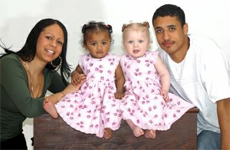
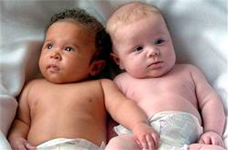

As family groups became isolated by language barriers, environmental factors allowed particular traits already present to be expressed more frequently. Noah’s family suggests a “racially mixed” population with biological potential for variation. The Biblical viewpoint is that there is not a black race, white race, yellow race, etc. Instead, there are three distinct families or characteristics of man that make up the oldest Table of Nations in existence, which is a completely authentic statement of how the present world population originated and spread after the flood, as recorded in Genesis 10 of the Bible (a historical document itself). Here we learn the true divisions of mankind, indicating how the present population of the world came to be. The listing of Noah’s descendants is more theological than hereditary, so we must understand that Noah’s descendants existed because of his righteousness.
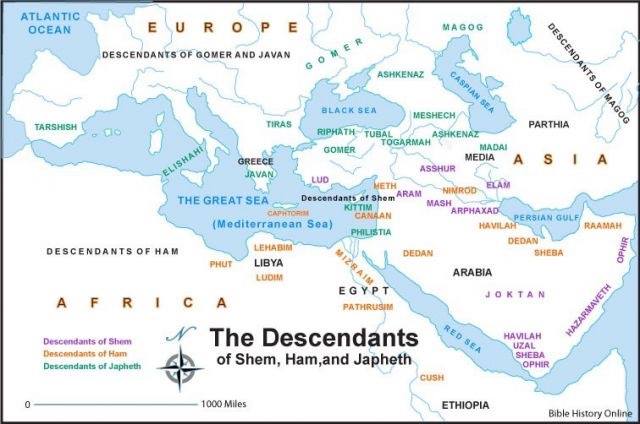
Genesis chapter 10 describes how the present world population was derived from Noah’s three sons: Shem, Ham and Japheth, and their wives (three family groups). Verse 32 states, “From these the nations spread out over the earth after the flood.” Additional references are given in 1 Chronicles chapter 1. Genesis 10 exactly names 16 grandsons of Noah, and then we are provided further details of the Babel dispersion (Genesis 11) where their descendants fanned out over the earth and established the various nations of the ancient world. The number of descendants of Noah (grandsons, great-grandsons, etc.) mentioned are 26 from Shem, 30 from Ham, and 14 from Japheth, totaling 70 “sons” or “nations.” These 70 nations are the descendants (generations, genealogies or family histories) of the sons of Noah, known from Hebrew antiquity (Talmudic tradition of seventy nations in the world), and other ancient sources. 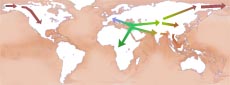 Most, if not all, tribes and nations can be traced to these men through their descendants. Chapter 10 describes the differentiation of nations, and asserts that we were all descended from Noah. It is important to understand that people and nations are referred to in a genealogical form (common in Hebrew and other Semitic languages). We find genealogical references in Genesis 10 are firstly to persons or families (ethnological), and secondly to nations or tribes (ethnographical); thus, the chapter ends with an emphasis on nations or tribes, which helps us understand in following chapters where they settled or “spread out over the earth” (geographical). We must acknowledge the early reality of inter-family marrying as individual family groups were established. This would later define skin color and other unique features within various subgroups and their subsequent populations. They began as hunter-gatherers and/or pastoral nomads (living off the land as they migrated).
Evidence shows that Noah’s sons kept together at first, then broke up into small groups and eventually arrived from the east in the southern Mesopotamian Plain (Gen. 11:2). The descendants of Elam, the first born son of Shem, were the first people to enter Mesopotamia. Susa, the capital city of the Elamites (Shemitic Elamites), gave rise to other early cities, such as Al-Ubaid (which later gave rise to Hamitic settlements—including the Sumerian civilization) and Jemdet Nasr. Recent excavations have provided very strong evidence of direct cultural links between some of the earliest cities in Babylonia and the lowest layers uncovered at Susa. These peoples established themselves first in the south and gradually spread toward the north, but without losing the cultural links. There are no known modern descendants of the Elamites. Other excavations have shown that one of the first Hamitic groups, the Sumerians, gave rise to considerable cultural advance and power in that region. Other people groups known very early included the Japhethites, noted especially for their fairness of skin, in the hill country east of the Tigris. [Soon the great tower of Babel arose.]
Further evidence indicates that the rulers of the City of Babel attempted to avert dispersal of the people by proposing the building of a monument as a visible rallying point on the flat plain of Mesopotamia. Scripture and historical texts note that the tower of Babel, the building of which Nimrod (a Sumerian) supervised, was to have two great significances. The city of Babel would become the metropolis of the world and unite its inhabitants under the dictatorial rule of Nimrod. The tower was to be a monument to man to stand as a symbol of Babel. Given the present knowledge of Babel history, Genesis 11 has a solid historical foundation in early Mesopotamia. Nimrod hoped to prevent the people from scattering abroad into colonies as God intended, thus bringing upon themselves a judgment which led to confusion of the languages and rapid scattering throughout the earth. Babel means confusion. Urbanization, as attested by archaeological records, did not occur until after the dispersal of languages. The history of linguistic development and settlement patterns in Mesopotamia support this. There are dozens of unclassified and isolate languages throughout the world, such as Basque, Ainu and Ticuna, which testify to the widespread language distribution at Babel. The name Babel would be preserved as Babylon, a future world empire. We can safely conclude that all people in the world are descended from the inhabitants of Babel, the first civilization after Noah’s flood. From there the great empires of the past arose, including Egypt, Assyria, Babylon, Persia and Greece, and all have strong historical links to the sons of Noah.
We can find validation from research scientists who study human genetics. They claim that lineages derived from known people groups did in fact appear to have migrated from the “Near East”, “Middle East” or “Mesopotamia” (also called the “Cradle of Civilization” or the “Cradle of Mankind”) sometime during prehistory. This information is derived from DNA haplogroups. Haplogroups are used in DNA tests for markers that give a broad or regional picture; haplotypes are one person’s results on various DNA tests. Data comes from either Y-chromosome DNA (Y-DNA) passed down from a father, or mitochondrial DNA (mtDNA) passed down from a mother. Both can be used to define genetic populations from one generation to the next intact. Here we attest there was a first pair, Adam and Eve. Scientists have traced the mitochondrial DNA in all living humans back to a single female, and similarly, genetic markers in all males in the world today can be traced back to a single male. Y-chromosome Adam and mitochondrial Eve are connected to everyone now living by an unbroken father-to-son or mother-to-daughter line (including everyone else in their generations who’s ancestors are connected through one or more father-to-daughter or mother-to-son links). Haplogroup classifications are based on identification of genetic markers which a population of individuals share, passed down from an ancient but common ancestor. These genetic markers are evolving as new markers are found, sometimes resulting from occasional mutations to DNA. Different populations carry distinct markers. Examples of these markers can be seen in the charts below:
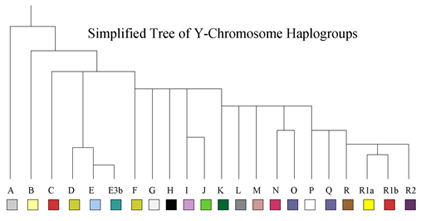 |
 |
Notice in the images below (public domain) that the genetic lineages originate from “somewhere in the Middle East” or Mesopotamia as the Bible claims:
The migration map below represents migration patterns for Y-chromosome DNA (Y-DNA) passed down from a father. The letters represent markers for individual mutations.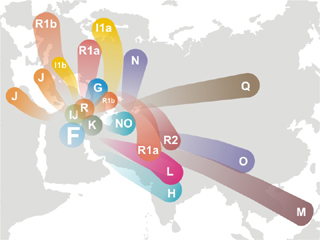 |
The migration map below represents patterns for mitochondrial DNA (mtDNA) passed down from a mother. The letters represent markers for individual mutations.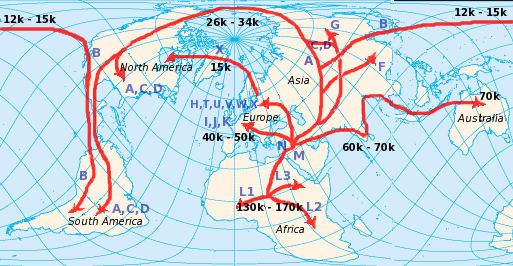 |
A majority of scholars and Bible historians agree that most of the descendants of Shem stayed in the Middle East, and that Shem’s descendants are well documented. These include the Hebrews, Persians and Assyrians. Modern day Arabs and Jews trace their lineage to Shem. Many Arabic nomad tribes still claim they descended from Shem. The descendants of Shem (Shemites) are often called Semites, a term first used in the late 18th century for peoples listed in the Bible as descended from Shem. Today the term Semite refers to peoples who speak any of the Semitic languages, including the ancient peoples who inhabited Babylonia (Mesopotamia). Modern peoples speaking Semitic languages include the Arabs and Jews. Several centuries before the Christian Era, many ancient Semitic populations were migrating in large numbers from Arabia to Mesopotamia, the coasts of the Mediterranean Sea, and the Nile River delta. Jews and other Semites settled in villages in Judea (southern Palestine). Today, Semitic-speaking peoples are concentrated in the Middle East and northern Africa.
The descendants of Ham include the Egyptians, Ethiopians, Canaanites, Phoenicians and Hittites. His descendants appear to be the first to fill the earth, as they were the early settlers of Africa, Asia, Australia, the South Pacific and the Americas. The descendants of Japheth migrated into Europe and parts of Central Asia. The Greeks, Romans, Spanish, Celts, Scythians and Medes were Japheth’s descendants. Some people groups merged to form one nation, as did the Persians (Shem) and the Medes (Japheth), which later became the Medo-Persian empire. We also find that many nations or peoples were named after an ancestor. Romans, and their capital city, were named after Romulus. Israelis and their country are named after their forefather, Israel. The observable fact of attaching the name of a leader to his people and his empire appears often in Ancient Near Eastern history. The Table of Nations in Genesis 10 illustrates this principle, whereby every land was named after its first successful settler: Canaanites were named after Ham’s son, Canaan, and so on.
Note that the many names of family groups and nations listed here naturally follow well-established rules in the development of language, and the transfer of words between languages of a different family or nation. Letters may be transposed, endings added, prefixes taken away or added, but the basic root persists to help trace the spread of the peoples of the earth. For example, the ancient city of Unuk (in the Bible is the first city ever built, equated with Enoch), later appears as Uruk and Erech, then as Wark or Warka by the Sumerians, and finally appears in Greek as Purgos or Pergos. The conversion of “wark” into “purg-” shows the transfer of words between languages of a different family (more on language groups at the end of this article).
Interestingly enough, purg- becomes burgh in modern Indo-European languages, which is the root of the English word, borough. Several examples of this are below, specifically in the lines of Japheth. The three sons of Noah and their descendants listed below are not in any particular order. From Babel the three families of man would populate the earth, and here we have the beginnings of all people groups through Shem, Ham and Japheth:
Shem. Also Sem. Literal meanings are named or renown (father of the Semitic people groups – Shemites). The sons of Shem were:
(1) Elam “eternity”(sons were Shushan, Machul and Harmon) – (Elamites, Persians);
(2) Asshur “a step” or “strong” (sons were Mirus and Mokil) – (Assyrians/Northern Iraqis);
(3) Arphaxad “I shall fail” (sons were Shelach, Anar and Ashcol) – (Chaldeans/Southern Iraqis, Hebrews/Israelites/Jews1, Arabians/Bedouins, Moabites/Jordanians/Palestinians, and related groups);
(4) Lud “strife” (sons were Pethor and Bizayon) – (Ludim, Lubim, Ludians, Ludu, Lydians, Chubs, other related groups in Asia Minor and North Africa);
(5) Aram “exalted” (sons were Uz, Chul, Gather and Mash) – (Aramaeans/Syrians, Lebanese, other related groups), and remnant groups throughout Asia, the Middle East, and North Africa.
1Hebrews descended from Eber (Heber), a great-grandson of Shem. Six generations after Heber, Abram (Abraham) was born, so Abraham was both a Hebrew and a Semite, born of the line of Heber and Shem. Ishmael and Isaac were born of Abraham. However, Ishmael was born of an unlawful union between Abraham and his Egyptian maid Hagar (Genesis 16, Galatians 4), making Ishmael half Semitic and half Hamitic. Sunnite Arabs (specifically Arabian Muslims) consider themselves to be descendants of Ishmael, often calling themselves Ishmaelites, and thus are both Semitic Hebrews and Hamites. To this day the descendents of Ishmael (Arabs) and his half-brother brother Isaac (Israelites) have fought over which family group is Abraham’s true spiritual heir, specifically relating to ownership of land in the Middle East. Thus, there has been an unsolvable problem, and the nation of Israel is progressively being forced to give up land for peace.
Isaac was born to Abraham and his lawful wife Sarah (Gen. 17, 18 & 21). Isaac had twin sons named Esau and Jacob. Esau was firstborn, and so had the right to inheritance (as was custom), but instead sold his birthright to Jacob during a time of hunger. Esau’s name was changed to Edom, and Jacob’s name was changed to Israel. The descendants of Esau (Edom) became known as Edomites, and the descendants of Jacob (Israel) became known as Israelites. Jacob fathered 12 sons which became the twelve tribes of Israel. Those who interchange the words “Jew” and Israelite, call Abraham a Jew, though Abraham was neither an Israelite or a Jew. The word “Jew” was not used in the Bible until nearly 1,000 years after Abraham. One of Jacob’s (Israel’s) children was Judah (Hebrew “Yehudah”). His descendants were called Yehudim (“Judahites”). In Greek the name is Ioudaioi (“Judeans”). Most all Bible translations use the word “Jew,” which is a modern, shortened form of the word “Judahite.” A “Jew” in the Old Testament would be a “Judahite;” and a “Jew” in the New Testament would be a “Judean.”
A bitter rivalry between the descendants of Esau and Jacob continued throughout history, and as they lived in close proximity for hundreds of years, their hatred worsened. The Romans referred to the Edomites as Idumeans, separate from Israelites, when they lived in the region of Palestine together. The Romans later divided Palestine into districts, with Idumea (land of Edomites) being one of the districts. As the Roman Empire faded, Idumea was divided again into Northern Idumea, and the region fell to an Ishmaelite (Arabian) Muslim army led by Caliph Umar in 638 A.D. Historians suggest the remaining Edomites embraced Islam at that time and remained in the land, blending with the Arabs, and uniting against the Israelites.
Jerusalem soon became a focal point for the Muslims (Moslems), being the third most holy city of Islam, after the cities of Mecca and Medina (though Jerusalem is never mentioned in the Koran, it is mentioned over 800 times in the Bible). By 691 A.D., the Mosque of Omar (also called the “Dome of the Rock”) was completed on the Temple Mount, where Muslims believe Mohammed ascended to heaven from. The Arabic term for the holy place is “al-Haram as-Sharif” meaning “The Noble Sanctuary.” To Israelites and Jews, Jerusalem was the city of the great prophets and the capital of the Kingdom of Israel and Judah under King David and his son King Solomon. The first and second temples were the center of worship until the destruction of the city by the Romans in 70 A.D. Christians revere the city as the place where Jesus Christ taught in the temple, and was later crucified. Christians believe that Jesus will return to establish His Kingdom at the Temple Mount with Jerusalem as world capital.
Still confused? Here’s a simple patriarchal chart, beginning with Noah, showing how these family groups came to be:
Noah
|
Shem-->Eber-->Terah
|
--------------|----
| | |
Abram Nahor Haran
| |
|----------| Lot
Isaac Ishmael |-------------------
| | | |
|------| |--->Arabs<-----Moab Ammon
Jacob Esau |
| |------->Arabs<----------------
|
Israelites & Jews
Ham. Also Cham or Kham. Literal meanings are passionate, hot, burnt or dark (father of the Australoid, Negroid and Mongoloid people groups – Hamites). He was the progenitor of:
(1) Cush “black” (sons were Seba, Havilah, Sabtah, Raamah, Sabteca and Nimrod) – also Chus, Kush, Kosh, Kish, Cushaean (Cushites, Nubians, Ethiopians, Ghanaians, Africans, Bushmen, Pygmies, Australian Aborignies, New Guineans, other related groups);
(2) Mizraim “double straits” (sons were Lud, Anom, Pathros, Chasloth and Chaphtor) – also Masr, Misr, Misraim, Mitzraim, Mizraite, Mitsrayim (Egyptians1, Khemets, Copts, other related groups);
(3) Phut “a bow” (sons were Gebul, Hadan, Benah and Adan) – also Punt, Puta, Put, Puni, Phoud, Pul, Fula, Putaya, Putiya, Libia, Libya (Libyans, Cyrenacians, Tunisians, Berbers, Somalians, Sudanese, North Africans, other related groups);
(4) Canaan “down low” (sons were Sidon [Zidon]2, Heth, Amor, Gergash, Hiv, Ark, Sin, Arod, Zemar and Hamat) – also Canaanites, Cana, Chna, Chanani, Chanana, Canaana, Kana, Kenaanah, Kena’ani, Kena’an, Kn’nw, Kyn’nw, Kinnahu, Kinahhi, Kinahni, Kinahna, Kinahne (Mongols, Asians, Orientals, Chinese, Tibetans, Taiwanese, Thais, Vietnamese, Laotians, Cambodians, Japanese, Eskimos, American Indians3, Malayasians, Indonesians, Filipinos, Hawaiians, Maoris, Polynesians, Tahitians, Guamanians, Samoans, Fijians, Tongans, Tokelauans, Tuvaluans, Pacific Islanders4 and related groups5).
Tribes in other parts of Africa, Arabia and Asia, aboriginal groups in Australia, native Pacific Islanders, American Indians and Eskimos were birthed from descendants of Canaan, Cush, Mizraim and Phut.
Looking at history, whichever region is considered, Africa, Europe, Australia, or America, the major migrations have always been from Asia. In every area of the world where Japhethites have subsequently settled, they have always been preceded by Hamites. This pattern applies in every continent. In early historic times the circumstance seems always to be true, the earliest fossil remains of man being Mongoloid or Negroid in character and in head shape, whereas those that came last belong to the family of Japheth (Caucasoid). When we study ancient history and technological achievements, which were in many ways the equal of, or superior of, much that we have today, we find Hamitic people showed an amazing adaptability to the world in which they founded, and carried to a high technological proficiency their societies. Their achievements were exploited by Japhetic and Semitic peoples, who became great scientific discoverers. The Hamitic migrations indicate they sought a way of life, not an understanding or a control of nature beyond what was immediately useful. A majority of Ham’s descendants were not negroid. Genesis 10:15-20 records that of the 32 descendants of Ham, four settled in unknown places, 23 settled in the Middle East and five settled in Africa. Archeologists tell us that no groups inhabiting the Middle East in Biblical times were negroid. Many had brown, red and white racial characteristics. Ham’s descendants appear to be the most varied of Noah’s lineage.
Ham’s fourth born son was Canaan. Genesis 10:15-19 identifies a distinctive characteristic of the sons of Canaan: They liked to spread out. The Canaanites are specifically mentioned as migrating far and wide, “…and afterward the families of the Canaanites were spread abroad. The territory of the Canaanites extended from Sidon as you go toward Gerar, as far as Gaza; as you go toward Sodom and Gomorrah and Admah and Zeboiim, as far as Lasha.” History indicates they did have a propensity for sprawl. The descendants of Canaan would later make up the vast populations of Asia, Africa and the Western Hemisphere. Much smaller populations migrated to the Southern Hemisphere. To this day, only about 10% of the world’s population lives in the Southern Hemisphere.
1Epypt is one of the most frequently mentioned names in the Bible. Egypt is also synonymous with Mizraim. For example, Misr (Mizraim) is the Arabic name for Epypt. The name Egypt is thought to be derived from the name Hout ka-Ptah or Hi-ku-Ptah, both meaning the “Place of the Spirit of the god Ptah.” The name was Hellenized by the Greeks, rendering Hi-ku-ptah as Ai-gu-ptos (Aiguptos), becoming the Latin Aegyptus, and later Egypt in modern English. The term Copt is also believed to be etymologically derived from this name. Hi-ku-Ptah was believed to be located in the capital city of Memphis. In the Bible, Memphis is called Moph or Noph.
2Sidon (or Zidon) and his descendants settled on the Mediterranean coast of present-day Lebanon, then known as the land of Canaan. The Sidonians called themselves Kena’ani, or Canaanites (adopted from the name of their father Canaan, and the land named after him). Interestingly, these “new” Canaanites came to speak a Semitic language, probably adopted from a large migration of Semites who came from land and sea, and introduced their language and a sophisticated maritime technology about 1800 B.C. Historians suggest these Canaanites succumbed to racial and linguistic intermixture with the invading Semites, which led to the loss of their own ethnic predominance, as evidenced by modern excavations. They eventually moved westward and occupied a very narrow coastal strip of the east Mediterranean, building new cities, and establishing significant trade with neighboring nations. In fact, the Israelite name for “Canaan” came to mean “traders,” though some suggest the name Canaan is from the Hebrew nameHurrian, meaning “land of red purple.”
These Sidonian Canaanites were known for their red and purple cloth (a purple dye was extracted from murex snails found near the shores of Palestine, a method now lost). The Greeks called the land of Canaan “Phoenicia,” which meant “purple.” Thus, Sidonians became known as Phoenicians, and became a nation of great trade, language, and culture. Phoenician, Hebrew and Moabite were a group of west Semitic languages, all dialects from Canaan, as referred to in Isaiah 19:18. The writing system of the Phoenicians is the source of the writing systems of nearly all of Europe, including Greek, Russian, Hebrew, Arabic and the Roman alphabet. The Phoenician empire fell under Hellenistic rule after being conquered by Alexander the Great about 332 B.C. In 64 B.C. the name of Phoenicia disappeared entirely, becoming a part of the Roman providence of Syria. At the beginning of the Christian era, remaining Phoenicians were the first to accept the Christian faith after the Jews. Sidon’s name is still perpetuated in the modern-day city of Sidon (Saidoon is the Phoenician name, Saida in Arabic) in southern Lebanon.
3Evidence for diverse migrations into the Americas comes from research on living American Indian populations, which includes data from Mitochondrial DNA (mtDNA) that is passed down from a mother to her children from one generation to the next intact. These studies have consistently shown similarities (deep ancestry) between American Indians and recent populations in Asia, Siberia and northern Scandinavia. These groups include the Lapps in northern Europe/Scandinavia, the Chukchi and Yukaghir in Siberia, plus Indians and Eskimos/Aleuts throughout Canada and North America. There is a wealth of information on the genetic relationship between early Taiwanese populations and southeast Asian, Oceanic (South Pacific) and Native American descendants. Ancient American Indian skeletal remains show a range of physical attributes (round-headed) suggesting separate migrations of different populations from Asia and the South Pacific, representing 97 percent of all modern American Indian populations. What of the other 3 percent?
There are exceptions. A 1998 DNA study conducted by the Center for Molecular Medicine, Emory University School of Medicine, Atlanta, GA discovered a mtDNA strain in roughly 3% of American Indians (Amerindians) called “Haplogroup X” which suggests a prehistoric migration of peoples to the Americas from the European theater. This genetic inheritance likely reflects transatlantic links since Haplogroup X is not found in Asians, demonstrating the DNA did not originate from those Asians who arrived in the Americas via the Bering Strait. Other researchers conclude that these transatlantic migrations took place before the Asian migrations into Canada and North America. Some experts believe that Haplogroup X provides concrete evidence of European ancestry for certain Native Americans (noted below). For example, the Algonquian Indians (Mahicans/Ojibwe) have as high as 40 percent of Haplogroup X, and their distant relatives, the Siouan family of tribes (Sioux), have as high as 15 percent of the DNA. Experts suggest a large amount of gene flow occurred between Algonquian-speaking and Siouan-speaking groups, consistent with archaeological and linguistic evidence. These tribes, initially arriving along the eastern shores of North America, migrated deep inland, also north into Canada. They are the popular red-skinned tribes having a long-head shape similar to that of early Italic peoples in Europe. They are thought to be descendants of Canaanites (Phoenicians) who intermarried with Indo-Europeans while migrating across Europe, and subsequently sailing to North America.
Having been the largest group of Native Americans in the United States, their DNA stretched across America, though very sparse further west. According to tradition, they populated the Carolinas then migrated to the regions of Louisiana, Mississippi, Missouri, and eventually Minnesota and the Dakotas. Many of these tribes had fortified villages similar to ancient Canaanites (who lived along the coast of the Mediterranean Sea, including parts of Egypt and the Jordan Valley). Archaeological evidence shows they constructed towns and cities with small pyramids and vast road systems throughout the Mississippi Valley. With them came a tradition that is thought to be a reference to the wives of Noah and his three sons. Four women are identified as “mothers of origin” whose names (possibly Canaanite) have been preserved down through the generations (see name chart below). Additionally, there are striking similarities between the languages of ancient Egypt and those of the Native Americans that inhabited the areas around Louisiana about the time of Christ. Epigraphy experts have stated that the languages of the Attakapa, Tunica and Chitimacha tribes have affinities with Nile Valley (Egyptian) languages involving certain words associated with Egyptian trading communities of 2,000 years ago. Scholars note the Algonquian and Siouan peoples used pictographs and ideographic writing symbols that also have similarities with ancient Canaanites.
Many groups migrated southwest into Oklahoma, Texas, New Mexico and eventually Mexico, establishing the powerful Aztec tribes with their beautiful fortified cities, integrating with the Mayas (who had been there hundreds of years before, and thought of the Aztecs as barbarians). Likely there was a mixing of cultures as they migrated, as there was no conquest of the Maya world by the Aztecs; that title would be given to the Spaniards in the late 17th century. The Aztec’s traditions and legends are largely ignored by modern scholars as myths and fables. The Aztecs, according to their own legends, departed from a region in the north called Chicomoztoc, a region that is today the areas of Texas, Oklahoma and New Mexico. Later establishing a city known as Aztlan, somewhere in north or northwest Mexico (now lost), their tribal name Aztec was born. Being nomadic, they eventually reached the valley of Mexico in the 12th century A.D. They were known as fearless warriors and pragmatic builders who raised an enormous city called Tenochtitlan, their capital city (now Mexico City).
The Aztecs would later call themselves “Mexica” (where Mexico is derived), and their language, Nahuatl, was linguistically related to other native language groups throughout the U.S. southwest and northern Mexico. Linguists note, for instance, the Shoshoni language in the Utah-Nevada region was understood by all the tribes from Mexico, without difficulty. Other related tribes included the Paiute, Hopi, Pima, Yaqui/Apache, Tepehuan, Kiowas and Mayos. Catholic missionaries in the 1850’s established the fact that all of those peoples were of one language family. While there are other examples of language similarities, studies of the native languages of the Americas have shown them to be extremely diverse, representing nearly two hundred distinct families, some consisting of a single isolated language.
4Pacific Islanders have a diverse and unique history. These oceanic peoples of the South Pacific, whom we know as Polynesians, Maoris, Tahitians, Samoans, Fijians, Tongans and others, have their roots in southern China. Prior to the Mongoloid peoples establishing themselves in southern China, there were migrations of negroid peoples from east Africa and the Sahara. A number of African cultures kept documents and ancient texts, as well as strong oral history and legends, of migrations to ancient China from Africa. Mongoloid groups later migrated into southern China, resulting in a mixing of cultures. Southern China is thought to have first come into being out of the mixture of Mongoloid and Negroid peoples. These peoples were likely driven out by other aggressive Mongoloids. Being master seafarers, they sailed into Polynesia and the surrounding region, populating the islands of the South Pacific.
5The vast aggregate of peoples who are generally classified as Mongoloid, who settled the Far East, have been a question as to where they fall into the Table of Nations. Evidence shows they are Hamitic, even though some have incorrectly reasoned that the Chinese were of Japhetic stock, and the Japanese were either Japhetic or Semitic. There are two names which provide clues. Two of Canaan’s sons, Heth (Hittites) and Sin (Sinites), are the likely progenitors of Chinese and Mongoloid stock. The Hittites are described in the Bible as a people ruled by kings living north of Assyria. Historians note they populated western Asia and the Far East, but conquered regions into Asia Minor and as far south as Palestine. The Hittite Empire was short-lived in history, but left a mark on the ancient world.
Assyrians called them Khatta or Khate, and they were known as the Kheta or Khata to the Egyptians. These names were variations of Hatti or Chatti, described on monuments of Assyria and Egypt. Archaeologists have noted many similarities between the Hittites and the Mongoloids. Egyptian monuments depicted the Hittites with prominent noses, full lips, high cheekbones, hairless faces, varying skin color from brown to yellowish and reddish, straight black hair in a pigtail or ponytail, and dark brown eyes. The Hittites depicted themselves in their bas-reliefs and hieroglyphs with short and thick limbs, pushed forward faces and large nostrils, confirming their identity when compared with Egyptian representations. Craniologists observe that these were characteristics of Mongoloid peoples.
The term Hittite in Cuneiform (the earliest form of writing invented by the Sumerians) appears as Khittae* representing a once powerful nation from the Asia and the Far East known as theKhitai, also in Hebrew as Khitti, Kheth and Khettai. Khitai and Khettai have been preserved through the centuries in the more familiar term, Cathay. They battled the Egyptian armies of Ramses II in the 13 century B.C., then disappeared forever from history. Their remnant, the Cathay, are considered the Mongoloid people who are part of early Chinese stock. This evidence comes from links between the Cathay and Hittites, for example, their modes of dress, their shoes with turned-up toes, their manner of doing their hair in a pigtail, and so forth.
*Khittae has, at times, been incorrectly associated with Kittim or Chittim (Greek Kition, Roman Citium, Jewish Cethimus), son of Javan, son of Japheth. Kittim is also the Biblical name for modern-day Cyprus. Javan is the Hebrew word for Greece, appearing five times in the Old Testament. Interestingly enough, Javan has been incorrectly interpreted to mean Japan. History distinctly shows Javan to be the ancestor of the Greeks and other related Mediterranean people groups.
Sin (or Seni), a brother of Heth, has many occurrences in variant forms in the Far East. There is one significant feature concerning the likely mode of origin of Chinese civilization. The place most closely associated by the Chinese themselves with the origin of their civilization is the capital of Shensi, namely, Siang-fu (Father Sin). Siang-fu appears in Assyrian records as Sianu. Today, Siang-fu can be loosely translated, “Peace to the Western Capital of China.” The Chinese have a tradition that their first king, Fu-hi or Fohi (Chinese Noah), made his appearance on the Mountains of Chin, was surrounded by a rainbow after the world had been covered with water, and sacrificed animals to God (corresponding to the Genesis record). Sin himself was the third generation from Noah, a circumstance which would provide the right time interval for the formation of early Chinese culture. In addition, the Miao tribe of southwest China had a tradition similar to the Genesis account, even before they met Christian missionaries. According to their tradition, God destroyed the whole world by a flood because of the wickedness of man, and Nuah (Noah) the righteous man and his wife, their three sons, Lo Han (Ham), Lo Shen (Shem), and Jah-hu (Japheth) survived by building a very broad ship and taking on it pairs of animals.
There is strong evidence that suggests early Chinese knew of the God of the Bible. There are accounts described in the “Shu Jing” (Book of History), compiled by Confucius, where it is recorded that Emperor Shun (ruled from about 2256 B.C. to 2205 B.C. when the first recorded dynasty began) that he worshiped and sacrificed a bull to “ShangDi.” ShangDi literally means “Heavenly Ruler.” Linguists point out that ShangDi, Creator-God of the Chinese, is the phonetic equivalent to El Shaddai, Creator-God of the Hebrews. About 700 B.C., the early Zhou pronunciation of ShangDi was “djanh-tigh” (Zhan-dai). The bull was sacrificed at an annual ceremony called a “Border Sacrifice,” a rite that did not end until 1911 when the last emperor was deposed. Additionally, recitations from the ancient rite parallel several Bible passages, including the creation account in Genesis. Scholars who have analyzed the most ancient forms of these pictographic Chinese writings (graphic symbols called ideograms), which date from before the time of Moses, have the entire story of creation, the temptation, the fall of man into sin, and God’s remedy for sin in the animal sacrifices, which pointed to the coming Savior, Jesus Christ. All the elements of the Genesis narrative are found recorded, and still in use, in Chinese character-writing. This confirms the idea that the ancient Chinese incorporated their early knowledge of Genesis into their written language.
History has much to say about the descendants of Sin who came from the Far East to trade. They were called Sinæ (Sin) by the Scythians. Ptolemy, a Greek astronomer, referred to China as the land of Sinim or Sinæ. Reference to the Sinim in Isaiah 49:12 notes they came “from afar,” specifically not from the north and not from the west. Arabs called China Sin, Chin, Mahachin, Machin. The Sinæ were spoken of as a people in the remotest parts of Asia. For the Sinæ, the most important town was Thinæ, a great trading emporium in western China. The city Thinæ is now known as Thsin or simply Tin, and it lies in the province of Shensi. Much of China was ruled by the Sino-KhitanEmpire (960-1126 A.D.), which Beijing became the southern capital. The Sinæ became independent in western China, their princes reigning there for some 650 years before they finally gained dominion over the whole land.
In the third century B.C., the dynasty of Tsin became supreme. The word Tsin itself came to have the meaning of purebred. This word was assumed as a title by the Manchu Emperors and is believed to have been changed into the form Tchina. From there the term was brought into Europe as China, probably from the Ch’in or Qin dynasty (255-206 B.C.). The Greek word for China is Kina (Latin is Sina). As well, Chinese and surrounding languages are part of the Sino-Tibetan language family. Years ago, American newspapers regularly carried headlines with reference to the conflict between the Chinese and Japanese in which the ancient name reappeared in its original form, the Sino-Japanese war. Sinology refers to the study of Chinese history.
With respect to the Cathay people of historical reference, evidence suggests that a remnant of the Hittites fled eastward after the destruction of their empire and apparent disappearance from history. As they traveled towards the east, their clans settled among the Sinites who were relatives, contributing to their civilization, and thus becoming the ancestors of Asian people groups. They are found together in major historical events that formed the Chinese nation and its people. Still others migrated throughout the region and beyond, making up present-day Mongoloid races in Asia and the Americas. The evidence strongly suggests that Ham’s grandsons, Heth (Hittites/Cathay) and Sin (Sinites/China), are the ancestors of Mongoloid peoples.
There are many native African tribes which trace themselves back traditionally to Ham. The Yoruba, who are black skinned, for example, claim to be descendants of Cush, and the Beja people have specific genealogical traditions of descent from Cush. Ethiopians still trace their ancestry back to Cush. To this day Cush has many tribal and ethnic designations in Africa and Arabia. Jewish historian Josephus in his Antiquities of the Jews gives an account of the nation of Cush as the son of Ham and grandson of Noah: “For of the four sons of Ham, time has not at all hurt the name of Cush; for the Ethiopians, over whom he reigned, are even at this day, both by themselves and by all men in Asia, called Cushites.” Libyans, who are much lighter skinned, are traced back to Phut (Phut is the Hebrew name for Libya). Egyptians are direct descendants of Mizraim (Mizraim is the Hebrew name for Egypt). Today, “Misr” is the name Egyptians use to refer to their country. Ancient Egyptians have been considered the greatest technicians in all human history.
Other African groups trace their roots back to Ham or one of his descendants. It is therefore suggested that all of Africa, despite the different shades of color of its native populations, was initially settled by various members of this one Hamitic family. In the course of time, some of these people groups had migrations to Australia, Melanesia, New Guinea and the surrounding region. For example, there is evidence of similarities in the form of horticulture found in the Sahara and in Papua New Guinea. Recent studies from archaeology have discovered there was once extensive trade between east Africa and New Guinea. The evidence appears to point consistently in the same direction, supporting that not only Africa with its black races, but the Far East, the Americas, Australia and the Oceanic nations with their colored races were all descendants of Ham. The Hamitic people were the first to reach the far and distant lands of the world, preparing the way for the future. Their inventions and discoveries made a significant impact on the world, and provided inspiration for those to follow.
Japheth. Also Diphath. Literal meanings are opened, enlarged, fair or light (father of the Caucasoid/Indo-Europoid, Indo-European, Indo-Germanic, or Indo-Aryan people groups -Japhethites). Japheth is the progenitor of seven sons:
(1) Gomer “complete” (sons were Ashkenaz, Riphath and Togarmah) – also Gamir, Gommer, Gomeri, Gomeria, Gomery, Goth, Guth, Gutar, Götar, Gadelas, Galic, Gallic, Galicia, Galica, Galatia, Gaulacia, Gael, Galatae, Galatoi, Gaul, Galls, Goar, Georgian, Celt, Celtae, Celticae, Kelt, Keltoi, Gimmer, Gimmerai, Gimirra, Gimirrai, Gimirraya, Kimmer, Kimmeroi, Kimirraa, Kumri, Umbri, Cimmer, Cimmeria, Cimbri, Cimbris, Crimea, Chomari, Cymric, Cymry, Cymru, Cymbry, Cumber (Cimmerians, Caledonians, Armenians, Phrygians, Turks, Picts, Milesians, Umbrians, Helvetians, Celts1, Galatians, Ostrogoths, Visigoths, Goths, Vandals, Scandinavians, Jutes, Teutons, Franks, Burgundians, Alemanni, Germans2, Belgians, Dutch, Luxembourgers, Liechensteiners, Austrians, Swiss, Angles, Saxons, Britons, English, Cornish, Irish, Welsh, Scots, French, and other related groups);
(2) Magog “land of Gog” (sons were Elichanaf, Lubal, Baath, Jobhath and Fathochta) – also Gog3, Cog, Gogh, Gogue, Gogarene, Jagog, Yajuj, Majuj, Juz, Majuz, Agag, Magug, Magogae, Magogue, Ma-Gogue, Mugogh, Mat Gugi, Gugu, Gyges, Bedwig, Moghef, Magogian, Massagetae, Getae, Dacae, Sacae, Saka, Scyth, Skythe, Scythi, Scythii, Scythini, Scythia, Scythae, Sythia, Scythes, Skuthai, Skythai, Cathaia, Scythia, Skythia, Scynthia, Scynthius, Sythian, Skudra Sclaveni, Samartian, Sogdian, Slovon, Skodiai, Scotti, Skolot, Skoloti, Scoloti, Skolo-t, Skoth-ai, Skoth, Skyth, Skuthes, Skuth-a, Slavs, Ishkuzai, Askuza, Askuasa, Alani, Alans, Alanic, Ulan, Uhlan (Scythians, Scots); also Rasapu, Rashu, Rukhs, Rukhs-As, Rhos, Ros, Rosh, Rox, Roxolani, Rhoxolani, Ruskolan, Rosichi, Rhossi, Rusichi, Rus, Ruska, Rossiya, Rusian (Russians4, Belarusians, Ukrainians, Chechens, Dagestanis); also Mas-ar, Mas-gar, Masgar, Mazar, Madj, Madjar, Makr-on, Makar, Makaroi, Merkar, Magor, Magar, Magyar (Hungarians – also Huns, Hungar, Hunugur, Hurri, Gurri, Onogur, Ugor, Ungar, Uhor, Venger); Yugoslavians, Finns, Lapps, Estonians, Siberians, Voguls, Poles, Czechs, Croatians, Bosnians, Montenegrins, Mordvins, Serbians, Slovenians, Slovakians, Karelians, Komi-Zyrians, Udmurts, Izhorians, Livonians, Bulgarians, Avars, Tartars, Turks, Colchi, Armenians, Georgians and other related groups).
(3) Madai “middle land” (sons were Achon, Zeelo, Chazoni and Lotalso) – also Mada, Amada, Madae, Madea, Manda, Maday, Media, Madaean, Mata, Matiene, Mitani, Mitanni, Minni, Megala(Medes5, Aryans, Persians, Parsa, Parsees, Achaemenians, Manneans, Caspians, Kassites, Iranians, Achaemenians, Kurds, East Indians, Romani, Pathans, Hazaras), including the peoples of Afghanistan, Pakistan, Azerbaijan, Khazachstan, Turkmenistan, Uzbekistan, Tajikstan and Kyrgyzstan, and other related groups;
(4) Javan “miry” (sons were Elishah, Tarshish, Kittim and Dodanim) – also Jevanim, Iewanim, Iawan, Iawon, Iamanu, Iones, Ionians, Ellas, Ellines, El-li-ness, Hellas, Hellenes, Yavan, Yavanas, Yawan, Yuban, Yauna, Uinivu, Xuthus (Grecians, Greeks, Elysians, Spartans, Dorians, Tartessians, Britons6, Aeolians, Achaeans, Myceneans, Macedonians, Albanians, Carthaginians, Cyprians, Cypriots, Cretans, Latins, Venetians, Sicanians, Italics, Romans7, Valentians, Sicilians, Cilicians, Italians, Spaniards, Portugese, other related groups);
(5) Tubal “brought” (sons were Ariphi, Kesed and Taari) – also Tabal, Tabali, Tubalu, Thobal, Thobel (Thobelites, Iberoi, Ibers, Iberians, Ivernians, Irish8, Spanish, other related groups),Tbilisi, Tibarenoi, Tibareni, Tibar, Tibor, Sabir, Sapir, Sabarda, Subar, Subartu, Tobol, Tobolsk (Cossacks, Samoyeds, Siberians, other related groups);
(6) Meshech “drawing out” (sons were Dedon, Zaron and Shebashnialso) – Me’shech, Mes’ek, Meshekh, Meshwesh, Meskhi, Meschera, Mushch, Muschki, Mushki, Mishi, Muski, Mushku, Musku, Muskeva, Muska, Muskaa, Muskai, Maskali, Machar, Maskouci, Mazakha, Mazaca, Mtskhetos, Modar-es, Moskhi, Moshkhi, Mosah, Mosher, Moshch, Moschis, Mosoch, Moschi, Moschian, Moshakian, Mo’skhoi, Moschoi, Mosochenu, Mosochean, Mossynes, Mosynoeci, Moskva, Moscovy, Moscow (Muscovites, Latvians, Lithuanians, Romanians, other related groups);
(7) Tiras “desire” (sons were Benib, Gera, Lupirion and Gilak) – also Tiracian, Thracian, Thirasian, Thiras, Thuras, Tyritae, Thrasus, Thrace, Trausi, Tereus, Trecae, Troas, Tros, Troia, Troiae, Troyes, Troi, Troy, Troya, Trajan, Trojan, Taunrus, Tyras, Tyrsen, Tyrrhena, Illyrian, Ilion, Ilium, Rasenna, Tursha, Tusci, Tuscany, Etruria, Etruschi, Etruscan, Eturscan, Euskadi, Euskara (Basque9), Erul, Herul, Heruli, Erilar, Vanir, Danir, Daner, Aesar, Aesir, Asir, Svear, Svea, Svie, Svioner, Svenonian, Urmane, Norge (Leleges, Carians, Pelasgians, Scandinavians10, Varangians, Vikings, Swedes, Norwegians, Danes, Icelandics, Baltics, other related groups).
The Japhetic people are, in general, the peoples of India and Europe (Indo-European stock), with which any demographer is familiar11.
1The whole Celtic race has been regarded as descended from Gomer, though history suggests modern Celts are descended from both Gomer and Magog. Archaeologists and ethnologists agree that the first Indo-European group to spread across Europe were Celts. The Irish Celts claim to be to the descendants of Magog, while the Welsh Celts claim to be to the descendants of Gomer. Irish chronicles, genealogies, plus an extensive number of manuscripts which have survived from ancient times, reveal their roots. The Irish were descendants of Scythians, also known as Magogians, which is strongly supported by etymological evidence. Archaeological evidence shows that both the Celts (from Gomer) and Scythians (from Magog) freely shared and mingled cultures at their earliest stages. Russian and eastern European excavations plainly reveal the blending of these two groups. Their geographical locations (what is now eastern Europe, southern Russia and Asia Minor) were referred to by the Greeks under the name of Celto-Scythae, which was populated by the Celts to the south and west, and the Scythians to the north. The ancient Greeks first called the northern peoples by the general name of Scythae; but when they became acquainted with the nations in the west, they began to call them by the different names of Celts, including the Celto-Scythae. Celts and Scythians were considered essentially the same peoples, based on geography, though many independent tribes of Celts and Scythians existed. The Latins called them “Galli,” and the Romans referred to them as “Gauls,” and considered them fiercely independent barbarians. Later names used by Greeks were the Galatai or Galatae, Getae, Celtae and Keltoi. In the third century before Christ (about 280 B.C.), the Gauls invaded Rome and were ultimately repelled into Greece, where they migrated into the north-central part of Asia Minor (Anatolia). They conquered the indigenous peoples of that region and established their own independent kingdom. The land became known as Galatia (Gaulatia). The Apostle Paul wrote his famous epistle to their descendants, the Galatians. Jewish historian Flavius Josephus wrote that the Galatians of his day (93 A.D.) were previously called Gomerites.Early Celtic tribes (from Gomer) settled much of the European theater, including present-day Spain, France, England and Germany, prior to contact with Scythians. For many centuries France was called Gaul, after the Celtic descendants of Gomer, whom ceded the territory to Romans and Germanic/Teutonic Franks (whence France) in the 4th century A.D. Northwest Spain is called Galicia to this day. Some of the Gomerites migrated further to what is now called Wales. The Welsh claim their ancestors “first landed on the Isle of Britain from France, about three hundred years after the flood.” The Celtic language survives intact today mainly in the two variants of Welsh and Irish/Scottish Gaelic. The Welsh call their language Gomeraeg (after Gomer). The Celts of today are descendants of Gomer, and of the blended tribes of Magog and Gomer.
2Present-day Germanic people groups are descendants of both Japheth and Shem, and there are several references from recent and ancient history. Recent history records the descendants of Gomer migrated and settled in the region that is now northern Europe (Germany and Scandinavia). These tribes became the Goths, Ostrogoths, Visigoths, Teutons and Burgundians, descendants of some of the first peoples to migrate to northern Europe from ancient times—the Askaeni. The Askaeni were descendants of Ashkenaz, son of Gomer, son of Japheth. When the Askaeni arrived in northern Europe, they named the land Ascania after themselves, which later translated Scandia, then Scandinavia. Later in history, we find the Askaeni being referred to as Sakasenoi, which became Sachsen, and finally Saxon. The Saxons played an large part in European and English history. Ashkenaz has been one of the most well preserved names throughout European history.
Semitic peoples also migrated to central Europe (southern Germany, Austria and Switzerland). These people were the descendants of Asshur, son of Shem, where early Germans originated. Asshur is well known in history as the father of the Assyrians. In the Aramaic language, “Aturaye” means Assyrian, and the land of the Assyrians is called “Atur,” which became “Tyr” or “Teiw” by early Germanic peoples. Later, the name linguistically changes to “Ziu.” Germans likely derived their identity and language from these ancestral names. The earliest known name of the German language was called “Diutisc,” which later becomes Dietsch, Deutsch or Deutsche (what Germans call themselves today). Deutschland (land of the Deutsch) could be called “Asshurland.” The Romans referred to the Deutschen as Teutons or Teutones. The Teutons were a tribe of Germans nearly wiped out by Romans in the second century B.C.
The term “German” comes from Latin (Roman) sources. The Assyrians occupied a Mesopotamian city on the lower Tigris River called “Kir” and placed captive slaves there (also referenced in 2 Kings 16:9, Isaiah 22:5-6, Amos 1:5, 9:7). The city was populated by the Assyrians for many years, and the inhabitants became known as “Kir-man.” The Assyrians (Kerman) were driven from their land shortly after their fall about 610 B.C. They migrated into central Europe where they were called “German” or “Germanni,” a general name used by the Romans to represent all Assyrian tribes. The known Assyrian tribes were the Khatti (also, Chatti, Hatti and Hessian)—Chatti is still the Hebrew term for German, and Khatti was also used by the Romans to represent various Germanic tribes; the Akkadians (Latins called them Quadians); the Kassites (or Cossaei); and the Almani (or Halmani, Allemani was the Latin name). Almani or Almain were historical terms for Germans living in southern Germany. Without question, these Assyrian Germans assimilated with the previously established tribes of Askaeni (descendants of Gomer) and adopted their Indo-European language, becoming one people.
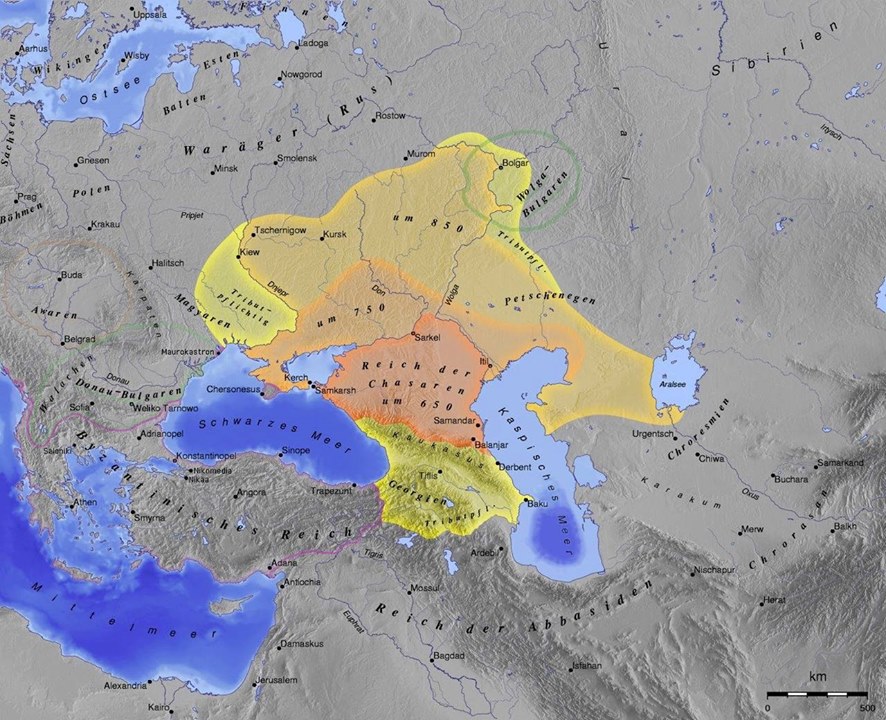
3One of the earliest references to Gog is thought to come from Assyrian inscriptions in the 9th century B.C. referencing “Mat Gugi,” meaning “country of the Gugu.” Hesiod, considered the father of Greek didactic poetry and literature, identified Magog with the Scythians and southern Russia in the 7th century B.C., written prior the book of Ezekiel. Hesiod likely derived this from the Colchi people (a Thracian tribe) where, in their ancient Chaldaic language, described the region of southern Russia as “Gog-chasan” or “Gog-hasan” (Arabic “Gog-i-hisn”) meaning “fortress of Gog” or “Gog’s fort.” There are scholars who also suggest that Gog and Magog, as a region, is where the name “Caucasus” originated. Certain scholars speculate the name “Caucasus” was derived from “Gog-chasan” which the Greeks translated as Gogasus or Caucasus. The Caucasus is generally considered the land between the Black and Caspian seas.
Greek historian Herodotus, whom historians call “the father of history,” mentions in the 5th century B.C. a people living around the Caucasus mountains called “Gargarians.” Greek myth depicted the Gargarians as “Gorgons,” which eventually became Gorgene or Gorgaene. He also wrote extensively about the descendants of Magog by their Greek name, the Scythians, about 150 years after Ezekiel. He wrote of “Royal Scythians” who ruled over all other Scythians of Scythia. Herodotus describes them as living in the territory north of the Black Sea, and that they terrorized the southern steppes of Russia beginning in the 10th century B.C. Numerous archaeological discoveries have confirmed Herodotus’ reports in general, and his Scythian accounts in particular. Flavius Josephus, Jewish and Roman historian, continued with that reference in the 1st century A.D. when he records that Magogians were called “Scythians” by the Greeks. Philo, Greek and Jewish philosopher in the 1st century A.D., also identified Magog with southern Russia.
The Gargarians show up again in Greek history. Strabo, early 1st century Greek historian, geographer and philosopher, famous for his 17-volume work Geographica which presented a descriptive history of people and places from different regions of the world known to his era, mentions “Gogarene” as a region in Iberia (present-day Armenia and Georgia). Scholars agree Gogarene is one of the best preserved names from Gog, which belonged to the Caucasian Iberian kingdom (present-day Armenia and Georgia) up to the 2nd century B.C. Aelius Herodianus, Greek and Roman scholar of antiquity, called the region “Goerene” in the 2nd century A.D. In the 5th century A.D., a viceroy in the region of old Armenia called himself Achoucha Gougarqtzi (Arshusha of Gogarene). In the 6th century A.D., geographer Stephanus of Byzantium referred to the region as Gogarene, and in the 7th century the region was known as Gougarq. Today it still exists as Gugark, a historical region in Armenia. As noted earlier, commentators suggest Georgia also derived its name from Gogarene, and today the Turkish name for Georgia is Gurgistan. In recent history, certain Georgians referred to themselves as “Gogi.” Interestingly, a peculiar Skythian people, who appear at the end of the 4th century A.D., called the Geougen (also Jou-jan, Jeu-jen, Juan-juan or Jwen-jwen), emerging as a powerful empire in the region of Tartary (Mongolia). Scholars suggest they were a mixture of eastern Huns (Skythian) and Tungus (Manchu) peoples, who for a short time became a Central Asian group of historical importance. The empire of the Geougen lasted from the end of the 4th century A.D. to the middle of the 6th century.
Magog’s name is also preserved. Albius Tibullus, Latin poet in the 1st century B.C., mentions a people living on the River Tanais (present-day River Don) called “Magini” or “Magotis”, whom scholars say were from the colonies of Magog. The Greeks called the area where the Magini lived along the Tanais, the “Maeotian marshes” where the river emptied into the Maeotian Lake (present day Sea of Azov). The marshes served as a checkpoint to the westward migration of nomad peoples from the steppe of Central Asia. The area was named after the Maitois or Maeotae people (as the Greeks and Latins called them) who lived around the Maeotian Lake or Sea. Jerome (who translated the Latin Vulgate), an Illyrian Christian apologist of the late 4th and early 5th centuries, affirms “the Jews of this age understood by Magog the vast and innumerable nations of Scythia, about Mount Caucasus, and the Palus Maeotis (Latin for Maeotis Sea), and stretching along the Caspian Sea to India.” Scholars suggest that at the early stages Magogites assimilated with Skythians, thus making up a part of the early Scythian hordes. In fact, wherever or whenever we see references to Gog and Magog in name or place, we also see the Skythians. Many of the mountains peaks in the Caucasian mountains and land areas there retained the place name “Gog” in medieval European and Armenian maps. Scholars also regard Gog and Magog as the wild tribes of Central Asia, including the Scythians, Alans, Parthians, Turks, Tartars, Mongols, and Huns, who had been making incursions on various kingdoms and empires from very ancient times. Russian traveller Jacob Reineggs, who visited the Caucasus five times in the 18th century, left many records of people groups he enountered. He discovered in the central Caucasus a people called Thiulet, who lived amidst mountains called Ghef or Gogh. The very highest of these mountains, lying to the north of their country, they knew by the name of Moghef or Mugogh. These place names are Gog and Magog derivatives.
Some have mistakenly confused the term Mongol with Magog. While the terms sound similar, Mongol was derived from a different source. For hundreds of years the descendants of Magog arrived from the west and north from Siberia, settling in parts of northern China. By by the 8th century A.D., we find the Chinese referring to these invading peoples as “Huangdou Shiwei” meaning “yellow (blonde) heads.” These Shiwei tribes were also called “Mengwu” or “Maoshou” which meant “hairy head or hairy face (bearded)” people. The Mengwu/Maoshou tribes were the first to be called “Mongols”, though they were not Mongoloid peoples of China. The term would later apply to Mongolic peoples who migrated to the region and named it Mongolia.
4The Scythians are descended from Ashkenaz, son of Gomer, son of Japheth, and first appear in Assyrian records as “Askuza” or “Ishkuzai.” The Assyrians tell of the Askuza as being involved in a revolt and pouring in from the north some time around the beginning of the 7th century B.C., which is also mentioned in the Old Testament (Jeremiah 51:27). The Askuza later became the Skythai (Scythians) of Herodotus. According to scholars, ancient peoples known as the Sarmatians (not to be confused with the Samaritans) and Alans lived in the area around the Caspian Sea from about 900 B.C. Sarmatian and Alani tribes were later called Scythians (Slavic peoples of today), who were also known as the Rukhs-As, Rashu, Rasapu, Rhossi, Rosh, Ros, and Rus. There is no debate that they were the inhabitants of southern Russia, and the existence of the names of rivers, such as the “Ros,” refer to Rus populations. Much later, about 739 A.D., the word Rus appears again in eastern Europe, interestingly, from a different source. Finnish peoples referred to Swedes as “Ruotsi,” “Rotsi” or “Rus” in contrast with Slavic peoples, which was derived from the name of the Swedish maritime district in Uppland, “Roslagen,” and its inhabitants, called “Rodskarlar.” Rodskarlar or Rothskarlar meant “rowers” or “seamen.” Those Swedish conquerors (called Varangians [Vikings] by the Slavs), settled in eastern Europe, adopted the names of local tribes, integrated with the Slavs, and eventually the word “Rusi,” “Rhos” or “Rus” came to refer to the inhabitants. Russia means “land of the Rus.” Scholars continue to debate the origin of the word Rus, which has derived from two sources: the Ruotsi or Rhos, the Finnish names for the Swedes, and earlier from the Scythians known as Rashu or Rosh in southern Russia.
5The Aryans first come into historical view about a thousand years before Christ, invading India and threatening Babylonia. Historians of old reference an Aryan chief called Cyaxeres, king of the Medes and Persians. The Medes and Persians seem to have been tribes of one nation, more or less united under the rule of Cyaxeres. Elam (son of Shem) is the ancient name for Persia. Elamites are synonymous with Persians. The Persians are thus descended from both Elam, the son of Shem, and from Madai, the son of Japheth. The Medes and Persians had settled in what is now modern Persia, the Medes in the north, the Persians in the south. The most notable Persians of today are the Iranians. Interestingly, the word Iran is a derivative of Aryan. The Medo-Persian people groups are divided into hundreds of clans, some sedentary and others nomadic. All speak Indo-European languages, and some groups have pronounced Mongoloid physical characteristics and cultural traits, derived from Mongolian invasions and subsequent cultural integration. An example today would be the Uzbeks of Uzbekistan, and remnant groups living in Afghanistan and parts of Central Asia.
6The history of Britain can be traced back to the sons of Japheth. Historical evidence strongly suggests the first inhabitants of the British isles were the descendants of Javan (from his sons Elishah and Tarshish), and of Gomer and Magog. Gomerites are today’s modern Welsh. Traditional Welsh belief is that the descendants of Gomer arrived about three hundred years after the flood, and the Welsh language was once called Gomeraeg. The Welsh (Celts) are thought to have created Stonehenge. Additionally, the descendants of Tarshish (Elishah’s brother) appear to have settled on the British Isles in various migrations about the same time. Genesis 10:4 refers to Tarshish as those of “the isles of the Gentiles.” The Phoenicians traded silver, iron, tin and lead with them (Ezekiel 27:7,12), and even mention the incredible stone monuments at Stonehenge. Around 450 B.C., ancient historian Herodotus wrote about shipments of tin coming from the “Tin Isles” far to the north and west. There is no question that the British isles, including the northern coast of Spain, were the seat of the tin trade. King Solomon acquired precious metals from Tarshish (1 Kings 10:22). English historians assert that British mines mainly supplied the glorious adornment of Solomon’s Temple, and in those days the mines of southwestern Britain were the source of the world’s supply of tin.
The name Briton originated from Brutus (a descendant of Elishah), the first king on Britain’s mainland, arriving about 1100 B.C. Two sons of Brutus, Kamber and Albanactus, are referenced in English prehistory. From Kamber came Cambaria and the Cambrians (who integrated with the Gomerites [mostly Celts] and became the present-day Welsh). The descendants of Albanactus were known as the Albans (or the Albanach whom the Irish commonly called them). Geographers would later call the land Albion. The Britons (also Brythons), Cambrians and Albans populated the British Isles, which later endured multiple invasions, beginning with successive waves of Celts about 700 B.C. The Celts (or Gaels) called the land Prydain, their name for Briton. Those Celts (descendants of Gomer) integrated with the descendants of Elishah and Tarshish (sons of Javan), creating what some scholars called “a Celticized aboriginal population” in the British Isles. Some of the invading people groups were Scythians, descended from Magog, who became known as the Skoths or Scots. The name for the Celts or Cymru was “Weahlas,” from Anglo-Saxon origins, meaning “land of foreigners”—Wales. The Welsh still call themselves Cymru, pronounced “Coomry.” Later the Romans referred to the land as Britannia, invading there about 50 years before the birth of Christ. By the third century A.D., Jutes, Franks, Picts, Moors, Angles, Saxons and other groups were invading from surrounding Europe. In the sixth century A.D., Saxons called the land Kemr (Cymru), and the language Brithenig (Breton). The Angles eventually conquered Britannia, renaming the territory Angleland, which became England. Vikings invaded in the 9th century, and the Normans (or Northmen—former Danish Vikings) conquered England in 1066. Today, the British isles are settled by the ancestors of those people groups, which included Gomer and Javan (first inhabitants), plus Magog (later invasions by various people groups).
7What of Romans and pre-Roman peoples? Migrating nomadic peoples came from across the Alps and across the Adriatic Sea to the east of the Italian peninsula. They were primarily herdsmen, and were technologically advanced. They worked bronze, used horses, and had wheeled carts. They were a war-like people and began to settle the mountainous areas of the Italian peninsula. Historians called these people Italic, and they include several ethnic groups: the Sabines, the Umbrians and the Latins, amongst others. Rome was, in part, founded by these agrarian Italic peoples living south of the Tiber river. They were a tribal people, and thus tribal organization dominated Roman society in both its early and late histories.The date of the founding of Rome is uncertain, but archaeologists estimate its founding to around 753 B.C., although it existed as a village or group of villages long before then. As the Romans steadily developed their city, government and culture, they imitated the neighboring civilization to the north, the Etruscans (former Trojans). Romans are sometimes referred to as “Etruscanized Latins.” Roman legend states that Aeneas, founder of the Roman race, was a prince of Troy who was forced to flee that city at the close of the Trojan war against Greece. Rome’s founder, Romulus, had a Latinized Etruscan name. The Etruscans dominated central Italy, and had already founded many cities, having arrived some 500 years earlier after leaving the city of Troy around 1260 B.C. The Etruscans were greatly influenced by the Greeks, and the Etruscans brought that influence to the city of Rome. The Romans called Etruscans the Tusci, and Tuscany still bears the name. The Etruscan language, once thought lost, is still spoken by the Basques, called Euskara. The first two centuries of Rome’s growth was dominated by the Etruscans. The Romans were first a subject people of the Etruscans, but the Romans would later be their conquerors. After many battles with the Etruscans, the city of Rome identified itself as Latin, eventually integrating the Estruscans and remaining peoples in the region. Rome became a kingdom, then an empire.
8The Irish were likely some of the first settlers of Great Britain. The Irish derive their name from Tubal, son of Japheth. Tubal’s descendant’s were called by various names, including Tabali (Tibarenoi in Greek), Tiberani (from the annals of the Assyrian Kings from which Iberian is derived), and Thobel from which the Thobelites came who were also called Iberes according to Jewish historian Flavius Josephus in the 1st century AD. Scholars note the Iberian and Ivernian peoples were a Mediterranean race from the east, possibly originating from the area of present-day Georgia. Tabal, Tubal, Jabal and Jubal were ancient Georgian tribal designations. The Iberians settled in what is now present-day Spain or Hispania, the name given by the Romans to the whole of the Iberian Peninsula. The Ivernians settled in the British Isles, arriving by sea as early as the 5th century B.C. Later invading Celts (called Goidels, later Gaels) encountered the tribes of Iverni (also Euerni), noting they were a small, dark-haired race, harsh-featured and long-headed. Strabo’s early 1st century work Geographia lists the Greek name of the isle as Iernh. Ptolemy’s 2nd century works describe the pre-Celtic tribes of Iverni as Eraind orErainn who spoke a Proto-Celtic language known as Ivernic (Primitive Irish). The Iverni were called Iouernoi by Greeks, also the Hiberni or Hibernians by Romans. As their names transliterated through time, Iverni descendants would call themselves Everiu, and later Eire, from which the term Irish comes, and the land of Eire, or Ireland was derived.
9The Etruscans are controversial in history. Their language, culture, and apparent departure from history are debated amongst scholars. Descendants of Tiras, the Etruscans did not disappear entirely from history. Their language and people, though a remnant, are the Basques of today. Though the Basques mixed with local populations over the past few millennia, their language didn’t die. A number of scholars consider Euskara (Basque language) the closest living relative to ancient Etruscan. Euskara is an isolate language, meaning it did not descend from an ancestor common to any other language family known today. The original Etruscan language (from ancient Etruscans in northwestern Italy) is thought to be an extinct isolate language, and there is agreement that the current Euskara language was already present in Western Europe before the arrival of other Indo-European languages. Another interesting connection is to Georgian (language of Georgians in southern Russia), each of which have linguistic commonalities, prompting scholars to hypothesize Euskara has a relationship to a lost Eurasian superfamily of languages. This further supports the suggestion that Etruscans were originally Trojans. After a succession of wars with the Greeks, around 1260 B.C. thousands of Trojans (speaking an ancient Thracian language) resettled abroad, which included Trojan warriors and families who sailed across the Black Sea to the Caucasus region in southern Russia, and also those who sailed to present-day northwest Italy. Their descendants, the Basques, would eventually migrate into what is present-day southeast France and northeast Spain.
DNA (R1b Y-DNA haplogroup) findings also support a connection between Basques and peoples of Georgia. As noted earlier, haplogroups (i.e., R1b) are used in DNA tests for markers that give a broad or regional picture; haplotypes are one person’s results on various DNA tests. Y-DNA is the theoretical most recent common male-lineage. The greatest concentration of the R1b haplogroup maps found a heightened incidence in the Basque region of Spain and in the region east of the Black Sea in southern Russia (present-day Georgia). Both DNA research and language commonalities provide a link to the history of the Basques, and thus the Etruscans.
10Scandinavian predecessors have a unique history. Scholars agree that Scandinavians (Danes, Norwegians, Swedes) came from early Germanic people groups, including the Goths, Ostrogoths, Visigoths, Teutons and Burgundians (descendants of Gomer). Ashkenaz, son of Gomer, is ancestor of those Germanic peoples. The descendants of Ashkenaz have many historical references. Known as the Askaeni, they were some of the first peoples to migrate to northern Europe, naming the region Ascania (after themselves). Latin writers and Greeks called the land Scandza or Scandia (now Scandinavia). Roman records describe a large city on the southern shore of the Caspian Sea (about 350 A.D.) where a chain of mountains begins, and runs eastward along the shore and beyond it, forming a natural boundary. Those mountains were called the Ascanimians, the region was called Sakasene (a form of Ashkenaz), and the dwellers of the city were the Saki. The Saki tribes had been migrating north to Europe for some time. The Saki called themselves the Sakasenoi, which we know as the Sachsens or Saxons. Around 280 A.D. the Romans tell of the employment of Saxons to guard the eastern British coasts against barbarians. About 565 A.D., the Saxons battled over territory in the Baltic region with another powerful people, the Svear. Historical records indicate that descendants of Tiras also settled in Scandinavia, a people called the Svear. The Svear are descendants of the first inhabitants of the ancient city of Troy, a people then known as the Tiracians (also Thracians, Trajans or Trojans). They were described as a “ruddy and blue-eyed people.” The city of Troy was destroyed around 1260 B.C. after a succession of wars with the Greeks. Thousands of Trojans resettled abroad, which included Trojan warriors who sailed across the Black Sea to the Caucasus region in southern Russia. One of the most documented of Trojan settlements is along the mouth of the River Don on the Black Sea. The locals (Scythians) named those Trojan settlers the “Aes,” meaning “Iron” for their superior weaponry. Later, the inner part of the Black Sea was named after them, called the “Iron Sea” or “Sea of Aesov” in the local tongue. Today, the name continues as the “Sea of Azov.”
The Aes or Aesir, traveled from the Caucasus region to the Baltic Sea in Scandinavia around 90 B.C., which is supported by scholars, modern archaeological evidence, and DNA. A tribe that migrated with them were the Vanir. The Aesir clans traded with local Germanic tribes, including the Gutar. Romans called the Gutar “Goths,” the Aesir “Svear”—Swedes, and the Vanir “Danir/Daner”—Danes. The Svear and Daner populations were described specifically as taller and fairer (blonde) than other people groups in the Baltic region. The Svear population flourished, and with the Goths they formed a powerful military alliance of well-known seafarers. The Romans noted that Svear people together with the Goths were, from the 3rd century A.D., ravaging the Black Sea, Asia Minor and the Mediterranean, using the same type of weapons as their Trojan ancestors. The Svear and Goths dominated the Russian waterways, and by 739 A.D. together they were called Varyagans or Varangians (from the Swedish Vaeringar), according to written records of the Slavs near the Sea of Azov. Like their ancestors, Scandinavians lived in large communities where their chieftains would send out maritime warriors to trade and plunder. Those fierce warriors were called the Vaeringar, which literally meant “men who offer their service to another master.” We later know them by their popularized name, theVikings. Further evidence of Aesir (Asir) settlements in the Baltic region came from their Thracian language, which not only influenced, but is very close to the Baltic and Slavic (Balto-Slavic) languages of today. By the 9th century A.D., the Svear state had emerged as the major power in Scandinavia. The Svear, Daner and Goths, along with other Germanic tribes, settled in what is now present-day Sweden, Norway, Denmark and other parts of the Baltic region. They were forefathers of the Scandinavians—the descendants of both Gomer and Tiras. Y-DNA (the most recent common male-lineage) in Scandinavians was found to be grouped with the Basques mentioned above.
11Early history shows the Japhethites split into two groups. One group settled in the region of present-day India and Central Asia, and the other group in the European theater. Indo-European languages originate from those people groups who migrated throughout western Eurasia (Europe, the Near East, Anatolia, and the Caucasus). Together they form what is known as the “Indo-European” family of nations. Both of these divisions trace their ancestry back to Japheth. For example, early Aryans knew him as Djapatischta (chief of the race), Greeks referred to Japheth as Iapetos or Japetos, East Indians called him Jyapeti or Pra-Japati, Romans used Ju-Pater or Jupiter, the Saxons perpetuated his name as Iafeth, subsequently transliterated as Sceaf (pronounced “sheef” or “shaif”—and recorded his name in their early genealogies as the son of Noah, the forebear of their various peoples), and the variant Seskefwas used by early Scandinavians. All of these peoples, we must remember, were pagans whose knowledge or even awareness of the book of Genesis had been lost, or was non-existent.
Endnote:
The information presented here is only an interpretation of historical research and Biblical data. Certain assumptions may not be accurate, and new discoveries can change group references. While many of the peoples and nations listed are easily identifiable, many remain obscure. Numerous scholars have attempted to identify lost or unknown nations with varying degrees of success. Much of the material is archaic, and there remains considerable ambiguity. There are some who suggest problems within the Table of Nations when attempting to correlate specific people groups with modern comparative linguistics. For example, we know Elamites descended from Shem, yet their language was not Semitic. Canaanites descended from Ham, yet their language was Semitic. These apparent conflicts are not conflicts at all. Cultures from ancient times were constantly subject to foreign migrations and invasions. Conquering powers often imposed their language and culture upon the defeated; this is what came to pass in Elamite and Canaanite civilizations. There are many other examples in history. The Israelites, who primarily spoke ancient Hebrew up until the Babylonian and Persian captivities, would eventually adopt Aramaic, the official language of the Persian Empire. That resulted in the Jewish Talmud being written in Aramaic. Aramaic was a language spoken by Jesus. The famous Grecian conqueror, Alexander the Great, subdued Persia, and soon the Jews adopted Greek as a second language. The result was the New Testament being written in Greek.
We are all directly related to either Shem and his wife, Ham and his wife, or Japheth and his wife. History has long since confirmed abundantly this distribution of mankind, exactly as the Bible describes. Every human being on earth today is your cousin, whether first, second or thousandth! Nothing in the legendary or archaeological history of the ancient world denies the biblical account of the creation of the world, the entrance of sin and death, the judgment of Noah’s flood, and the rise of the peoples from his descendants after their dispersal from Babel. Furthermore, the historical dates used to determine the formation of people groups, nations or kingdoms does not in any way conflict with the Genesis account, but are well within the approximate dates for the creation of the world and mankind about 4000 B.C., the flood of Noah about 2350 B.C., and the dispersal from Babel around 2100 B.C. Click here for a genealogical chart from Genesis 10.
This information is not intended to promote or reflect a particular theology, religious sect or genealogical group. Don’t dismiss the fact that with some of the Shemites, Hamites and Japhethites there would have been intermarriage and subsequent people groups. For example, scholars note evidence that suggests the descendants of Lud (Shemites) migrated north and intermarried with the Greeks (descendants of Japheth), and were eventually absorbed in that culture.
The interaction of all three family contributions is the theme of history. The remarkable thing is that they all can be substantiated to a degree, often unsuspected by students of history, up to the present time. The descendants of Shem, Ham and Japheth are evidenced, not only by Biblical history, but archeological, anthropological, biological, ethnographical, ethnological, etymological, geological and secular history. The question is not one of levels of worth but of uniqueness of contribution, and though differences exist, not any one group is superior or inferior.
Listed below are 19 of the 94 recognized language families of the world, representing just over 6,900 distinct languages. Approximately 45 percent of the world’s population fall into the Indo-European language family, with 22 percent falling into the Sino-Tibetan language family. Linguists claim that many of the languages of the world are related by their “proto-language.” Subsequently, all languages can be traced back, in their various linguistic groups, to a “father tongue,” which then evolved multiple times. However, current knowledge refutes such explanations entirely. For example, the two largest language families, Indo-European and Sino-Tibetan, come from their own Proto-Indo-European and Proto-Sino-Tibetan families exclusively. Many linguists now understand these two proto-languages were so radically different, they could not have come from a single original language. The same holds true for the other 92 language families. Such evidence supports the Bible’s claim that the languages given at Babel were unique and distinct from each other:
Here are some of the most common spoken & written languages worldwide:Achinese, Afrikaans, Akan, Albanian, Amharic, Arabic, Armenian, Assamese, Aymara, Azerbaijani, Balinese, Baluchi, Bambara, Bashkir, Basque, Batak Toba, Baule, Beja, Belorussian, Bemba, Bengali, Beti, Bhili, Bikol, Brahui, Bugis, Bulgarian, Burmese, Buyi, Cantonese, Catalan, Cebuana, Chagga, Chig, Chinese, Chuvash, Croatian, Czech, Dairi, Danish, Dardic, Dimli, Dogri, Dong, Dongola, Dutch, Dyerma, Dyula, Edo, Efik, Ethiopic, English, Esperanto, Estonian, Ewe, Finnish, Fon, French, Frisian, Fula, Fulakunda, Futa, Jalon, Gaelic, Galician, Ganda, Georgian, German, Gilaki, Gogo, Gondi, Greek, Guarani, Gujarati, Gusii, Hadiyya, Hakka, Hani, Hausa, Haya, Hebrew, Hiligaynon, Hindi, Ho, Hungarian, Iban, Icelandic, Igbo, Ijaw, Ilocano, Indonesian, Italian, Japanese, Javanese, Kabyle, Karo, Kamba, Kannada, Kanuri, Kashmiri, Kazakh, Kenuzi, Khmer, Kikuyu, Kongo, Konkani, Korean, Kurdish, Kyrgyz, Lampung, Lao, Latvian, Leyte, Lingala, Lithuanian, Luba, Luhya, Lulua, Luo, Luri, Luxembourgish, Lwena, Macedonian, Madurese, Makassar, Makua, Malagasy, Malayalam, Malaysian, Malinke, Mandarin, Manx, Marathi, Mazandarani, Mbundu, Meithei, Mende, Meru, Miao, Mien, Migindanaon, Min, Minangkabau, Mongolian, Mordvin, Moré, Nepali, Ngulu, Nknole, Norwegian, Nung, Nupe, Nyamwezi, Nyanja, Occitan, Oriya, Oromo, Panay, Pampangan, Pangasinan, Pashtu, Pattani Malay, Persian, Polish, Portuguese, Provençal, Punjabi, Quechua, Rajang, Rifian, Romanian, Romany, Ruanda, Rundi, Russian, Samar, Sango, Santali, Sasak, Serbian, Sgaw, Shaba, Shan, Shilha, Shona, Sidamo, Sindhi, Sinhala, Slovak, Slovenian, Soga, Somali, Songye, Soninke, Sotho, Spanish, Sudanese, Sukuma, Swahili, Swedish, Sylhetti, Tagalog, Tajiki, Tamazight, Tamil, Tatar, Tausug, Telugu, Temne, Thai, Tho, Thonga, Tibetan, Tigrinya, Tiv, Tonga, Tswana, Tudza, Tulu, Tumbuka, Turkish, Turkmen, Uighur, Ukranian, Urdu, Uzbek, Vietnamese, Welsh, Wolaytta, Wolof, Wu, Xhosa, Yao, Yi, Yiddish, Yoruba, Zande, Zhuang, Zulu. Interesting fact: Worldwide, one language disappears every two weeks. |
Curious about the names of the wives of Noah, Shem, Japheth and Ham? The Bible gives us no information on the names of the wives of Noah and his three sons, although the phrase “Noah’s wife” appears five times. The Book of Jasher (or Book of the Upright), referred to in the Bible in Joshua and 2 Samuel, is considered a reliable ancient Hebrew source for Biblical patriarchs. The Book of Jasher cites Noah married Naamah, daughter of Enoch. They brought forth Japheth and Shem. Later, Noah married Namah, daughter of Lamech, and they brought forth Ham. There are several extra-Biblical sources of the names of their wives in the chart below:
|