Qadiri Naqshbandi Shadhilli, Qutb Allah, Rami Al Boustani Al Rifai | ‏بِسْمِ ٱللَّهِ ٱلرَّحْمَنِ ٱلرَّحِيمِ ‏يُؤْتِى ٱلْحِكْمَةَ مَن يَشَآءُ ۚ وَمَن يُؤْتَ ٱلْحِكْمَةَ فَقَدْ أُوتِىَ خَيْرًۭا كَثِيرًۭا ۗ وَمَا يَذَّكَّرُ إِلَّآ أُو۟لُوا۟ ٱلْأَلْبَبِ|Bi.isim.Allah@outlook.com

The Islamic Lataif, Chinese Meridians, and Buhddist and Hindu Chakras and Their Basis In Islamic Law
7f567c41d90b4a9ba44bc04c99679c4d

The Dua Of Light; the Prophet (saws) often prayed in Sujood, “O Allah, place light in my heart, and on my tongue light, and in my ears light and in my sight light, and above me light, and below me light, and to my right light, and to my left light, and before me light and behind me light. Place in my soul light. Magnify for me light, and amplify for me light. Make for me light, and make me light. O Allaah, grant me light, and place light in my nerves, and in my body light and in my blood light and in my hair light and in my skin light.” (Bukhari)

“O Allaah, make for me a light in my grave… and a light in my bones.” (Tirmidhi)

“Increase me in light, increase me in light, increase me in light.” (Bukhari, adab al mufrad)

“Grant me light upon light.” (Bukhari)

The Origins of the Lataif in Islam lie in medicine and science, it originated with the work of Imam Kubra in the twelfth century regarding dream and vision interpretation. As his work and tariqa spread through the muslim world it also influenced the teachings of the Buddhist, Chinese and Hindu religions because Islamic society was the most advanced in the world at the time.

This subject has always been at the core of islam since it’s first days, beginning with the prophet (saws) himself who would teach the companions how to interpret dreams and visions as well as the science of the self, among the early generations the famous and highly respected Tabi’i scholar Imam Ibn Sireen, who was born in 33 AH (653AD) during the rule of Uthman ibn Affan (ra), wrote a famous book on dream and vision interpretation which encompassed much of that knowledge, it survives to this day and has been translated into english. The Imam himself was a zahid (ascetic) the equivalent among the tabiin (first generation of muslims) to what was later termed sufi, the Zahid’s in the Ummah would organise into Tariqa’s (schools) to better teach the spiritual side of Islam just as the faqih’s (Lawyers) would organise into Madhhabs (legal schools), this tradition survives to this day in the many tariqa’s (sufi schools) that exist around the world.

It is difficult to say what specifically advanced this knowledge in Islam but a look at the Islamic world during the 12th and 13th century will tell us this was the period of Islam’s golden age of scientific and social discovery, besides making countless discoveries of their own, the Muslim world took outdated knowledge from all areas of the world it spread to and advanced it to a level never seen before, so advances in understanding the physiology of spirituality was inevitable. This began with scholars who’s people had converted to Islam in these new lands, they adopted the islamic way of looking at the world and thus began the work of advancing their own traditions (science). Persian muslims would advance Persian science, Indian muslims would advance Indian science, Chinese muslims would advance Chinese science all the while taking from the wider islamic community that they where now connected to to aid in this process, in this way the religion of Islam was instrumental in spreading science on earth in an unprecedented manner and specific regions in the muslim world began to lead the world in science.

This process came under the Shariah Laws of Urf (custom and culture) and hence Islam protected people’s naturel identity. It is impermissible to make tahrim (declare a thing impermissible) as some modern heretical sects took to doing simply because of it’s origin, because Islam accepts peoples cultures and backgrounds, it was something Allah himself created and He stated it in the Quran in very clear terms, “O mankind! We created you from a single (pair) of male and female, and made you into nations and tribes, that ye may know each other (not that ye may despise and reject each other). Verily the most honoured of you in the sight of Allah is (he who is) the most righteous of you. And Allah has full knowledge and is well acquainted (with all things, meaning all cultures).”(49:12)

This is relevant today because some heretical sects denounce entire fields of science because they come from a region of the world they are racist against, which is another evil Allah condemns in the Quran. They contradict many of the prophets (saws) instructions, for example the Prophet (saws) instructed that we should “seek knowledge even unto China” (al-Munawi cites al-Dhahabi’s Talkhis in which he said it is a widely reported narration, some of its chains are weak, and some are sound),  the prophet (saws) also said “The Search of Knowledge is an obligation laid on every Muslim” (Ibn Majah and Baihaqi) meaning on every muslim in every part of the world.

The Messenger of Allah acknowledge in the 7th century that China was an advanced society and had knowledge about this world we should seek out, the companions visited China not long after the prophet’s (saws) death because of this. As a result of the Islamic golden age, which Allah himself promised his prophet (saws) in number of narrations, Europe was taken out from the Dark ages by fuelling it’s enlightenment and it helped greater India, China and Asia recover from the Mongol Horde that devastated it.

The Prophet (saws) said “I have been sent with ‘Jawami-al-Kalim’ (the shortest expressions with the widest meaning and knowledge) and have been made victorious with awe, and while I was sleeping, I saw that the keys of the treasures of the world (which means the knowledge present among other nations) were placed in my hand.” Abu Huraira added: Allah’s Apostle has gone, and you people are utilizing those treasures (knowledge), or digging those treasures out.’(Bukhari) in other words making use of old knowledge from every region on earth, the spread of knowledge by Islam was something clearly promised to the prophet (saws) by Allah, and this is exactly what occurred throughout history.

The Messenger of Allah (saws) said: “Indeed Allah gathered the earth for me so that I saw its east and its west. And surely my Ummah’s authority shall reach over all that was shown to me of it. And I have been granted the two treasures; the red (Roman empire, were the Greek sciences were taken from) and the white (Persian empire, were over 200 of Islam’s greatest scholars and scientists would come from). I asked my Lord that my Ummah is not to be destroyed by a universal drought, and that He does not overcome them by enemies outside of them, reaching to their heart of power (Madina and Makkah). My Lord said: ‘O Muhammad! When I issue a decree it is not reversed. I have granted for your Ummah that they shall not be destroyed by universal drought. And that they not be overcome by enemies outside of themselves reaching to their heart of power even if they gather against them from all the regions.”’ Or he said: “Among the regions. But some of them will destroy others, and some will capture others.”’ (Tirmidhi)

Allah also says in the Quran “To thee (Muhammad) We sent the scripture (Qur’an) in truth confirming the scriptures that came before it, and guarding it in safety. Say: Whoever is the enemy of Jibreel — for surely he revealed it to your heart by Allah’s command…”(2:97)

Abu Hurairah (ra) also narrated:”We were sitting in the company of Allah’s Apostle (saw) when Surat al-Jum`a was revealed to him and when he recited amongst them, (those who were sitting with the prophet) said `Allah’s Messenger?’ but Allah’s Apostle (saw) made no reply, until he was questioned once, twice or thrice, and there was amongst us Salman the Persian. Allah’s Apostle (saws) placed his hand on Salman and then said:”Even if faith were near the Pleiades (the stars), a man from amongst these would surely find it (referring to knowledge of religion).” Persia became a great centre for knowledge and many of the worlds great scholars came from there like Imam al Ghazali, Imam Abu Dawwud, Imam Bukhari, Ibn Sina, Ibn Haytham one could name well over 200 prominent and well known Islamic figures (Scholars, Scientists, Philosophers, and Physicians) in world history that came from Persia.

It is also significant to note that the Greeks such as Plato followed and revived the teachings of a prophet of Allah sent earlier to the Persians called Zoroaster (a greek translation of his name from Plato’s work). Allah in the Quran recognizes the Zoroastrians (Majus in the Quran) as people who believed in Allah mentioning them with the Jews and Christians: “Verily, those who believe and those who are Jews, and the Sabians, and the Christians, and the Majus, and those who worship others besides Allah, truly, Allah will judge between them on the Day of Resurrection. Verily! Allah is over all things a Witness”. (22:17).

The Lataif of Islam don’t resemble anything from other religions or cultures, ‘any automatic reference to the Hindu concept of koshas is inappropriate and the alluring association of the Lataif Sitta with the Tantric esoteric physiology is deluding. The central mythic power defining the Hindu Tantra, Kundalini Shakti, has no equivalent in Sufism’. Some have also likened it to Jewish traditions, beside the fact that both religions are revealed from Allah who stated the zuhd (asceticism) He taught in Islam He likewise revealed it in the scriptures of Abraham and Moses, it is highly unlikely muslims took from the Jews because the Jewish understanding of physiology would have certainly developed in the Islamic Empire during Islam’s golden age, most of their great scholars lived in Islamic lands. The Jews were largely persecuted around the world through history, except in Islamic lands and every time they were exiled their texts were destroyed, so scientific advancement among the tribes would have been slow and mostly borrowed from Islam, this was the case from most of their history and prior to Islam 1400 years ago knowledge of the body did not resemble anything we know today.

Other’s have likened the Lataif to Hindu Chakra’s, while the definitions may resemble each other that is were the similarity ends because the Chakra points are located in entirely different locations on the body and deal with different things than the Lataif.

Chakras and Acupuncture meridians are closely related, in old terms ‘meridians carry the life force (energy) that vitalizes all life forms and allows them to flourish and grow’, today using modern language we call this the nervous system. Different cultures call this life force by different names: Chi in chinese medicine, subtle (Lataif) energy in Islam, Spirit or Prana and vital energy in Hindu to name just a few but it is all referring to the same thing.

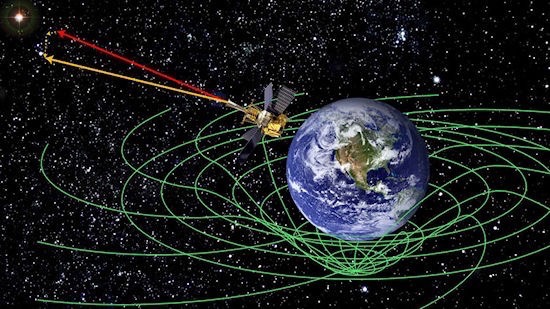
Chi and Lataif energy in the language of physics is the electromagnetic force that governs this universe and the fields created because of it, the electric, magnetic and electromagnetic fields. There are only four fundamental forces in the Universe, three of them are responsible for why everything occurs from chemical reactions to electricity to magnetism, the other one is gravity but it is ruled out because it doesn’t relate to this subject. The strong nuclear force and the weak nuclear force likewise don’t relate to this subject, while the electromagnetic force is a perfect fit considering what it does and the major role it plays in life.

Everything we have mentioned above about the Lataif, Chakra’s and Meridians is mans observation of this force throughout history, it is responsible for it all.

It is responsible for the electromagnetic field that the heart, brain and other organs produce and surrounds the human body, and it is responsible for electricity and magnetism in the body. The electro-magnetic force also surrounds every single Atom in the Universe and dictates, similar to how magnetism works, it’s attraction and repulsion to other Atoms, when this is considered on a larger scale, the electromagnetic force decides the strength, shape and hardness of objects as physics states, because it is responsible for stopping things from passing through each other like they are ghosts, if it was to stop working everything would collapse into a black hole.

It is also significant that the magnetic component of the electro-magnetic field the heart generates is far stronger than the electrical component, which is important to the attraction and repulsion of particles, that the hearts rhythm also affects.

It goes without saying that martial arts masters who learnt to manipulate this force flowing through the body displayed extraordinary abilities all relating to strength, hardness and the manipulation of objects (shape).

Above all else Allah mentions this force in the Quran in the verse of light clearly, stating that He uses it to guide all people, this is the basis in Islam for the scholars using the Lataif points and this force to similarly guide and purify people through it because this is what Allah himself does.

Allah says, “Allah is the Light of the heavens and the earth. The example of His light is like a niche (the particle field in space) within which is a lamp (the particles Atoms are made from), the lamp is within glass (the Atom), the glass as if it were a pearly

[white] star lit from [the oil of] a blessed olive tree, [it’s Olive, the particle, is] neither of the east nor of the west (but from subatomic space), whose oil (the forces of the universe) would almost glow even if untouched by fire. Light upon light (particles within particles). Allah guides to His light whom He wills (Allah uses the particles and forces of the universe to guide to him). And Allah presents examples (such as this) for the people, and Allah is Knowing of all things”. (Qur’an 24:35) (we have explained this verse in detail in our work “Allah Is The Light Of The Heavens and The Earth”)

This verse describes how the Atom comes into existence and how Allah guides man through the forces and energy of the universe that our body uses to survive. All atoms along with the particles they are made from right down to the smallest particle are created because of the four fundamental forces in the Universe, the electromagnetic force (Chi) being one of them.

In the Quran Allah, in a language Arabs living 1400 years ago could understand, calls the Atom a lamp and the forces that create it the Oil that is fuelling the lamp, the particle (Olive) the tree produces is not from the east or the west it is from within space, subatomic space, He then tells us this is His light in the Universe through which people and their hearts are guided because the body relies on what is occurring subatomicly.

The verse begins by asserting that “Allah is the Light of the heavens (the Universe) and the earth” then Allah gives an example for how His light exists. The simile for the Atom and the smaller particles it is made from in this verse is Light because both are quantum substances and light is the most visible subatomic particle, there are many ahadith that clearly state Allah created the universe from His light (particles) just as the verse of light explains what His light is by explaining how Atoms come into existence. (Our book “Ibn Arabi On Imagination and The Creation Of The Universe” quotes many of these Ahadith and discusses them at length, it also discuses the prophets (saws) knowledge of subatomic space.)

Allah then says “the example of his light is like a niche”, a niche is like a crevasse in the middle of a wall, and as physics teaches particles exist in a field spread out in space as if a wall, so this is it’s similitude.

Within which is a lamp”, the Atom or particle itself, “the lamp is within glass“, the Atom creating its own outer shell or field as it spins or vibrates.

The glass as if it were a pearly [white] star“, it’s outer shell looks exactly like a star when it shines, this is caused by its excitation that makes it react to other particles and forces around it, as well as want to join together with other particles to make up larger particles in the universe.

Next Allah talks about the four fundamental forces in the Universe, one of which is Chi (Lataif, meaning subtle, energy) also called the electromagnetic force, “Lit from the blessed oil”, particles are created (Lit) from the fundamental forces (Oil) of the Universe, “of a blessed olive tree” the tree is the hierarchy of particles, starting with the Atom down to the smallest one, essentially the tree is the Universe itself.

The example of the tree in the verse is similar to a family tree with a list of the older generations of people going all the way back to our ancestors, just like the Atom and the particles (older generations) going back to it’s ancestor or the smallest particle it came from, in fact this is the same terminology used by physicists today when looking at the hierarchy, the particles are known by what generation they belong to, (the full explanation of the verse is in our work “Allah Is The Light Of The Heavens and The Earth”).

Through this reality of space “Allah guides to His light whom He wills”, through this blessed Tree, or the subatomic universe, Allah guides man to Him.

This is the basis for the Lataif (subtle energy) and Chi in the Quran, another clear example is given is Surah al Shams (91) where Allah talks about the celestial bodies like the sun, moon and the earth and says He guides man through the fields they generate, the electro-magnetic fields of the sun which create it’s varied solar activity and the earth that is surrounded by a magnetic field protecting it from the sun and creating it’s atmosphere, this along with it’s gravity, all of which exist because of the electro-magnetic force.

Allah speaking about the subatomic effects of these celestial bodies on human consciousness, say’s “BY the sun and its radiant brightness (It’s solar activity created by the electromagnetic force), By the moon as it reflects the sun! (It reflects the suns solar activity and protects the earth) BY the day as it reveals the (sun to the) world, By the night as it veils it darkly! (The day and night cycle is the period of increased and decreased electromagnetic activity which humans experience) BY the sky and its wondrous make (the sky and atmosphere is created because of the earth’s magnetic field shielding it from the sun), By the earth and all its expanse! (The expanse of the earth creates the atmosphere and different weather that exist around the world, as well as the gravity we experience) BY the Soul (which is made from subatomic particles), and how it is formed (from these particles) in accordance with what it is meant to be (subject to the Laws of physics, the pen wrote down what would occur according to the Laws Allah placed in the Universe which are set, mans freewill acts within the boundaries of these laws i.e. what it, the soul, is meant to be), And inspired it (through the subatomic universe, the particles and forces that exist there, with) what is wrong for it and (what is) right for it. To a happy state shall indeed attain he who causes this [self] to grow in purity (Zakaha), and truly lost is he who buries it [in darkness]. TO [THIS] TRUTH (that previous civilizations already new) gave the lie, in their overweening arrogance, [the tribe of] Thamud”(91:1-11) (we have written a lengthier tafsir to these verses on our website).

Previous civilizations understood man is guided through the celestial bodies and built massive structures to mark there knowledge which they left behind like the pyramids and stone henge, the tribe of Thamud had knowledge of all this but denied their creator and worshiped the stars and invented gods instead.

Because Man’s consciousness and imagination (what we see in our mind) is made of matter, like solids and liquids are made from matter, the image in our head is made from subatomic particles, particles smaller than the atom, our imagination is created from the very same forces that govern this Universe and create these particles, Allah says He guides man through them to Himself, “Those who strive hard in Us, We shall most surely guide them in our Ways” (29:69) which is through the self, man’s consciousness and imagination that shapes who he is.

This is the significance of the verse of light in relation to the nature of man and how Allah guides people to him, this is why Allah mentioned guidance at the end of the verse. He is saying man is guided to him through the subatomic universe and the verse of light explains what that Universe looks like.

Allah presents examples for the people and Allah is Knowing of all things”, this is the simile for the Universe, how Allah guides man from within his own self and physiology just like the Lataif of Islam teaches, Allah is the light of the heavens and the earth that we should connect our self to.

The science behind the Lataif Allah promised to reveal how it works in the Quran to the later generations of Mankind, even specifying that man would need to know how his self is connected to the subatomic universe to have certainty (al Yaqeen) that Islam is the truth, “In time We shall make them fully understand Our messages [through what they perceive] in the utmost horizons [of the universe] and within themselves, so that it will become clear unto them that this [revelation] is indeed the truth. [Still,] is it not enough [for them to know] that thy Sustainer is witness unto everything?”[Qur’an 41:53]

Allah made a connection between the the deepest regions of space and what is within man, this is the quantum universe, the subatomic world, mankind understood space by understanding what atoms are made from, the connection between atoms, space and the self is how they relate to each other in the body and the science behind the Lataif deals with this subject which Allah is alluding to here “what they perceive within themselves”, because our consciousness is made from subatomic particles all the things we witness in the self relate to physics and space which the science of the Lataif connects very clearly in it’s teachings, today the emerging field of biophysics deals with this subject.

The science of the Lataif found acceptance and consensus (Ijma) among Islam’s scholars and spread through out the earth.

“[O MEN!] We have now bestowed upon you from on high a divine writ (the Quran) containing all that you ought to bear in mind (it speaks about all knowledge relevant to the self) will you not, then, use your reason?”[Qur’an 21;10] Will you not then study the matter and think, see how these subjects are connected, Allah gave us the blueprint we need to see how it fits together and works.

“They know but the outer surface of this world’s life, but of the End of things they are heedless.”[Qur’an 30:7] They only know the material world but people are unaware of the impact their actions have in the universe. To state the matter succinctly the end of things means the end result of your actions, that is the impact our actions have on the subatomic world which is the end of things since actions are done in the physical world then impact our surroundings in every level of the universe. Every advice Allah ever gave about our behaviour and how to act is because what we do has spiritual consequences, since ghayb the spiritual world is the subatomic part of our universe it means our actions impact the subatomic world and it harms us and others.

Our bodies rely on subatomic particles, our consciousness which is made from these particles along with our heart which creates the electromagnetic field we sense the world through are tuned into the subatomic part of the universe all the time. What occurs there impacts our organs, brain and self directly. We can’t change the physical world with a thought but we can manipulate subatomic particles with our imagination with ease, so our body through our self and actions is always affecting that part of the universe directly and indirectly. This means as we act we impact the world sub atomically and what others do impacts on us as well. Hence Allah is teaching us in the verse that bad actions come back to harm us spiritually (subatomiclly) in a language people can understand, and we should be aware of it, other religions called this Karma and Allah speaks about it in many verses in the Quran.

Allah does everything through the universe and what occurs in it are described by the laws of Physics, He calls these laws in the Quran His commands which descend through subatomic space. In many verses Allah speaks about the creation of the universe and the laws of physics that govern it in a language Arabs could understand; “VERILY, your Sustainer is Allah, who has created the heavens and the earth in six aeons (periods), and is established on the throne of His almightiness (see the next article for it’s meaning). He covers the day with the night in swift pursuit (the motion of the universe is continuous), with the sun and the moon and the stars subservient to His command (the Laws of physics): oh, verily, His is all creation and all command (all laws of physics). Hallowed is Allah, the Sustainer of all the worlds! (planets in the Universe)” (7:54)

“It is Allah Who created the seven heavens and of the earth, it’s like (the other planets). The command (laws of physics) comes forth (lit. descends in arabic) between them (through subatomic space) so that perhaps you would know that Allah is Powerful over everything and that Allah, truly, enclosed everything in Knowledge.” (65:12) This is probably the most significant verse regarding the laws of physics, that it descends to the physical world from the spiritual is the most accurate scientific description possible that is only in our lifetime being understood and proven. In the earlier verse Allah mentions the Throne in relation to these laws, the throne is situated at sidrat al muntaha, the deepest subatomic depth and it is created from the first particles to exist in the universe, as later particles came to be created the many laws of physics came into existence along with them, literally the laws of physics descend from the deepest subatomic depths to the physical world, the command comes forth through subatomic space.

Keeping in mind the verse of light where He says He guides man through the subatomic universe and surah al Shams where He says He uses subatomic forces to achieve this, Allah says about these laws “To thee (Muhammad) We sent the scripture (Qur’an) in truth confirming the scriptures that came before it, and guarding it in safety. Say: Whoever is the enemy of Jibreel — for surely he revealed it to your heart by Allah’s command (Laws)…”(2:97) using the laws of physics, because the heart receives everything from ghayb (the subatomic universe) through the laws of physics. Once properly understood this verse establishes how man is inspired and how he receives revelation, it is the foundation for the lataif system because the heart is the place of revelation.

Christianity similar to Karma teaches we reap what one sows (Galatians 6:7), Chinese Taoism teaches “There are no special doors for calamity and happiness (in men’s lot); they come as men themselves call them. Their recompenses follow good and evil as the shadow follows the substance” the shadow is the subatomic world that follows what is occurring in the physical world. While Allah similarly says “Allah tasketh not a soul beyond its scope. For it (is only) that which it hath earned, and against it (only) that which it hath deserved.”(2:286) If we can’t understand the science behind this then we can understand the warning and take heed.

Verse 30:7 is literally talking about how the universe works and the subatomic part of space, Allah sets the context for this verse very clearly in the next verse, “Have they never learned to think for themselves? Allah has not created the heavens and the earth and all that is between them (the subatomic part of the universe) without [an inner] truth and a term (for it’s end) set [by Him]: and yet, behold, there are many people who stubbornly deny the truth that they are destined to meet their Sustainer!” (30:8).

Similar to ultra violet light the Lataif energy (Chi) is invisible to the human eye. However, in Chinese medicine experienced Chinese doctors can feel and trace these pathways of energy with their hands, the electromagnetic force surrounds every Atom in our hands and because of the electromagnetic field our body generates it is possible, Chinese scholars have also mapped these meridian (Lataif or Chakra) lines and many charts are available. With this understanding, acupuncture and the science of Lataif were developed to balance Chi (energy) in the body, today energy is known by a different name. Through science we know if something affects mans nervous system, if something is stopping the flow of signals (energy) the body will become sick because the brain and heart can’t regulate the body and maintain it’s balance which it needs to do all the time.

We can think of these acupuncture meridians (pathways) as streams or rivers flowing with energy. It is like a river that provides life-giving water to its surrounding areas, these channels distribute revitalizing energy to the surrounding area of the body. Today we call this the nervous system and we can be certain we are talking about the same things because physics tells us energy in the air follows the path of least resistance, the path that already exists in the body, and the nervous system is the most physical path for energy to follow. Mans nervous system and organs which generate the bodies electromagnetic field influence and manipulate the flow of energy so it follows the paths going to and from each organ.

Acupuncture is a method of touching and using ch’i, the electromagnetic force, and the energy created by it whether it is the electromagnetic field, electricity (including static) or magnetism which our body also uses, all these types of energies are created by this single force.

These meridian channels are mapped on the surface of the body, along the meridian lines there are acupuncture points, also called Lataif points, places where we know that we can connect with ch’i to work with the body and its healing process. Acupuncture uses the points related to healing the body from physical illness while the Lataif of islam use the points related to mans consciousness and self, the points most closely connected to the soul that gives us life.

Generally people seek acupuncture treatment when they are ill because Chi follows the nervous system and it is connected to our organs so we can heal the body in specific places using it.

Unlike the Meridians used in Chinese medicine the Lataif of Islam are located near the centre of the chest were the soul is centred. Our consciousness isn’t just the culmination of our senses and memory it is also created from the cumulative energy in the body created by it’s different organs. Because the entire body is connected by the subatomic fields (energy) it generates and they connect with the mind and heart more directly than through the nervous system, our reflexes and instincts rely on this part of us existing, animals specifically use it to greater effect.

This is the top down view of the human body, like someone hitting a nerve in the body then it causes the entire arm to move the electromagnetic field created by different organs are nerves for different aspects of our self. Because of the electromagnetic field created by different organs in the body which is directly connected to our heart and brain, our consciousness, various parts of the body are responsible for different emotions and states.

Listed below are the twelve primary energy meridians, and the main emotions linked with them used in Chinese medicine:
Pasted Graphic1. Lung meridian; grief, intolerance

2. Large intestine meridian; guilt

3. Stomach meridian; disgust, greed

4. Spleen meridian; worry, anxiety about the future

5. Heart meridian; joy, anger

6. Small intestine meridian; insecurity, sadness

7. Bladder meridian; fright, impatient, restless

8. Kidney meridian; fear, indecision

9. Pericardium/circulation-sex; hurt, extreme joy, jealousy, regret

10. Triple warmer/thyroid meridian; hopelessness, depression, despair

11. Gall bladder meridian; rage, wrath

12. Liver meridian; anger, unhappiness

This is not unlike what Imam Ali (ra) said although the list above focuses on illness, Imam Ali (ra) said “The (seat of the) intellect is located in the heart. Mercy is located in the liver, Compassion is located in the spleen. The self (soul) is located in the lungs (these refer to regions in the body that affect these types of emotions from the subatomic universe).”(Adab al Mufrad, Hasan).

The Buddhist and Hindu Chakras are similar to meridians, there are many chakras (centres of energy) in the body but in the Hindu tradition there are seven that are considered the most important. This may at first seem like different opinions coming from different religions, but one look at the location of these seven chakras tells us a different story. Unlike the Lataif of Islam which are located near the centre of the chest or the Meridians of Chinese medicine which are located in the various organs in the body the Hindu Chakras are located in a vertical line starting at the head and going directly down the body, to many this may seem unrealistic because no organs in the body are located in such a vertical way, but it is perfectly accurate if we think about the spinal cord and it’s role.

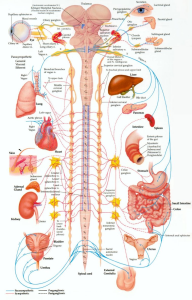
When every Organ in the body wants to send a signal through the nervous system to the brain, including the heart, it sends it through the spinal cord, so along this cord at various locations on it are chakra points associated with each organ, the picture is of the nervous system and how every organ sends a signal to the brain through the spinal chord, as well as the different locations along the spinal chord, exactly like the Chakra points.

It then becomes clear that each tradition treated the body from a different part of the Chi/Charkra/Lataif system that exists in the human body, while the Chinese focused on the organs in the body and the Hindu’s focused on the spinal chord which is a step above the organs to heal physical illness, Islam focused on the workings (“psychology”) of the self which centred around the heart, through that the rest of the body would be healed as the prophet (saws) said “Truly in the body there is a morsel of flesh which, if it be sound, all the body is (spiritually and physically) sound and which, if it be diseased, all of it (spiritually and physically) is diseased. Truly it is the heart”, so Islamic scholars focused on the heart and the soul attached to it, which is the most top down approach to healing and helping man of all these systems. None of them are wrong in their approach but the Lataif deal with the highest part of mans self first then the rest of the body.
How The Human Body Learns and The Downward Spiral Of Western Medicine Over The Past 100 Years

8c6256f896d72a9ffeb8171f12662f25The History of the Lataif of Islam begins with Shaykh Najmudin Kubra (12/13century) but it’s basis starts with the prophet (saws) himself who better than anyone understood the physiology of the Human body, how Allah created it and gave it the ability to be inspired. The prophet (saws) understood both the physical and spiritual side of man’s physiology which reflected in many of His (saws) actions and dua (prayers) that He (saws) taught His Ummah. When the Angel Jibril (ra) first came to him He instructed the prophet (saws) to (iqra), “Read! In the Name of your Lord, Who has created (all that exists)”.

That is, to Iqra (read) the Ayat (signs) in the Universe in the name of Allah, and the first thing Allah taught Him (saws) was that He “has created man from something that clings (Alaq, the fetus).” Then He told Him (saws) to again “Read!” these Ayat (signs) because “your Lord is the Most Generous” (96: 1-3), meaning He will be generous in revealing the signs to Him (saws), so He (saws) should continue to look for them and study them.

Because this knowledge was new to the prophet (saws), Allah wanted to first focus the prophets (saws) mind on how man was created and from there He would then think about man’s complete physiology as He (swt) revealed it to Him (saws) in other verses. The first verses of the Quran were not a warning to mankind but the scientific foundation for everything the prophet (saws) would later instruct man to do in Islam in order to perfect himself, because all actions in the Deen (religion) relate to mans creation and physiology.

It is the foundation of how to perfect the self because every action man takes reflects in his body chemically, psychologically and spiritually, to much of something or to little will push man’s psychology and perception in one direction or another and that will warp his view of the world, if he can’t perceive properly then he can’t know Allah properly, hence this religion is about being balanced.

In this verse Allah ties the ability to be balanced with being just and proper witnesses, ”Thus have We made of you a nation justly balanced, that you may be witnesses over the people and the Messenger a witness over yourselves” (al-Baqarah 143).

In the opening verses of the Quran Allah teaches man to ask to be made balanced people, ”Guide us to the straight way, the way of those upon whom You have bestowed Your grace, not those whose (portion) is wrath nor those who have gone astray (become unbalanced)“ (al-Faatihah 6-7).

Man needed to purify his body so it can be capable and ready to accept Allah’s (physical) light in his heart, this is because light or the electromagnetic field is the source for all knowledge we receive through our body and faculties. The Human body through our nervous system and organs such as the heart and brain produce a strong electromagnetic field, in simple terms Light, almost all the great scholars of Islam like Imam Malik who founded the Maliki (ra) madhhab understood and said knowledge is a light Allah places in the heart, this is because there is a physiological process behind gaining knowledge which starts at the subatomic level.

A pure heart free from fault is capable of holding, sensing and understanding a subtle light, some light is visible others invisible, a good example of this was at the battle of the trench, when the muslims were digging the trench a large rock stood in their way from completing it, the prophet (saws) struck the rock three times and each time He saw a flash of light, Salman al farisi (ra) saw the light as did the prophet (saws) who was granted three future victories at that time, He was shown the lands of the Romans, Persians and Yemen in the light, but while Salman noticed these visions vaguely he could not make out what was in the light, (the hadith is related in full at the end of this work).

This has to do with the purity of the heart which reflects in mans physiology, purity and light are terms from 1400 years ago while in modern times science has rewriten the language of knowledge, to put it simply if there is something in the heart that allows it to perceive light then doing harmful actions Allah termed sins would hinder the hearts ability to understand that light, Allah said “Nay, but what they were committing has spread like rust over their hearts.” (83:14), rust stops a machine from working Allah here is likening these harmful acts to rust that stops the heart from perceiving light properly hindering the flow of knowledge, the prophet (saws) explains “When a believer sins there is a black spot on his heart, and if he repents and asks pardon his heart is polished (the act has subatomic consequences); but if he does more it increases ‘til it gains the ascendancy over his heart. That is the rust mentioned by Allah Most High” (Ahmad).

In physics this transmission of information and knowledge through the electromagnetic field (light) is called the coherence of waves, (a field is just a bunch of waves together). When one electromagnetic wave connects with another, if they are in a state of coherence (synchronized, calm and there is no interference) then information can be passed on from one to the other clearly, this is like a mobile phone which also uses the electromagnetic field (light) to communicate, if there is bad reception because of interference with the signal from something (in terms of the human body, a persons bad character or mood or the “rust” that has built up) then you will get drop outs in the information the phone is sending and receiving, if there is a good signal (coherence, produced by good character and self control that creates calmness) then the information is passed on crystal clear.

This is where the entire matter of revelation begins, with Light and the Angels created from Light are charged with giving mankind the revelations of Allah. Imam Malik (as) said “Knowledge does not consist in narrating much. Knowledge is but a light which Allah places in the heart” this is the beginning of knowledge, what we witness of it in our lives is it’s results. Narrations are the end result of receiving knowledge not the beginning which is the light Allah placed in the prophets heart, the source of the prophets (saws) knowledge was revelation passed to him by the light of the Angels who revealed it to his heart, “For he (Gabriel) it is who hath revealed (the Quran) to thy heart by Allah’s leave.” (2:97)

This process of gaining knowledge wasn’t something unique to him because the Prophet had a human body that functioned like everyone else,  “Say (O Muhammad): I am only a man like you. It has been revealed to me that your Ilaah (God) is One Ilaah (God)” (18:110), “And We did not create them (the Messengers, with) bodies that ate not food, nor were they immortals” (21:8), but their is a physiological process in receiving revelation that hasn’t been properly understood, “Their Messengers said to them: We are no more than human beings like you” (14:11).

Imam Al-Dhahabi, along with many other scholars, all similarly said, Knowledge (al-`ilm) “is not the profusion of narration but a light which Allah casts into the heart.” From here Imam Dhahabi goes on to explain what all the major scholars understood, that man passes on knowledge that he knows to his students, friends, family, children…etc, through the light (electromagnetic field) of his own heart, knowledge is passed on to the light produced by the heart of the student or child they are teaching in their presence. This is along with the normal manner of communicating, what we sense about the way a person is speaking is because this electromagnetic field exists, which adds depth to the teachers words. A person with a clear heart will be able to take in more of what they are learning and hearing if they can form a coherent link with the teacher, usually achieved through respect and good conduct towards the teacher, something Islam’s scholars said is the foundation of learning.

Imam Dhahabi said about the light the heart receives “Its condition is followership”, ittibaa, following someone, akin to a respectful teacher student relationship which is what following the sunnah meant to the companions who received from His (saws) light of prophethood, it was because of the Prophet’s light that Madinah the city He lived in was called Madinah al Munawara (the illuminated city) a literal name which meant “The City that is Enlightened”, it referred to the amount of knowledge being passed on through His (saws) light of prophethood which many companions living in the city could sense and see clearly, and when He (saws) died the companions said that light left and the city became darker.

There are many ahadith about the light of prophethood which was something Allah gave to each prophet but for it to work as the light of knowledge there had to be a physiological basis in the human body for it work on the wider islamic community, this is why light holds a special place in all religions on earth.

Allah in the Quran clearly says He sent the prophet (saws) as a light for people because of this, “O Prophet! We have sent you as a witness, a bearer of good tidings and of warning, And as a summoner unto Allah by His permission, and as a lamp that giveth light.”(33:45-46) Just like the lamp creates light the Human body creates light, in this verse Allah said He sent him as a lamp for people whose role was to illuminate them, because physiologically people are guided by the light (electromagnetic field) of people so Allah gave each prophet the light of prophethood to help them reach people.

The Prophet, may Allah’s blessings and peace be upon him, said “Allah created His creation in darkness then He sprayed them with His light. Those whom this light reached became rightly guided, while those it did not went astray.”(Tirmidhi)

Those who saw the prophet (saws) in the full moon noticed that his blessed face was brighter than the moon (Tirmidhi), and one of his Companions, the Lady Rubayyi‘, when asked to describe him, said, “My son, had you seen him, you would have seen the sun shining.”(Tirmidhi)

Aisha (ra) the prophets wife related how she saw the whole room fill with light one night, then it disappeared, while the Prophet continued to call upon Allah. Then the room was filled with a more powerful light which disappeared after a while. She asked, “What is this light I saw?” he said, “Did you see it. O ‘A‘isha?” “Yes!” she replied. He said, “I asked my Lord to grant me my nation, so He gave me one third of them, so I praised and thanked Him. Then I asked him for the rest, so He gave me the second third, so I praised and thanked Him. Then I asked Him for the third third, so He gave it to me, so I praised and thanked Him.” She said that had she wished to pick up mustard seeds from the floor by this light she could have (Hilya).

This is the basis for the Tariqah’s of Tassawwuf and learning from a teacher who has a silsila (genealogy) of teachers that goes back to the prophet (saws), because as the scholars have been saying for 1400 years the silsila (genealogy) of teachers means your are receiving from the light of a teacher who received from the light of a teacher who, going all the way back, received from the light of the prophet (saws) himself, Allah speaks about this reality in very clear terms in the Quran, in a few places.

The scholars understood the importance of this and preserved this chain of teachers very carefully, today every tariqa (path) of Tassawwuf can recount the lineage of teachers they received their knowledge from all the way to the prophet (saws), usually through Imam Ali (ra) or Sayidinah Abu Bakr (ra), the same is true for scholars of the madhhabs of Fiqh and Aqeedah in which it is called Ijaza.

This is what Allah means in the verse “They aim to extinguish Allah’s light with their utterances: but Allah has willed to spread His light in all its fullness (until the coming of the hour), however hateful this may be to all who deny the truth”, this expression is Jawmi al-Kamil encompassing of more knowledge, literally the verse is saying they want to extinguish the light of Allah the prophet (saws) is passing on to his students by their bad conduct, the foul things they are saying which destroys the light of knowledge, other translations have “They want to extinguish the light of Allah with their mouths, but Allah will perfect His light, although the disbelievers dislike it”.(61:8)

“Allah will perfect His light”, Allah’s light is already perfect so this is referring to it’s role and spread on earth that will be perfected, it primarily spreads from teacher to student through the Ijaza of the Madhhabs and the Silsila of the scholars of Tasaawwuf otherwise their is no physical connection back to the prophet (saws) at the heart of this matter and it would be lost.

Allah in the verse refers to revelation as light because of how it will spread on earth, this isn’t frivolous or hollow speech which is beneath Allah, it has significance and purpose, Allah is trying to teach us something by stating the verse in this unique way, and He promised to protect this light as it spreads from person to person until the coming of the hour.

This is why the prophet (saws) said He has left for us his descendants to learn from, the scholars among them carry this light the best which Allah wished for them in the Quran, and that they and Islam will not separate from each other until He meets them all at His reservoir (al Kawthar) on the day of Judgment. He (saws) said “I am leaving among you something which is very important and should (both) be followed, you will not go astray if you get hold of it after I am gone, one part of it being more important than the other: Allah’s Book, which is a rope stretched from Heaven to Earth, and my close relatives (and descendants), who belong to my household. These two (the Quran and my descendants) will not separate from one another till they come down to the reservoir (al Kawthar, on the day of judgment), so consider how you act regarding them after my departure.” (Tirmidhi)

“Allah has willed to spread His light in all it’s fullness” meaning in every manner the light of the heart can spread knowledge and through this means His religion, Allah prepared the way until the hour by saying about the prophet (saws) descendants in the Quran “Allah intends only to remove from you impurity (to cleans their hearts), O people of the

[Prophet’s] household, and to purify you with [extensive] purification”(33:33), it is significant enough that the last Khalifah the Muslim Ummah (nation) will have, Imam Mahdi (ra), will be a descendant of the prophet (saws) showing how Allah is fulfilling this promise, and only the pagans among the muslims “want to extinguish the light of Allah with their mouths”.

Al-Mahdi (the Mahdi) is an Arabic word which means “The Guided”, the Messenger of Allah (saw) said, “The Mahdi is from us, the people of the (Prophet’s) Household. Allah will rectify him in one night.” (Ahmad). There are many ahadith about how Allah preserved the light of Islam and who is responsible for what in history;

Jabir bin Samura said “I heard the Prophet (saws) saying, “There will be twelve Muslim rulers (Allah will send for the muslims after the prophet).” He then said a sentence which I did not hear. My father said, “All of them (those rulers) will be from Quraish (the tribe of the prophet (saws)).” (Sahih Al-Bukhari ) Abu Dawud in his Sunan also reported this Hadith, but added to it “and the whole community will agree on each of them.”

Ibn Umar said Allah’s Apostle (saws) said, “This matter (the light of Islam) will remain with Quraish even if only two of them were still existing.” (Sahih Al-Bukhari ), if this wasn’t talking about a spiritual (subatomic) reality Allah placed in the world then any person who can read a book on Islam would fulfil this role Allah intended, but we are talking about the light of Allah spreading, the prophet (saws) was sent among the tribe of Quraish and they witnessed the light of prophethood directly, a book can’t reproduce that.

Abu Huraira said Allah’s Messenger (saws) said, (referring to spiritual succession) “The kingship belongs to Quraish, the legal authority (belongs) to the Ansar (people of Madinah), the call to prayer (belongs) to the Abyssinians, and faith (belongs) to Azd (A Tribe in Yemen).” (Tirmidhi), The Prophet beckoned with his hand towards Yemen and said, “Belief (the light of Iman) is there.” (Bukhari).

The Messenger of Allah (saws) said: “This matter (the light of Islam) will be in Al-Madina, then in AsSham, then in the Al-Jazirah, then in Iraq, then in Al-Madina (which is today), then in Bayt Al-Maqdis (Jerusalem, with Imam Mahdi). And when it comes to Bayt al-Maqdis, then it will be in its homeland. And it will never go away from a people and afterwards return to them, (the Hour will be established after this time)”  (Nuaim bin Hammad’s Kitab Al-Fitan)

Allah calls the human body a light in the Quran many times because it produces light, and in fact because of this He called the prophet (saws) a Lamp to illustrate this point literally; “O Prophet! We have sent you as a witness, a bearer of good tidings and of warning, And as a summoner unto Allah by His permission, and as a lamp that giveth light.”(33:45-46)

Allah says the body doesn’t just produce light it follows the light of other people, the heart perceives the light of others, in this context the prophets (saws) light, “Is he whose bosom Allah hath expanded for the surrender (unto Him), so that he followeth a light from His Lord (as he who disbelieveth) ? Then woe unto those whose hearts are hardened against remembrance of Allah. Such are in plain error. (39:22)

“On the day when thou (Muhammad) wilt see the believers, men and women, their light shining forth before them”. (57:12)

“On the Day when the hypocritical men and the hypocritical women will say unto those who believe, look on us that we may borrow from your light! It will be said: Go back (to the previous life) and seek for light!” (57:13)

“Now hath come unto you a light from Allah and a plain scripture.” (5:15) light isn’t a metaphor for the Quran, Allah mentions giving muslims two seperate things light and the Quran.

“Then those who believe in him (Muhammad) honor him, help him, and follow the light which is sent down with him: They are the successful.” (7:157)

“O mankind! Now hath a proof from your Lord come unto you, and We have sent down unto you a clear light”(4:174)

Allah instructs mankind to follow the light He sent down “Believe, therefore, in Allah and His Messenger, and in the Light which we have sent down. And Allah is well acquainted with all that ye do.”(64:8)

Light plays a significant physiological role, mankind will ask Allah to perfect it for them so their bodies can benefit from it, “O you who believe! turn to Allah a sincere turning; maybe your Lord will remove from you your evil and cause you to enter gardens beneath which rivers flow, on the day on which Allah will not abase the Prophet and those who believe with him; their light shall run on before them and on their right hands; they shall say: Our Lord! make perfect for us our light, and grant us protection, surely Thou hast power over all things.”(66:8)

Mankind will have their reward and their light in Jannah because strengthening light in the human body enhances a person in every way, this is why it is mentioned next to the reward in Heaven, “And those who believe in Allah and His messengers, they are the loyal, and the martyrs are with their Lord; they have their reward and their light; while as for those who disbelieve and deny Our revelations, they are owners of hell-fire.” (57:19)

To help mankind Allah made reading the Quran produce a light people can benefit from, “ And thus did We reveal to you an inspired book by Our command (the book is granted something unique by Allah’s command). You did not know what the Book was, nor (what) the faith (was), but We made it a light, guiding thereby whom We please of Our servants; and most surely you show the way to the right path”(42:52)

When the body is deprived of it’s ability to produce light this creates torment in the person, “On the same Day, the hypocrites, both men and women, will say to the believers, ‘Wait for us! Let us have some of your light!’ They will be told, ‘Go back and look for a light.’ A wall with a door will be erected between them: inside it lies mercy, outside lies torment.(because their bodies are deprived of light)”(57:13).

The most significant verse in the Quran about this subject is the one in which Allah literally states the heart has the ability to see and gain knowledge, referring to when the prophet (saws) saw Allah, Allah says “And He revealed unto His slave (Muhammad) that which he revealed. The heart did not lie (about) what it saw.” (53:10-11)

From all this we can see light plays an important role not just in gaining knowledge, but being happy and avoiding hardship because increasing light in the human body makes everything easy for man, the prophet (saws) understood this perfectly which reflected in the many acts He (saws) did to increase the light in his body.

Imam Dhahabi, who was Ibn Taymiya’s student, then explains what preserves this light that the heart is taking knowledge through from being destroyed… “Its condition is followership and the flight away from egotism (hawa) and innovation (which destroys that light)”, “They aim to extinguish Allah’s light with their (foul) utterances” their ego and pagan innovations.

Imam Ali (ra) understood all this and said “Enlighten the heart with prayers”, meaning prayer causes the heart to create light which helps it sense and translate knowledge, increasing light in the body is the foundation of why we do everything in religion.

In this regard Allah said “Whomsoever Allah desires to guide, He expands his breast (heart) to Islam (so it can easily understand that light); whomsoever He desires to lead astray, He makes his breast narrow, tight, as if he were climbing to heaven (it becomes difficult to perceive the light of religion, even if someone is talking to us about it). So Allah lays abomination upon those who believe not.” (6:15)

The heart produces an electromagnetic field (light) but the chest concentrates it, this is the significance of Allah mentioning the chest in this ayah instead of the heart directly. We can effectively take out the word Islam from this verse and replace it with the word knowledge, “He expands his breast to knowledge”, but Allah mentions Islam because He is referring to a specific type of knowledge that man is given or deprived of as punishment, while the heart is still capable of perceiving other kinds of worldly knowledge. A man can be cut off by Allah and still perceive knowledge but religion is being able to understand wisdom, this is why most irreligious people are also the least wise people and care little for it, whatever standard they think they have it isn’t on pare with the standard of real morality, to them it’s like becoming a priest or some uphill climb they have to take, “He makes his breast narrow, tight, as if he were climbing to heaven”.

If for some it is difficult to see the connection between all these things, all we have to ask is, what does Allah mean by expand a persons chest in relation to Islamic knowledge, and what is in the chest that literally receives that knowledge because it isn’t the brain or the lungs, the only receptive organ is the heart.

From here we have to then ask, how is the heart able to receive knowledge because to most people it just pumps blood, but this simple understanding is the old outdated view of western medicine over the past 100 years, that the heart is just a muscle, in fact the heart has very a complex nervous system, it’s “electrical wiring and circuitry” which does some very sophisticated things like a computer, because of recent advances in technology that allowed for a closer inspection of that organ science has shown that the heart is like a mini brain.

This state of western medicine over the past century was unfortunate because mankind, most of the world, has always understood the heart had a sophisticated role to play in man’s body, but as the west became secularized during the 19th century it attacked religion and used it’s pseudo scientific discoveries of the past 100 years to prematurely justify it’s Atheism, which now it is moving away from because the science is crystal clear and can’t be ignored.

Like the human body all animals produce an electromagnetic field, through it they sense the world around them and hunt other creatures, through it birds can migrate large distances and navigate the magnetic currents of the earth, most animals have specific organs designed to interpret what they sense or see through the electromagnetic field that their body produces and the human body is closely related to theirs, but perfected as Allah states, “We have indeed created man in the best of moulds”(95:4) the human body is a perfected animal and every creature has an ability to sense through the electromagnetic field our senses are more perfected than theirs because while they focus on locating things we deal with higher realities and gain knowledge.

The electro-magnetic field is made of two things, an electric field and a magnetic field which feed upon each other, both exist because of the electro-magnetic force which is like gravity (but not exactly the same) for small (subatomic) particles.

The electromagnetic force is one of the fundamental forces that the universe relies on, in importance it is second behind gravity, it affects everything in the universe including gravity and is the force behind magnetic fields, electric fields and light. It is also responsible for giving things strength, shape and hardness because it is responsible for how particles are attracted to each other or how they repel each other, just like in magnets.

This force is approximately 10 to the 36 (10^36) times stronger than the gravity on earth, but it mainly works on the small (quantum) particles, if this force wasn’t there everything would collapse into a black hole because particles are no longer being kept apart (repelled), which tells us how significant it is to life and space as well as how widespread it is in the universe.

The electromagnetic force is also responsible for giving us the ability to hold and move things, the electric field (technically it’s called the electrostatic field) generated among atoms and molecules near the surface of our hand generates a force field that doesn’t allow large objects to pass through our hand, it’s also responsible for dirt sticking to our hand, but this is how common and far reaching this force is in the universe, our heart, brain and entire body are governed by it, through it they produce an electromagnetic field that surrounds the entire human body by a distance of 3 to 4 feet which can be measured with scientific instruments.

Animals have specific organs that allow them to interpret or see with these fields, man has his heart and we do more complex things in our body, through them we sense and feel what others want or intend and through them we pass on knowledge, there isn’t an organ or cell in the human body that isn’t affected by this force.

Science and medicine, with many recent advances over the past decade, have already in our time established what we have known about the human body from the first days of Islam, for example if we hear a second hand conversation from someone, we take less information from what we are told than if we witnessed it ourself because our body takes input on many more levels from the presence and atmosphere of the people speaking or events unfolding in front of us, if this didn’t relate to mans heart and senses than any second hand conversation will do because it is the same words being repeated.

Our body senses through our organs, the heart and it’s electro-magnetic field as well as our sense of touch, hearing and smell, the heart is that extra bit of input we all know is there and rely on to judge events. We sense what people are feeling and expressing and the mind which receives all that information from our body translates all these inputs so we can comprehend it.

Most scientists agree that cognition and emotion are distinct functions in the body, mediated by separate but interconnecting neural system’s, moreover, communication channels in the brain are hard wired, and linking the mental and emotional systems together are essential for the expression of our full range of mental capacities, meaning our emotions and what we sense and feel are part of mans ability to perceive and understand, they are not useless “women’s” emotions as the western view came to be for many years.

It is very significant that the actual number of neural connections in the brain going from the emotional processing areas (centres) to the cognitive (rational) centres in the brain is greater than the number going the other way, meaning the body and brain are hard wired to translate and pay attention to what we sense and feel first then to be rational.

This goes some way to explaining the powerful influence of emotions on thought processes, and the brains receptiveness to emotions, or the bodies input to the brain through our senses, this is why the heart is the seat of the intellect because rational thought comes after what we sense and feel, western psychology has been teaching the opposite of this for well over 100 years with drastic results to society.

Ali ibn Abi Talib said “The seat of reason is the heart (al-`aqlu fi al-qalb)” the prophet (saws) said  “Verily, Allah looks not at your bodies nor at your faces but He looks at your hearts.”(Muslim) Allah wouldn’t be looking at the heart if it was just a lump of flesh that pumps blood, the brain would be more deserving of consideration but Allah chose the heart above it because it does something significant for man. Imam al-Nawawi stated that this narration was used as proof that the seat of the mind is the heart and Ibn Hajar similarly adduced the same and Imam Ahmad likewise said “Its seat is the heart”.

Neuroscience has shown that because of the way the body is hardwired that while emotions can easily dispel non emotional thoughts from our awareness, non emotional thoughts do not easily displace emotions from the mental landscape.

In this regard the scholars said the heart is the seat of the intellect not the brain, Imam Ali (r.a) said at Siffin, “The (seat of the) intellect is located in the heart. Mercy is located in the liver, Compassion is located in the spleen. The self (soul) is located in the lungs (these refer to regions in the body that affect these types of emotions).”(Adab al Mufrad, Hasan). Imam Ali (ra) also said: “The (spiritual) disease of the heart is worse than the disease of the body.”

What is emerging from the most recent research is that the human body also has another layer of sensory input on top of our physical senses, and this is the input from mans electromagnetic field produced by the brain and heart. Our body is made from cells which are sensitive to what occurs at the quantum (subatomic) level of the universe because they need light to survive, so the heart and brain through the electromagnetic force are connected to the most basic level of matter, the subatomic world.

When there is coherence within and between the mental and emotional systems of the body, they impact constructively to expand awareness, they also enable the body to work optimally both psychologically and physiologically. In relation to this very point the prophet (saws) on a regular basis used to make dua for Allah to increase him in light (the electromagnetic field) (Bukhari, Muslim and many others). He (saws) would ask Allah to place light in very specific organs of the body because He understood how the body uses and relies on the electromagnetic field (light), these dua are among the most repeated prayers in Islam.

There is no doubt that the prophet (saws) understood the importance of the electromagnetic field (Light) in the body and the significance of keeping it strong. The Prophet (saws) would ask “O Allah, place light in my heart, and on my tongue light, and in my ears light and in my sight light, and above me light, and below me light, and to my right light, and to my left light, and before me light and behind me light. Place in my soul light. Magnify for me light, and amplify for me light. Make for me light, and make me light. O Allaah, grant me light, and place light in my nerves, and in my body light and in my blood light and in my hair light and in my skin light.”(Bukhari, Muslim)

“O Allaah, make for me a light in my grave… and a light in my bones.”(Tirmidhi)

“Increase me in light, increase me in light, increase me in light.”(Adab al Mufrad)

“Grant me light upon light.”(Bukhari)

“And make the light greater for me.”(Muslim)

Opposite to the coherence of light is when the mental and emotional systems are out of phase, they lack synchronisation and they interact in a conflicting manner, degenerating the performance of the human body.

Many positive thinking strategies, developed today, “follow the assumption that all emotions follow thought, which occurs first, and so by changing one’s thoughts, we should be able to gain control over our emotions. However, in the last decade, research in neuroscience has made it quite clear that emotional processes operate at a much higher speed than thoughts, and frequently bypass the mind’s linear reasoning process entirely. In other words, emotions do not always follow thought; in many cases, in fact, emotions occur independently of the cognitive system and can significantly bias or colour the cognitive process (in other words how we perceive and gain knowledge) and it’s output or decision.”

This is completely in line with the Islamic understanding that man reacts after he senses, the brain isn’t the starting point of the self and is just sitting there reacting and creating everything we experience as western medicine concluded last century and spread around the world. Mans senses give him input from what is occurring around him and the body is hardwired to process and translate this input, again reinforcing what Imam Ali (ra) and many verses in the Quran indicated, that the seat of the intellect is located in the heart.

Researchers state that “Since the mind and emotions affect a wide range of abilities and responses, mental and emotional coherence (synchronisation) are of the utmost importance. Vision, listening ability, reaction times, mental clarity, problem solving, creativity, and performance in a wide range of tasks are all influenced by the degree of coherence of these two systems at any given time. Because emotions exert such a powerful influence on cognitive processes, emotional incoherence often leads to mental incoherence and is often the root cause of mental problems and stress.”

Allah speaks about the consequences of this in the Quran clearly, “Such are they whose hearts and ears and eyes Allah hath sealed (the heart has a perceptive faculty which can be sealed, when it is), And such are the heedless.” (16:108), when He mentions the heart, He is referring to its cognitive processes, starting from the subatomic level of the Universe and the consequence is complete heedlessness in the person.

In the Quran Allah says many times, He guides man from the subatomic level (ghayb) for example the verse of light (24:35), after Allah explains how His light exists in the Universe by outlining how the Atom comes into existence from the subatomic part of our universe, He says He guides man to Him through this process, (our book “How Is Allah The Light Of The Heavens and The Earth” explains this in detail).

“Increasing stability in the emotional systems of the body can often bring the mind into a greater sense of peace and clarity”, we achieve stability through the acts of worship we perform because they all impact upon mans body and then self physiologically, Allah mentions this connection very clearly in the Quran when He says, “Then (O people)…prostrate yourself (in prayer first then) draw nearer to Us.” (96:19), nearness is achieved in the heart but it requires a physical act in order to attain it, this is the relationship between prostration and the self coming closer to Allah.

When the mental and emotional systems of the body are in sync (in coherence), we have greater access to our full potential in order to achieve our aims because we are focused.

Research has shown through experimentation with heart rate variability patterns, it’s rhythm as it beats which shapes the electromagnetic field it produces, that our emotional state constantly reflects in the field produced by the heart.

Very literally, our emotions are broadcast through the electromagnetic field produced by the heart like a broadcast tower, for example anger produces a very distinct wave from love, another layer of complexity is added once we consider quantum mechanics and the entanglement of particles, at the quantum level this is how all particles interact with each other to cause all reactions, and the body is certainly entangling quantum particles in it’s vicinity through it’s fields.

Particles are prevalent through out the universe, for example physicists estimate that about 60 billion solar neutrinos, particles created by the sun, pass through a persons fingernail every second, but this is all due to the latest research which is making the old western understanding of science obsolete as they re-evaluate their core beliefs about the body and man ’s psychology.

‘Current (western) scientific knowledge regarding the physiology of emotions has it’s roots in Gaelic medicine. Galen’s influence on scientific thinking persisted well into the 1800s, with the notion that thought’s circulate in the ventricles of the brain, and emotions circulate in the vascular system (circulatory system of the blood). A persons temperament was determined by four “humors” or secretions in the body: sanguine, choleric, phlegmatic, and melancholic. Modern biochemical research has added much to this inaccurate and simplistic model but the withdraw from this perspective, that the brain does one thing and the heart another and each part of the body works separately, has been slow and guarded for two reasons: “Old theories do not die easily, and there is an aspect of truth to this view, the thoughts circulating in the ventricles have turned out to be neural electrical activity and the humors are endocrine secretions (the secretion of hormones and other products into the blood)”’, this view has tied the hands of western society for well over a hundred years slowing any progress because it is still far to simplistic from the actual reality of the human body which is faster and more complex then the worlds fastest super computers.

By comparison to what we know today, this is a two dimensional understanding of the body, while the latest scientific understanding perfectly explains what the pseudo science of the 19th and 20th century attempted to throw out rather than advance, Eastern and Islamic medicine.

There is a deep relationship between emotions and physiology which western science and medicine has deliberately turned away from for the past 100 years, “even ordinary conversations about emotional experiences contain many physiological allusions. So there is no question that emotions are accompanied by a vast array of physiological changes, this is why people often describe emotional experiences in physiological terms, such as “My heart was pounding”, “My throat went dry”, “My blood ran cold”, “My skin crawled”, “It was gut wrenching”, “and it took my breath away.”

In the 1920’s physiologist Walter Cannon (erroneously) proposed that the essential mechanism of emotion occurred within the brain, and that bodily responses and other inputs were not needed to fully experience emotions. Much of his research centred on responses that occur in states of hunger or intense emotion (and not normal situations), and led him to propose the “fight of flight response”, his views won over the scientific community of the day and shaped western scientific views for decades to come, others simply built upon his original ideas and assumptions. In 1937 James Papez introduced the Papez circuit, and later in 1950 Paul Maclean suggested the Limbic system of the brain, responsible for emotions, both would later prove flawed and incomplete.

The result of cutting out the body and heart as the centre of emotions would shape the heartless world we now live in today, as many adopted this philosophy around world that emotions ‘were just chemicals’ and ‘it was all in the brain’, the cruelest and most desensitised period in man’s history would follow, WW2 and the rise of Capitalism, secularisation of the christian world was the real motivation because they focused on spirituality and secular Atheist needed a “heartless” society to achieve capitalism. As was often the case they looked for scientific proof for their preconceived ideology that man was just a blank slate waiting to be moulded, an ideology that came to be known as Tabula Rasa. Capitalism was the commercialisation of every aspect of life, literally everything was rationalised and stripped of it’s value then put up for sale and used to make a profit. With this new found belief that “love is a chemical” independent of who the person is, everything was devaluated since nothing had the same meaning any longer, nothing remained sacred in the world of chemicals, not religion, not morality, not women, not chastity, not even the family.

This fatal error and path in western medicine that emotions occurred within the brain alone, ignoring what man already had understood and been studying for millennia would not only shape their understanding of physiology but psychology and psychiatry as well. With the advent of recent advances in technology and the discoveries that came with neuroscience these two fields had to literally throw out the past 100 years of their doctrines and teachings to rewrite the book, this is their history as they teach it. Along with western medicine, psychology ands psychiatry were the foundations that secular Atheism came to build itself upon.

The Islamic’s worlds fundamental understanding of the human being is now proving true after almost a century of being challenged by premature theories based on incomplete science.

The impact of assuming that emotions were manufactured by the brain alone had a significant impact not just on western medicine but religious and secular beliefs as well, it almost certainly fuelled the evolutionary debate which attempted to downgrade the significance of Man in the universe in order to promote their likewise flawed theories that he originated from monkeys, despite the fact that still to this day the missing archeological link their theories relied upon hadn’t been found, there is still a few hundred thousand years gap in the archeological record between their ancient monkeys that fraudulent scientists have been passing on to the scientific community (see piltdown man and other hoax’s designed to shape the views of society) and when they assume Man first appeared on earth.

What was more intriguing were the results of simple human reaction time experiments, or reflexes, the heart decelerated during preparation which resulted in faster reflexes, man reacts to what he senses because the electromagnetic field of the body is the first point of contact with the outside world, then man’s sight hearing and body follow, most martial artists trained at having “superhuman” reflexes would attest to this while lethargic people would have hardly experienced this, Athletes call this being in the “zone”. This led researchers to propose that the feedback to the brain plays a role in accepting or rejecting what is going on in the environment, very literally the heart was telling the brain to block out the world around it, or tune out so the person could focus, a similar mechanism seen in animals when they hunt.

While Islam certainly advanced the idea of evolution in creatures through out history (see past issues of the Journal), it was now being used to attack religion through the manipulation of facts.

Evolutionary assumptions were responsible for the rise of secular Atheism which relied on evolution and psychology to prove that man was just another animal, in order to challenge religious perceptions and secularise society through what is by todays standards pseudo science.

What we know today in physics and quantum mechanics alone could debunk many of their beliefs, which is why new fields of science like biophysics are emerging which establish the relationship between man’s body and the subatomic universe.

Most medical textbooks are replete with diagrams that illustrate the nervous system sending signals from the brain to the organs in line with the idea that the brain produces emotions alone, this fuelled the over rationalised secular Atheist belief that the brain is doing everything, medical textbooks though do not complete the circuit because they omit the existence of the pathways which carry signals from the body to the brain.

“Remarkably we now know that the heart sends more neural traffic to the brain than the brain sends to the heart.”

Most academic theorists now agree that emotion involves, at the most basic level, stimulus from memory in addition to information from the human body (it’s various organs) and the emotional state we are in, and in recent years attempts have been made to determine the correct sequence of these components.

Although even more recently it is now understood that it is indeed possible to have emotional processing in specific brain areas simultaneously with input from the body to the brain, each building on the other to contribute to what we ultimately sense and feel at that moment in time.

It was first observed in the 1970’s that input from the heart and cardiovascular system (nervous system etc) significantly affected perception and behaviour, this was the first time Cannon’s theories were challenged because it was observed that the heart seemed to behave as if it had a mind of it’s own.

Subsequent research also revealed a link between the heart rate response (independent of other parts of the body) to different environmental stimuli, and a persons cognitive attitude to the environment around him. This indicated that the heart’s response was not merely a mechanical (or automatic) response due to signals being sent from the brain, it literally thought on it’s own, which implied it can react before the brain to situations.

What was more intriguing were the results of simple human reaction time experiments, or reflexes, the heart decelerated during preparation which resulted in faster reflexes. This led researchers to propose that the feedback to the brain plays a role in accepting or rejecting what is going on in the environment, very literally the heart was telling the brain to block out the world around it, or tune out so the person could focus, a similar mechanism seen in animals when they hunt.

When the signals from the heart to the brain are compromised by disease, there is less awareness of feeling sensations in the body, evidence now clearly demonstrates that signals from the heart significantly influence the way the brain processes, the signals are not only relayed to the brain so it can balance the body, but they have a separate and specific effect on higher mental processes of the brain related to perception.

This is literally part of the mechanism involved in revelation (wahy), because revelation (knowledge) is revealed to the heart and not the brain.

“In addition to functioning as a sophisticated information processing and encoding centre, the heart is also an endocrine gland, it controls the way our body functions by producing and releasing hormones and neurotransmitters, that travel through out the body to maintain our tissues and organs.”

“So with each beat of our heart it not only pumps blood, but also continually transmits dynamic patterns of neurological, hormonal, pressure, and electromagnetic information to the brain and body. Therefor the multiple inputs from the heart and cardiovascular system to the brain are a major contributor in establishing the dynamics and patterns of the brain.”

The brain familiarises itself with the rhythmic patterns of the heart, whether ordered or disordered, it then regulates the body to keep it’s balance and at the same time process emotions and senses.

The systems of the brain operate essentially as a pattern recognition system, it’s to simplistic and inaccurate to say it processes singles from the body, the brain in reality processes the complete picture being sent to it by the body rather than just individual signals, this old way of thinking is what limited western medicine and gave rise to many incorrect theories in psychology.

It’s like watching a movie, the body is relaying the complete picture to the brain, scene by scene, along with atmospheric effects (feelings) that dramatise the moment, while science and western medicine for a long time assumed the body was sending random and almost unrelated pixels. The incomplete and incorrect understanding of the heart and body inevitably lead to incorrect doctrines that shaped the course of history.

This is where western science fell short in comparison to the Islamic understanding of the human body for more than 100 years, because looking back on western history starting with the dark ages came Europe’s enlightenment then it’s secularisation, there wasn’t a period in western history where they accepted this reality of the heart, until now.

In addition to monitoring and controlling the bodies stability in each moment of time, there are also processes that assess the degree of harmony between the past (moment), what is occurring now, and the projected future, these give rise to more complex emotions like optimism and pessimism, like wise subatomic particles are entangled in more complex ways than just simple reactions, because in the subatomic universe time is a significant factor in how particles behave.

If the body doesn’t perceive (or predict) it is going to return to stability this can give rise to fear or anxiety. In simple terms the body is equipped to process and deal with time itself and what arises due to the passing of time, this is one of the more significant ways in which the western understanding of the human body fell short because they looked at the body in a two dimensional manner, completely ignoring the fact that time even exists and how the body deals with it.

If we were to take this a step up, above this simple view of man, in a Hadith Qudsi Allah said, the “Sons of Adam inveigh against [the vicissitudes of] Time, and I am Time, in My hand is the night and the day” (Bukhari).

Allah created man in His image or likeness, but with human limitations, so that man is capable of knowing Him completely, regarding this mans body must then be capable of understanding and dealing with time. The word for Time used in this Hadith is Dhuhr, in classical Arabic according to the Ullumah (scholars), Dhuhr means the Span of Time, or Time stretched out, so Allah (swt) is saying in regards to knowing His qualities He is “the Span of Time”, His qualities are known through the passing of time and the body must be able to quantify and understand through time.

It was because of this Imam Ali (ra) said “The vision of the eye is limited; the vision of the heart transcends all barriers of time and space”, this is because the heart gives a complete image (picture) of what it is focused on, and not jus a single signal that is relayed to the brain in that second, what it does is more complex than that.

One of the ways an emotion is generated is through the comparison of information received from our external senses, such as sight, sound and smell, against those present in our memories, this occurs almost with out thinking about it, but it is how the feeling of familiarity in new environments occurs.

With this understanding we can view emotions and thought emerging from an intricate array of interactions, occurring within a complex system that is the body, it’s main components include the brain, heart, nervous system, and the hormone system.

Although there are many sources for input to the brain, the heart is given particular importance due to the unique degree of inputs and rhythmic patterns that indicate a change in a persons overall emotional state.

Allah mentions the heart in the Quran often teaching us it has a complex role to play in man’s body;

“Have they not travelled in the land so that they should have hearts with which to understand, or ears with which to hear? For surely it is not the eyes that are blind, but blind are the hearts which are in the breasts.”(22:47)

“Already have We urged unto hell many of the jinn and humankind, having hearts wherewith they understand not, and having eyes wherewith they see not, and having ears wherewith they hear not. These are as the cattle – nay, but they are worse! These are the neglectful.”(7:179)

“They preferred to be with those who remained behind, and a seal is set on their hearts so they do not understand.”(9:87)

“These are they into whose hearts He has impressed faith, and whom He has strengthened with an inspiration from Him: and He will cause them to enter gardens beneath which rivers flow, abiding therein; Allah is well-pleased with them and they are well-pleased with Him these are Allah’s party: now surely the party of Allah are the successful ones.”(58:22)

“Your Allah is one Allah; so (as for) those who do not believe in the hereafter, their hearts are ignorant and they are proud.”(16:22)

“Whosoever believeth in Allah, He guideth his heart. And Allah is Knower of all things.”(64:11)

“Most surely there is a reminder in this for him who has a heart or he gives ear and is a witness.”(50:37)

“And obey not him whose heart we have made heedless of Our Remembrance, who followeth his own lust.” (18:28)

“He it is who sent down peace of reassurance into the hearts of the believers that they might add faith unto their faith.” (48:4)

“He it is who supporteth thee with His Help and with the believers. And (as for the believers) hath attuned their hearts.” (8: 62-63)

“Say (O Muhammad, to mankind) who is enemy to Gabriel! For he it is who hath revealed (this scripture) to thy heart by God’s leave.” (2:97)

“The day when wealth and sons avail not (any man). Save him who bringeth unto Allah a sound heart“ (26: 88-89)

“Whoso is blind in here (this life) will be blind in the Hereafter, and yet further from the road.”(17:22)

(The main source used in writing this was “Heart-Brain Neurodynamics: The Making Of Emotions”)

Ibn Arabi On Imagination and The Creation Of The Universe

a942eea8efa8a1c99f0b39a7afabfda1This work is based on a paper by William Chittick entitled “Death and The World Of Imagination: Ibn al Arabi’s Eschatology”, I have taken this work made corrections to it, expanded it and added explanations through out so it almost won’t be possible to discern the original authors words from mine. This was done because although Chittick’s translations of Ibn Arabi are valuable they contain mistakes in his understanding and explanations.

The author is not a muslim so he doesn’t believe in what He is writing and because of that He can’t fully understand Ibn Arabi, it is only when people believe the same things that they can understand each other completely. Chittick approaches the work of Ibn Arabi as a philosopher while he needs to approach it as a philosopher and physicist at the same time to ground Ibn Arabi statements in the science that he was employing. Everything Ibn Arabi says is about this same Universe we are living in, but somehow you don’t get that from the translations, not Chittick’s or any other westerner who translates His works. Islamic scholars were not just qualified religious scholars they were qualified in physics, mathematics, Astronomy, geometry and other sciences at the same time, so their words are well grounded in science and not the philosophy Islam rejected.

If we can’t understand were the statements of the scholars are coming from it is more than certain it is grounded in the science of their times no matter how that may have fallen short, not philosophy which Islam essentially banned as a method of proving science, where they fail to see the science of the scholars times then they are most certainly based on the words of the prophet (saws) and the Quran as we have shown in previous chapters, which the scholars understood at a level far deeper than the translators are capable of perceiving in these texts.

The universe Allah spoke about in the Quran is the same universe science is discovering today, no one knows it better than Him, hence He is the one who can make the promise (41:53) to show it to mankind before the hour is established and He did this by speaking about it in the Quran, therefor the science of the Universe is already with us but only those with understanding of science can see, “And we strike these similitudes for the people, but no one understands them except those who know.” (29:42).

As we will see from the Imam’s own words He based much of what He said on the very Ahadith and verses in the Quran we quoted earlier, even if they aren’t quoted directly.

Ibn Arabi On Imagination and The Creation Of The Universe

Eschatology is the part of theology concerned with death, judgement, and the final destiny of the soul and of humankind. The scholars who discussed it covered a wide variety of topics, two among them being the voluntary return to Allah which relates to attaining spiritual perfection and the compulsory return which is the death of a person.

Imam Ibn al Arabi discusses both topics at length in his works, he raised the bar regarding their understanding and essentially set the stage for all subsequent scholars to come.

Long before Imam Ibn al-Arabi imagination had been employed in interpreting Islamic eschatological teachings; Ibn Sina had suggested its relevance and Imam al-Ghazali had made extensive use of the lessons and examples it provides. But Imam Ibn al-Arabi was the great exponent of the imagination as the means for understanding the true nature of after-death experience, after all our imagination is made from subatomic particles and so is our soul hence the subatomic part of the universe they exist in are one and the same.

The term imagination refers to the nature of our existence becouse what we are able to imagine represents the sum of our knowledge and personality and in reality how we learn, it plays a fundamental role in both the physical world and the subatomic world (ghayb, the unseen world) because for man it is the medium between both worlds, (a good quick introduction to what Ghayb is and it’s role in mans life is the section on my website dedicated to tafsir al Quran the verses and chapters specifically deal with the subject in the broader sense).

We know our imagination is made from subatomic particles because basically it has to be made from something and particles are the building blocks of all matter, it seems a few scholars understood this in the ancient world although this was not common knowledge so indirect examples were used to describe what it is and how it exists. For example Imam Ibn al-Arabi says that the imagination “is neither existent nor nonexistent, neither known nor unknown, neither affirmed nor denied” (Futuhat al Makiyah), which are simply ways of describing non physical things, if something is physical it is existent, if it isn’t physical then it is non existent in the old manner of speaking, so the image in our mind is non existent but it is also real and created because it is made of something. In this same vein subatomic particles are non existent because they are not physical matter but they are also real and created because they are made of even smaller particles.

The common example of an imaginal (not “imaginary”) reality is the image that a person sees in a mirror: Imam Ibn al Arabi says man “knows for certain that in one respect he has seen his own form, but he also knows for certain that in another respect he has not seen it” (He has not seen his physical form) (Futuhat al Makiyah), such examples are used to point out what the imagination is, of course in our time we are able to give more precise answers to the average person.

Relating to our existence, imagination is situated between the spiritual (subatomic) and the corporeal (physical world), possessing characteristics of both sides. Hence it is often referred to as an “isthmus” (barzakh, a barrier between two things), which is defined as “something that separates two other things”, it is the barzakh that Allah mentions in the Quran which separates our world from ghayb, the unseen world, in modern terms the subatomic world.

In modern science we have the physical world and the subatomic world and there is nothing else, but if we remember the verse about the seven earths or strata Allah has divided our world into regions as it approaches the subatomic which begins after the seventh strata, the barzakh of imagination is a region existing between the two, but this description isn’t an exact science it’s a generalisation because it posses characteristics of both sides so there is overlap. Some part of subatomic space is part the barzakh and some part of physical space is part of the barzakh.

A standard example in our world is the line that divides shadow from sunlight; though we see the line, it exists only because of the two realities it separates, light and darkness. In the same way, the imagination for us separates the spiritual or unseen world (ghayb) from the corporeal or visible world; all of its characteristics are derived from its intermediate situation. It isn’t a seperate part of the universe, it is significant to man because of the role it plays.

In the universe the imaginal world stands between the human soul (al-arwah), which is disengaged or disembodied (mujarrad), luminous, simple (non-compound), and the corporeal human bodies (al-ajasam), which are made from multiple substances. In man the imagination corresponds to the animal self (al-nafs al- hayawani), or the ego, which acts as an intermediary between the body and the disengaged spirit, which was breathed into the human reality by Allah, giving it life (Futuhat al Makiyah).

The characteristic activity of imagination is to embody (tajsid) or give form to that which is disembodied, and to spiritualize (tarawhun), represent spiritually, symbolise, or sublimate (taltif) that which is corporeal (physical), such is the case when we dream. Its intermediate status means that everything that leaves the unseen world for the visible world, or the visible world for the unseen, like the jinn or Angels, must first be imaginalized. Thus, for example, the angels appear to human beings in imaginal form, and revelation is first imaginalized before it takes the sensory form of a scripture. Likewise the visions of spiritual things experienced by the saints take place in the imaginal world; relatively few of them are able to leave imagination behind and enter into the realm of souls and purely intelligible meanings (al-maani al-maqula) (go beyond the imagination and see the real spiritual world, ghayb).

The vast majority of people experience the world of imagination directly in dreams. Imam Ibn al-Arabi says, “Allah placed dreams in (our) world so that all men might witness the World of Imagination and know that there exists another world, similar to the sensory world” (Futuhat al Makiyah). The world of dreams is a bridge between us and the spiritual life of Angels, it helps translate our life to them and their life to us. In dreams “Meanings are transferred from their state of disengagement from material substrata (mawadd, or not having form) into the clothing of material substrata (having form, these forms are made of particles)” (Futuhat al Makiyah) in other words the meanings behind our actions in life are “clothed” given form in the spiritual world, just like our thoughts create images in our mind this is what it means to clothe a thought, give it shape and body and this body is made from subatomic particles.

Imam Ibn al Arabi says a good example of this is the dream of the prophet (saws) who said, “While I was sleeping, I was given a bowl full of milk, and I drank of it to my fill until I noticed its wetness coming out of my nails, and then I gave the rest of it to ‘Umar.” They (the people) asked, “What have you interpreted (about the dream)? O Allah’s Apostle?” He said, “knowledge.” (Bukhair).

Imam Ibn al Arabi says here a disengaged meaning, knowledge, has assumed an appropriate form and become embodied within the world of imagination, the dream.

What many fail to understand is that the bowl of milk was real just as the Angels holding it were real, but it’s meaning is what needed to be clothed and interpreted, in this dream the Angels clothed knowledge with a bowl of milk so the prophet (saws) could receive it, the bowl of milk wasn’t a symbol of knowledge it was the embodiment of knowledge. The essence of this matter is the scholars understanding that knowledge is a (type of) light Allah casts into the heart, which means after a person receives this light they begin to see knowledge in things and light is made of particles just like the bowl and milk in the dream.

This is the truth of dreams they are not simply meanings come to life they embody the real qualities of that meaning, and what ever has form has qualities.

Imam Ibn al-Arabi likes to refer to the Prophet’s saying, “I

[dreamed that I] saw my Lord in the form of a youth.” He says, “The dreamer sees meanings in the form of objects, since the reality of imagination is to embody that which is not properly a body” (Futuhat al Makiyah), in the dream Allah took the form of a youth even though He isn’t bound by form and has none, the meaning behind the dream was what took form and this is the role of subatomic particles since in life they take form to create our physical world and in the dream they take form around the meaning of the dream.

If on the one hand Imam Ibn al-Arabi employs the term imagination to refer to the barzakh (the place) between the spiritual (subatomic) and corporeal (physical) world, on the other he uses it to describe the whole of created reality, which is an isthmus (barzakh) between Being (the universe) and nonexistence (what Allah hasn’t created), very literally the universe is a barzakh (barrier) between us and non existence.

Imam Ibn al Arabi’s understanding aligns well with what we know about subatomic space, the spiritual world ghayb is subatomic space, everything in the physical world originated from there, all Atoms begin from what occurred sub-atomically at the creation of the universe. If Atoms did not exist we would not exist, when the universe was created everything began with the creation of subatomic particles that then formed atoms and our world last of all, so the subatomic world is the barrier between existence and non existence.

This tells us to what extent Imam Ibn al Arabi understood this universe and how much he was in line with modern science.

In a well-known poem in the Fusus al ahkam he writes “Engendered (created) existence (al-kawn) is nothing but imagination (forms the particles have taken), though in reality it is Truth (haqq). Whoever understands this has grasped the mysteries of the Path”.

This is amazing because He is essentially saying everything is created from subatomic particles, but by using the word imagination He is giving us a complete picture because imagination is the act of creating with these particles, He then says “Whoever understands this has grasped the mysteries of the Path”, Islam, this is because every road to Allah goes through this route since all mysteries begin and end with what is occurring sub-atomically in the universe.

The term “engendered existence” is synonymous with the “cosmos” (al- alam), which is defined as “everything other than Allah” (ma siwa Allah). The first line of the poem (which paraphrases the shahada: “There is no god but Allah”) affirms that everything other than Allah is unreal or “imaginal” (because it isn’t lasting and given temporary form); they derive form from Allah, this is how He is the sustainer of the Universe  “Allah is the One who (literally) holds the heavens and the Earth (through the forces holding Atoms together), lest they cease to exist” (35:41)

We are given temporary form through these formless particles, we derive our form from Allah who “imagined” (gave form to) this universe with them and it is a self-manifestation of His reality (Haq). This phrasing is used because the human mind is on the archetype of Allah, the term imagined is the same as created in this respect. We are created in Allah’s image so when we imagine something we likewise move these particles to create the image in our mind, but Allah can give life to what He imagines while we can’t.

Imam Ibn Arabi says: The reality of imagination is transmutation (tabaddul: transformation of these particles) in every state and manifestation (zuhur) in every form (they take). There is no true being which does not accept (or undergo) transmutation except Allah; so there is nothing that possesses Real Being (al-wujud al-muhaqqaq) except Allah (what is our true form, if we loose our form once we die). As for that which is other than Allah, that is imaginal existence (temporary). So when Allah manifests Himself within this imaginal existence (this universe). He only appears in keeping with its reality, not in His Essence (dhat), which possesses true Being (Allah is more than what He has shown to this universe). This is what is meant by Allah’s words, “Everything is perishing except His Face” (28:88), i.e., except His Essence, since no state in the cosmos continues to endure. whether it be engendered (created and given form) or divine. . . . Hence, everything but Allah’s Essence undergoes transformation (istihala), rapid or slow; everything but Allah’s Essence is intervening imagination and vanishing shadow (by comparison). Therefore no engendered existent in this world, (or) in the next, and in whatsoever is between them, neither spirit (Jinn, Angel), nor soul, nor anything other than Allah’s Essence, remains in a single state; on the contrary, it is transmuted from one form to another constantly and forever: imagination is nothing but this, (and this universe is nothing but Allah’s imagination) (Futuhat al Makiyah).

Imam Ibn Arabi calls the imagination by other names, well-known to those familiar with the Imams teachings. Perhaps the most famous is the “Breath of the All-Merciful” (nafas al-rahman) mentioned in verse 32:9.

Imam Ibn Arabi says: “The cosmos (space) in the state of its existence is nothing but the forms that are received by the Cloud and that become manifest within it.” Hence the breath is Allah’s command to subatomic particles (the cloud mentioned earlier in ahadith) to take the form of this universe as He commanded.

This explains how miracles manifest in the physical world, they come into existence by Allah commanding particles to form into matter, Abdullah said “We used to consider miracles as Allah’s Blessings, but you people consider them to be a warning. Once we were with Allah’s Apostle on a journey, and we ran short of water. He said, “Bring the water remaining with you.” The people brought a utensil containing a little water. He placed his hand in it and said, “Come to the blessed water, and the Blessing is from Allah.” I saw the water flowing from among the fingers of Allah’s Apostle, and no doubt, we heard the meal glorifying Allah, when it was being eaten (by him)” (Bukhari).

Imam Ibn Arabi Continues…“So if you look at the reality of the cosmos (space), you will see it as a vanishing accident (aradh, better translated as “incidental characteristics” or temporary qualities). . . , while the fixed substance is the Cloud (solid matter is temporary, vanishes when matter is destroyed, but the smallest subatomic particles are more lasting), which is none other than the Breath of the All-Merciful. All the forms that become manifest in the cosmos are accidents ( have “incidental characteristics”) within the cosmos and may vanish; they are the possible existents (al-mumkinat) and are related to the Cloud as forms are related to a mirror [when different objects are placed in front of it]” (Futuhat al Makiyah).

This is an amazing statement by the Imam because it mirrors modern physics in it’s understanding of how atoms are created and in turn create the universe. The Imam simply said space is created from subatomic particles and it’s characteristics are temporary qualities that can easily change. The term Accident (aradh) is one taken from Islamic physics directly, Islamic scholars who were also physicists called the smallest indivisible particle in the universe ‘Al-Jawhar Al-Fard’ (lit. the unique essence), it is not important what subatomic particle is the indivisible one, this is the concern of modern physics, but that eventually when all particles are divided, the Atom, electron, proton etc we will reach one that is indivisible, they believed this because the universe as the Quran often explains is not infinite, it has an end.

Aradh which is often translated as “Accidents” is better translated as “incidental characteristics”, they are simply attributes (forces) that shape the particles (jawhar), neither of them can exist without the other, in essence this is very similar to modern physics understanding of how smaller particles make up larger particles, the qualities of the larger particle like the Atom only exist once the smaller particles come together to define what that Atom will be like, so because the universe is made from atoms and particles that have temporary qualities, then as the Imam was saying, space itself is temporary in the way it exists, it has “incidental characteristics”.

Allah says in the Quran “(He is) the Knower of the Unseen. Not an atom’s weight (a general translation of the word “Zaratin”), or less than that or greater, escapeth Him in the heavens or in the earth, but it is in a clear Record” (34:3).

Allah referred the knowledge of what the smallest particle is back to himself, some modern translators assume the smallest particle here is referring to the smallest visible thing in the ancient world where by they are filling in the gaps of history, but this is a clear mistake because this subject was spoken about at length in the Islamic world. In Ash’ari and Maturidi Aqeedah which dealt with physics and the creation of the universe, scholars often discussed theoretical physics and how subatomic particles come into existence, particles they clearly stipulate have no magnitude or size until they are affected by the accident (Aradh, force) which is essentially the same as the forces governing our universe, the Atom can’t come into existence until subatomic forces bring protons and electrons together, so in no way was the smallest particle to them the smallest particle seen by the naked eye.

This verse in the Quran states clearly that everything smaller than the “Zaratin” is recorded, so this verse is a clear reference to the existence of subatomic particles, Allah began the verse by saying (He is) the Knower of the Unseen” He was pointing people towards particles the naked eye can’t see because the subjects of the unseen and  particles smaller than the eye can see are mentioned together.

Allah similarly says about His breath in the Quran directing people to what it is referring to;

32:6 Such is the Knower of the Invisible and the Visible, the Mighty, the Merciful,

32:7 Who made all things good which He created, and He began the creation of man from clay;

32:8 Then He made His offspring come into existence from an extract (sperm) of insignificant fluid;

32:9 Then He fashioned him and breathed into him of His (Own) Spirit; and appointed for you hearing and sight and hearts (that take advantage of this soul). Small thanks give ye!

Allah begins the passage about the creation of man by mentioning He is the knower of the visible and invisible, the visible is the physical matter we are created from and the invisible is the subatomic particles everything comes from, the invisible is most relevant to the verse “and breathed into him of His (Own) Spirit” because the soul is entirely made from subatomic particles, while the visible is a reference to clay.

The designation of what Allah breathed into man, to Himself (Of his Own Spirit) means the soul is made from particles from the deepest subatomic depth, above the Throne, these particles are mentioned in the hadith of Jabir they are similar to the first light (particles) He created creation from and the same light He gifted to the prophets to prove who they are, the light of prophethood. “Of His own spirit” then has a similar meaning to “Istiwa”, established Himself on the throne, it simply means the Arsh is the means by which creation can know Him, in modern terms the Arsh is the interface between the Universe and Allah, this is it’s role. Allah in essence “Istiwa” the human soul because at the subatomic depth of the throne that is were Allah established Himself for creation, while the soul is made of finer particles than the Arsh (throne) so it experiences that as well and it was created to do so.

“And they ask you about the soul. Say: The soul is one of the commands of my Lord, and you are not given aught of knowledge but a little.” (17:85), “His command, when He intends anything, is only to say to it: Be, so it is. Therefore glory be to Him in Whose hand is the kingdom of all things, and to Him you shall be brought back.” (36:82-83), “And Our Command is but a single (Act),- like the twinkling of an eye”(54:50).

The description of the soul as a command (Amr) is unique because it is a subtle reference to how Allah began the universe, the laws that govern it and how all particles come into existence from the first particles (light) Allah created, mentioned in the hadith of Jabir (as). There are specific ahadith which mention when the prophets soul was created at the first moments of creation and from what it was created, Shaykh Abd al-Qadir al Ginlani (d. 561) who was one of the major scholars of Islam, in his book Sirr al-asrar fi ma yahtaju ilayh al-abrar (p. 12-14 of the Lahore edition) said: “Know that…Allah first created the soul of Muhammad from the light of His beauty, as He said: I created Muhammad from the light of My Face, and as the Prophet said: The first thing Allah created is my soul, and the first thing Allah created is the Pen, and the first thing Allah created is the intellect”, these ahadith are referring to the many things Allah created at the first moments of creation from the same particles (light).

The soul was created around the same time as the pen more than likely from the same particle, while the Throne of Allah was created later, “when Allah wished to create creation, he divided that Light (particle) into four parts and from the first (type of particle) made the Pen, from the second (particle) the Tablet, from the third (particle) the Throne”.

In literal terms the verse says the soul is one of the Laws in the universe, meaning it is something that shapes this universe just like the Laws of Allah, the soul gives life and this is what it means to bring to life you are in command of the universe giving Life. The laws of physics are in command over what they affect, therefor the verse means the soul is subservient to Allah but just like one of the Laws in the universe it is in control of the universe within the physiology of man giving him life.

To illustrate this, to date there is one particle we have discovered that has some of these qualities, it behaves like one of the laws of the universe and is a particle, although it comes from a shallower part of subatomic space, the Higgs field which is made up of the Higgs boson particle gives other particles Mass, this particle essentially helped decide how matter would form in space when the universe was being created becouse Mass decides how particles move, this particle was so significant in deciding how things were to be in the universe that physicists took to calling it the god particle. It would not be surprising that other particles exist that also have significant consequences on life in space. The Higgs particle is more than likely the particle the prophet (saws) referred to as the “Angel” in the hadith we quoted earlier, because Angels govern this universe from subatomic space and that particle governed every subatomic particle that formed after it.

Allah says in the Quran “We certainly created man and know what his self whispers to him, and We are closer to him than [his] jugular vein”(50:16). Allah doesn’t move He has no location so the closeness is what He gave us to be close to him, the jugular vein is in the neck it caries blood from the head to the face this vein is used as an expression of closeness to our face because the face is our identity, hence the jugular vein is the limit of physical closeness to our face, in Allah saying He is closer than our face to us, by referring to something inside us, He is referring to the subatomic part of our physiology.

Allah “istiwa” (is established) on the throne and because mans soul is made from the finest particles in the universe and it is a part of our physiology it means we are connected to this depth of the universe, man in his self can reach that depth to know Allah and what he created, this is a step above the Angels who were created from a part of the Universe created later, “when Allah wished to create creation, he divided that Light (particle) into four parts and from the first (particle) made the Pen, from the second (particle) the Tablet, from the third (particle) the Throne, and then he divided the fourth [part] into four [other] parts (particles) and from the first (particle) he created the bearer of the Throne, from the second (particle) the Chair (Kursi), from the third (particle) the rest of the angels.”

The Angels bore witness to this fact in the prophet (saws) when He (saws) went beyond “sidrat al muntaha” to the position of “two bows length”, meaning the prophet (saws) traveled beyond the Arsh to the limit of what the soul can reach, while Jibril (as) who was accompanying Him the entire journey said to Him ‘I can not go any further’, once they approached that depth.

A creature can only fly if Allah gave it “wings” so man can only reach this far because of what Allah placed in him.

But man is made from constituent parts, the soul and the “clay” and “clay”, physical matter, was created last in this universe, in this way among the creatures Allah created we are the first with Him, and the lowest in our type of existence because of our bodies.

Referring to His (saws) light of prophethood, which was the first particle (light) the universe was created from before the light (particle) was divided, the messenger of Allah (saws) said “I am from Allah and the believers are from me, and Allah created all souls from me (my particles) in the spiritual world and He did so in the best form” (Abdul Qadir al Jilani).

It’s explained in Ahadith we quoted in the previous chapters that Allah created everything in the universe from the “cloud” (or smoke in that translation) which He extracted from the “water”. This is the exhalation of Allah from which all created beings take shape, just as the light of words take shape within human breath, we understand the reality behind them when we hear them, we don’t just hear a sound being made. It is called an exhalation because this is the Cloud (al-ama) “within” which was Allah—according to the Prophet—“before” He created the creatures, “within” here has a similar meaning to “Istiwa” because at this time there was no throne and it was almost the only thing in existence and Allah chose it to know Him.

When the prophet (saws) was asked were was Allah before he created the creatures, the prophet (saws) replied “in a cloud neither above which nor below which was any space.” (Tabari)

This may seem like it is talking about the time before the universe was created but it isn’t, this is a specific question referring to the moment before Allah created the Angels, who were his first creatures to exist. From the Hadith of Jabir and the other Ahadith quoted in the previous chapters, we know one of the last things Allah created was the Nun which is the space we see in the night sky and the first things created were the subatomic particles along with dark matter and dark energy, basically the stuff the blackness of space is made from. So their was no space at that point in time neither above or below the cloud because space hadn’t been created yet, but there where particles which is the cloud.

Our sense of direction comes from the fact space exists as we know it but if we unravel space we unravel time as well which is created by the universe, this is why space and time are joined together, and all directions as we know them would be gone.

So why is it called a cloud, if we look at the light coming from a light bulb that light is made from small subatomic particles called photons, when they are all bunched together they look like a “cloud” of light we see coming from the light bulb so the simile is very accurate, the smoke is another name translators sometimes use for this cloud.

The cloud is a simile for those particles and matter that existed at the beginning of the universe, so then why is there no space above or below, this is a technical question which has to do with time and the fact solid matter hasn’t been created yet.

To begin the particles that atoms are made from don’t look like Atoms because a particle as used in elementary particle physics is created because of an excitation in the subatomic field it comes from. Meaning the Higgs Boson particle is created when something excited the Higgs field, every particle is created from a particle field spread out in space and when something reacts with this field it creates the particle from it. Allah amazingly said this in the Quran, “Allah is the Light (particles) of the heavens and the earth. The example of His light (particles) is like a niche within which is a lamp” (24:35) a niche is a small hole in a large wall, the niche is the small pocket in the particle field and the particle (lamp) comes from this niche (field). So basically if we are at the point in time in the universe when only elementary particles exist and all that would have existed at this time are these flat particle fields that haven’t developed into solid matter, space or anything else, very literally there would have been no space above or below because it hadn’t been created.

Regarding time, “Time and space, according to Einstein’s theories of relativity, are woven together, forming a four-dimensional fabric called “space-time.” The mass of the Earth dimples this fabric, like a heavy person sitting in the middle of a trampoline. Gravity, says Einstein, is simply the motion of objects following the curvaceous lines of the dimple (gravity is the result of the earth bending space which becomes a force on the things on it). Our planet spins, and the spin twists the dimple, slightly, pulling it around into a 4-dimensional swirl”, four dimensional because it includes time.

In 2004 scientists did an experiment in space to prove this, they “put a spinning gyroscope into orbit around the Earth, with the spin axis pointed toward some distant star as a fixed reference point. Free from external forces, the gyroscope’s axis should continue pointing at the star–forever. But if space is twisted, the direction of the gyroscope’s axis should drift over time. By noting this change in direction relative to the star, the twists of space-time could be measured.”

spacetime4.html

“More recently this year scientists recorded the sound of two black holes colliding a billion light-years away, it made a fleeting chirp that fulfilled the last prediction of Einstein’s general theory of relativity. That faint rising tone, physicists say, is the first direct evidence of gravitational waves, the ripples in the fabric of space-time that Einstein predicted. It completes the vision of a universe in which space and time are interwoven and dynamic, able to stretch, shrink and jiggle.”

If we unravel the particles and matter space is created from then we also unravel the flow of time because they are interwoven together since the creation of the universe created time with it.

Hence literally the deeper we go sub-atomicaly we are going into a part of the universe were the building blocks of time don’t exist and the closer we near the Arsh of Allah, the limit of subatomic space, the more timeless we become, dreams are good example of this, scientifically an hour long dream only takes about 2 or 3 seconds in real life, the dream world is simply a world we created from subatomic particles which we experience with our consciousness, and as physics is now understanding our consciousness is a state of matter created from subatomic particles, like solids or liquids or gas’s are and it is subject to the same laws of physics subatomic particles are including the fantastic things quantum mechanics has discovered.

Allah affirms this fact about the universe and time in the Quran, “The angels and the Spirit ascend to Him in a day, the measure of which is fifty thousand years.”(70:4), “((Whereby) the angels and the Spirit) i.e. Gabriel (ascend unto Him) unto Allah (in a Day whereof the span) the span of ascending it for other than the angels (is fifty thousand years)” (Tanwir al Miqbas min Tafsir Ibn Abbas).

Ascending to him means they travel to his Arsh (throne), had this meant Gabriel traveled for 50000 thousand years of our time just to fulfil a single task then that would take more time than most of humanity had been on earth and the Angels actions would not be relevant to our lifetime because people would die before they return to carry out Allah’s decree. Another clear proof of this is the prophets (saws) night Journey the prophet (saws) traveled to Jerusalem and through the seven Heavens all the way to the Arsh (throne), saw what He did, learnt what He learnt and returned home all in a single night, the scholars said the event took no longer than the time it takes to have a dream, this was because he was traveling this universe through Ghayb (it’s unseen parts).

But the clearest example yet is found in another verse in the Quran which at it’s heart shows the nature of the Miraj of our prophet (saws). When Queen Bilqis went from yemen to visit the prophet Sulaiman (as) in Jerusalem He (saws) said “O chiefs! Which of you can bring me her throne before they come to me surrendering themselves in obedience (as Muslims).”

An Ifrit from the Jinn (the strongest type of Jinn) said: (Mujahid said, “A giant Jinn.” Abu Salih said, “It was as if he was a mountain.”) I will bring it to you before you rise from your place (throne, meaning instantly). And verily, I am indeed strong and trustworthy for such work. Sulayman, upon him be peace, said, “I want it faster than that.” When Sulayman said, I want it faster than that, “One with whom was knowledge of the Scripture said I will bring it to you within the twinkling of an eye!” (even faster than the Jinn).

Ibn Abbas said, “This was Asif, the scribe of Sulayman.” It was also narrated by Muhammad bin Ishaq from Yazid bin Ruman that he was Asif bin Barkhiya’ and he was a truthful believer who knew the Greatest Name of Allah. (Tafsir Ibn Kathir, 27:38-40)

In the twinkling of an eye means before you need to blink, both the Ifrit and Sulaiman’s scribe said they could bring it in no time at all because traveling in Ghayb takes no time by our awareness of time, we should also consider the fact Isa (Jesus) presently lives in Ghayb, a place not in “physical” space, Jannah.

So before Allah created the Angels He hadn’t finished the building blocks of time yet, and our space relies on the existence of time because the reactions of particles, matter and energy occur with our flow of time and it is movement and direction, if this seems difficult imagine our space existing but time doesn’t, it isn’t possible the two rely on each other. Time in the universe has to be thought of like it is a substance because it is attached to space, many still hold to the belief that what is referred to by time here is the ticking of the clock after which they assert that because it is just human observation or something we are measuring time then does not really exist, many philosophers and islamic scholars asserted this, like Imam Ibn Arabi, but this is time in relation to human awareness and consciousness, we invented the measurement of time we didn’t invent time itself.

When the Imam makes His argument he quotes the following verses in the Quran; “the Imam’s ultimate argument is that time, as he says, is an illusory thing, non-existent. Because of this, Allah attributes it universally to Himself, in His words, Allah is to everything All-knowing [Q. 33:40] and To Allah belongs the matter, before and after [Q. 30:4], and in the Sunna, the petitioner’s phrase is confirmed, Where was our Lord before He created His creation? If Time were an existent thing itself, Allah would not be truly removed from limitation, as the force of Time would limit Him. So we understand that this phrasing has over it no existent matter.”

As we will see time only exists in our universe because our universe created it, and Allah isn’t bound by the universe or anything in it.

When Allah wanted to teach man about time He related the matter back to physics, the forces in the universe and the revolution of the planets around the sun to show how it exists. It isn’t certain if the Imam was aware of the following Hadith because it is more literal than the verses He quoted to make his argument. In a hadith Qudsi Allah said the “Sons of Adam inveigh against [the vicissitudes of] Time, and I am Time, in My hand is the night and the day” (Bukhari, Muslim), when Allah says He is something it means it exists and has a strong relationship to his qualities, because all events occur in time Allah’s qualities are known through time so He said “I am Time”. The other remarkable thing about this hadith is the relationship between time and the alternation of night and day, when Allah says something is in his hand He is referring to a force in the universe, here the sun’s gravity which pulls on the planets making them rotate around it, so Allah is pointing towards gravity which is the bending of spacetime to understand what time is.

What we are referring to is the time that the universe created and matter relies on. If time didn’t exist for the universe then gravity wouldn’t be accelerating falling objects to earth at 9.8 meters per second and on the moon at 1.62 meters per second, irrespective of whether humans existed or not, this is the time matter relies on. “If time didn’t exist then all events would be simultaneous and there would be no defined points. Space curves and bends with events in time so it must exist.”

“Time is not an independent variable, it is strictly related to space. So if time does not exist then space would not exist. Think of “time” as a clock like the one that makes computer CPU’s run: it is something “orthogonal” (at right angles) to space. What I mean is that time is a fourth dimension whose spacial projection is the center of any mass (from which actually 3d space coordinates departs). So “time” is not perceivable nor measurable like “space”, rather its measurement is in term of “space modification”.

If time didn’t exist then the flow of time, our experience of time, in the universe would be constant everywhere but it isn’t. Time is the movement of all matter, when you go subatoimicly you expierince time direfently, you experience more time, you live longer in a shorter period of time compared to earth. In the Quran Allah says the Angels ascend to him in a day whose length is 50,000 years (by our account), the prophets (saws) Isra wal Miraj occured in the same time it took to have a dream, and the scrbe of Sulaiman brought Him the throne of Bilqees from yemen to Jerusalem in a shroter amount of time than it took to blink. When we go sub atomically we become more timeless because our flow of time relies on the existence of Mass and there is less of it sub atomically.

Because matter and particles in subatomic space created the universe in stages until it reached the inkwell (our space, the container of all subatomic matter) the flow of time was progressively created with it, the Higgs field exists at a specific subatomic depth it gives particles greater than it Mass and as physics states “time exists only where mass exists” and Mass in the universe increases as you approach the physical world.

We should note much of this is still being established in physics because scientists haven’t been able to establish the direct connection between the physical world represented by the general theory of relativity which explains gravity and large-scale phenomena such as the dynamics of stars and galaxies in the universe and quantum mechanics which explains microscopic phenomena from the subatomic to molecular scales.

There is gap in our understanding of how these are connected, obviously they are because there is no gap in space between the physical and subatomic but it isn’t known how space and time are literally interwoven. Presently it is emerging that quantum entanglement is the source of space time, “Space-time, is just a geometrical picture of how stuff in the quantum system is entangled”, the term space time here is interchangeable with how every 3 dimensional object is created because every particle it is made of is entangled with those around it to make it form like that.

Quantum entanglement explains how particles form the objects of our world almost as if particles have a DNA blue print to follow; “Gravity in a three-dimensional volume (an object) can be described by quantum mechanics on a two-dimensional surface surrounding the volume (object) (think particles are relatively flat to solid matter so gravity is treated in objects layer by layer of particle in the object). In particular, the three dimensions of the volume should emerge from the two dimensions of the surface.”

Quantum entanglement is a subatomic “information carrier”, if we think about a heater heating a room the hot particles from the heater make contact with the cold particles of the room, they then entangle with each other and quantum entanglement carries the information (state) of the hot particle and tells the cold particle to become like it, hot, in this way a room is heated as the cold particles slowly copy the state of the hot particles, quantum entanglement does this for every single type of reaction in the universe it is how all particles interact with each other, essentially it is how everything occurs.

Presently it is believed quantum entanglement decides how the particles of all physical objects shape or create the object layer by layer, almost like a 3d printer prints the object layer by layer, not just because entanglement passes on information, the entanglement of all particles in a region like a giant spider web creates an atmosphere that influences what occurs sub atomically. Even though we are in the process of establishing all this, it is very significant Islamically because Allah states that He literally surrounds all things in Knowledge (65:12) which means every particle, and knowledge here does not mean words in a book it is a reference to how things come to be created.

“It is Allah Who created the seven heavens and of the earth, it’s like. The command (laws of physics) comes forth between them (subatomic space) so that perhaps you would know that Allah is Powerful over everything and that Allah, truly, enclosed everything in Knowledge.” (65:12), after Allah mentions the laws of physics and subatomic space He then explains how everything is enclosed in knowledge, the term here relates to the laws of the universe just mentioned in the verse and refers to how objects form since the verse begins with Allah creating the universe, the context of the entire verse.

Quantum entanglement projects data on the two dimensional surface of all objects as it forms, this allows for the computation of energy density which is a source of gravitational interactions, this method is emerging as a possible way to unify general relativity with quantum mechanics.

Quantum entanglement is very significant because it is believed that it creates time and Allah says He is time, when Allah says He is something it means it is encompassing of all His qualities, translators often translate verse 65:12 as “enclosed everything in His knowledge” and Allah says elsewhere in the Quran His Kursi surrounds all things, “His Kursi (footstool) encompasses the heavens and the earth”(2:255), the Kursi is a subatomic field at the lowest depths in space like the Higgs field, while the Arsh is sidrat al muntaha (the furthest depths of subatomic space), the companions explained that His Kursi is His knowledge (buhkari) hence it has a role in quantum entanglement and the data it projects onto objects. (Our article “The Depth Of The Heart Is The Depth Of The Subatomic Universe and It Ends With The Arsh Of Allah” in the Islamic Journal (05) explains the Arsh and Kursi further).

Quantum entanglement relies on particles and the forces of the universe that create them. Concerning the day of resurrection, Allah says: ‘On that Day eight shall bear the Throne of thy Lord’ (69:17), Imam Ibn al-Arabi said that when this verse was recited before the Prophet Muhammad, peace be upon him, he said ‘And today (in the world) they are four’, ‘And tomorrow (in the Hereafter) they will become eight’ (Futuhat).

“Imam Ibn al-Arabi then explains that al-ʿarsh (usually translated as ‘the Throne’) in Arabic has two meanings: it can either mean the chair of the king, or it can also mean the kingdom itself (the kingdom is the Universe since the Arsh like the Kursi is a subatomic field spread out in space). According to the second meaning, he says that the bearers of the Throne or the Kingdom are those who are in charge of its affairs (carying it in the hadith means responsible for it’s affairs, they don’t literally carry it), and these are like the four supports or pillars (awtad) that hold up the tent or the house (the universe).”

“These four Throne-bearers who maintain the Kingdom (Universe) of Allah in this world (before it ends) are the four primary archangels: ʿAzraʾil (the angel of death), Jibraʾil (Gabriel, the Messenger of Allah), Mikhaʾil (Michael who is in charge of the earths and nature) and Israfil (Seraphiel who will blow the trumpet, in charge of ending the universe). With respect to the angels, Imam Ibn al-Arabi indicates in his book Insha al-Dawaʾir (Constructing the Circles): ‘They are called angels (malaʾika) because they are links or conductors that link the godly rules (laws of physics) and the divine effects with material worlds, because al-malak, the angel, in Arabic means force or intensity’.”

“Thus, we can correlate these four archangels that bear the Throne with the four fundamental forces in Nature, which are: the force of gravity, the electromagnetic force, the weak nuclear force, and the strong nuclear force, on which the Cosmos is constructed. Thus, these four forces can be conceived as manifestations of these four prime archangels.”

The Angels are created from Light, Light in the Quran is a simile for subatomic particles, hence keeping in mind these are the first Angels Allah created at the beginning of the universe one after the other from the first particles in existence; “In explanation of this, if we want to compare these four angels with the four fundamental forces that operate in Nature, we can clearly see, for example, a correspondence between gravity and the angel of death, since both operate upon forms or bodies, and they always attract everything down to the earth. We can also see a clear relationship between the electromagnetic force and Michael (who is charge of nature and the planets), because both are responsible for subsistence and nourishment, when we recall that all the food we eat is in some way produced by light and heat, both of which are electromagnetic waves (forces) emitted by the sun and other energy sources.”

Jibril is the Angel of revelation, in charge of inspiration in mans heart, the strong nuclear force is the strongest of the four and is responsible for binding together the fundamental particles of matter to form larger particles, essentially the creation of matter in the universe. This corresponds with Jibril who brings together the subatomic elements in mans heart responsible for his inspiration and the visions that prophets see. Dreams are a miniature universe we experience and both they and visions are made from subatomic particles that have bound together to create it. The weak nuclear force corresponds to Israfil the Angel who will end the universe because the weak force plays a greater role in things falling apart, or decaying and after He blows the trumpet the universe will unravel, particles will fall apart and disintegrate into nothingness.

Jibril (as) corresponds to the forces of creation and guidance in the universe because Allah teaches what is being created has meaning and purpose behind it, these are the higher aspects of life. Mikail (as) correspond to the forces of life, what creates it and what sustains it, of the two Angels Mikail is the elder, Life is the most precious thing with Allah and He placed Mikail in charge of it. Azrail (as) corresponds to the forces of Death and the things that bring it about, and Israfil (as) to the forces of destruction.

The following are technical notes but the matter should be explained; The arrow of time is the “one-way direction” of time, it moves forward, the arrow of time relies on the reactions of subatomic particles to exist, particles need energy to react, the thermodynamic arrow of time is explained by the Second Law of Thermodynamics, which says that in an isolated system, entropy (complexity and disorder in the universe) tend to increase with time, entropy is also the energy that is unavailable for use (the remainder of energy) in the universe and time is the measurement of the rate of entropic change (complexity which causes energy to be unavailable for use by things in the universe) because that is the overall direction of the universe as it expands.

Think of the building blocks of the universe getting more complex over time from it’s beginning, it is a general law that this occurs, the universe kept getting more complex until all physical matter and creatures were created, physical matter was the limit of how particles evolved.

Looking at the bigger picture, the cosmological arrow of time points in the direction of the universe’s expansion. It may be linked to the thermodynamic arrow, with the universe heading towards a Big Chill as the amount of usable energy in the universe becomes negligible, so from all this it means the continued expansion of the universe relies on time existing and the expansion created the space (direction) and time we know today.

In Ahadith the prophet (saws) points to a point in time when Allah began this expansion, so before that it hadn’t started yet, this is the same point in time we are referring to when the “cloud” was extracted from the “water” Allah began expanding the universe after this, essentially the big bang and the moment Allah began expanding the universe are two seperate events.

This understanding sheds light on what the soul actually is, since it is made from the first particles in existence which are almost timeless because they exist at the deepest levels of subatomic space almost free from the constraints of spacetime.

Some of the classical scholars of Tassawwuf understood this but not in the context of particles that the soul is made from; The soul quickens the body this is how it give’s it life from death, inanimate means complete stillness of matter while animate is movement and life. Inanimate objects are dead in time and a complete slave to it’s flow and laws, which means in contrast the soul is almost timeless and has qualities closer to Allah who is free of the universe. Allah is not bound by time, if we consider the flow of time in the universe and the creation of space neither are the particles of the soul, what this means is that in the material sense death is to be a complete slave to the flow of time and the laws of the universe while life means to be free of them and to have choice and free will. Man has this because of his soul but his body limits him to the constraints of the universe, so it is the soul that gives life to the dead body. All subatomic particles move through space ignoring it’s laws as if the universe was not even there but they are bound by the laws of subatomic space, the particles of the soul are even less bound by these laws because of the depth of subatomic space they exist in.

Allah entangled the particles of the soul with the Human body in the womb, this process He likened it to breathing the soul into the womb, “And (remember) her (Marry) who guarded her chastity: We breathed into her of Our spirit (“Our spirit” means the particles come from the deepest subatomic depths), and We made her and her son a sign for all peoples” (21:91), “then [He] formed him (man) and breathed of His (own) Spirit into him and gave you hearing, sight and hearts. What little thanks you show!” (Surat as-Sajda:9).

Allah in contrast to man is not bound by creation but as the prophet (saws) said about free will for us it is half and half, the body must follow the laws of the universe while the soul gives us freedom. If we consider the creatures Allah created we have the most free will because our soul is unique while the rest have it to lesser degrees until we reach the Angels who don’t have it, they can make choices within their constraints but their isn’t enough freedom to call them free. The qualities we see in the Human soul are only there because of the qualities that exist in the subatomic particles it is created from, we only have free will because Allah placed it in the very things we are created from and they give us this ability.

The forms created from the cloud, that exists in the universe whether living or inanimate are the manifestation of Allah’s Names (qualities) and Attributes, names like the breath of the merciful or His Imagination draw a more complex picture for mankind living 1400 years ago of how this occurred because we can relate to them in our self, Imam Jalal al Din Rumi wrote:

“Know that the creatures are pure and limpid water,

shining within them the Attributes of Almighty Allah.

Their knowledge, their justice,

their kindness are stars of heaven reflected in flowing water.

Kings manifest Allah’s Kingness.

the learned display His Knowledge.

Generations have passed, and we are a new generation—

the moon is the same, but the water has undergone change . . . .

All pictured forms are reflections in the river’s water—

when you rub your eyes, you see that all are He!”.

This understanding of how the universe came into existence was common knowledge among the scholars of that time, Imam Ibn Arabi for example lived in Spain while Imam Rumi lived in Persia yet He (as) was writing poetry about the same knowledge. Did the scholars literally understand all matter was created from small particles and they intern where created from smaller particles and this went on and on, absolutely, the fact is many debates where held over the nature of these particles and whether the universe was infinite or these particles had an end, orthodox Islam came to the conclusion that eventually there was an end and the universe is not infinite, Allah states this in the Quran very clearly when he mentions sidrat al muntaha, literally the end or limit of the subatomic universe beyond which no created being has any knowledge, exactly as the prophet (saws) explained.

Imam al Ghazali, Imam Suyuti and many others all wrote very similar things, some expanded on it more than others but the underlaying knowledge was all the same, the foundation for it all where the words of the prophet (saws) and physics and in the ancient world the schools of Aqeedah (creed and theology) dealt with physics and taught how the universe was created, these scholars expanded on that foundation. Most of them followed the Ashari school of Aqeedah and some followed the Maturidi school, the former was more common among the great scholars of Islam and the later among the common people. They essentially taught the same thing but where they differed was on the big questions of cosmology, how the Universe was created and it’s nature.

Some scholars understood better than others that ghayb is the subatomic part of our universe and put the bigger picture together clearer than others, Imam Ibn al Arabi was one such scholar whose work was well ahead of his time.

To understand this picture better we should envision the Prophet Musa (saws) when Allah removed the veils so He (as) could see Him, what direction was that occurring in was He looking up at the sky into the darkness of space or the mountain in front of Him (as). Allah didn’t show Him (as) the furthest distance in the Universe because that is where the Arsh (throne) is, He removed the veils from the space directly above the mountain in front of him until He reached Allah’s light and the mountain crumbled, which means Allah unraveled the forms particles and matter had taken (these are the veils) until He reached the end of subatomic space which is the Arsh, then Allah unraveled it so He could see His light directly which is beyond it, the Arsh is the largest thing Allah created because it exists throughout all created space at it’s furthest subatomic depths and surrounds the universe as well, the term Arsh is a metaphor it isn’t a throne and never was, the Higgs field exists everywhere in space and gives all particles their Mass, in a similar way the Arsh is a field that exists in space and allows everything in the universe to connect with Allah and know Him.

Because all creatures are signs displaying Allah’s Names and manifesting His creative Word, all are constantly “speaking”, in other words displaying His qualities that He endowed them with throughout their life: “There is nothing that does not proclaim His glory, but you do not understand their glorification” (27:44). Imam Ibn al Arabi comments: “No form that exists in the world, and the world is nothing but forms, that is not glorifying it’s creator with a special praise with which He has inspired it” (al Futuhat, II).

Man plays a unique role among the world’s creatures since he was created to be vicegerent (khalifah) to Allah, meaning containing the most of His qualities within him. According to the Prophet, man was created “upon Allah’s Form”; he manifests the All-Comprehensive Name (Allah) and thus reflects all other Names (qualities) as well, this is one meaning of the Quranic declaration that Allah “taught Adam all the Names”, He placed them in his heart to manifest their qualities in his self.

Allah created the Universe with two realms one unseen, the subatomic realm, and one sensory the physical realm; Imam Ibn al Arabi says: “Know also that the Reality (Allah) has described Himself as Being the Outer (al Zahir) and the Inner (al Batin). He brought the Cosmos into being as constituting an unseen realm and a sensory realın …” So one reflects one type of qualities while the other another type of qualities, man is unique among the creatures because he is made from a complete spectrum of matter, with Allah’s “two hands”, hence he can display all the qualities.

Imam Ibn al-Arabi divided the Cosmos into five hierarchical planes or types of existence. They are as follows 1-Hadharat ‘Alam al Ghayb or al-Mutlaq, i.e. the Divine Existence; 2-Hadharat ‘Alam al-A’yan al-Thabita, i.e. the presence of the archetypes, this is Allah’s knowledge of everything before He created it, 3-Hadharat Alam al-Malakut, i.e., the presence of the purely spiritual and angelic existences, the creatures made of subatomic particles; 4-Hadharat Alam al-Mulk, i.e., the presence of the material existences, animals etc; 5-Hadharat Alam al-Insan al-Kamil, I.e., the presence of the Perfect Man, the highest type of existence because it combines the full spectrum of matter both spiritual and physical.

Imam Ibn al Arabi said the Cosmos as a whole is evolutionary, and it is a result of the continuous evolutionary process of the divine order “Be” As everything is a gradual expression of Allah’s power, it belongs to a defined level of graduation in the Cosmos, the creation began with a command and continued to evolve from a single particle (light) over time into the complex universe we see today.

Evolution of the universe was a common understanding among many muslim scholars and the source for Darwin’s theory on evolution who learnt it from Islamic text prevalent at the time, his family was also known for studying them, Imam Ibn al Arabi goes on to say “Then creation continued in the earth, minerals, then vegetations, then animals, and then Man. Allah made the last of every one of these kingdoms of the first of the next kingdoms…The last of the animal and the first of mankind is the monkey”, translators in Europe would have taken this statement at face value, a common mistake in almost everything they translated, but the Imam is saying that Allah created creatures in gradual steps independent of each other but they are related archetypes.

Considering science at the time hadn’t discovered everything their is to know about the universe, the Imam identified 28 different kingdoms of existential graduation, between every kingdom is a transitional species and some link, beginning with the Angelic and spiritual type of existence and the last kingdoms are the earthly existences.

Imagination employed as a synonym for the Cloud or for the Breath of the All-Merciful is described as being “non delimited” (mutlaq, without limit), since (the subatomic particles) as the infinite Self-manifestation of Allah, it can act as a receptacle for any form (Allah wants them to have) whatsoever.

In contrast the particular ontological realm within the cosmos (the universe) which is also known as “imagination” and which acts as an isthmus (barrier, this is the nun and Barzakh) between the spiritual world and the corporeal bodies (space where the particles our imagination manipulates, exist) is described as “discontiguous” (munfasil, disconnected because it is a barrier); while space is dependant on the imagination of Allah to exist it is independent of creatures; the Imagination of Allah in turn is contrasted with “contiguous (muttasil, connected) imagination,” the imagination (of man) that is reliant on the existence of the universe, that is the imagination of “animal man” (al-insan al-hayawani), the individual who has not attained to the spiritual degrees of the saints and the Perfect Man (al-insan al-kamil).

Imagination is discontiguous if it is independent of the subject that perceives it, “contiguous” if it depends upon the individual mind.

Hence, Imam Ibn Arabi says: The contiguous kind disappears with the disappearance of the imaginer (man), while the discontiguous kind (Allah’s and the perfect man) is an essential ontological level, forever receptive toward meanings and spirits, which it embodies through its intrinsic nature. (Al Futuhat II)

To the extent that it is perceived by man, discontiguous imagination comes from “outside” (min kharij). “It is an independent and integral ontological level made up of embodied forms that are put on like clothing by meanings and spirits” (Futuhat II).

In the Imams words is the explanation for the miracles of the prophets and saints, when they attain perfection they can Will the type of miracle they want into existence because Allah gives them this ability over the universe, as they imagine it the universe and it’s particles move for them. This is clearly expressed in many miracles of the prophet’s and companions where they wilfully choose the type of miracle they want to occur and it occurs as they will it, they are independent of influence (contiguous).

Allah affirms the imams understanding in a number of Ahadith Qudsi, referring to man’s imagination and his relationship to Allah the Prophet (saws) said, “Allah the Most High said, ‘I am as My servant thinks I am (the universe is as the person sees it to be). I am with him when he mentions Me. If he mentions Me to himself, I mention him to Myself; and if he mentions Me in an assembly, I mention him in an assembly greater than it. If he draws near to Me a hand’s length, I draw near to him an arm’s length. And if he comes to Me walking, I go to him at speed.’” (Bukhari)

The universe is as the person sees it to be, the imperfect person will suffer his imperfections as his delusions rule his self, while the perfect person will see it and Allah as it is. The underlaying knowledge is that a person can shape his universe or be shaped by it and the path to achieving this is Ihsan (perfection of the self), for the person who reaches perfection Allah raises them to Himself, makes their image of Him complete, so they can shape the universe (create miracles) as they want which the following ahadith state.

The prophet (saws) then said “If Allah has loved a servant [of His], He calls Gabriel (on whom be peace) and says: ‘I love So-and-so, therefore love him.’” He (the Prophet – peace and blessings of Allah be upon him) said: “So Gabriel loves him. Then he (Gabriel) calls out in heaven, saying: ‘Allah loves So-and-so, therefore love him.’ And the inhabitants of heaven love him.” He (the Prophet – peace and blessings of Allah be upon him) said: “Then acceptance is established for him on earth. And if Allah has abhorred a servant [of His], He calls Gabriel and says: ‘I abhor So-and-so, therefore abhor him.’ So Gabriel abhors him. Then Gabriel calls out to the inhabitants of heaven: ‘Allah abhors So-and-so, therefore abhor him.’” He (the Prophet – peace and blessings of Allah be upon him) said: “So they abhor him, and abhorrence is established for him on earth.” (Bukhari, Malik, Tirmidhi)

The first step in this is Allah establishing acceptance in the universe for the person who reaches perfection, then the Messenger of Allah (saws) said: “Allah (mighty and sublime be He) said: Whosoever shows enmity to someone devoted to Me, I shall be at war with him. My servant draws not near to Me with anything more loved by Me than the religious duties I have enjoined upon him, and My servant continues to draw near to Me with supererogatory works so that I shall love him. When I love him I am his hearing with which he hears, his seeing with which he sees, his hand with which he strikes and his foot with which he walks. Were he to ask [something] of Me, I would surely give it to him, and were he to ask Me for refuge, I would surely grant him it. I do not hesitate about anything as much as I hesitate about [seizing] the soul of My faithful servant: he hates death and I hate hurting him.” (Bukhair)

Allah takes hold of the persons senses until they see His signs through them, they gain knowledge about the universe from their experiences other people who haven’t experienced this couldn’t, this is why Allah described the scribe of Sulaiman (as) in the Quran as “One who had knowledge of the scripture”, his knowledge was the prerequisite for the miracle He displayed which opened the way for him to achieve this ability, Allah states this prerequisite very clearly in the Quran elsewhere “Has he the knowledge of the unseen so that he can see?”(53:35), while for the Jinn it was his strength since Allah called him a Ifrit. The miracles of the prophets and saints occur as they will them to occur, this is what the phrase, “Were he to ask [something] of Me, I would surely give it to him” means and many ahadith indicate this.

In the following hadith we see the saintly person commanding something to occur and it does, it isn’t the result of an answered prayer before hand it occurs at the persons will and many ahadith reporting miracles are like this; Abu Hurayrah reported that he heard the Messenger of Allah, may Allah bless him and grant him peace, say, “No human child has ever spoken in the cradle except for ‘Isa ibn Maryam, may Allah bless him and grant him peace, and the companion of Jurayj.” Abu Hurayrah asked, “Prophet of Allah, who was the companion of Jurayj?”

The Prophet replied, “Jurayj was a monk who lived in a hermitage. There was a shepherd who used to come to the foot of his hermitage and a woman from the village used to come to the shepherd. “One day his mother came while he was praying and called out, ‘Jurayj!’ He asked himself, ‘My mother or my prayer?’ He concluded that he should prefer the prayer. She shouted to him a second time and he again asked himself, ‘My mother or my prayer?’ He thought that he should prefer the prayer. She shouted a third time and yet again he asked himself, ‘My mother or my prayer?’ He again concluded that he should prefer the prayer. When he did not answer her, she said, ‘Jurayj, may Allah not let you die until you have looked at the faces of the evil women.’ Then she left.

“Then the village woman was brought before the king after she had given birth to a child. He asked, ‘Whose is it?’ ‘Jurayj’s,’ she replied. He asked, ‘The man in the hermitage?’ ‘Yes,’ she answered. He ordered, ‘Destroy his hermitage and bring him to me.’ They hacked at his hermitage with axes until it collapsed and was broken to pieces. They bound his hands to his neck with a rope and dragged him along to the king. When he passed by the evil women, he saw them and smiled. They were looking at him along with the people.

“The king asked, ‘Do you know what this woman claims?’ ‘What does she claim?’ he asked. He replied, ‘She claims that you are the father of her child.’ He asked her, ‘Where is the child?’ They replied, ‘It is in her room.’ He went to the child and said, ‘Who is your father?’ ‘The shepherd,’ he replied. The king said, ‘Shall we build your hermitage out of gold?’ ‘No,’ he replied. He asked, ‘Of silver?’ ‘No,’ he replied. The king asked, ‘What shall we build it with?’ He said, ‘Put it back the way you found it.’ Then the king asked, ‘What made you smile.’ ‘Something I recognized,’ he replied, ‘The curse of my mother overtook me.’ Then he told him about it.” (Imam Bukhari’s Adabul Mufrad)

Imam Ibn Arabi explains that Allah brings the three worlds—the spiritual (subatomic), imaginal (the water or nun or Barzakh in ahadith, the subatomic space closest to us), and corporeal (physical)—into existence within the Breath of the All-Merciful or non-delimited imagination, which (the particles), acting as an isthmus (a place) between the Light of Being and the darkness of nonexistence, manifests the properties of both sides, (literally the subatomic part of our universe is a barrier between us and the non existence beyond our universe, we think that beyond our universe is another place but if time doesn’t exist outside the universe then space can’t exist, and everything is simultaneous, it is non existence since particles can only exist in time). The macrocosm (physical universe) in turn has these three primordial states in it’s nature —Being, imagination, and nonexistence—in its three ontological levels (because the material part of our universe has a subatomic depth and beyond that is non existence): the spiritual world manifests the Light of Being, the corporeal world displays the darkness of nonexistence (it contains lifeless creations), and the imaginal world embraces the properties of both (because it is the subatomic space between us and the spiritual existence).

The fact that Allah is stoping this universe from going into non existence is affirmed in  the Quran; “Allah is the One who holds the heavens and the Earth (the universe), lest they cease to exist. And if they vanished no one could then keep hold of them. Certainly He is Most Forbearing, Ever-Forgiving.”(35:41)

The discontiguous Imagination (al-khayal al-munfasil) is the world of imagination that exists independently of the person, it is a specific part of the universe the subatomic space closest to us which Allah in the Quran calls the Barzakh. Just as discontiguous imagination is an isthmus (barzakh) between the spiritual and corporeal worlds, so non-delimited (Allah’s) imagination is the “Supreme Isthmus” (al-barzakh al-ala) or the “Isthmus of Isthmuses,” for “It possesses a face turned toward Being and a face turned toward nonexistence” (al Futuhat III), it is what is keeping everything from vanishing away.

Voila_Capture 2015-12-28_05-52-28_PM

Figure 1. The Universe as Non-delimited Imagination, “The Breath of the All-Merciful”

Figure 1 illustrates the above scheme: The circle represents non-delimited imagination, “everything other than Allah’s Essence.” Nonexistence outside the circle (the universe) describes the state of the things (al-ashya’) all entities (al-ayan) of the cosmos before Allah brings them into existence, the Angels and Jinn exist in the world of spirits because they are made from subatomic particles only, while mankind exists in the corporeal part of the universe because he is made from physical matter.

The prophet (saws) said “Then Allah will drive out (resurrect) the creation with one driving (resurrection), and they will be like they were the first time: whoever was inside of it (the universe) will be inside of it (this is mankind), and whoever was on it will be on it (this is the Angels and Jinn).”(Ibn Kathir)

Concerning the ontological role of both non-delimited (divine) and discontiguous imagination (the Barzakh), Imam Ibn al-Arabi likes to quote the Qur’anic verse, “Allah let forth the two seas that meet together, between them an isthmus (barzakh) they do not overpass” (55:20) to illustrate the Barzakh (isthmus) between the physical world and the subatomic world. He says “If it were not for the isthmus (barzakh between us the unseen world) the two seas would not become distinct” (Futuhat), these “two seas” are Being and nonexistence.

Referring to the dead who go from the corporeal world to the world of spirits Allah says “ behind them (meaning the place of the living they left), there is a barrier (Barzakh) which prevents them from going back [to this world], until the day when they are raised” (23:100, Tafsir al Jalalayn).

As for contiguous imagination (of man), it reflects discontiguous imagination (the barzakh) at the level of the microcosm (subatomic) As was pointed out, the clearest access man has to contiguous imagination is through his dreams And since dreams are the imagination of the microcosm (subatomic), it is not surprising to find Imam Ibn al-Arabi calling the universe—non-delimited imagination—the dream of Allah.

Imam Ibn Arabi says: In reality, in respect of Allah’s Name the Inward (al Batin), the forms of the universe are related to Him like the forms of a dream to a dreamer, The “interpretation” (tabir) of His dream is that these forms (the things created) are His states (ahwal), so they are not other than He (in this respect), just as the forms of a dream are the states of the dreamer, nothing else—he sees only himself (al Futuhat II), who he is through what he created in the dream.

Allah’s Non-delimited imagination is infinitely vast, for it is the cosmos itself, everything “other than Allah” “It is the vastest of engendered (created and given form) beings, the most perfect of existents” (al Futuhat II) Even at the delimited level (the boundaries of existence), that is in its discontiguous and contiguous forms.

Imagination can encompass all things in a certain manner, pointing to the skeptical views of rational thinkers when presented with a description of imagination’s qualities, Imam Ibn al-Arabi states that even their ability to “suppose the impossible” (fard al-muhal) for the sake of an argument depends upon imagination. “If the impossible did not receive existence at some level or another, it could not be supposed” (al Futuhat II).

Because imagination is the moulding of matter to it’s will and has substance in this way Imam Ibn Arabi says: Nothing is vaster [than imagination], since, in its very reality, it governs all things and non-things (a person can imagine everything in existence and everything that isn’t in existence or real). It gives form to sheer nonexistence, to the impossible, to Necessity, and to possibility. It makes existence nonexistent and nonexistence existent. (Al Futuhat I).

Having already heard that imagination is characteristically “neither this nor that,” we should not now be surprised to be told that imagination is not only infinitely vast, it is also exceedingly narrow.

Imam Ibn al Arabi says: For imagination is not able to receive anything except as a form, whether it be something pertaining to the sensory or spiritual levels, or a relation, or an attribution, or Allah’s Majesty, or His Essence. Were imagination to attempt to perceive something without a form, its own reality would not allow it to do so. . . . It cannot in any way disengage meanings from material substrata (the meaning of something, it’s worth, can exist without form, the form given to it in the dream is meant to represents it’s value, but it’s value will always exist even if it isn’t given form). . . . Hence imagination is the vastest thing that can be known; yet, in spite of this amplitude, which allows it to be exercised over all things, it is unable to receive meanings as they are in themselves, disengaged from material substrata (it can’t understand things unless it’s value is given form, because the worth of something is truly invisible to man and only known to Allah who uses the universe and life to inform His creatures of it). Hence [and here Imam Ibn al-Arabi refers to a series of ahadith about the prophets dreams] it perceives knowledge in the form of milk, honey, wine, or a pearl; it sees Islam as a dome or a pillar; it sees the Qur’an in the form of butter and honey; it sees a debt in the form of a fetter; it sees Allah in the form of a human being or a light. Thus it is vast and narrow, while Allah Himself is only vast. (Al Futuhat I)

This is the relationship between the universe, man and Allah, man’s connection to it is through the subatomic particles he moulds in his dreams and shapes with his imagination, this is the ghayb Allah often mentions in the Quran and the underlaying knowledge required to unlock it’s meanings.

وَلِلَّهِ الْمَثَلُ الْأَعْلَىٰ

“To Allah belong the Highest Similitude”(16:60)

أَعِندَهُ ۥ عِلۡمُ ٱلۡغَيۡبِ فَهُوَ يَرَىٰٓ

ذَٲلِكَ عَـٰلِمُ ٱلۡغَيۡبِ وَٱلشَّهَـٰدَةِ ٱلۡعَزِيزُ ٱلرَّحِيمُ

The Islamic Quantum Structure Of The Universe

64ef4047c0037ae33d4b4d43475a66edIntroduction

This section isn’t part of the original intended work or essential to it, it is rather an extension of the knowledge already mentioned, it is included to resolve the question, to what extent did muslim scholars discuss the quantum nature of the universe, and to further remove the misinformation surrounding the origins of Islamic Intellectual thought. In answering the question one scholars work is presented but it shouldn’t be thought of as the total extent of the matter.

In the works of scholars throughout Islamic history, such as Imam al Ghazali and Imam Ibn al Arabi, they have touched upon the Quantum structure of the Universe. All muslim scholars read the same Quran, studied the same Sunnah, Hadith literature along with the Seerah (biography of the prophet) to draw knowledge from. The Ash’ari and Maturidi Aqeedah speaks about the nature of the quantum world but some scholars took this further and conceptualized the entire quantum structure of the universe from what the Quran and Sunnah have said.

Imam Suhrawardi

One scholar in particular who’s work was rejected because of its inaccuracies was Imam Shihab al-Din al-Suhrawardi (d.1193, Imam al Ghazali d.1111), he was a Shafi‘i Sunni scholar and possibly followed the Ashari Aqeedah as he speaks about the Aradh (accidents) and Jawhar (substances) in his works. We are presenting parts of his work here to clarify what has been said about him and to expand peoples understanding of classical islamic thought on the quantum world. The Islamic sources for his work are provided as this has been something western academics have intellectually blundered. I should add again his work was not considered Orthodox because it was assumed to be unique, speaking about the quantum world, something scholars rarely do, but it is clearly derived from the Quran and Ahadith, as he himself was an Orthodox Scholar (Sunni). 

In 1183, Imam Suhrawardi arrived in Aleppo (Syria), the year Salah al Deen (d.1193) conquered the city and handed it’s governance over to his son al-Zahir (d.1216), who the Imam befriended. In 1186, he completed his most significant work, “Kitab Hikmat al-Ishraq”. Hikmat al Ishraq literally means the “Wisdom of Illumination”, referring to the light Allah created the Universe, Angels, Pen and Intellect from, mentioned in the Quran and Sunnah. The title of the work gives the literal intention behind the Imam’s work because in Islam wisdom is from Allah, “And whosoever is granted wisdom is indeed granted abundant good”(2:269). 

Because all Muslims scholars drew on the same sources we can understand how there ideas would seem similar to the layman, but be vastly different to the expert. In light of this the Imams work teaches similar ideas to what Imam al Ghazali said about the structure of the universe and what Imam al Suyuti (d.1505) said Angels are, in relation to their role in this universe, neither scholars having anything to do with Imam Suhrawardi’s work which only found limited acceptance. The only similarity is that each scholar followed the Shafii Madhhab of Fiqh (Legal School of Thought), meaning they would have employed the same rules (Usul) for interpretation and applied the same Usul al Fiqh (Principles of Jurisprudence) to the Quran and Sunnah, they all practiced Tasawwuf, and possibly they all followed the same Ashari Aqeedah.

Imam Suhrawardi’s ideas where rejected because of the inaccuracies of his other sources, but through them he developed his own unique theories regarding the quantum world. Besides the Quran and Sunnah, he drew upon the works Zoroaster, a Prophet Allah had sent to persia more than a thousand of years earlier, and Plato, who like Imam Suhrawardi relied upon the same prophets revelations. In using Plato’s works, because of the sources Plato relied upon, it can be understood, as he said himself, he was seeking the knowledge Allah gave to the prophet Zoroaster. He was also a critique of Ibn Sina’s theories and teachings (like Imam al Ghazali) among other Ancient philosophers. 

The Imam, although used the works of Philosophers rejected Philosophy, something he made clear in much of his writings for essentially the same reasons as Imam al Ghazali in his Incoherence of the Philosophers. 

The Imam was attempting to understand the scientific nature of Allah’s light in the universe throughout his works. Imam Suhrawardi, who was of persian origin like the prophet, and in his Hikmat al-Ishraq states why he considered the teachings of Zoroaster important:

“There was among the ancient Persians a community of people guided by God (Zoroastrians) who thus walked the true way, worthy Sages, with no resemblance to the Magi (Dualists, philosophers). It is their precious philosophy of Light, the same as that to which the mystical experience of Plato and his predecessors bear witness, that we have revived in our book called Hikmat al-‘Ishraq, and I have had no precursor in the way of such project”. 

he said elsewhere this constitutes a superior means of accessing the luminous reality and the divine realm of Haq, (understanding the true state of something, whether good for you or harmful or something else).

He considered Plato and his Greek predecessors Gnostics, and not simply philosophers as the modern ascription, because in reality you cant be a philosopher and a gnostic at the same time, and relied upon his writings which where based on the teachings of the Prophet Zoroaster. He classified the learned men according to their respective merits in discursive (philosophy) and intuitive (Gnostic) knowledge. As Imam Ibn al Arabi explained in his works, the Imam similarly said, Prophetic knowledge relies on the functions of the faculty of (the minds inner eye) imagination, its role in the particularization of universal truths (the hearts ability to encompass the larger reality of something). Prophecy becomes the ‘direct’ experience of the world of lights (Nur Allah). The Imam speaks about the ability of mans inner eye to see Barzakh and scientifically explains this ability of the Prophets and the Awliya, to access the unseen realms where quantum beings (Angels and Jinn) and forms (Jannah and Jahanam) already exist. Such people are either commissioned or uncommissioned by Allah to receive and transmit his message, the prophets being those who are the most perfect in passing on Allah’s revelation.

Imam Ali said “The vision of the eye is limited; the vision of the heart transcends all barriers of time and space” to be succinct, this saying of Imam Ali sums up everything Imam Suhrawardi was trying to explain in scientific terms throughout all his works, regarding the vision of the heart and its light, in doing so he relied on the works of people who had gained this vision, the people of Gnosis. 

The Messenger of Allah (saws) said: “Amongst the nation of Bani Israel who lived before you, there were men who used to be inspired with guidance though they were not Prophets, and if there is any such person amongst my followers, it is Umar.”(Bukhari)

And he said: “Among the nations before you there were Muhaddathun (people who were inspired, though they were not Prophets). And if there is any such a person among my followers, it would be ‘Umar” (Agreed upon)

Umar (r.a) was given the gift of true inspiration which is the characteristic of Allah’s Friends named kashf or “unveiling.” The prophet (saws) said “Allah has engraved truth on the tongue of `Umar and his heart” and “If there were a Prophet after me verily it would be `Umar.” 

Imam al-Tirmidhi said that according to Ibn `Uyayna “spoken to” (muhaddathun) means “made to understand” (mufahhamun), while in his narration Muslim added: “Ibn Wahb explained ‘spoken to’ as ‘inspired’ (mulham).” This is the majority’s opinion according to Ibn Hajar who said: “‘Spoken to’ means ‘by the angels’.” 

Imam al-Nawawi and Ibn Hajar said respectively in Sharh Sahih Muslim and Fath al-Bari: The scholars have differed concerning “spoken to.” Ibn Wahb said it meant “inspired” (mulham). It was said also: “Those who are right, and when they give an opinion it is as if they were spoken to, and then they give their opinion. It was said also: “The angels speak to them…” Bukhari said: “Truth comes from their tongues.” This hadith contains a confirmation of the miracles of the saints (karamat al-awliya). The one among

[Muslims] who is “spoken to,” if his existence is ascertained (he is Siddiq), what befalls him is not used as basis for a legal judgment, rather he is obliged to evaluate it with the Qur’an, and if it conforms to it or to the Sunna, he acts upon it, otherwise he leaves it.

The Imam in his work criticizes philosophers like Aristotle and says regarding his own work Hikmat al Anwar (The Wisdom of Lights) ‘only direct experience guarantees acquisition of true knowledge’, not philosophy.

This all originates from the fact He practiced Tassawwuf and this has been the way of Islam from its first days, in fact those specific words can be traced back to the earliest Islamic scholars. Imam al Ghazali for example said the same thing in his Ihya Ullum al Deen, simply because Imam Suhrawardi’s methods for achieving Gnosis in his works resembled the works of previous thinkers it shouldn’t be assumed and asserted (as western academics have incorrectly done) that is the place he learnt it from at every turn, to the neglect of the obvious influences in his life, Islam. He was a trained Shafii Faqih who practiced Tasawuuf before anything else, He followed a specific tariqah (school) in Tasawwuf with its own specific teachings and teachers. This accusation is equivalent to saying, that to be athletic one needs to train the body and therefor all Athletes learnt this fact from the first person who became an Athlete six thousand years ago, the product of training is self evident, it doesn’t mean all Athletes know each other. 

In this regard the path to Gnosis (Maarifah), by renouncing the world, is the same no matter what time or place you live in and in fact Allah mentions this in very clear terms in the Quran, “But those will prosper who purify themselves. And glorify the name of their Lord in prayer. No, you prefer the life of this world; But the hereafter is better and more enduring (here Allah is encouraging people to renounce it). And this is in the books of the earliest revelations. The books of Abraham and Moses. (Surah al Alla 87:14-19) which predate the prophet Zoroaster and Plato.

The Zoroastrian Religion

“To thee (Muhammad) We sent the scripture (Qur’an) in truth confirming the scripture that came before it, and guarding it in safety. Say: Whoever is the enemy of Jibreel — for surely he revealed it to your heart by Allah’s command, verifying that which IS before it and guidance and good news for the believers.”(2:97)

Imam Suhrawardi looked into the quantum structure of the universe and drew ideas from different sources besides Islam, not unlike modern scholars who use science developed in many different countries to understand the scientific significance of verses in the Quran and the Ahadith of Rasul Allah (saws). 

To briefly go into the Zoroastrian religion, Allah in the Quran recognizes the Zoroastrians as people who believed in Allah mentioning them with the Jews and Christians: “Verily, those who believe and those who are Jews, and the Sabians, and the Christians, and the Majus, and those who worship others besides Allah, truly, Allah will judge between them on the Day of Resurrection. Verily! Allah is over all things a Witness”. (22:17). 

The 12th-century historian Imam al-Shahrastani describes the Majusiya as being three sects, the Kayumarthiya, the Zurwaniya and the Zaradushtiya, among which Imam al-Shahrastani said that only the last of the three were properly followers of Zoroaster, who muslims recognized as one of the prophets which Allah did not mention by name in the Quran. Regarding the recognition of a prophet, Zoroaster himself said: “They ask you as to how should they recognize a prophet and believe him to be true in what he says; tell them what he knows the others do not, and he shall tell you even what lies hidden in your nature; he shall be able to tell you whatever you ask him and he shall perform such things which others cannot perform.” (Namah Shat Vakhshur Zartust, .5–7. 50–54) 

When the companions of the Prophet (saws), on invading Persia, came in contact with the Zoroastrian people and learned these teachings, they came to the conclusion that Zoroaster was a Divinely inspired prophet. Thus they accorded the same treatment to the Zoroastrian people which they did to other “People of the Book”. 

He was regarded as one of those prophets whose names have not been mentioned in the Qur’an: “And We did send apostles before thee: there are some of them that We have mentioned to thee and there are others whom We have not mentioned to Thee.” (40:78). Accordingly the companions treated the founder of Zoroastrianism as a true prophet as they did in other inspired creeds, and thus, protected the Zoroastrian religion and its people. 

Zoroaster was generally said to have lived about the 600 BCE, Ibrahim (as) was said to have lived about 1600 BCE and Musa (as) was said to have lived about 1200 BCE. Plato lived about 400 BCE so he was almost the prophets contemporary and a relatively accurate source for his teachings.

Zoroaster’s name in his native language was Avestan. His English name, “Zoroaster”, derives from a later (5th century BCE) Greek transcription, Zōroastrēs (Ζωροάστρης), as used in Xanthus’s Lydiaca (Fragment 32) and in Plato’s First Alcibiades (122a1). 

1cef70bd74b1311e6f128b6dd2577a67The Quantum Structure of the Universe

If we keep in mind the verse of Light (24:35) and it’s meaning then we can see how close the scholars of Islam came to explaining the universe in relation to modern physics.

This verse is a representation of the quantum world and the manner by which subatomic particles exist. “We have explained in detail in this Qur’an, for the benefit of mankind, every kind of similitude: but man is, in most things, contentious” (18:54) 

Allah says the example of his light is like a niche (this is the particle existing in the field), a crevasse or something like a hole in the middle of a wall (the wall being the similitude of the field). In this hole is a lamp (this is the particle), the lamp is in glass (this is the particle creating its own outer shell or field), the glass is like a pearly white star (this is caused by its excitation), lit from the blessed oil (these are the forces in the universe, particles are created because of them) of a blessed olive tree (the hierarchy of particles in the universe, particles are created from smaller particles and the oil comes from the tree), the source of this light is neither of the east or of the west, it is fueling itself, whose oil would almost glow even if unattached by fire. It has a depth, and it is light upon light (particles are created by smaller particles which in turn are created from smaller particles), through this reality Allah guides whom He wills (though this structure, as consciousness is a state of matter like a solid or liquid, but quantum, it is born from the same laws that govern the Universe and guided through it). And Allah presents examples for the people and Allah is Knowing of all things

The prophet (saws) said “Allah hath Seventy Thousand Veils of Light and Darkness: were He to withdraw their curtain, then would the splendors of His Aspect surely consume everyone who apprehended Him with his sight.” (Imam al Ghazali Mishqat al Anwar).

Imam Suhrawardi taught that all the universe is a successive outflow from the original Light of Allah, Light of Lights (Nur al-Anwar). The fundamentals of his teaching is pure light, that unfolds from the Light of Allah in a descending order of ever-diminishing intensity in relation to Allah’s splendor, and through complex interaction, gives rise to a “horizontal” array of other lights. In other words, the universe and all levels of existence are but varying degrees of Light—the light and the darkness.

In the Niche of Lights (Mishqat al Anwar), Imam al-Ghazali (d.1111) discussed this using Qur’anic terminology of light, whereas Imam Suhrawardi, in his Wisdom of Illumination, according to western academics who could not trace his sources, “developed a truly original light ontology”, in other words he proposed a unique structure to the quantum nature of the universe. 

Allah says about the first moments of creation, “And the heaven We created with might, and indeed We are (its) expander.” (Quran 51:47), “Have those who disbelieved not considered that the heavens and the earth were a joined entity, then We separated them, and made from water every living thing? Then will they not believe?” (Quran 21:30)

“In the previous verse (21:30), the Arabic words ratq and fataq are used.  The word ratq can be translated into “entity” “sewn to” “joined together” or “closed up”.  The meaning of these translations all circulate around something that is mixed and that has a separate and distinct existence.  The verb fataq is translated into “We unstitched” “We clove them asunder” “We separated” or “We have opened them”.  These meanings imply that something comes into being by an action of splitting or tearing apart.  The sprouting of a seed from the soil is a good example of a similar illustration of the meaning of the verb fataq”. 

Today physicist have coined the term the big bang, the universe came into being from a singularity, matter and time both unfolding as the universe we know today, implied in this is the idea that we can trace the origins of matter and particles by there earlier states in the universe, as they developed to the forms we know today. For example Iron did not exist at the first moment of creation rather Iron is created by extremely large, extremely hot (over 2.5 billion kelvin) stars through the silicon burning process, meaning the stars that created Iron had to form first.

The Imam explained that while light always remains in itself identical, its proximity (depth as we go deeper into the quantum aspects of the universe) or distance from the Light of Allah (its origin) determines the ontic (real) light reality of all beings (referring to the origin of matter from the light of Allah). Light operates through the activities of dominion (the way successive lights, like the generations of particles, interact with each other) of the higher ‘triumphal’ or ‘victorial’ lights, as well as the desire of the lower lights (lower generation of particles) for the higher ones (referring to a hierarchy of varying types of lights and their nature), operating at all levels and hierarchies of the universe. 

Reality proceeds from the Light of Lights (Allah’s light) and unfolds via the First Light (the lowest generation of particles) and all the subsequent (generations of) lights whose exponential interactions bring about the existence of all entities. As each new (generation of) light interacts with other existing lights, more light and dark substances are generated. Light produces both immaterial and substantial lights, such as immaterial intellects (Angels), human and animal souls. 

Light also produces dusky substances, such as bodies. Light can generate both luminous accidents (Aradh), such as those in immaterial lights, physical lights or rays, and dark accidents, whether it be in immaterial lights or in bodies (similar to the Ashrari conceptualization of the universe, through the Aradh, accident, and Jawhar, substance).

With the notion of intensity of light, Imam Suhrawardi then develops his two-fold process of light production. A vertical hierarchy (generations) and a horizontal hierarchy of pure immaterial light structure (termed) his “Illuminationist” quantum physics. From the Light of Lights proceeds a first vertical hierarchy (generation) of lights from which is created a Second Light (generation), and from which the all-encompassing barzakh, unseen quantum world is created, (this order here is referring to the big bang and how the universe was created from the first light), from the Second level of lights a Third Light level (generation) of lights is created, and the Second (level of) barzakh (the unseen quantum world has levels of existence and depth), or the Sphere of Fixed Stars, and so forth. The vertical hierarchy (generation) of lights interacts with a horizontal hierarchy (generation) of lights (not unlike the hierarchy of elementary particles). 

Out of the interaction of the vertical and the horizontal lights, the bodies of the lower physical world are generated. These horizontal or vertical lights are all structurally interrelated.

The two dimensional hierarchy of lights introduces a new non linear notion of quantum causation. The multiplication of quantum entities serves to increase the ontological distance that exists between the Light of Lights (in the quantum world) and the sublunar world (that resulted from it), while simultaneously providing a greater holistic view of reality, since light lies at its core.

The Imam in his tafsir of what the Quran (such as 24:35) and Sunnah mention of Light, makes mistakes in relation to what Light is in this process, while Allah says “the similarity of Allah’s light is…”, it wasn’t clear to what extent he though of light as literal in the creation of the universe because he eventually says from this light matter and the world is created. But essentially he is accurate in the quantum structure of the universe. 

The Imam states that from energy matter can be created and quantum particles create other quantum particles which in turn creates everything in the universe in a hierarchy, and in descriptive terms such as the verse of light the similitude of energy and quantum particles is that of light. 

The Imam’s work regarding matter being created from light is much more accurate than previously presumed. Scientists have long been able to convert matter to energy, an example is a nuclear explosion, where a small amount of matter creates tremendous energy. Physicists have recently succeeded in doing the opposite, converting energy in the form of light into matter. Researchers have worked out how to make matter from pure light, the theory underpinning the idea was first described 80 years ago. 

At the time due to the state of technology the conversion of light into matter was considered impossible in a laboratory. Two particles of light, or photons, could combine to produce an electron and its antimatter equivalent, a positron. Electrons are particles of matter that form the outer shells of atoms in everyday objects around us. Scientist considered this the most elegant demonstrations of the famous relationship showing matter and energy are interchangeable currencies, E=mc^2.

“Photons are massless particles which don’t interact with each other, because they have no mass, if we shine two laser beams at each other, they simply pass through one another, but “Photonic molecules,” behave less like traditional lasers and more like something you might find in science fiction – the light saber”.

“Scientists created a special type of medium in which photons interact with each other so strongly that they begin to act as though they have mass, and they bind together to form molecules. When these photons interact with each other, they’re pushing against and deflecting each other. The physics of what’s happening in these molecules is similar to what we see in the movies”. 

The verse of light is a metaphor for the subatomic structure of the universe, it begins by Allah relating the metaphor to all creation then ending it by relating it to Allah’s knowledge of all things created and uncreated, meaning this is the form He has chosen to reveal himself through. This wisdom in the nature of creation is mentioned by the Ulumah, essentially it is so all beings can know each other through our human nature and Him, despite our vast difference in bodies and location in the Universe. 

It would be fair to say that man could not have understood the universe if he didn’t understand the light spectrum he studied on earth, different colors in space would tell man the composition and nature of what was occurring, thus through similarities he already understood he began to unravel the mysteries of space and creation.

The Wisdom Behind a Quantum and Physical Universe

“AND LO! Thy Sustainer said unto the angels: “Behold, I am about to establish upon earth (a Khalifah)  one who shall inherit it.” They said: “Wilt Thou place on it such as will spread corruption thereon and shed blood – whereas it is we who extol Thy limitless glory, and praise Thee, and hallow Thy name?” [Allah] answered: “Verily, I know that which you do not know.”(2:30)

When Man was created and before he had been placed on earth and performed a single act good or bad, the Angels said about him “Wilt Thou place on it such as will spread corruption thereon and shed blood”, this wasn’t an accusation, Angels don’t have imagination they know and speak from pure knowledge, this was said because they witnessed mans creation and understood his nature and the nature of the place Allah was sending him to. 

It is a place of limited light, the lowest aspect of creation, the physical world, where the light Man’s heart needs to sense the world around it is only attainable through mans actions, it isn’t given freely like in Jannah (Heaven) which if we can imagine it’s existence is in the quantum universe behind a barzakh a place of light and energy, the Angels understood man through his nature because they are created from Light and asked Allah, Why. 

To which Allah responded “Did I not say unto you, `Verily, I alone know the hidden reality of the heavens and the earth, and know all that you bring into the open and all that you would conceal’?”(2:32-33). Allah said to them i know more about the Laws of the Universe and how Man will be on earth than you, and this was said in relation to mans ability to know all of the universe and everything in it. 

“And He imparted unto Adam the names of all things; then He brought them within the ken of the angels and said: “Declare unto Me the names of these [things], if what you say is true. They (the Angels) replied: “Limitless art Thou in Thy glory! No knowledge have we save that which Thou hast imparted unto us. Verily, Thou alone art all-knowing, truly wise.”(2:31-33)

The hearts of the Angels don’t see like ours, they don’t see with the imagination as we do, they are made from light, hence they don’t have an imagination, they only know what they are given knowledge of. The Angels who are created from the same quantum particles as the universe and one of the four fundamental forces governing it, can see what is occurring from a quantum level, the Jinn who are on a similar nature to Angels have a heart that is something in between a Humans and an Angels, they are created from thermal energy (heat), have less perception than an Angel but more than a humans and are on earth being tested like Man. Man was created with Allah’s two hands, his immediate perception is not the same as Angels and Jinn, but his Heart can encompass more than theirs, something man was given freely by Allah, hence he can surpass both in wisdom and perfection.

Allah then Said: “O Adam, convey unto them the names of these [things].” And as soon as [Adam] had conveyed unto them their names, [Allah] said: “Did I not say unto you, `Verily, I alone know the hidden reality of the heavens and the earth, and know all that you bring into the open and all that you would conceal’?” (What is in your Hearts) (2:31-33)

The heart of man, like Adam, has the capacity to know all creation (by its manner of existence), Allah gave Adam revelation of all the names but we have to gain knowledge of them by other means. 

The first step to knowing something is to know its name, so while Adam was given the names of all things, the Prophet Muhammad (saws) was given the keys to their knowledge, and we are discovering that knowledge. 

Abu Huraira related that Allah’s Apostle said, “I have been sent with the shortest expressions bearing the widest meanings, and I have been made victorious with awe, and while I was sleeping, the keys of the treasures of the world were brought to me and placed in my hand.” Abu Huraira added: Allah’s Apostle has left the world and now you, people, are bringing out those treasures. (Bukhari) 

That treasure is the knowledge of everything Adam was given, and this is reflected in the history of man and our recent advancement in knowledge compared to mans previous ages. its often stated while previous prophets where given clear miracles like Isa (as) who could raise the dead in front of people and heal the sick the miracle of the prophet Muhammad (saws) was the Quran itself, and this refers to the knowledge contained in it and it’s role in life evident by the Muslim Ummah it produced which lead the world in knowledge for the past 1400 years. 

One of the primary effects of it’s existence was the unparalleled sharing and development of knowledge from one side of the earth to the other, it lifted Europe from the dark ages it was in and by comparison China at that time chose to close it’s borders and keep it’s advanced knowledge to itself. 

Imam Ali in saying that “The vision of the eye is limited; (while) the vision of the heart transcends all barriers of time and space” understood all this about the nature of man existence on earth, as well as many scholars through out history like Imam al Ghazali. 

That connection in the heart of man relating to time and space is made because particles can be entangled regardless of space and distance, and as Imam al Ghazali and Imam Ibn al Arabi among many others explained, the Quran is the “Sun” for mans imagination (inner sight). 

It is its guide to the real things in the universe because it is Allah’s literal words, not mans words describing what He said and taught, this is the Quran’s significance in relation to this vision of the heart which other religious text’s don’t have, usualy they are historical accounts of the lives of these prophetic figures and by comparison that is the Seera (biography) of the prophet, not revelation itself (the literal words of Allah the creator). 

The Prophet (saws) said: “Trials are presented to the heart (repeatedly) as a mat is woven straw by straw. So, whichever heart absorbs it, a black spot is blotched on it, and whichever heart deflects it, a white dot is spotted on it. (This continues) until hearts become one of two states: a whitened heart that is not harmed by any trial so long as the heavens and the earth remain, or a blackened, deviant heart that knows no good and rejects no evil except what it absorbs of its desires” (Reported by Muslim). 

The Quran directs the heart and its vision to the things in the unseen world and what it sees is true, only his imagination distorts his perception. Hence the Angels have no imagination, or need of it, they only know from direct knowledge and experience. 

In one narration the prophet (saws) asked Jibril (as) about the extent of his knowledge to which He answered, i can see to the extent of the number of leafs on this tree.

All this is clearly explained in the famous Hadith of Harithah, the Prophet, may Allah bless him and grant him peace, asked him, “Harithah, how are you this morning?” He said, “This morning I have become a true mu’min.” He said, “Think about what you are saying! Because every statement has a reality.” He said, “Messenger of Allah, my self dislikes the world, so that it is sleepless at night and thirsty in the day, and it is as if I am gazing upon the Throne of my Lord appearing, and it is as if I am gazing upon the people of the Garden in the Garden and how they visit each other in it, and it as if I am gazing upon the people of the Fire and how they howl in it.” He said, “You have seen, so remain firm. [You are] a slave whom Allah has illuminated the iman in his heart.” (Narrated by Tabarani, Suyuti, al-Haythami in Majma` al-zawa’id in the “Chapter on the Reality of Belief and its Perfection“, al-Askari, Ibn al-Mubarak, Abd al-Razzaq, Bayhaqi and Imam Abu Hanifa mentions it in his al-Fiqh al-Akbar, among others.)

This hadith was recorded by Imam Ibn Rajab al Hanbali in his famous Compendium of Knowledge and Wisdom, a Tafsir to Imam Nawawi’s famous 40 hadith under his Tafsir of the Hadith of Jibril (hadith no.2), where the Prophet of Allah (saws) says Human Perfection (Ihsan) is “That you worship Allah as if you see Him, for if you don’t see Him then truly He sees you.” (Bukhari and Muslim)

The most famous and most Important hadith in all Islam is the hadith of Jibril which occurred 86 days before the prophets (saws) death and was witnessed by many companions who reported it. The Prophet was sitting with a group of companions when Jibril came to Him in the form of a man wearing extremely white cloths showing no sign of travel through the desert and having exceedingly black Hair.

Umar, may Allah be pleased with him, said, “While we were sitting with the Messenger of Allah, may Allah bless with him and grant him peace, one day a man came up to us whose clothes were extremely white, whose hair was extremely black, upon whom traces of traveling could not be seen, and whom none of us knew, until he sat down close to the Prophet, may Allah bless him and grant him peace, so that he rested his knees upon his knees and placed his two hands upon his thighs and said,

‘Muhammad, tell me about Islam.’

The Messenger of Allah, may Allah bless him and grant him peace, said, ‘Islam is that you witness that there is no god but Allah and that Muhammad is the Messenger of Allah, and you establish the prayer, and you give the Zakat, and you fast Ramadan, and you perform the hajj of the House if you are able to take a way to it.’

He said, ‘You have told the truth,’

and we were amazed at him asking him and [then] telling him that he told the truth.

He said, ‘Tell me about Iman.’

He said, ‘That you affirm Allah, His Angels, His Books, His messengers, and the Last Day, and that you affirm the Decree, the good of it and the bad of it.’

He said, ‘You have told the truth.’

He said, ‘Tell me about Ihsan.’

He said, ‘That you worship Allah as if you see Him, for if you don’t see Him then truly He sees you.’

He said, ‘Tell me about the Hour.’

He said, ‘The one asked about it knows no more than the one asking.’

He said, ‘Then tell me about its tokens.’

He said, ‘That the female slave should give birth to her mistress, and you see poor, naked, barefoot shepherds of sheep and goats competing in making tall buildings.’

He went away, and I remained some time. Then he asked, ‘Umar, do you know who the questioner was?’ I said, ‘Allah and His Messenger know best.’ He said, ‘He was Jibril who came to you to teach you your deen’.” (Muslim and Bukhari narrated it and has a grade Higher than Sahih and that is “Agreed upon”).

This hadith is described by Imam Nawawi as one of the hadiths upon which the Islamic religion turns. The use of the word Deen in the last line, “Atakum yu’aallimukum dinakum”, He “came to you to teach you your religion” entails that the religion of Islam is composed of the four fundamentals mentioned in the hadith: Islam, or external compliance with what Allah asks of us (Fiqh); Iman, or the belief in the Unseen that the prophets have informed us of (Aqeedah); Ihsan, or to worship Allah as though one sees Him (Attaining Human Perfection); and The Hour, or the remembrance of death and the afterlife (Remembering the Akhira).

The reason it is one of the most important Hadiths in all of Islam is because it summed up all the parts of the Deen (Religion of Islam) 86 days before the prophets (saws) death, at a time when Allah revealed the verse, “This day have I perfected your religion for you (sent down all it should be about), completed My favor upon you (decided your blessings and what you shall receive spiritually and materially), and have chosen for you Islam as your religion (All that is mentioned in the Hadith Jibril)” (5:3). 

Because Jibril (a.s) was the one who brought down this verse to the Messenger, Allah inspired him to prepare the Prophet (saws) and the Ummah for what it meant, by first visiting them and instructing them on all the aspects of the Deen so they wouldn’t be forgotten.

So there is no room to say the hadith is missing any part of what Islam is, and to deny any part of it is to deny what Allah revealed, which is Kufr of the Deen because the Prophet (saws) said “He was Jibril who came to you to teach you your deen” affirming its place and significance in the religion.

The holy Prophet Muhammad (saws) had four Prophetic duties mentioned in the holy Qur’an: “Certainly did Allah confer [great] favor upon the believers when He sent among them a Messenger from themselves, reciting to them His verses and purifying them and teaching them the Book and wisdom, although they had been before in manifest error.”(3:164)

His role to purify was to raise people to a state where they could worship Allah as if they saw him, and each companion achieved according to His capacity. The Prophet (saws) said, “Abu Bakr does not precede you for praying much or fasting much, but because of a secret that has taken root in his heart.”(Ahmad with a sound chain) 

And restrain thyself with those who call upon their Lord at morning and evening, desiring His countenance, and let not thine eyes turn away from them, desiring the adornment of the present life; and obey not him whose heart We have made neglectful of Our remembrance so that he follows his own lust, and his affair has become all excess”. (18:28)

361f1dd7da24fe2a67de7ff1ed8905f5Imam Suhrawardi’s Islamic Sources

There is a body of Qur’anic verses and Aahdith, which the Imam clearly knew, that gave rise to this structure of particles in the universe such as the verse of light and the ahadith regarding the first thing Allah created, the pen and the intellect, to which the scholars explained the pen and the intellect are the same thing and both are Light. Some of these narration’s the imam relied upon, we have quoted, while many others we haven’t for the sake of being brief.

Ibn `Umar narrated that the Prophet said: “Allah the Exalted created creation in a darkness (fi zulmatin); then He cast upon them from His Light. Whoever was touched by that Light, he is guided, and whoever was missed by it is misguided. Therefore I say that the Pen is dry (and all is) in Allah’s foreknowledge.” (Narrated by Tirmidhi, Ahmad, Tabarani, al-Hakim and Bayhaqi )

Abdullah ibn Amr narrated: I heard Allah’s Messenger (peace be upon him) saying: Verily Allah created the elements of man in darkness and then He “infused” into them His light. He who received this light (and then made use of it) received the right guidance and he who erred was led astray. That is why I say that the Pen has no more to write about Allah’s knowledge. (Ahmad and Tirmidhi).

Imam Nawawi said in Sharh Sahih Muslim, in his commentary on the Prophet’s du`a which begins: “O Allah, you are the light of the heavens and the earth and yours is all praise…” (Book of Salat al-musafirin #199): The scholars said that the meaning of “You are the light of the heavens and the earth” is: You are the One who illuminates them and the Creator of their light. Abu `Ubayda said: “Its meaning is that by Your light the dwellers of the heavens and the earth obtain guidance”. (“Allah guides to His light whom He wills”(24:35)) 

“Ibn `Arabi al-Maliki in his commentary on Tirmidhi entitled `Aridat al- ahwadhi (10:108) confirmed the latter’s grading of Hasan and comments on the hadith”: “It is clear from it that each one receives of that Light to the extent of what he has been granted out of the general and the specific… in the heart and in the limbs.”

The Prophet said: “The angels were created from light, the jinn from smokeless fire (Thermal energy), and Adam from what was described to you (i.e. in the Qur’an).”

Many sources can be quoted to illustrate the quantum structure the Imam mentioned but one hadith in particular mentions it literally. The judgments on this narration vary greatly among the scholars, it has received many different gradings, many prominent scholars said it is fabricated others said it’s chain (of narration) was merely Dai’f (weak) and other prominent scholars mentioned it was Sahih. To avoid a discussion on authenticity for the sake of being brief, we can simply take it is fabricated but different scholars relied upon it according to how they graded it. We are quoting it here to sum up in a few words the body of knowledge in Islam that alludes to what many of Islams major scholars mentioned over the centuries:

Shaykh al Islam Ibn Hajr al-Haythami, the Major Imam that later Mujtahid scholars of the Shafii Madhhab (rah) followed, narrates in his Fatawa al Hadithiyyah:

Undoubtedly Abdur Razzaq mentioned with his Sanad from Jabir ibn `Abd Allah who asked: “O Messenger of Allah, may my father and mother be sacrificed for you, tell me of the first thing Allah created before all things.” He said: “O Jabir, the first thing Allah created was the light of your Prophet from His light, and that light remained (lit. “turned”) in the midst of His Power for as long as He wished, and there was not, at that time, a Tablet or a Pen or a Paradise or a Fire or an angel or a heaven or an earth.  And when Allah wished to create creation, he divided that Light into four parts and from the first made the Pen, from the second the Tablet, from the third the Throne, [and from the fourth everything else] (Narrated by Imam Ibn Hajr al Haytami in Fatawa al Hadithiyyah Page No. 289)

فقد أخرج عبد الرزاق بسنده عن جابر بن عبد الله الأنصاري رضي الله عنهما قال: “قلت: يا رسول الله بأبي أنت وأمي أخبرني عن أوّل شيء خلقه الله قبل الأشياء؟ قال: يا جابر إن الله خلق قبل الأشياء نور نبيك محمد صلى الله عليه وسلّم من نوره فجعل ذلك النور يدور بالقدرة حيث شاء الله، ولم يكن في ذلك الوقت لوح ولا قلم ولا جنة ولا نار ولا ملك ولا سماء ولا أرض ولا شمس ولا قمر ولا إنس ولا جن، فلما أراد الله تعالى أن يخلق الخلق قسم ذلك النور أربعة أجزاء: فخلق من الجزء الأوّل القلم، ومن الثاني اللوح، ومن الثالث العرش، ثم قسم الجزء الرابع أربعة أجزاء: فخلق من الأول حملة العرش، ومن الثاني الكرسي، ومن الثالث باقي الملائكة

Imam Abd al-Razzaq narrates that Jabir (May Allah be pleased with him) said:  “I said: O Messenger of Allah, may my father and mother be sacrificed for you, tell me of the first thing Allah created before all things”. He said: “O Jabir, the first thing Allah created was the light of your Prophet from His light, and that light remained (lit or “turned”) in the midst of His Power for as long as He wished, and there was not, at that time, a Tablet or a Pen or a Paradise or a Fire or an angel or a heaven or an earth or a sun or a moon or a jinn or a man. 

And when Allah wished to create creation, he divided that Light into four parts and from the first made the Pen, from the second the Tablet, from the third the Throne, and then he divided the fourth [part] into four [other] parts and from the first he created the bearer of the Throne, from the second the Chair (Kursi), from the third the rest of the angels. Then He divided the fourth into four other parts and created from the first the heavens, and from the second the earth, and from the third the Paradise and the Fire, and then he divided the fourth into four parts and created from the first the Light in the believers visions, and from the second the light of their hearts which is knowledge of Allah, and from the third the light of their inner harmony (‘Uns) which is the Tawheed ‘There is no god but Allah and Muhammad is the Messenger of Allah, etc…”. (Abd al-Razzaq (d. 211) narrates it in his Musannaf according to Qastallani in al-Mawahib al-laduniyya (1:55) and Zarqani in his Sharh al-mawahib (1:56 of the Matba`a al-`amira edition in Cairo). There is no doubt as to the reliability of `Abd al-Razzaq as a narrator. Bukhari took 120 narrations from him, Muslim 400., We do not have the entire Musnad of Abd al-Razzaq in our hands, the 11 volumes presently published are not the entire work).

Essentially the first particles create other particles and so one, if we keep in mind the verse of Light and its similitude “Allah is the Light of the heavens and the earth. The example of His light is like a…”(24:35) we can see how close the scholars of Islam came to explaining the universe and the existence of quantum particles, and the mistake of literalism in relation to the light of Allah. 

The fundamental forces of the universe carried by semi particles, and the elementary particles are essentially in descriptive terms “Light”.

Allah brought forth his creation from the darkness of non-existence out into the knowledge of existence so it could know him, our study of the universe is that knowing. “In time We shall make them fully understand Our messages [through what they perceive] in the utmost horizons [of the universe] and within themselves, so that it will become clear unto them that this [revelation] is indeed the truth.”[Qur’an 41:53]

The Prophet (saws) said “The first thing that Allah created was the Intellect,”[Tirmidhi]. He also said, “The first thing that Allah created was the Pen,” and “The first thing Allah created was my Light.” The scholars said this amounts to the same thing, by similitude, the Pen the Intellect, the Light, can be understood as the light of our intellect that imagines the sum of our knowledge, this relates to the fact Allah created man in his own image, and the understanding that Allah also created creation in the likeness of his attributes. Allah’s Messenger (peace be upon him) said: The first thing which Allah created was the Pen. He commanded it to write. It asked: What should I write? He said: Write the Decree (al-Qadr). So it wrote what had happened and what was going to happen up to eternity. (Tirmidhi) basically for the remainder of existence.

The scholars understood it in this manner because the first intellect is the primordial (Ancient) light in its passive aspect as a recipient of Allah’s knowledge, of what is to be, essentially Allah created Light and placed with it His knowledge and commanded it to write/record that knowledge. While the Pen is the primordial (Ancient) light in its active aspect of writing this knowledge on the Guarded Tablet at Allah’s command (The “Pen” is always understood as a simile by the scholars). 

The Prophet (saws) said “The first thing that Allah created was the Pen and He said to it: Write! So it wrote what is to be forever.”(Tabarani and Abu Nu’aym) 

The Prophet (saws) said, “The first thing created by Allah was the pen, then, He ordered it to write, so it wrote everything that will happen till the Day of Judgment.” (narrated by Tirmidhi, Abu-Dawud, and Ahmad). 

This Hadith is narrated in another way by Imam Bukhari, the Messenger of Allah (saws) says, “Allah (swt) said to the pen write my knowledge about my creatures until the Day of Judgment.” When Allah (swt) commanded it to right it wrote the knowledge He gave it.

The Pen, Light, Intellect as well as the light of prophethood that shines from a prophets face all amount to the same thing in what they are (a the type of light from the first light’s Allah created), and from the light of the intellect, all of the universe, with all its varied forms and meanings unfolded as Allah willed. Imam al Ghazali said in his Mishkat al Anwar (Niche of Lights) Allah created the Angels from the Light of the Intellect.

Voila_Capture 2015-09-11_02-42-48_pm

[Note 1:The new portrait precisely pegs the age of the universe at 13.7 billion years, with a remarkably small one percent margin of error (According to NASA). They observed light emitted when the universe was 13+ billion years younger than it is today.

They found that the big bang and Inflation theories continue to ring true. The contents of the universe include 4 percent atoms (ordinary matter), 23 percent of an unknown type of dark matter, and 73 percent of a mysterious dark energy. The new measurements even shed light on the nature of the dark energy, which acts as a sort of anti-gravity.] [Note 2: A full-sky map of the oldest light in the universe. Colors indicate “warmer” (red) and “cooler” (blue) spots. The oval shape is a projection to display the whole sky; similar to the way the globe of the earth can be represented as an oval.]

Shaykh Abd al-Qadir al Gilani, (d. 561) in his book Sirr al-Asrar fi ma Yahtaju Ilayh al-Abrar said: “Know that since Allah first created the soul of Muhammad (essentially the soul is a form of Light) from the light of His beauty, as He said: I created Muhammad from the light of My Face, and as the Prophet said: The first thing Allah created is my soul (not the literal human soul), and the first thing Allah created is the Pen, and the first thing Allah created is the intellect. What is meant by all this is one and the same thing, and that is the haqiqa muhammadiyya. However, it was named a light because it is completely purified from darkness, as Allah said: There has come to you from Allah a Light and a manifest Book. It was also named an intellect because it is the cause for the transmission of knowledge, and the pen is its medium in the world of letters. The Muhammadan soul (al-ruh al-muhammadiyya) is therefore the quintessence of all created things and the first of them and their origin, as the Prophet said: I am from Allah and the believers are from me, and Allah created all souls from me in the spiritual world and He did so in the best form. It is the name of the totality of mankind in that primordial world, and after its creation by four thousand years, Allah created the Throne from the light of Muhammad himself (saws), and from it the rest of creation.”

The “Haqiqa Muhammadiyya” is always referred to when mentioning the hadith of Jabir that Imam Suhrawardi used, and he was a person who practiced tasawwuf so no doubt he knew and understood it. Among the people of Tasawwuf the understanding and knowledge of the “Haqiqa Muhamadiya” is widely known, but Imam Suhrawardi in his works took this a step further and elaborated on the whole process of creation, meaning the extent to which he relied on original ideas from outside of Islam is not as extensive as academics have thought, most prominent scholars who practice Tasawwuf speak of it.

Regarding the Haqiqa (reality) in relation to man, Allah created man in his image which Imam Ibn al Arabi explained, but he chose specific perfected forms for aspects of it from various prophets (saws). 

The prophet (saws) said “The people of Paradise will enter Paradise in the most perfect and beautiful form, in the form of their father Adam (in the general sense), whom Allaah created with His own hand and perfected his form and made his shape beautiful (this doesn’t mean our faces will look the same). Everyone who enters Paradise will be in the form of Adam” (Bukhari). 

And in another narration, They will enter paradise the same age as Isa (as) 33 years old (Book of the End, Ibn Katheer), the scholars did not take the soul mentioned by Shakh abdul Qadir al Jilani in its literal sense as the human soul we know, (“The first thing that Allah created was my light”) the souls of humans where created later which Imam Suhrawardi stipulates, but this first created light is spoken of in the descriptive sense as a form of active light, not simply photons.

Regarding the prophets (saws) words “I am from Allah and the believers are from me, and Allah created all souls from me in the spiritual world and He did so in the best form”, the first light Allah created was not a literal Human soul it was a substance similar to light, as one quantum particle in descriptive terms is similar to another, light is this substances similitude, from it other matter was created and so on until eventually Allah created the human soul in the best of forms, on the form of the prophet Muhammads (saws) soul originating from the light it originated from, because in life He was the one who achieved the most nearness to him through his soul. 

The role of the soul is similar to the intellect, while the intellects role is to gain knowledge and know creation the soul’s role is to know Allah and the unseen quantum world, which it is constantly witnessing, and our hearts look at what it sees (Imam al Ghazali). The prophet (saws) was the best of creation, Adam was the first man and Isa (Jesus) was unique in his purity because he did not have a father, we will have the form of Adam when we enter jannah (heaven), be the same age as Isa (as), meaning in the best of paths, and our souls are originated from the light the prophet muhammad’s soul originated from, who achieved the most nearness to Him. The words “from me” essentially mean from what Allah granted “me”, Allah was its creator and this isn’t referring to lineage, the language is descriptive of the moments of creation.

“O people of the Book! There hath come to you our Messenger, revealing to you much that ye used to hide in the Book, and passing over much. There hath come to you from Allah a light and a perspicuous Book (Qur’an 5:15).

Imam Alusi (rah) said in his tafsir: 

وكونه صلى الله عليه وسلم رحمة للجميع باعتبار أنه عليه الصلاة والسلام واسطة الفيض الإلهي على الممكنات على حسب القوابل، ولذا كان نوره صلى الله عليه وسلم أول المخلوقات، ففي الخبر ” أول ما خلق الله تعالى نور نبيك يا جابر ” وجاء ” الله تعالى المعطي وأنا القاسم ” وللصوفية قدست أسرارهم في هذا الفصل كلام فوق ذلك،


Translation: “The Prophet being a mercy to all is linked to the fact that he is the intermediary of the divine outpouring over all contingencies [i.e. all created things without exception], from the very beginnings (wasitat al-fayd al-ilahi `ala al-mumkinat `ala hasab al-qawabil), and that is why his light was the first of all things created, as stated in the report that “The first thing Allah created was the light of your Prophet, O Jabir,” and also cited is: “Allah is the Giver and I am the Distributor.” (Tafsir Ruh al-Ma`ani, Volume 017, Page No. 105)

Among the scholars who said : “What is meant by a Light is: Muhammad, Blessings and peace upon him.” are, Imam Suyuti in Tafsir al-Jalalayn, Imam Fayruzabadi in the Tafsir Ibn `Abbas entitled Tanwir al-miqbas (p. 72), Shaykh al-Islam Fakhr al-Din al-Razi, the Mujaddid of the sixth century, in his Tafsir al-kabir (11:189), Imam al-Shirbini in his Tafsir entitled al-Siraj al-munir (p. 360), the author of Tafsir Abi Sa`ud (4:36), Imam Ibn al-Jawzi in Z’ad al Maseer fil Ilm at-Tafseer Under the verse 5:15. 

Imam Qurtubi and Mawardi (al-Nukat wa al-‘uyun, 2.22) mention that interpreting Nur as “Muhammad” (Allah bless him and give him peace) was also the position by the Imam of Arabic grammar Ibrahim ibn Muhammad al-Zajjaj (d. 311/923). [Ahkam al-Qur’an , 6.118]

This original light and “soul” is also said to be the light of prophethood that shone from each prophets face (saws), meaning this light wasn’t simply referring to photons but a more complex substance in the active sense which is why it was also called a soul (whose role was to know the unseen world). 

If we think of the light of Prophethood, the pen, and the light of the intellect, we can understand better what is being referred to, this type of light was similar to the light of the intellect we all see in our inner eye which “imagines” our knowledge as we think, it was shinning forth from all the prophets of Allah.

The scholars said the Ancient light is what is called the Light of the Prophet, may Allah’s blessings and peace be upon him, since he is the created being who received the major share of it, and it is also the Light of Prophethood granted to each prophet by which the people know them. The prophets message was sent to all mankind not simply muslims, he was a prophet to all humanity, this Last religion Allah sent would have to guide man for his remaining time on earth, which is more than any previous prophets time on earth, 1400 years so far, so his receiving the vast majority of it was because of his perfection and his role in life.

Abdullah Ibn Abbas (RA) explains the “Parable” of Allah’s Nur as:

مثل نوره نور محمد صلى الله عليه وسلم في أصلاب آبائه على هذا الوصف إلى

The Parable of Allah’s Nur is the Nur of Muhammad (The light of Prophethood) which was present in the loins of his forefathers (Tanwir al Miqbas, Min Tafsir Ibn Abbas, Page No. 376, Published by Maktaba al Asriyyah, Beirut, Lebanon)

The Prophet (Peace Be Upon Him) said : “When my mother gave birth to me a Nur emerged from her which lit up the castles of Syria (By it she could see them from a distance) (Imam al-Bayhaqi in Dala’il an-Nubuwwa)

Abu Bakr al Baihaqi (rah) narrated from the mother of Uthman bin Abi al Aas (ra) that she witnessed the Haml (carying period) of Amina bint Wahb (ra) the prophets mother, and on the night of the birth she saw that there was nothing but Nur spread everywhere in the house and the stars had come so close to earth (because of it) that it was hard to comprehend (Al Bidayah Wal Nihayah, Volume 2, Page No. 164)

Sayyidna Arbaz Bin Sariyah (r.a) narrated that the Sahaba asked (about the reality of Prophet). The Prophet (Peace Be Upon Him) said: I was in front of Allah written as Khatam an Nabiyeen (seal of the prophets) in Umm ul Kitaab (the mother of books) when Adam (as) was intermingled between clay (and spirit) (while he was being created).  I am the prayer of Ibrahim (Peace Be Upon Him) and Isa (Peace Be Upon Him) gave glad tiding of my arrival to his nation. (The Prophet – Peace be upon him said): My mother saw such a Light (Nur) coming out from her body that it lit the castles of Syria. (Bayhaqi, Ahmad, Ibn Kathir in his tafseer, among others)

Abu Hurraira (ra) narrates from the Messenger of Allah (May Peace be upon him) that he said: When Allah created Adam (Peace be upon him) He informed him of his descendants, at this Adam (Peace be upon him) saw superiority of some over others, then he saw me towards the end in form of an “Illuminating Nur” (i.e. first to be created from Nur (light) but sent last to mankind), he (Adam) said: O my Lord who is this? The Lord replied: This is your son Ahmed who is the first and the last and (on the Day of Judgment) he will be the first to do intercession (for humanity). (Imam Bayhaqi in his Dalail an Nabuwwah: Volume 005, Page No. 483)

Imam Badr ud-din Ayni (rah) states in his Umdat al Qari, Sharh Sahih al Bukhari to the hadith “First of all, there was nothing but Allah, and (then He created His Throne). His throne was over the water” (Sahih Bukhari in English, Volume 4, Book 54, Number 414)

روى أحمد والترمذي مصححا من حديث عبادة بن الصامت مرفوعاً أول ما خلق الله القلم ثم قال أكتب فجرى بما هو كائن إلى يوم القيامة واختاره الحسن وعطاء ومجاهد وإليه ذهب إبن جرير وابن الجوزي وحكى ابن جرير عن محمد بن إسحاق أنه قال أول ما خلق الله تعالى النور والظلمة ثم ميز بينهما فجعل الظلمة ليلاً أسود مظلماً وجعل النور نهاراً أبيض مبصراً وقيل أو ما خلق الله تعالى نور محمد قلت التوفيق بين هذه الروايات بأن الأولية نسبي وكل شيء قيل فيه إنه أول فهو بالنسبة إلى ما بعدها

Imam Ahmed and Imam Tirimdhi have narrated the Marfu hadith with Sahih Isnad from Ibada bin Samit (ra) which proves that Allah first created the Pen and then told it to write and It wrote everything which would happen till day of Judgement. Hassan, Ata and Mujahid have adopted this too, Ibn Jarir and Ibn Jawzi also have this Madhab whereas Ibn Jarir has narrated from Muhammad bin Ishaq that “Allah created the Nur (light) and Darkness prior to everything” and then differentiated between them, There is also a saying that Allah first created “The Nur of Muhammad (saws)” so how could reconciliation be brought in these different narrations? I say that they could be reconciled by saying that everything has its “relative primacy” and they are first in relevance to things which came after them. (Umdat al Qari, Sharh Sahih al-Bukhari, Volume No. 15, Page No. 109)

Mullah Ali Qari (rah) beautifully said: Being first is amongst the matters of “Idhafiyah” hence the interpretation will be done that these things (i.e. Qalam, Aql, Nur, Ruh, Arsh etc…) are first according to their own “Jinss” (type or kind)… The Prophet (Peace be upon him) said: “The First thing which Allah created was my Nur” and It has also come in another report that It was his “Ruh” (soul) and both of them “Have the same meaning because spirits (in general) are created from nur”(Mullah Ali Qari in Mirqat, Sharh al-Mishqaat (1/290))

“This (first) light was the origin of the lights of all other Divine Messengers, of the Angels, then of all other beings. This is how and why the Prophet, may Allah’s blessings and peace be upon him, could say, “I was a Prophet when Adam was still between spirit and body.” (Tirmidhi, Ahmad, Hakim and Bukhari in Tarikh) The power of this light made the Prophet’s radiation (the light he radiated) so powerful, once he appeared on earth, that Allah calls him in the Qur’an “an illuminating lamp.”(33:46) “He is an Illuminating lamp for the intellect, and the Qur’an is like the Sun for it, directing man to the rest of creation” (unseen and seen) (Imam al Ghazali). Rubayyi (r.a), when asked to describe the Prophet (saws), said, “My son, had you seen him, you would have seen the sun shining.” (Tirmidhi)

Anas (r.a) reports: “The day the Nabi (saws) came (migrated) to Madinah, everything in Madinah became illuminated. (a natural illumination, was felt, when the anwaar increased, it could be felt. In the dark nights of Ramadaan many times because of the intensity of the anwaaraat (illuminations)). The day when Rasulullah (saws) passed away, ‘everything of Madinah became dark. We had not yet dusted off the dust from our hands after the burial of Rasulullah (saws) when we began to feel the change in our hearts.”(Tirmidhi, Ahmad, Ibn Maaja)

If we keep in mind all these definitions we can understand what Imam Abu Abdullah Ibn al-Haaj al-Maliki related about this matter, “The first thing Allah created is the light (Nur) of Muhammad (Peace Be Upon Him), and that light came and prostrated before Allah. Allah divided it into four parts and created from the first part the Throne, from the second the Pen, from the third the Tablet, and then similarly He subdivided the fourth part into parts and created the rest of creation. Therefore the light of the Throne is from the light of Muhammad , the light of the Pen is from the light of Muhammad (Peace Be Upon Him), the light of the Tablet is from the light of Muhammad , the light of day, the light of knowledge, the light of the sun and the moon, and the light of vision and sight are all from the light of Muhammad (Peace Be Upon Him). [al-Madkhal, Volume 002, Page No. 32-3]

The Light of Prophethood was seen on the prophets father Abdullah (r.a) when he was to marry Aminah (r.a) the prophets mother. On His way to Her tribe the Bani Zuhra, He passed by a Jewish soothsayer named Fatima, she propositioned him because she saw the light of prophethood shining from his forehead and she was hoping that she would conceive this honorable Prophet. 

Abdullah (ra) replied, “Regarding haram, death is better, And I don’t see any halal in sight,  And about what you are asking for, An honourable one must protect his honor and religion.” Abdullah (ra) married, Aamina (ra), who was then the best woman in Quraish, both in lineage and birth. They became husband and wife on Monday, and she conceived the Prophet (saw). The next day, Abdullah (ra) went out and passed by the woman who proposed to him earlier. He asked her, “Why don’t you offer me what you offered me yesterday?” She replied, “The light that you were carrying yesterday has left you; therefore I have no need for you today. I was hoping to have that light in me, but Allah (swt) willed it to be put elsewhere.” 

The sister of Waraqa bin Nawfal (ra), Umm Qatal similarly saw Light between the eyes of Abdullah (ra) before he had gone onto his wife Amina (ra), and she had proposed to him too, her brother (Waraqa bin Nawfal) had told her that a mighty Prophet would be born from Abdullah (ra) therefore it was a desire of Umm Qatal that the Nabi is born through her, however the Nur was transferred into Amina (r.a) (Ibn Kathir in Al Bidayah Wal Nihayah)

Abdullah Ibn Abbas narrated: That I said ‘O’ Prophet (Peace Be Upon Him), my mother and father be sacrificed for you, where were you at the time Adam was in heaven, He said that the Prophet (saws) smiled so that his teeth became clear then he said I was in the loin of Adam (this differentiates from the prophet himself from the Light Allah created and his being a prophet when Allah was creating Adam) and then in the loin of my father Noah (saws) then I was taken on a ship then my Light was put into the loin of Abraham (saws) my parents (lineage) were never given to me except through those who did Nikah (married) I was always transferred to pure people. In the Torah and the Bible was my name mentioned, every Prophet of Allah mentioned my blessings, With my Light (Nur) the morning would light up and the people (would) get clouds giving shadow due to me, and Allah granted me one of his names, He is Mehmood al Arsh, and I am Muhammad, and Allah promised me Hoodh al-Kowthar (river from Jannah) and he made me the first Intercessor and I will be the first person who’s Intercession will be accepted, and Allah gave me birth in the best time of mankind, the people of my Ummah are those who praise Allah, they ask to do good deeds and stop from sins. (Ibn Asakir, Tarikh Madina-Damishq Volume 003, Page No. 408, the original translation was not clear and some corrections where made).

The souls of all Humans where created much later than the beginning of the universe, the light of Prophethood intended for each prophet, was created before Adam was created, this is how the Prophet (saws) was a prophet before Allah finished creating Adam, referring to the light of prophethood. It was a reference to this light not him as a person, he mentioned it as “him” in the sense that its qualities of prophethood where his. The Quran says “he speaks nothing of his own desire”, telling us something about his personality and the degree to which it agreed with what Allah wanted, hence he used this language. But since All these things and the rest of creation where created from the first “light” in a successive order, different names where given to similar things according to their function (role).

75e0170f2f167d9a2ee5ceb9f5463dd3Creation is the Veil of Form of Allah’s Attributes

Because one particle is created from another smaller particle and matter as well as the objects in the universe are created from these particles and ultimately life itself, and this all began with  Nur al Anwar (Light of Lights), if we keep in mind what Imam Ibn al Arabi said about Allah creating man in his image, it becomes clear that all objects and beings in creation are the veils of form, of Allah’s attributes. 

Seeing the sings of Allah in creation is to understand the meaning Allah has placed behind what is occurring in life.

Allah says: Allah is the light of the heavens and the earth; a likeness of His light is as a niche in which is a lamp, the lamp is in a glass, (and) the glass is as it were a brightly shining star, lit from a blessed olive-tree, neither eastern nor western, the oil whereof almost gives light though fire touch it not– light upon light– Allah guides to His light whom He pleases, and Allah sets forth parables for men, and Allah is Cognizant of all things.(Surah Nur, 24. Ayah 35)

The physical meaning and representation of this verse has been given but the meaning of this structure Allah placed in the universe which represents his attributes is also represented in the way Allah created man in his Image, His image is a totality of the attributes in creation, He ended the verse by saying “Allah guides to His light whom He pleases, and Allah sets forth parables for men” connecting the verse to mans guidance, through what He mentioned of the universe, in the form of a parable. 

Allah created the Universe in a manner that his creations could know it and each other through it, He created the jinn with one hand and created mankind with both as Imam Ibn al Arabi explained. 

Imam al Ghazali explained what Imam Ali meant when he said “The vision of the eye is limited; the vision of the heart transcends all barriers of time and space”, this is so the heart is not limited by what it sees and it’s vision can reach the furthest reaches of space (many prophet were given sight of the Arsh of Allah from earth). Both Imam Ibn al Arabi and Imam Ghazali said this vision is distorted in sinful people who don’t receive much light to see with, they explained that the reason why Allah created creation from his light as it “unfolded” in time after the first moment of the big bang, was because on a quantum level through the entanglement of particles (similarity of substances and nature of our bodies to distant objects) they could connect to each other spiritually regardless of distance (the explanation is stated in simple terms and may be falling short in some regards). 

Keeping in Mind that quantum entanglement (as the name describes) means that any two particles irrespective of distance in space can be connected to each other, and “Nonlocality” (which occurs because of entanglement) describes the apparent ability of objects to instantaneously know about each other’s state, even when separated by large distances (potentially even billions of light years, almost as if the universe at large instantaneously arranges its particles in anticipation of future events), this aspect of creation is spoken of in the works of Imam al Ghazali (r.a) and can be understood from the saying of Imam Ali “The vision of the eye is limited; the vision of the heart transcends all barriers of time and space”. 

More recently mathematicians are showing that entanglement between parts of large systems having thousands (or trillions) of particles is the norm, rather than being a rare and short-lived relationship, researchers are also suggesting the entanglement of the universe occurred at the time of the big bang, from this we know that Quantum Entanglement drives the arrow of time, and that Large-scale entanglement guides how our world evolves, often in crucial ways. Experiments are also showing that “Quantum Entanglement benefits” exist even after the links are broken, reasonable or not, entanglement indeed appears to be a part of reality.

What this points to is the deeper interconnectedness of the universe that this greater meaning in life is born from and can be understood, “and Allah is Cognizant of all things” (24:35) an attribute of his reflected in the universe. 

In relation to entanglement at the first stages of creation, the Prophet (saws) said: “Allah the Exalted created creation in a darkness (fi zulmatin); then He cast upon them from His Light. Whoever was touched by that Light, he is guided, and whoever was missed by it is misguided. Therefore I say that the Pen is dry (and all is) in Allah’s foreknowledge.” (Tirmidhi)

This ability to understand the greater meaning behind things which Imam Suhrawardi tried to explain in his works referring to the light of the hearts ability to see the Haq (reality) of something and it’s true nature, is taken from the hearts ability to encompass and know the reality of things in its vision which we know through what we sense and feel about moments and things in life. 

Allah in a Hadith Qudsi says: “My earth and My heaven do not encompass Me, but the heart of My servant who has faith does encompass Me.” (Ihya Ullum al Deen, Imam al Ghazali) Often this was summarized by Scholars in the briefer formula “The heart of the person of faith is the Throne of the All-Merciful”, Qalb al-mu’min ‘arsh al-Rahman

This is another way of understanding the hadith “Allah created man in his Image”. Allah said “He knows what is before them and what is behind them, while they cannot encompass Him with their knowledge.” (20.110) man can not encompass Allah with knowledge but his heart can encompass qualities and attributes from which he interprets the world around him and derives knowledge. 

There is a difference between information, knowledge, understanding and wisdom, wisdom comes from qualities we embody in our hearts. Knowledge is abundant in our time but it has been reduced to mere information and facts, a list of points about a topic. When one goes beyond facts and information they gain knowledge of an issue, after they have reached this point only then they can begin to have an understanding of the wider aspects of the topic in relation to the wider world, if the individual has wisdom, when this is combined with understanding they become sagacious and can see it in context with the greater picture of life. This is how man (such as the prophets) can surpass the Angels in perfection and wisdom but not knowledge.

To better understand this we have to refer back to the works of the scholars who spoke about it in more depth, but this explanation should be sufficient (insha allah). 

This meaning behind the structure of the universe Allah mentioned in the verse of Light (24:35) was spoken of and explained in relation to the prophet (saws) himself by the companions and the scholars, who was mankind’s perfect representation, as Man was created in Allah’s Image. The Key to understand what they said is to keep in mind that Allah mentioned in relation to the verse, at the end, that “Allah guides to His light whom He pleases” which was in part the reason He spoke about it. The companions Ka’b al-Ahbar (ra) and Ibn Jubayr (ra) said: By the second light He (Allah) means Muhammad (Peace be upon him). Allah said “The Likeness of his light” this refers to the Nur of Muhammad (صلى الله عليه وسلم) (Ash-Shifa bi Tarif al Haquq al Mustafa, Page No. 6) (which is also in agreement with the origin of the light of Prophethood)

Sahl bin Abdullah (ra) said that (the metaphor) means that Allah is the “guide” of creation in the heavens and the earth, he then said: Like the Light of Muhammad (Peace be upon him) when it is lodged in the loins (of his forefathers) like a niche. By the Lamp he means his heart. The glass is his breast. It is as if it were a glittering star because of the belief and wisdom it contains, kindled from a blessed tree, i.e. from the light of Ibrahim (a.s). He makes a comparison with the blessed tree and He says: “Its oil would nearly shine” i.e. Muhammad (salallaho alaihi wasalam)’s prophecy is evident to the people even before he speaks just like the oil. (Ash-Shifa bi Tarif al Haquq al Mustafa, Page No. 6)

Imam Ibn Kathir (Rahimuhullah) says under this ayah in his Tafsir,

وقال شمر بن عطية: جاء ابن عباس إلى كعب الأحبار فقال: حدثني عن قول الله تعالى: { يَكَادُ زَيْتُهَا يُضِىۤءُ وَلَوْ لَمْ تَمْسَسْهُ نَارٌ } قال: يكاد محمد صلى الله عليه وسلم يبين للناس، ولو لم يتكلم أنه نبي؛ كما يكاد ذلك الزيت أن يضيء

Ibn Abbas (ra) went to Ka’b al-Ahbar (ra) and asked him to explain Allah’s saying: “whose oil is well-nigh luminous”, Ka’b (ra)  said: It is an (example of) Muhammad (صلى الله عليه وسلم) i.e. He is evident to people as a Prophet even if he had not declared his Nubuwah, just like the olive oil glows even without being lit. (Tafsir Ibn Kathir, Volume No.3, Page No. 490, under 24:35)

Imam al-Baghwi (Rahimuhullah) explains:

فقال بعضهم: وقع هذا التمثل لنور محمد صلى الله عليه وسلم، قال ابن عباس لكعب الأحبار: أخبرني عن قوله تعالى: { مَثَلُ نُورِهِ كَمِشْكَاةٍ } فقال كعب: هذا مثل ضربه الله لنبيه صلى الله عليه وسلم، فالمشكاة صدره، والزجاجة قلبه، والمصباح فيه النبوة، توقد من شجرة مباركة هي شجرة النبوة، يكاد نور محمد وأمره يتبين للناس ولو لم يتكلم أنه نبي كما يكاد ذلك الزيت يضيء ولو لم تمسسه نار.

Some (scholars) said: This similitude refers to Nur of Muhammad (salallaho alaihi wasalam), Ibn Abbas (ra) asked Kab al-Ahbar (ra) to explain Similitude of Nur, at which he replied: Allah has mentioned his Prophet (Peace be upon him) as a parable in this ayah, Mishkat refers to the chest of Prophet (saw), Glass refers to his heart, and Misbah refers to his Nabuwah and the wording “whose oil is well-nigh luminous” means that even if Prophet (صلى الله عليه وسلم) had not declared himself a Prophet still his Nur would have glowed proving to people that he is a Nabi. (Ma’lim at Tanzil by Imam Baghawi, Under 24:35)

By similitude to the Prophet (saws) himself about who Allah said “Say, “I am only a man like you, to whom has been revealed that your god is one God.” (18:110) this verse in relation to Man means, Allah is the “guide” of creation, the heavens and the earth: Like the Light of Mankind when it is lodged in the loins (of his forefathers) like a niche. By the Lamp he means Man’s heart. The glass is his breast. It is as if it were a glittering star because of the belief and wisdom it contains, kindled from a blessed tree, i.e. from the light of Adam (a.s) and his ancestry. He makes a comparison with the blessed tree and He says: “Its oil would nearly shine” that is, Man’s vice-regency on earth is evident to the other beings in creation even before he speaks just like the oil.

Or: Man in his being is a parable in this ayah, Mishkat refers to his chest, Glass refers to his heart, and Misbah refers to his Vice-regency and the wording “whose oil is well-nigh luminous” means that even if Man had not declared himself a Vicegerent still his Nur (Light) would have glowed proving to the rest of creation that he is Allah’s vicegerent on Earth. 

This is how Allah guides man with his light through his physiology, “We have explained in detail in this Qur’an, for the benefit of mankind, every kind of similitude: but man is, in most things, contentious” (18:54)

Imam Ibn al Arabi elaborated on mans reality saying: So if you have understood, I have explained to you what is meant by “man”. Look at his grandeur through the Most Beautiful Names (of Allah, he was given), and the fact that they seek him (Allah’s other beings the Jinn and Angels) Through their seeking him (and their requiring his existence) you will come to understand his majesty, and through his appearance through them (as the Angels and Jinn support Him), you will understand his lowliness. So understand!

From this it is understood that he is a copy of the two forms Allah, and the Universe. (Imam Ibn al Arabi’s own summary of his work al Fusus al Ahkam).

922a8f2445b10860275ac847aa5844d41) Imam Ibn al Arabi On True Knowledge:

(The following should be understood in the context of knowledge gained in the way of Allah, and in relation to the saying of Aisha about the Prophet (saws) “He was a Walking Quran” and is relevant to understanding this work and what Imam Suhrawardi explained in his.)

How can true knowledge be obtained? What do we usually depend on when we want to know things, especially the reality of existence, and what is the role of our sense perception and rational consideration? Can the seeker of deeper insight gain this insight by what is generally called independent reasoning? (Ijtihad, or deductive contemplation) 

Shaykh Al-Akbar Imam Ibn al Arabi shows that whatever knowledge is acquired, reason is always bound to follow an authority (it holds to be true), for it cannot do otherwise. So what then is the best course to follow, that is which authority (or what the mind considers authoritative) can be trusted above others?

Imam Ibn al Arabi said: “The eye is never mistaken, neither it nor any of the senses. . . . The rational faculty perceives in two modes: through an inherent (dhati) perception in which it is like the senses, never being mistaken; and by a non-inherent perception. The second is what it perceives through its instruments (ala), which are reflection and (our) sense perception. 

Imagination follows the authority (taqlid/imitation) of that which (our) sense perception gives to it. Reflection considers imagination and finds therein individual things (mufradat). 

Reflection would love to configure a form to be preserved by the rational faculty (its sense of what sanity is). Hence it attributes some of the individual things to others (it confuses between things to maintain its sense of sanity and rationality, in spite of what the truth may be). In this attribution it may be mistaken concerning the actual situation, or it may be correct. Reason judges upon this basis, so it also may be mistaken or correct. Hence reason is a follower of authority, and it may make mistakes (as our sense of what is more authoritative about a matter can be misplaced). 

Since the Sufis (people of Tasawwuf) saw the mistakes of those who employ consideration, they turned to the path in which there is no confusion so that they might take things from the Eye of Certainty (ayn al-yaqin) and become qualified by certain knowledge. (“And worship your Lord until there comes to you the certainty”(15:99) 

Reason is full of meddling because (human) reflection governs over it, along with all the faculties within man, since there is nothing greater than reason in following authority (and what is authoritative). Reason imagines it has God-given proofs, but it only has proofs given by reflection. Reflection’s proofs let it take reason wherever it wants, while reason is like a blind man. No, it is even blinder in the path of Allah. The Folk of Allah do not follow the authority of their reflections (they continue to reflect), since a created thing should not follow the authority of another created thing. Hence they incline toward following Allah’s authority. They come to know Allah through Allah (as Imam Ali said about Maarifa, i Know Allah by (the Maarifa of) Allah), and He is as He says about Himself, not as meddlesome reason judges (and fails to comprehend what it doesn’t yet know). 

How is it proper for an intelligent man to follow the authority of the reflectivtive faculty, when he divides reflective consideration into correct and corrupt? Necessarily, he has need for a criterion (fariq) with which to separate the correct from the corrupt, but he cannot possibly distinguish between correct and corrupt reflective consideration through reflective consideration itself (what he reflects on is limited by what He doesn’t know, and he isn’t considering all there is to know). Necessarily, he has need for Allah in that. 

As for us, when we want to discern correct reflective consideration from the corrupt so that we may judge by it, we first have recourse to Allah, asking Him to bestow upon us knowledge of the object without the use of reflection. The Ummah (community) depends upon this and acts in accordance with it. This is the knowledge of the prophets, the friends (of Allah, saintly men) and the possessors of knowledge among the folk of Allah. They never transgress their places with their reflective powers. 

No one can have knowledge unless he knows things through his [its] own essence. Anyone who knows something through something added to his own essence is following the authority of that added thing in what it gives to him. Nothing in existence knows things through its own essence other than the One (Allah). The knowledge of things and not-things possessed by everything other than the One (Allah) is a following of authority (perceived to be authoritative). Since it has been established that other than Allah cannot have knowledge of a thing without following authority, let us follow Allah’s authority, especially in knowledge of Him. 

Why do we say that nothing can be known by other than Allah except through following authority? Because man knows nothing except through one of the faculties given to him by Allah: the senses and reason. Hence man has to follow the authority of his sense perception in that which it gives (him), and sense perception may be mistaken, or it may correspond to the situation as it is in itself. Or, man has to follow the authority of his rational faculty in that which it gives to him, either the incontrovertible (darura) or consideration. But reason follows the authority of reflection, some of which is correct and some of which is corrupt, so its knowledge of affairs, is by chance (bi’l-ittifaq). Hence there is nothing but following authority (and what we perceive authoritative). 

Since this is the situation, the intelligent man who wants to know Allah should follow His authority in the reports He has given about Himself in His scriptures and upon the tongues of His messengers. When a person wants to know the things, but he cannot know them through what his faculties give him, he should strive in acts of obedience (ta’at) until the Real (Haq) is his hearing, his seeing, and all his faculties (Allah says in a hadith Qudsi: “My servant continues to draw near to Me with supererogatory works so that I shall love him. When I love him I am his hearing with which he hears, his seeing with which he sees, his hand with which he strikes and his foot with which he walks. Were he to ask [something] of Me, I would surely give it to him, and were he to ask Me for refuge, I would surely grant him it”(Bukhari)). Then he will know all affairs through Allah and he will know Allah through Allah. In any case there is no escape from following authority, but once you know Allah through Allah and all things through Allah, then you will not be visited in that by ignorance, obfuscations (confusions), doubts or uncertainties. Thus have I alerted you to something which has never before reached your ear! 

The rational thinkers from among the people of consideration imagine that they know what consideration, sense perception, and reason have bestowed upon them, but they are following the authority of these things. Every faculty is prone to a certain kind of mistake. Though they may know this fact, they seek to throw themselves into error, for they distinguish between that within which sense perception, reason, and reflection may be mistaken and that within which it is not mistaken. But how can they know? Perhaps that which they have declared to be a mistake is correct. Nothing can eliminate this incurable disease, unless all a person’s knowledge is known through Allah, not through other than Him. Allah knows through His own Essence, not through anything added to It. Hence you also will come to know through that through which He knows, since you follow the authority of Him (Allah) who knows, who is not ignorant, and who follows the authority of no one. Anyone who follows the authority of other than Allah follows the authority of him who is visited by mistakes and who is correct only by chance. 

Someone may object: “How do you know this? Perhaps you may be mistaken in these classifications without being aware of it. For in this you follow the authority of that which can be mistaken: reason and reflection.” 

We reply: You are correct. However, since we see nothing but following authority, we have preferred to follow the authority of him who is named “Messenger” and that which is named “the Speech of Allah.” We followed their authority in knowledge until the Real was our hearing and our sight, so we came to know things through Allah and gained knowledge of these classifications through Allah. The fact that we were right to follow this authority was by chance, since, as we have said, whenever reason or any of the faculties accords with something as it is in itself, this is by chance. We do not hold that it is mistaken in every situation. We only say that we do not know how to distinguish its being wrong from its being right. But when the Real is all a person’s faculties and he knows things through Allah, then he knows the difference between the faculties’ being right and their being mistaken. This is what we maintain, and no one can deny it, for he finds it in himself. 

Since this is so, occupy yourself with following that which Allah has commanded you: practicing obedience to Him, examining (muraqaba) the thoughts that occur to your heart, shame (haya) before Allah, halting before His bounds, being alone (infirad) with Him, and preferring His side over yourself, until the Real is all your faculties, and you are (upon insight,12:108) in your affair (“Say, This is my way; I invite to Allah with insight, I and those who follow me. And exalted is Allah; and I am not of those who associate others with Him.”12:108). 

Thus have I counseled you, for we have seen the Real report about Himself that He possesses things which rational proofs and sound reflective powers reject, even though they offer proofs that the report-giver speaks the truth and people must have faith in what he says. So follow the authority of your Lord, since there is no escape from following authority! Do not follow your rational faculty in its interpretation (ta’wil)! 

By following the authority of Allah, the wayfarer thereby passes beyond mere following authority, for then the knowledge he has received through the revealed Law can be “verified” within himself. Thus “verification and realization” (tahqiq) (of what he has learned) completes and perfects following (taqlid). 

This Ummah (community) works toward acquiring something of what the divine reports have brought from the Real (Haq). They start to polish their hearts through invocations (Dhikr), reciting the Qur’an, freeing the locus (a center of activity, attention, or concentration, i.e the heart and self) from taking possible things into consideration, presence (hudur, being aware of your present self and behavior), and self-examination (muraqaba). They also keep their outward manifestation (the emotional states we fall into) pure by halting within the bounds (Fiqh) established by the Law (Deen), for example by averting the eyes from things such as private parts which it is forbidden to look upon and by looking at those things which bring about heedfulness (of Allah) and clear perception (Looking at unlawful things hinders perception). 

So also with the hearing, tongue, hand, foot, stomach, private parts, and heart (each unlawful thing hinders the faculty that carries it out). Outwardly there are only these seven, and the heart is the eighth. Such a person eliminates reflection from himself completely, since it disperses his singleminded concern (hamm, essentially his focus). He secludes himself at the gate of his Lord, occupying himself with examining his heart, in hopes that Allah will open the gate for him and he will come to know what he did not know, those things which the messengers and the Folk of Allah know and which rational faculties cannot possibly perceive on their own. 

When Allah opens the gate to the possessor of this heart, he actualizes (enlightens his iman as the prophet said to harithah) a divine self-disclosure which gives to him that which accords with its own properties. Then he attributes to Allah things which he would not have dared to attribute to Allah earlier. He would not have described Allah that way except to the extent that it was brought by the divine reports (He used to describe things from reading about them now He speaks from seeing them). He used to take such things through following (the written) authority. Now he takes them through unveiling which corresponds with and confirms for him what the revealed scriptures and the messengers have mentioned. He used to ascribe those things to Allah through faith and as a mere narrator, without verifying their meanings or adding to them. Now he ascribes them to Him within himself, with a verified knowledge because of that which has been disclosed to him. 

True knowledge cannot be other than unveiled by Allah to His creature, and this is a knowledge without the intermediary of reflection or any other faculty. It is a given, according to the saying, “Knowledge is a light which Allah throws into the heart of whomsoever He will.” 

Sound knowledge is not given by reflection, nor by what the rational thinkers establish by means of their reflective powers. Sound knowledge is only that which Allah throws into the heart of the knower. It is a divine light for which Allah singles out any of His servants whom He will, whether Angel, Messenger, Prophet, friend, or person of faith. He who has no unveiling has no knowledge (man la kashf lahu la’ilm lahu). (This was the way of Saydinah Khidr in guiding Musa (as) in the lessons mentioned in the Qur’an) (Futuhat al-Makkiyya by Imam Ibn `Arabi) 

2) Many sources where used in writing this work, at times quoted directly at others we have paraphrased, we have not cited them for spiritual reasons, this work was done feesabilillah.

Imam Maturidi and The Accident (Aradh) of Substance (Jawhar); Maturidi Aqeedah on Physics

5fb2f64fd49300d8f32e4af351eda762(Source: Adopted from a work written by br Dhul Qarnyan from an Islamic forum, it is an unfinished work)

For those familiar with the concepts surrounding ancient atomism and the notion of substance (Jawhar) and accident (Aradh), Islamic theology was distinguished for its view of substance (jawhar) itself being a kind of accident (Aradh). In the mind of Western commentators it was definitely for the worse as they saw Islamic physics as strange and ridiculous. Particles continuously being created and annihilated out of the void, substance was not substantial but was itself a transient arrangement of the interactions of a class of constitutive accidents, an idea which most closely corresponds to our modern idea of the four forces or interactions of nature. The driving motivation behind the development of these ideas was that it best upheld Islamic theology’s specific brand of occasionalistic monotheism.

Atomism in Islam is usually associated with Imam Ash’ari (ra), but Orthdox Islam was defined by the school’s of both Imam Ashari and Imam Maturid in Aqeedah. Imam Maturidi, like Imam Ashari, also made contributions to this doctrine by focusing on accidents (Aradh) rather than on substances (Jawhar).

Even though Imam Maturidi did not place as much of an emphasis on the quantum physics of the universe, preferring to emphasize the connection between man’s rationalism and God over the physical world and God as the more effective method in debating the particular heresies he ran into in Central Asia, he did use a coherent quantum model where necessary. Particularly when debating theologies such as those of the Manichean dualists (Philosophers). The Manicheists also tended to favor a materialist spin on dualism, talking about opposing flavors of “substances” (in the metaphysical sense of the word like jawhar or Leibniz’s understanding of Divinity) which were constantly in a struggle for supremacy over each other. They correlated to good (light) and evil (matter) and were the source of motion.

The polar opposite of this view was the general Neoplatonist viewpoint of other groups in Central Asia like the Shia Ismailis, or some of the pantheist/atheist philosophers. This view, based on Plato’s idealized forms, thought of the material world as a mere projection of the idealized world of forms (drawing strong comparisons to Descartes).

The understanding developed by Islamic scholars, initially the Mu’tazilah and later the Ash’ari’s was the Jawhar (atom), where the ideal principle of the world of creation was monistic, real, and also reflective of the description of Allah in the Qur’an (as having omnipotence over a quantified material world with ontological externality in the context of real existence). Imam Maturidi generally favored this view, especially some of the implications of the idea of a “rest accident” granting spatiotemporal meaning.

In general though he did not go far into detailing or trying to identify a particular elementary constituent substance. He spoke of matter in its colloquial, “continuous”, sense as we could hypothetically go about arbitrarily dividing it into “substance” ad infinitum without any empirical accountability. So he only did this as much as he needed to, he instead used the idea of “natures” or “taba’i”.

This was an expansion of existing ideas of “constitutive accidents” (a class of accidents common to all bodies, playing a role similar to substance but having no spatial reality of their own). Imam Maturidi used the term taba’i by which he referred to the “primary qualities” of bodies. They are part of the essential attributes of a thing.

The root of the word is the same as that of “tabeehat” which is used today to refer to one’s health.

The root Tab’ means nature, as well as pressure; it reflects an idea of animal instincts or four humors, on whose equilibrium Galen defined health.(279)

These natures corresponded to the ancient attributes of heat, cold, moisture, or dryness which were derived from the more familiar ancient idea of four elements (fire, water, earth, air). The essence of the relationship is what’s useful for Imam Maturidi, that they are in mutual opposition and have a divisive effect. On the other hand, their transient interactions are also seen as constructing all other accidents. He used this to argue against Manichean dualist metaphysics by pointing out that four natures were not enough, substances (in which the other four would interact constructively) had to be considered as a fifth principle, effectively negating any theology which tried to join dualism with materialism. Furthermore, he reasoned, there had to be yet another influence to explain the creation and interaction of such inherently opposite natures into the order we see in the world today.

Imam Maturidi compared this idea to humans and our own natures (i.e, fitrah). We have varying tendencies, dispositions, emotions, desires, etc and our rational mind controls and orchestrates them by weakening some and focusing others to form more coherent motivations.

This is similar to the “naturalistic panentheism” of Roman Stoics who posited an active God configuring passive matter composed of four elements however a strong distinction must be made between the idea of an “element” and Imam Maturid’s idea of a “nature”, the latter being a class of accident or ‘aradh and the former being a class of substance or jawhar. This translates into our understanding today of elementary particles and the fundamental forces of nature. Jawhar most literally correspond to elementary particles,(283) ‘aradh to the general idea of properties, states, or attributes and taba’i to the fundamental forces of nature.

The fundamental forces of nature, also called the fundamental interactions or interactive forces, also happen to be four. The electromagnetic force, the weak nuclear force, the strong nuclear force, and gravity. There is a remarkable and uncanny parallel between these and Imam Maturidi’s idea of natures which focused on them predominantly as constitutive interactions forming the fabric of material existence.

Imam Maturidi’s natures are, as mentioned, derived from the ancient elements. Though the ancient notion of element corresponds, in Stoic metaphysics and perhaps others, to the same way we use our modern elements today, they were not the same thing. Our elements can be more aptly called substances (only one kind of atom makes up each element). The ancient elements were a mixture of substances and accidents. Imam Maturidi didn’t use elements, he used their interactions which he called natures. If we think of natures as the tendencies or dispositions (dispositions is the word I use often as it most reflects the definition) then they obviously describe interactions. It doesn’t even matter what elements you use, but he (no doubt for convention when debating old religions) used the old four. So the natures were like dryness, moistness, heat, cold, etc. Each elemental nature was thus divided into specific polarized interactions, usually two opposite tendencies. There was also a sense of parity, or symmetry in their constructive interactions. The point is that the functional use thereof (and end result of his logic in using them) is the same as our modern concept of the fundamental interactions.

With regards to the current fundamental interactions of nature studied in physics, they too represent fields of interactions and separate forces themselves interact and in fact join in symmetry under higher energy conditions. The electromagnetic and weak nuclear force join to form the electroweak force. The electroweak and strong nuclear force join to form what’s known as the “Grand Unified Force” (of GUT or Grand Unified Theory). That combined with the force of gravity is known as “supergravity” which existed in the extremely high energy conditions near the Big Bang. In accordance with our view of energy, what Imam Maturidi said about only Allah being able to hold the divisive and opposite natures together in bodies becomes clear.

There was “spontaneous symmetry breaking” as the forces decoupled. The separation of gravity from the other unified force is associated with the beginning of “real” time (before this the dimension of time could have been spacelike or “imaginary” rather than timelike as we perceive it today). The symmetry breaking of the grand unified force into the strong nuclear force and electroweak force is associated with the inflationary epoch and reheating. This marks the start of the “electroweak epoch” or the radiation dominated era of the universe.

One of the most significant features of Imam Maturidi’s physics is the idea of the “rest accident of existence” granting spatio-temporal meaning (i.e, real existence and ontological externality within that context) which was the result of the constructive interaction of these natures. This is how substances, and in turn bodies, existed. This accident, being transient and fleeting, ultimately required constant “renewal” through Allah’s creating for anything to have sustained existence, even then Allah was involved in every aspect of the universe and this was just one.

The end of the electroweak epoch signified the breaking or decoupling of the weak nuclear force and electromagnetic force. Like the inflation field, there is a posited scalar field called the Higgs field.(284) The spontaneous electroweak symmetry breaking interacts with the Higgs field causing excitations in it which take the form of elementary particles (Goldstone bosons) which are absorbed by the elementary particles of other fields, giving them mass.(285) Thus begins the “matter dominated era” of the universe, when the fundamental particles acquired mass.

References

279 – Simko, Ivan (2008). Parallels of Stoicism and Kalam, University of Vienna

283 – And the Stoic notion of “element” would correspond to what we define as element today.

284 – In early inflationary cosmology, the inflaton field was thought to be the Higgs field.

285 – The Higgs boson would be a leftover elementary particle from this interaction. The elementary particles of the Higgs field are called, somewhat ironically in the context of this section, the “God particle”.

The Significance of Ash’ari Aqeedah and Theology According To The Qur’an and Sunnah 

7ae9cc419360e9810815e053dc17504fVery few places outside the lands that Islam began in, our prophet (saws) described as centers of knowledge we should seek, but Persia was such a place, Abu Hurairah (ra) narrated Allah’s Messenger (saw) as saying:”If the Religion were at the Pleiades (in Persia), even then a person (muslim) from Persia would have taken hold of it, or one amongst the Persian descent would surely have found it.” Persian lands under Islam became a great centre for knowledge and many of the worlds greatest scholars came from there like Imam al Ghazali, Imam Abu Dawwud, Imam Bukhari, Ibn Sina, Ibn Haytham one could name well over 200 prominent and well known Islamic figures (Scholars, Scientists, Philosophers, and Physicians) in world history that came from Persia, but Imam as-Suyuti (ra) remarked:”It has been communicated unanimously (there is Ijma or consensus) that this hadith refers to Imam Abu Hanifah (who was a Persian) and founded the Hanafi Madhhab (School of Law).”

Another centre of knowledge the prophet (saws) said we should seek even if it is the furthest place to travel to was China, The Prophet (saws) said “seek knowledge even unto china” (al-Munawi cites al-Dhahabi’s Talkhis in which he said it is a widely reported narration, some reports have chains that are weak, and some are sound),  Anas reported that Allah’s Apostle (saws) said, ” The Search of Knowledge is an obligation laid on every Muslim” (Ibn Majah and Baihaqi).

Another place we are advised to seek knowledge from was Yemen, The Prophet (saws) said “The people of Yemen have come to you, most sensitive in their souls, softest of hearts! Belief (Iman: Aqeedah or Theology) is from Yemen, wisdom is from Yemen! Pride and arrogance are found among the camel-owners; tranquility and dignity among the sheep-owners.”(Bukhari and Muslim)

The Prophet (saws) taught that we should seek out Iman and Aqeedah (Theology) from the people of Yemen and the Ashari’s specifically.  He (saws) did not teach any else the following words and when he offered it to others they did not accept it from him: Imran Ibn al-Husayn related, “I went in to see the Prophet after tying my camel at the gate. People from the Banu Tamim came in to see him. He said: ‘Accept the glad tidings, O Banu Tamim!’ They said: ‘You gave us glad tidings; now give us something tangible.’ This exchange took place twice. Then some from the people of Yemen came in to see him. He said: ‘Accept the glad tidings, O people of Yemen! (Abu Musa al-Ash’ari was leading them) for the Banu Tamim did not accept them.’ They said: ‘We accept, O Messenger of Allah!’ Then they said: ‘We came to ask you of this Great Matter.’ He said: ‘Allah was when nothing was other than Him. His Throne stood over the water. He wrote all things in the Remembrance. He created the heavens and the earth.’…Then someone (suddenly) called out: ‘Your camel has fled, O Ibn al-Husayn!’ I darted out and between me and my camel I could see a mirage. By Allah! How I wish that I had left it alone.”(Bukhari)

The significance of Allah teaching a specific people a knowledge is that when the prophet (saws) does this it will be established as a sunnah among them and their descendants.

Imam Al-Subki who was a Mijtahid (the Highest degree of scholarship) said: “Our scholars have said that the Prophet did not speak to anyone of the foundations of the Religion (usul al-Deen) in such a way as he has spoken to the Ash`aris in this hadith.”(Al-Subki, Tabaqat al-Shafi`iyya al-Kubra (3:364))

When Allah revealed this verse “O you who believe! Whoever among you turns back from his Religion, know that in his stead Allah will bring a people whom He loves and who love Him, humble toward believers, stern toward disbelievers, striving in the way of Allah, and fearing not the blame of any blamer. Such is the grace of Allah which He gives to whom He will. Allah is All-Embracing, All-Knowing.” (5:54) the Prophet pointed to Abu Musa al-Ash’ari (the Yemeni) and said: “They are that man’s People.”(Narrated from `Iyad by Ibn Abi Shayba and al-Hakim who said it is saheeh by Imam Muslim’s criterion, and by Imam al-Tabarani with a sound chain as stated by al-Haythami. This was also reported by Imam Suyuti in Tafsir al Jalalayn to verse 5:54 and in Tanwir al Miqbas min Tafsir Ibn Abbas, 5:54)

The Prophet (saws) said “‘Tomorrow shall come to you a people more sensitive in their hearts towards Islam than you.’ Then the Ash`aris came, among them Abu Musa al-Ash`ari. As they approached Madina they sang poetry, saying: ‘Tomorrow we meet our beloved ones, Muhammad and his group!’ When they arrived they began to shake hands with the people, and they were the first to innovate hand-shaking.”(Ahmad, Sahih)

Abu Hasan al Ashari (d.935) after whom the Ashari Aqeedah was named was a descendant of the companion Abu Musa al Ashari (d.672), he began as a Mu’tazili growing up as the step-son and student of the famous Mu’tazili teacher Abu Ali al-Jubba’i (d. 303/915). However, at the age of forty, he shocked everyone by severing himself from them and publicly renouncing their beliefs. He then set out to defend the beliefs the Ahl al-Sunna wa ‘l-Jama’a (Sunni Islam) held by its Great Jurists and Hadith scholars of the time.

Imam al-Ash’ari says: During the first ten days of one Ramadan, I saw Rasul Allah (saws). He said: “O ‘Ali, aid the madh’habs that are veritably reported by me (Those who follow my Sunnah), because only that is the Truth.” I woke up and was perplexed about this grave matter. I was immensely worried about this because I had numerous proofs opposing the ‘reported’ belief.

Within the next ten days, I saw him again. “What did you do about that which I ordered you to do?” I said: “Ya Rasul Allah, I tried to do it but I have many strong proofs

[and arguments] against those beliefs which are reported from you. Therefore, I follow that which has stronger proofs concerning [the Attributes] of Allah ta’ala” He said: “Aid the madh’habs that are reported from me, because that is the truth”

I woke up and I was terribly saddened. I then forsook Kalam [theology] and began following the Hadith and reciting the Qur’an.

In Basrah (Iraq) we have a custom that reciters (qurra’a) assemble together on the twenty seventh night of Ramadan and finish the entire Qur’an in that night. But I was feeling very sleepy and I couldn’t stay back any longer. So I went home and slept, feeling very sorry at the great loss of missing that night’s khatm (recitation).

I saw Rasul Allah (saws) who said “What did you do about that which I told you?” I replied: “I have forsaken Kalam and taken a firm hold of the Book of Allah and your sunnah.” He said: “I did not tell you to forsake Kalam (Theology). I told you to aid the madh’hab that is reported from me, because that is the truth.”

I said: “Ya Rasul Allah, how can I shun those ideas which I have helped in strengthening myself and aided its cause for the past thirty years, on the basis of a dream?”

He said: “If I did not know that Allah will aid you [in this], I would not have come here to explain all this. Do not make light of this dream in which I have come. Is that (dream) in which I saw Gibril, just another dream? I will not come again to you. Do well and Allah will aid you.”

I woke up and said to myself: only falsehood remains after truth has been manifest. So I began to advocate Hadith about seeing Allah, intercession etc. And I have found proofs – by Allah – which I have never heard before, nor read in a book. This, I have realized to be the aid from Allah, the good news of which was given to me by Rasul Allah (saws). (Extracted from Ibn ‘Asakir’s: Tabyin Kadhib al-Muftari fima Nusiba ila al-Imam Abu’l Hasan al- Ash’ari, pgs 51-52.)

He first wrote the Ashari Aqeedah to refute the minority heretical Mutazila sect that had plagued Islamic lands for some time, after this work was completed many of the followers turned away from the Sect which had a number of Different Khalifah’s (rulers) as its followers and it never recovered until eventually it ceased to exist. It’s significant that in the dream the prophet (saws) rebukes him for shunning theology, previously the scholars of Islam had left it alone to avoid controversy, but eventually saw it as a necessity to protect the religion from the heresies of the philosophers. The scholars of Islam all adopted this stance of Imam al Ashari on the matter after him, it was employed in this defensive manner that has been the position of Orthodox Islam right until our time.

Time in Islamic Theology (Aqeedah)

e8fe8d8cd49a160d6ee204f65cd74068“Behind them lies the intervening (Barzakh) barrier (stretching) to the day of their resurrection” (23:99-100). (It’s interesting that Allah says the barazh stretches to the day of judgment and not across space, this reference to time rather than location has significance in physics, relating to relativity, time (time dilation), the nature of the barrier (Barzakh) or field between the seen and unseen quantum world, and the nature of existence in that world.)

(Source: “Time in Islamic Kalam”)

Time is connected with change of state. Natural time units are taken from the periods of motion of astronomical objects like the Sun and Moon. It was realized by ancient scholars that time is very much connected to motion. In fact, time was considered to be a measure of motion.

In Islamic Kalam (Theology) time was regarded as being always related to space, space and time where considered to be relative measures. Both space and time were considered to be discrete. Some Muslim theologians and Mutakallimun detailed these aspects of time to such an extent that one can figure-out a whole theory of space and time. Their views concerning the relationship between space and time are in good agreement, conceptually, with contemporary  conception of relativistic time.

Two leading Islamic thinkers about time, where Ibn Hazm Al-Zahiri and Imam Al-Ghazali. Both are thinkers, who may be considered good representatives of Kalam (Theology), they refuted the notion of absolute space and absolute time, they always considered space and time to be inter-related. Imam Al-Ghazali talked specifically about the “time-dimension” and considered it to be on equal footing with spatial dimensions. In fact many of the properties of time in Islamic Kalam agree conceptually with the description of time in relativity theory. Furthermore, Islamic Kalam assumes that time (like space) came into being with the creation of the universe, and therefore they consider the question: ‘what was God doing before the creation of the universe?’ meaningless. Most of the Mutakallimun considered time (and space) to be discrete, being composed of finite, non-divisible moments called ‘Ana’. In accordance with the Islamic creed, the Mutakallimun considered Allah to be outside of (not bound or limited by) space and time (if your not bound by time you can see all Time at once, which is the perspective of that observer, hence Allah’s actions are not be bound by sequential events occurring in time).

The sources of Islamic Kalam are quite different from those of classical natural philosophy, including the philosophy of the Greeks. The Mutakallimun considered the Qur’an to be the prime source for their knowledge of the world, and accordingly they sought to achieve an understanding of the world based on the stipulations of the Qur’an. The Mutakallimun had the understanding that space has no meaning on its own.

Without having a body we cannot realize the existence of space. So too with time, which cannot be realized without the existence of motion which, in turn, needs a body to be affected.

According to Ibn Hazm, time is defined to be “the duration within which a particle would exist motionless or in motion, and if it (the time) is separated from the body, then the body will seize to exist and thus time will seize to exist too.”

In this definition, time is directly connected with motion and the existence of a body that is the subject of the motion. This is why Ibn Hazm repeatedly referred to this definition of time throughout his discussion of the creation of the world.

Ibn Hazm says, “Time is the duration through which an object stays at rest or in motion, and if the object is to be deprived of this

[rest or motion] then that object will cease to exist and time will cease to exist too. Since the object and the time both do exist, therefore they both co-exist”

(In modern physics time and space are woven together in what is called space-time, this was established after it was first theorized that large objects must affect the flow of time as the earth must drag on the fabric of space as it moves, this was then measured with satellites and it was found the earth does drags the fabric of space and time around it, hence time and space where established to be connected together).

Bodies themselves would not exist without motion; rest itself was considered by some of the Mutakallimun to be a kind of simultaneous motion in two opposite directions, two opposing forces. This is not unlike Newton’s First Law of Motion which states that a body at rest will remain at rest unless an outside force acts on it, and a body in motion at a constant velocity will remain in motion in a straight line unless acted upon by an outside force. Or the Normal Force (N, Fn) – The force between two solids in contact that prevents them from occupying the same space (sliding into each other).

Space and time were both considered to be dependent on the relative position of the observer, forward and backward, “above” and “below” are all considered to be spatial assignments that depend on the reference. Likewise “before” and “after” were considered to be relative.

Imam Al-Ghazali expressing his views on this point and said “All this is due to the inability of the estimative [faculty] to comprehend an existence that has a beginning except by supposing a (before) for it. This (before) from which the estimation does not detach itself, is believed to be a thing realized and existing, namely, time. This is similar to the inability of the estimation to suppose the finitude of body overhead, for example, except in terms of a surface that has an above, thereby imagining that beyond the world there is no place, either filled or void. Thus, if it is said that there is no “above” above the surface of the world and no distance more distant than it, the estimation holds back from acquiescing to it, just as if it is said that before the world’s existence there is no (before) which is realized in existence, [and the estimation] shies away from accepting it”

Imam Al-Ghazali treated space and time on an equal footing in respect of being both relative in extension, and being observer dependent, he said: “Similarly, it will be said that just as spatial extension is a concomitant of body; temporal extension is a concomitant of motion. And just as the proof for the finitude of the dimensions of the body prohibits affirming a spatial dimension beyond it, the proof for the finitude of motion at both ends prohibits affirming a temporal extension before it, even though the estimation clings to its imagining it and its supposing it, not desisting from [this]. There is no difference between temporal extension that in relation [to us] divides verbally into (before) and (after) and spatial extension that in relation [to us] divides into (above) and (below). If, then, it is legitimate to affirm an “above” that has no above, it is legitimate to affirm a (before) that has no real before, except an estimative imaginary [one] as with the (above)”

Discreteness of time was one main principle, among several others, that the Mutakallimun proposed as being a basic feature of the physical world. The discrete structure was applied to everything in nature. Specifically time was thought to be composed of tiny units, each of which was called “Ana”. The Mutakallimun, believing that the age of the universe was finite, assumed that the number of instants is denumerable. Ibn Hazm says: “And every period of time is composed of finite instants that have beginnings” While other Mutakallimun contributed to the concept of discrete time, Imam al Ghazali did not have much to say on this point, perhaps because overall he had little interest in the principle of discreteness.

Today physical time is considered to be continuous; however, the known laws of physics are valid only to a limit defined by the so-called Planck time of about 10^-43 seconds. Moreover, unifying quantum theory with general relativity may require some sort of time quantization.

The Mu’tazilite Al-Nazzam believed that motion on the microscopic level takes place in discrete jumps called “tafra”. It appears that Al-Nazzam was driven to this conclusion because although he believed in a non-discrete space, he believed in discrete time, so he had to explain motion by assuming that the particle is covering space through jumps or leaps. Some academics considered this understanding of al-Nazzam to be the oldest realization of a quantum motion, it was said: “In fact Al-Nazzam’s notion of leap, his designation of an analyzable inter-phenomenon, may be regarded as an early forerunner of Bohr’s conception of quantum jumps”

Quantum mechanics is establishing that time in the universe is born out entanglement, in this manner the existence of time is approaching discreetness in moments, attached to motion and action (“events”) of and in the universe.

The Prophet (saws) in the Hadith of Tabari said: If you wish to have this made clear, look to the circulation of the sphere alternately here and there. It is the circulation of Heaven and the circulation of all the stars together with it except those five. Their (referring it seems to heaven and stars) circulation today is what you see and that is their Prayer (Prayer is an act of obedience). Their circulation to the day of resurrection is as quick as the circulation of a mill because of the Dangers and tremors of the Day of Resurrection (so the end of the universe is tied to its movement, which has scientific implications). This is meant by Allah’s word: “On a day when the heaven sways to and fro and the mountains move. Woe on that day unto those who declare false (the Devine message). (52:9-11). (History of al Tabari vol 1, Pg 235-236).

In this way Islam holds (as entanglement suggests) the end of the universe is bound by its motion, and ultimately as the smallest being of consequence the actions of man will have a role in determining this, as Imam ibn Arabi said time will not end until there is no one left on earth who remembers Allah.

The Prophet (saws) said, “The Hour will not come until no-one on earth says ‘La ilaha illa Allah’.” (Ahmad.) It was also reported from Anas that the Prophet (saws) said: “The Hour will not come until no-one on earth says, ‘Allah, Allah’.” (Ahmad)

“For each person, there are angels in succession, before and behind him. They guard him by the Command of Allah,” (Al Ra’d 13:11).

Angels govern the universe from the unseen quantum world, the most abundant particle in the universe is the photon they are created from, and the electromagnetic force is one of the four fundamental forces in the universe, the relationship between the end of the universe and mans actions is understood in the prostration of the Angels to Adam (Mankind) directing there focus to what man is doing on earth. Before creating Adam (as), Allah informed the angels that He was going to create a human being, Allah says in Surah al-Baqarah (2: 34), “And (remember) when We said to the angels, ‘Prostrate yourselves before Adam.’ And they prostrated” (2: 34)

This prostration of the angels before Adam was out of obedience to the command of Allah. Qatadah commented, ‘The obedience was for Allah and the prostration was before Adam. Allah honored Adam (with their focus) and commanded the angels to prostrate before him.’ [at-Tabaree (1): 512]

Israfil is the angel who will blow the trumpet to begin the end of the universe this will not occur until Man has forgotten his creator entirely and the function the universe served has ended, the Qur’an says in chapter 69 (Al Haqqah) that the trumpet’s first blow will spread through out creation, it will have an effect of breaking the bonds (and forces) of matter until the sky is seen like molten brass and we will see the mountains passing in front of us like clouds of dust, the first blow of the trumpet will cause the destruction of everything, it is also called the “shout” in the Quran and is a sound that will travel through the universe, and in chapter 36 (Ya Sin) the second blow will begin the Day of Resurrection.

Is the Jawhar (Atom or smallest particle) Perpetual?

7c3eb687d04463a2213810fff3546a90(Source: Adopted from the work of Shaykh Abu Adam al-Naruji)

Question: I have a question regarding atomism that the Salafis are charging on us Sunnis. Do the Ashari really believe that the atom is perpetual in the sense that it itself is not an accident? So, this is one special object that exists, all else is accident? And this one special object is the common composition of everything? I know about there not being an infinitely indivisible particle, but my question is regarding its perpetuality. Should not this small special object “the atom” be an accident itself, as God would have to recreate it at every instant. So then everything in the universe is an accident according to the Asharis but based on the existence of this indivisible particle?

One of their academics says: “For the Asharites, the only perpetual object is the atom. The atom itself is created at a specific point in time, but after that time, it remains in creation until God wills otherwise.”

Answer: First of all never say “God would have to recreate it,” because God does not have to do anything. This is one of the most important principles of belief (Imam al Ghazali was quoted on this earlier, from his Incoherence of the Philosopher).

Second, using the word “atom” is a bit misleading. Asharis do not hold that the atom is the jawhar, the indivisible element of physical things.

As for your question: They are all things that have a beginning. “Accidents” or `arad, better translated as “incidental characteristics”, in my opinion, are simply attributes of the indivisible element (jawhar) that bodies are made of. None of them can exist without the other, but the indivisible elements are more lasting, because if there is a change in a body, then the `arad has changed, but the jawhars presumably remain the same. That is why they are longer lasting, but not perpetual in an absolute sense, only relative to the `arad. On the other hand, a jawhar cannot be without being either moving or still, so you cannot have a jawhar without `arad, because movement and stillness are `arad.

The academic appears to be a mushabbih, that is why he says things like “The atom itself is created at a specific point in time, but after that time, it remains in creation until Allah wills otherwise.” He imagines this is the Ashari position, because he seems to think that Allah, after  creating something, might just take a break from it and leave it until He wills for it to be no more. This is equivalent to the Judeo-Christian belief that the creator took a rest on the 7th day. He has the same position on causation. He says that once a thing has been given a power to cause things, to actually influence events, it can be left alone to do its own thing under supervision, in his opinion. Here are his exact words: “Rather, Allah has created each and every substance with intrinsic properties, and these properties may in fact effect other substances if Allah allows them to.” This belief is one of the origins of shirk, because it explicitly states that Allah’s power is shareable.

This belief in complete or partial rest comes from the methodology of thinking of Allah in terms of created things. The mushabbihah believe that Allah’s actions are sequential events: doing one thing and then another and another and so on (while Allah isn’t bound by time and the complexity of his actions, from the perspective of His existence, are not limited by the sequence of time). Actually though, Allah’s actions are not events, they do not start or stop, they are not sequential, they are not in time. They are without a how.

Asharis, on the contrary to what was proposed by the academic, believe that neither a change nor a lasting existence happens even for a moment without Allah having specified and created that. Nothing is ever acting without Allah having specified and created that act to the last detail. This is because every moment of existence for a created thing is only a possibility, so if Allah has not willed for its existence in the next moment, it will not exist.

The Indivisible Particle; (Islam on the smallest Particle in the Universe)

5f19148140fec0c9d257768b8da2c907(Source: Adopted from the work of Shaykh Abu Adam al-Naruji)

Ibn Taymiyyah disagreed with the Ash’aris about the divisibility of an atom and supported the view of the philosophers that the atom is indeed infinitely divisible contrary to the Ash’ari school, later in his life he changed his opinion and adopted the Ashari Madhhab which was witnessed by many and reported by his student Imam al Dhahabi in his biography of Imam al Ashari.

Today even school children know about the divisibility of atoms.

This silly claim is based on translating the term “jawhar” as equivalent to the term “atom” in physics. The jawhar in Ashari Aqeedah is the term for the indivisible particle that bodies are made of. It is not important what particle is the indivisible one, this is the concern of physics. Is it the quark, for example, or something else?

The scholars said that if bodies are divided into smaller and smaller parts, one will eventually reach a particle that is impossible to divide in the mind’s eye. Some of the Greek philosophers denied this, because it disagreed with their idea that the world is eternal.

Ahl al Sunnah (Sunni Islam) are currently under the accusation that they founded their belief on the existence of the indivisible elements of bodies (anything with a bulk – i.e. all physical things, material structures, organisms – anything that fills space). The accusers say that Sunni Scholars took this idea from Greek philosophy, and that the affirmation of such elements’ existence has been shown to be ridiculous by science. None of these claims have been backed by proof, and they are a poorly disguised attempt to baselessly attack Orthodox Islam. Wide spread belief in anthropomorphism (believing Allah has a body) and bigoted literalist sophistry, has made many engage in assaults on the people of tanzih

[1], Ahl al Sunnah wa al-Jamaa`ah. No punches against sound reason are spared these days, and all of this is done in the name of Allah’s religion. As has been narrated in a ḥadith about the last days before the coming of Al-Dajjal (Allah curse be upon him):

وَيَتَكَلَّمُ فِيهَا الرُّوَيْبِضَةُ

“And in those days the silly people will speak about matters of public importance.”[2]

The Basis for Knowing that There is an Indivisible Element is from the Quran, not Greek Philosophy

It is important to hold that the elements of this world are finite, and not infinite in number. This is the case whether it be moments of time, bodies or their attributes (such as movement, stillness and colour), because the Quran unequivocally implies that created things are finite:

وَمَا مِنْ غَائِبَةٍ فِي السَّمَاءِ وَالأَرْضِ إِلا فِي كِتَابٍ مُبِينٍ

Meaning: “there is nothing hidden of creation in the Heavens or the Earth that is not in a clear book.” [3]

Clearly, the book is not infinite in size. Therefore, the created things in the Heavens and the Earth are limited in number, and not infinitely many, otherwise there would be no room to record them all in a finite book.

Another ayah:

لا يَعْزُبُ عَنْهُ مِثْقَالُ ذَرَّةٍ فِي السَّمَاوَاتِ وَلا فِي الْأَرْضِ وَلا أَصْغَرُ مِنْ ذَلِكَ وَلا أَكْبَرُ إِلاّ فِي كِتَابٍ مُبِينٍ

Meaning: “(He is) the Knower of the Unseen. Not an atom’s (a general translation of the word “Zaratin”) weight, or less than that or greater, escapeth Him in the heavens or in the earth, but it is in a clear Record”(34:3)

Not what has the size of the smallest ant (as some translators have taken) in the Heavens or Earth, and nothing smaller or larger than that, and it is all recorded in a clear book.” [4] Allah referred the knowledge of what is the smallest thing back to himself, some translators assume the smallest thing here is referring to the smallest visible thing in the ancient world where by they are filling in the gaps and assuming what the most brilliant minds that lived more than a thousand years ago, knew of the universe, all the while, Ash’ari and Maturidi scholars have been discussing theoretical physics in there works and how these particles come into existence, particles they clearly stipulate have no magnitude or size until they are affected by the accident, showing there understanding of Quantum Mechanics and how particles form, was very advanced and they are not the simpleton’s the translators are.

This ayah states clearly that everything smaller than the smallest ant is recorded. If everything was infinitely divisible, then the elements that are smaller than the ant would not be a finite number. They would therefore not fit in a finite book.

Further to this is another ayah:

وأحْصَى كُلّ شَيْءٍ عَدَدا

Meaning: “He keepeth count of all things..” [5]

This ayah states that things are numbered. This means that they are not infinitely divisible, because that would make there quantity infinity.

Yet another ayah that affirms the finite existence of creation is:

وَكُلَّ شَيْءٍ أَحْصَيْنَاهُ كِتَابًا

Meaning: “the count of everything has been recorded in a book.” [6]

Al-Tabari stated regarding the meaning of this ayah that all things are counted and recorded in a book, that is, “its total number, amount, and value”[7] is always known. Clearly then, they are not infinite, because that would make all the numbers infinity, and not real numbers.

The indivisible element of bodies is called ‘Al-Jawhar Al-Fard’ (lit. the unique essence) in Arabic jargon, but that is just a name. This ‘Jawhar’ as the scholars defined is not the same as the atom (because it has electrons and protons as parts,) or even necessarily the quark (as it to has parts.)

The existence of the indivisible element is affirmed by scholarly ijma’, consensus of Islamic scholars.

The existence of the indivisible element of bodies, call it a ‘Jawhar’ or whatever you like, is affirmed by scholarly ijma’ consensus. Abu Manṣur ‘Abdul Qahir Al-Baghdadi (429 H) said in his book Usul al-Din[8]:

“Ahl al-Sunnah agreed by consensus that any jawhar is a part that is indivisible, and they declared as a blasphemer Al-Nazzam (a Mu’tazilite leader) and the philosophers who said that all parts are divisible into infinitely many parts. This is because it leads to saying that their parts are not known as a limited count by Allah, and this contradicts the saying of Allah:

وأحْصَى كُلّ شَيْءٍ عَدَدا

Meaning: “He knows the number of all things[9].” The nature of the discussion between the Scholars and the philosophers makes it clear they are speaking about matters smaller than the atom because we are referring to infinity.

In his book Al-Farqu Bayna Al-Firaq, Abu Mansur said:

“As for affirming the existence of the jawhar, the indivisible part (of anything with bulk): this is the saying of most (of those who claim to be) Muslims, except Al-Nazzam, for verily he claimed that there is no end to the parts of a single body, and this is the saying of most of the philosophers. If this was true, then the mountain would not be bigger than the mustard seed…. because what does not have a finite existence, is not larger than something else that does not have finite existence (i.e. infinity=infinity, note that we are speaking of real existence, not potential existence, such as what is to be in the future)….

…. As for Al-Nazzam, it is said to him: If you believe in the Quran, then there is the saying of Allah:

وأحْصَى كُلّ شَيْءٍ عَدَدا

Meaning: He knows the number of all things.[10], so if the parts of all the kinds of creation were not limited (at all times), then they would not be known as a number.”[11]

This narration of ijma’ (consensus) must be taken seriously, because its proof is clear, and the narrator, ‘Abdul Qahir ibn Ṭahir Al-Baghdadi Al-Tamimi, Abu Mansur, (429 AH/ 1037 AD) was the head of the scholars of his time. The Major historian of his time Imam Al-Dhahabi (673-748 AH/ 1274-1348 AD) described him in his book Siyar ‘A’lam Al-Nubala’[12] as: “the great, outstanding, and encyclopedic scholar”…. “He used to teach 17 different subjects and his brilliance became the source for proverbs.” Al-Dhahabi said that he would have liked to write a separate, more complete article about him. He quoted Abu ‘Uthman Al-Ṣabuni[13] (373-449 AH/ 983-1057 AD) saying: “Abu Mansur is by scholarly consensus counted among the heads of the scholars of belief and the methodology of jurisprudence, as well as a front figure of Islam.”

From the above we can safely assume that the idea of the indivisible element, the Jawhar, is from the Quran and is affirmed by ‘ijma’ consensus. Therefore, it is not taken from Greek Philosophy.

The Importance of the Indivisible Element

As stated by Al-Taftazani and others, the knowledge about the indivisible part is important when fighting those who believe that there is something other than Allah that is without a beginning. He said:

“If someone asks: ‘Is there any particular benefit to this disagreement (proving the existence of the Jawhar, and refuting those who deny it)?’ Our answer: ‘in proving the existence of the Jawhar, there is salvation from a lot of the darkness of the philosophers, like the affirmation of their concepts of eternal matter, and of forms, which lead to the belief that the world is eternal and beginning-less[14].’”

The Real Nature of The Indivisible Element is Unknown to Us

Note that what is mentioned in scholarly works about the nature of the indivisible element, is not essential with regards to the Islamic belief. In fact, its nature is unknown. Some scholars such as Fakhr al-Dīn Al-Rāzī, felt confident enough to talk about it, and did.

Needless to say, the scholars of old differed widely in their views, with the limited mathematics and instruments they had. Many Ash’aris, such as Al-Zarakshi, contended that to speak of its nature is a mistake, because everything we observe is divisible. Others ventured to do it. Their purpose was to attack the philosophers on their own premises in geometry and other fields of science. They wanted to refute every argument that the philosophers presented.

They did not do this with the intention of making these arguments the core of the Islamic belief, they merely wanted to show that even based upon their own premises the philosophers were wrong. Many of these proofs are not of the unequivocal type, unlike the proofs for the jawhar’s existence, though they can be helpful in developing one’s conceptualization and finding out just how limited we are. Today, needless to say, many of these arguments are no longer needed, as they are no longer used by the opponent.

It is very important to understand then, that the weakness of some of the proofs which are based on geometry are not evidence for doubt in the indivisible element. The Prophet (saws) mentions that “Allah hath Seventy Thousand Veils of Light and Darkness: were He to withdraw their curtain, then would the splendours of His Aspect surely consume everyone who apprehended Him with his sight.”(Mishqat al Anwar, by Imam al Ghzali) keeping in mind that space and time are interwoven this means at some point this divisibility of particles ends and the splendor of Allah’s aspect can be known. These veils maybe pointing towards something outside of space and time which the Quantum world leads to. It is interesting the prophet (saws) mentioned veils of Darkness and Light because Black is thought of as the absence of light and not an object in it self permeating space on the same level as Light, in our time we have devised theories regarding Dark Matter and Dark Energy.

If we where to keep in mind how matter forms from the smallest particle to the objects and creatures we know of in life, then the different objects and creatures in the universe are the veils of form, of Allah’s attributes:

“Then He fashioned him and breathed into him of His spirit.” (32:7-9),  “And when We said to the angels, ‘Prostrate yourselves before Adam.’ And they prostrated” (2:34), He said: O Iblis! What hindereth thee from falling prostrate before that which I have created with both My hands? Art thou too proud or art thou of the high exalted?(38:75), “Then his Lord chose Adam, relented towards him and guided him.” (20:122), “Indeed, we offered the Trust to the heavens and the earth and the mountains, and they declined to bear it and feared it; but man [undertook to] bear it. Indeed, he was unjust and ignorant” (of it). (33:72), “I created the jinn and mankind only so that they might worship Me.” (51:56), “We have removed the veil from your eyes, and so your vision will now be sharp and strong”.(on this day of judgment) (50:22), “By time, Indeed, mankind is in loss, Except for those who have believed and (have) done righteous deeds and advised each other to truth and advised each other to patience.” (Surah al-Asr, 103)

Hence the proof of the indivisible particles existence, is firmly established by the Quran, scholarly ijma’ (consensus), and sound reasoning.

Conclusion

In conclusion, to say that the idea of the indivisible element is ridiculous is to contradict what the ayahs mentioned above necessarily imply. It is also a claim that contradicts scholarly ijma’ consensus. Moreover, it is an opinion that is not backed by scientific findings. It is finally a failure to think logically, for how would a scientific experiment show with certainty that an element is infinitely divisible, when dividing it in such a case would never end? Clearly then, science has not shown the idea of the Jawhar to be ridiculous because you can not make a claim about something you haven’t disproven yet. We are still coming to terms with the Higgs Boson and wondering if that particle itself is devisable and if so how much further does this goes on.

If the accusation of Greek philosophy still has not been settled in some peoples minds, then this  is the equivalent of accusing Scholars of taking science from the Greeks in the general sense, and that is the basis for prohibiting it, not the nature of the matter, i.e whether the thing is correct or incorrect. To refute anything it first has to be studied and judged on its merits only if it wrong is it rejected, and to refute anything you have to quote it and find a solution to the problem, simplistic comparisons between Greek works and Islamic works without the study of the context for these works is not accurate.

At this point we should apply these warped principle in our lifetime as well and ban all modern science that came from the lands outside of Islam as haram and heresy, simply because a muslim scholar did not conceive it.

This is the reality of the accusation leveled at the Ashari Scholars, it is an ill thought out accusation of Kufr and bigotry in disguise, from a hypocritical perspective revolving around physics, that no one would be free of if applied today.

I hope that the modern attack on the belief in the indivisible element was not a sign for the coming of something far worse and the spreading of kufr.

References

[1] Tanzīh is the Sunni belief that Allāh does not resemble His creation, that He is not in a place or in time, because He existed before He created them and He did not change. Al-Ṭaḥāwī stated (in {brackets}): {Allāh is above} the status of {having limits, extremes, corners, limbs or instruments.} {The six directions} up, down, front, back, left and right {do not contain Him} because that would make Him {like all created things}. The opposite of tanzīh is anthropomorphism, which is the belief that Allāh has attributes similar to that of creation. The most prominent of such beliefs today is the belief that Allāh is above the ‘Arsh (throne) in the literal sense. They promote this idea to the general public by adding “but we don’t know how.” This does not help, because having this belief entails believing that Allāh is something adjacent to the throne, and that He therefore has a limit. This belief is blasphemous by the consensus of the Salaf, and all reasonable human beings.

[2] Fatḥ al-Bārī, 13/84, [3] Sūrat al-Naml, 75, [4] Sūrat Saba’, 3, [5] Al-Jinn, 28

[6] Al-Naba’, 29, [7] Jāmi’ al-Bayān Fī Ta’wīl al-Qur’ān, [8] Uṣūl al-Dīn, 36

[9] Al-Naba’, 29, [10] Al-Naba’, 29, [11] Al-Farqu Bayna Al-Firāq, 354

[12] 17/572

[13] Abū ‘Uthmān Al-Ṣābūnī, who said this, is one of the greatest scholars of Islām and among Sunnis he is known as ‘Shaykh Al-Islām’ – the Shaykh of Islām. Al-Subkī, in his “The Levels of the Shāfi’ī Scholars,” quotes a number of scholars praising Al-Ṣābūnī. He stated that Al-Bayhaqī said, “Verily Al-Ṣābūnī is in reality the Imām of the Muslims and in truth the Shaykh of Islām. All the people of his time are humbled by his state of religion, leadership, sound beliefs, amount of knowledge, and his commitment to the way of the Salaf generation (the first three generations, or first three centuries of Muslims) (1/223-224).”

[14] Sharḥ al-‘Aqā’id Al-Nasafiyyah, 36

Islamic Intellectual History: Atomistic Conception of The Universe

4544d137624640874976089e152ac517(Source: Adopted from “Daqiq al-Kalam” and “The Atomistic Conception of Nature in Ash’arite Theology” (with some corrections to both) and “Kalam and Islam”.)

In Islamic intellectual history, we encounter several conceptions of nature, which differ from each other because they arose out of different perspectives of viewing and understanding the nature of the universe in different regions of the world through out history. These different conceptions arose in an Islamic Empire which spanned from central and north Africa all the way to China over a period of 1400 years which spoke many languages. The most well-known of these, and also the earliest to have been formulated, was the theory associated with the theologians (mutakallimun) of the Ash’ari school (Madhhab of Aqeedah). It has been often referred to as the atomistic conception of the universe, since it emphasizes the discontinuous and atomistic character of matter, space, and time.

In Islam there are Madhabs of Fiqh (school of thought relating to Law), Madhabs of Aqeedah (relating to creed and theology) and Madhabs of Tasawwuf (relating to Ihsan, Human perfection and development), this is the same devision of knowledge in religion outlined in the hadith of Jirbil (as). Scholars choose from different schools between them to specialize in these different areas of knowledge.

In Arabic “Kalam” means speech (or a collection of words). However it also means “dialogue” and this is the meaning which was intended for Islamic Kalam.

Classically Kalam was considered to form the foundation of jurisprudence, or “Fiqh”, which constitute the base for Islamic “Shari’a”. Kalam dealt with problems related to the Divine attributes, the resurrection of the dead, questions related to the Divine knowledge, will and power, the question of the creation or the Eternity of the World and the question of Causality, these subjects lead to the question of Man’s Free Will.

Kalam investigated the same basic concepts that are the subjects of present-day physics, like space, time, matter, force, speed, heat, colors, smells (gases) and the like. Although the question of the universe was dealt with by the scholars of Aqeedah, this is unlike modern times where a person specialized in one area of knowledge. The Islamic Islamic scholars whose works stood out the most and where relied upon where the most brilliant in the Islamic Ummah, they reached the highest levels of scholarship and where given the title of Mujtahid, they where polymaths (a person whose expertise spans a significant number of different subjects) mastering many fields of Science such as Physic, Mathematics, Law and Language.

If we inspected the requirements for there qualifications hardily any scholar alive today could match there capacity for learning. For example The Scholars who where qualified to write commentaries on the Quran (Tafsir) said it can only be done by those who have mastered nine fields of learning, they then have a right to undertake it.

These are lexicography (lugha), the derivation of words (ishtiqaq), Arabic Grammar (naḥw), Qur’an recitation (qiraʾa), biographies (siyar), Hadith (the narration’s of the prophet), the principles of jurisprudence (uṣul al fiqh), the science of the legal rulings (ʿilm-l aḥkam, Fiqh), the science of transactions and interactions (muʿamalat), and some have added a tenth, the science of bestowal (mawhiba), which is the science of Maarifa from Allah, “Be aware of Allah, and Allah Himself will teach you” (2:282).

To put that into a modern perspective what is meant by mastered is that you would require an equivalent of a Phd in each of these 10 fields to be Qualified to make a commentary (Tafsir) on the Quran. This Standard was established by Scholars who where at genius level in their IQ (intelligence), capacity for understanding and we can be certain what is also meant by mastered is they need to have memorized voluminous texts in each field of study, along with at least 100,000 narration’s in the science of Hadith, which means they also need to have near perfect memory and recall.

The title Hujat al Islam (The Proof of Islam) is given to scholars who have memorized 300,000 Ahadith, that is the narrations along with there chains of transmission, each person in the chain constitutes a single account of that narration, because in terms of historicity (historical authenticity) in some cases the wording of a person earlier in the chain may differ than the wording of a latter person in the chain so this difference was also studied and was part of the science surrounding the Historicity of Islamic texts.

This is relevant because modern translators who usual only have a qualification in philosophy or a related field have failed to understand the scientific sources in Islamic texts and have simplified it down to a matter of copying and pasting previous texts. Imam al Ghzali for example was given the title Hujat al Islam (The Proof of Islam) although it may have been for a reason other than hadith specialization, other titles exist such as Shaykh al Islam and Mujadid, the last one in particular is the most significant title earned by a scholar through his work and achievements. A Mujadid means he was the scholar of his era, the most significant scholar in the past hundred years, Imam al Ghazali and Imam Suyuti both earned that title.

This isn’t to say they where absolutely accurate, they relied on the science of their times, but limitations in equipment should not be considered as deficiency in relation to modern academics.

The resources of Kalam are quite different from those of the classical natural philosophy including the philosophy of the Greeks. Mutakallimun considered the Qur’an as the prime source for their knowledge about the world, and accordingly they intended to set-up to understand the world according to the stipulations of the Qur’an. This is the main reason why we find that Kalam concepts are different in meaning and implications from their counter part in the Greek and Indian philosophy.

For example: the Qur’an stipulates that the world was created by Allah some finite time in the past, accordingly the Scholars developed an entire body of knowledge regarding creation of the world and generated their own understanding of substances (Jawaher) and the accidents (A’radh, equivalent to the fundamental forces in quantum physics). If Allah designed the world according to his own will, having full control over the world, nature was understood as being composed of unstable and ever changing events. This requirement generated the concept of “accidents” causing change in the world, discreteness of natural structures applies not only to material bodies but to space, time, motion, energy (heat) and all other properties of matter.

The Scholars said that all entities in the world are composed of a finite number of a fundamental components called Jawhar جوهر (substance) that are non-divisible (referring in the general sense to the smallest non devisable particle) and have no parts. The Jawhar is rather an abstract entity that does not acquire its physical properties unless occupied by a character called ‘Aradh عرض (accident). These accidents are ever-changing characters. This was expressed by saying .العرض لايبقى زمانين أو آنين that no accident can persist for two successive moments (times). Discreteness (of time) applies not only to material bodies but to space, time, motion, energy (heat) and all other properties of matter.

Because Allah is The absolutely able Creator of the world and because He is alive and ever acting قيوم , therefore the world has to be re-created (sustained at) every moment (in these discrete times). The Scholars proposed that the world is in a state of continuous creation, i.e., that once it is created in these discrete (very finite) moments it is immediately annihilated, meaning it is dependent on a sustainer.

The annihilation is understood crudely by many people and stated in simple terms (which i have left in quoting these articles, even though it contains errors in representing it), this is because most translations are done by people qualified in philosophy and not physics, while historically Islamic Theology is the domain of theoretical physics because logically that was the area of knowledge that dealt with the universe and the sciences where not compartmentalized as they are today which is why Polymaths in our time are extremely few.

So a theory of physics based on the Quran and Sunnah becomes a philosophy according to modern translators, while according to Stephen Hawking and Imam al Ghazali philosophy is dead. The ultimate result is the accusation that revelation is philosophy, something entirely Kufr, no philosopher ever claimed the source of his knowledge was other than himself, his knowledge would no longer be philosophy otherwise. Scholars like Imam Ibn Arabi and Imam al Ghazali spoke at length about Maarifa which Allah mentions several times in the Quran as a source of knowledge, Imam Malik ibn Anas (after whom the Maliki madhhab is named) may Allah bless him, said: “Knowledge is not cleverness of intellect as many people believe it to be, but it is the light that Allah bestows upon a human being’s heart”. So the label of philosophy has become an accusation of Kufr leveled at these scholars and the prophet (saws).

If we use the four fundamental forces as an example, if one of them ceased to exist matter as we know it would not exist, similarly if the Higgs field did not exist which gives quantum particles Mass, that dictate the motion of these particles in relation to the expansion of the universe, and this in turn allows the fundamental forces to exist that impact our world, most matter in the universe would disintegrate and fall apart.

The scholars used the Quran as a source for their inspiration and understanding the world, just like the Quran describes at the blowing of the trumpet if what is holding matter together stops holding it, the sky would seem like molten brass or tanned leather and we would see the mountains like clouds of dust passing by. “And thou wilt see the mountains, which

[now] thou deemest so firm, pass away as clouds pass away: a work of Allah, who has ordered all things to perfection! Verily, He is fully aware of all that you do!”(27:88). Perfection here means completion, in this context it is the completeness of the mountains construction, Allah is referring to its most finite element in relation to His knowledge of it.

Allah set the image firm in the scholars minds from the first days of Islam, if the mountains are made of Jawhar (substances), standing firm as large rocks, they will pass like clouds (of particles) when Allah orders the trumpet blown, therefor matter is being held together by a force that will no longer exist at that moment.

Imam Suyuti the Mujadid of his time and an Ash’ari wrote in his tafsir (commentary) to verse 27:88 “And you see the mountains, you notice them, at the moment of the Blast, supposing them to be still, stationary in their place, because of their tremendous size, while they drift like passing clouds, [like the drifting of the] rain when it is blown around by the wind, in other words, they [the mountains] will be drifting in like manner until they [eventually] fall to the ground, whereby they are flattened before becoming like [tufts of] ‘wool’ [cf. Q. 101:5] and then ‘scattered dust’ [cf. Q. 56:6]”(Tafsir al Jalalayn, 27:88).

The mountains which are firm in the ground will first be uprooted as dust (gravity and the fundamental forces no longer exist), then they will begin to float (“when the hills are uprooted from their spots”, Tanwir al Miqbas min Tafsir Ibn Abbas: 56:6) then pass like the clouds of “scattered dust” (56:6). The idea of matter itself being made of small particles is firmly established in the Quran, and that these substances in there current form will one day no longer exist in this manner and change will occur was made vividly clear.

If time is discrete, something not all theologians spoke about or agreed with, then Allah’s act of sustaining it from moment to moment means that it is sustained for a moment then when that is finished that moment needs to be sustained again, (time is born from entanglement, and entanglement occurs because of motion) there is no limit to how finite a time this occurs on and it isn’t to say Allah is not also acting in these moments but he decreed we have free will and choices in life, meaning he also responds to our actions in the Universe which is illustrated by the verse “You did not throw, when you threw, but Allah threw” (8:17).

The issue with some translations referring to the world as being annihilated and recreated isn’t with the process, but the image of the world not existing then existing, it is annihilated and then recreated, even though this is mentioned as being a finite process the words used to describe it conjure in the mind the world being destroyed then recreated which is a false image, what is being referred to here is something impossible to perceive and time is clearly and apparently fluid and continuous, meaning no scholar ever witnessed a moment of un-creation to speak of the matter in these vivid terms.

In fact Allah in the Quran challenges us to see otherwise, “Blessed is He in Whose hand is the Sovereignty (of the universe), and, He is Able to do all things. Who hath created life and death that He may try which of you is best in conduct; and He is the Mighty, the Forgiving, Who hath created seven heavens in harmony. Thou (Muhammad) canst see no fault (flaw) in the Beneficent One’s creation; then look again: Canst thou see any rifts?(67:1-3)

The scholars used science to explain the Quran, not philosophy. In his work, Risalah fi istihsan al-khaud fi’l-kalam, Imam al-Ash’ari replied to questions regarding motion, rest, body accident, atom, and space by saying that “the Prophet (saws) wasn’t unaware of all these things. Moreover, one can find the general principles (usul) underlying these physical issues and problems explicitly mentioned in the Quran and the hadiths”.

The Scholars associated this action of re-creation after annihilation with Aradh (the accident) rather than with the Jawhar (the substance). But once we know that the Jawhar cannot exist without the Aradh, the accident (Aradh) can be thought of as the forces sustaining the Jawhar (substance), this is equivalent to the four fundamental forces of the universe without which quantum particles could also not exist as described by modern physics.

By such a process they attributed the act of the universe being sustained, to the forces acting on the substances (Jawhar), and thus through this manner Allah is the continuous sustainer of the Universe. The discussions in Imam al Ashari’s lifetime were not merely scientific, but involved issues that clearly touched upon religious beliefs, they necessitated the active participation of the religious scholars. And answers to these problems where deduced from the general principles contained in the Quran and the Hadiths.

Imam al-Ashari quotes both the Quran and Ahadith to establish that Allah asks man to study these signs in the universe. For example, he quotes the following Quranic passage to show that there is a scriptural basis for the definition of Aradh (accident) as “that which cannot endure, but perishes in the second instant of its coming-to-be”, Allah says “Ye look for the transient things (arad) of this world, but Allah looketh to the Hereafter (8:67).

The Ash’ari’s called the existence of indivisible particles “al-juz’ alladhi lam yatajazza’”, literally meaning “the part that cannot be divided” (which came to be inaccurately termed atom in english). These particles are the most fundamental units that could exist, and out of which the whole world is created.

The First major characteristic of the Ash’ari atoms (Jawhar) is that they are devoid of size or magnitude (kaam), and are completely homogeneous like the Higgs boson, in fact a closer look at there description will show that the word atom is inadequate, because there are types and it is impossible to think water is made from the same atoms as dirt indicating the general nature of the discussion which they understood in more complex terms. Being devoid of size or magnitude in other words means, they are entities without length or breadth, but which combine to form bodies possessing dimensions, this bears a very close resemblance to quantum particles as we know them today behaving as waves, or particles existing in the field. They therefore differ from the atoms of Leucippus and Democritus or those of Epicurus in Greek philosophy, which are always presented as having magnitude.

The Second main characteristic of the Ash’ari atoms is that they are determinate or finite in number. Thus, in opposition to all schools of Greek atomists, who believed in the infinite divisibility of matter, and who maintained that atoms are infinite in number, the Ash’ari rejected the infinity of atoms on the basis of the Quranic verse: ‘And He counteth all things by number’ (Chapter LXXII, verse 28), meaning at some point this divisibility will stop and “the part that cannot be divided” is the smallest particle (Jawhar).

The Third important characteristic of the Ash’ ari atoms is that they are perishable by nature. The Ash’ari’s maintain that the atom (Jawhar) cannot endure two instants of time. At every moment of time the atoms (Jawhar) come into being, and pass out of existence (This is not unlike Quantum field theory, all particles are excitations of fields and the Higgs Boson was observed by exciting the Higgs field, the particle was observed momentarily then it went back into the field, In the words of Imam al-Baqillani, the accident “perishes in the second instant of its coming-to-be.”). Each atoms duration (baqa’) is instantaneous. Its momentary existence is made possible ultimately through Allah’s supervention upon it through the accident (Aradh) of duration, which, like all other accidents, is perishable.

When conceptualizing the universe the Ash’ari’s “atomize” matter, space, and time, as a result of which the universe becomes a domain of separate, concrete entities which are independent of each other, there is no connection between one moment of their existence and the next.

The idea of atomism (Atomic nature of the universe) itself had a long history in both Eastern and Western thought. Out of the different philosophical and religious molds in which this idea has been conceived throughout that long history, have arisen such a wide variety of its formulations that, content wise, no single definition can adequately express and comprehend them.

From the classical atomic theory of Greek philosophical speculation, to fifth-century atomism of Indian religious sects, from the atomism of Kalam (Theology) in ninth-century Islam to that of the European Renaissance and to the atomic theory of modern science, one fundamental idea, and the only one, that has remained common to all these theories is the idea of the finitude of the divisibility of particles constituting the material world. This is assuming that those variants which convey the idea of the divisibility of substance ad infinitum (continues divisibility) are excluded, otherwise, they have nothing in common.

By similitude the relevance of Greek Philosophy to Orthodox Islamic intellectual thought is as significant to Islamic history as someone finding an isolated tribe in the middle of the Amazon who had not left their lands and introduced the idea that the world is vast, except in this instance Allah had already spoken about the natural phenomena in the Universe and the smallest particle in existence in both the Quran and Sunnah, it nudged in some directions the understanding of what was already there and after careful consideration the eventual outright rejection of its particulars occurred.

The Greek philosophers them self relied on the the revelations of persian prophets, Plato for instance often quotes the persian Prophet Zoroaster (the majus in the Quran).

Just like it has been theorized and cant be establish which came first the “Chicken or the Egg” we cant establish the exact minimal extent of that influence to overall Orthodox Islam, muslim scholars where not interested in philosophy or philosophical thought they where interested in science and the scientific nature of existence and outright rejected such methods until it was deemed necessary to refute them with the emergence of the Mutazila and other heretical sects.

For the first few hundred years of Islam, Orthodox Islam fought the heresies of the Philosophers, ensuring that the identity of Islam was well defined by producing works outlining its Creed (Aqeedah), Theology, Law (Fiqh), History, Language and much more, which was done by its scholars throughout its lands. Imam al Ash’ari did this from the central Lands of Islam while Imam Maturidi, the other main Islamic school of Aqeedah is named after him, did this from central Asia and there where many others.

Muslim Scholars where well aware of the divisions that was to occur, there is the famous hadith, The Prophet (peace and blessings of Allaah be upon him) stood among us and said: “Those who came before you of the people of the Book split into seventy-two sects, and this ummah will split into seventy-three: seventy-two (will be) in Hell and one in Paradise, and that is the jamaa’ah (main body of Muslims).”(Abu Dawood), the Main body of Islam as we know it today is Sunni Islam, which comprises roughly 90% of the Muslim population, the devision being over the very things the philosophers liked to debate over, Aqeedah (creed) and the nature of Allah and existence, about which they held heretical views.

Imam al Ghazali one of Islam’s major theologians wrote the work “The Incoherence of the Philosophers” which dealt a blow to Philosophy in Islamic lands which historically it never recovered from. It is an insult to one of Histories Greatest minds to relabel his works as philosophy as has been the case by modern academics. What they wrongly perceived as philosophy was the science that existed in his time and Imam al Ghazali was careful to separate the two. Beyond specific scholars in history, in various parts of the Islamic world adopting some of there views, we are only interested in understanding the atomic theory of kalam as one of several theories of nature formulated by the Ullumah.

The atomistic theory of nature is Islamic insofar as it has a Quranic basis, it was based not only upon the teachings of the Quran concerning nature, but also specific theological perspectives of the revealed Book and science as it was understood in the day. There are other theological interpretations of the Quran, which have been used by other intellectual schools like the Maturidi school of Aqeedah.

For over a thousand years Orthodox Islam was defined in the follwoing manner, when the Imam of the late Shafi‘i school of Law (Madhhab, meaning the entire school relied on his works) Imam Ibn Hajr al-Haytami was asked for a fatwa identifying as-hab al-bida or heretics, he answered that they were “those who contravene Muslim orthodoxy and consensus (Ahl al-Sunna wa al-Jama‘a): the followers of Sheikh Abul Hasan al-Ash‘ari and Abu Mansur al-Maturidi, the two Imams of Ahl al-Sunna” (al-Fatawa al-hadithiyya (c00, 280).

It shouldn’t be surprising that Islamic Orthodoxy, Sunni Islam, or Ahl al Sunnah wal jama’ah is defined by its Aqeedah (creed) and not it’s Fiqh (Laws). A person can make mistakes in Law and he would be committing a sin but if he makes mistakes in his Aqeedah (creed) that can take him out Islam entirely, short of this are the heretical sects which just fell short of being outside of Islam altogether. In fact the famous hadith of the 73 sects “My ummah will be divided into seventy three sects. All of them will be in the Fire except one”, (Muslim, no.976), the Ulluma defined by the Aqeedah of these groups not there fiqh, and the one group is Sunni Islam.

There are many different groups having different Fiqh beliefs based on the four madhhabs but the number of groups that varied in Aqeedah numbered 73, all have already come in history, and this is identified by the content of what they believed and not just their names alone.

Islamic theology is based on an ethical rather than speculative imperative, this point is worth emphasizing, in essential terms, the debate between kalam (Theology) and falsafah (Philosophy) was not a debate between two world views, one Islamic the other un-Islamic or less Islamic, it was a debate between two particular perspectives interpreting the Islamic sacred Texts one failed to arrive at sound conclusions and was deemed a flawed methodology.

Moreover, “belief” means holding something to be true, not merely believing what one’s forefathers or group believe, such that if they handed down something else, one would believe that instead. That “belief” is blind imitation without reference to truth or falsity, it is not belief at all. Allah specifically condemns those who reject Islam out of such reasons, by saying:

“When they are told: ‘Come to what Allah has revealed, and to the Messenger,’ they say, ‘It suffices us what we found our forefathers upon’—But what if their forefathers knew nothing, and were not guided?” (5:104).

In short, Islamic Theology exists because belief in Islam demands three things:

(1) to define the contents of faith;

(2) to show that it is possible for the mind to accept, not be absurd or inconsistent;

(3) and to give reasons to be personally convinced of it.

One of the first groups in recorded history to speak about the theory of atomism in Islam was the heretical sect the Mu’tazili, during the first half of the third(AH)/ninth(CE) century, although it is possible that the idea had already been discussed earlier, early islamic scholarship was largely an oral tradition which changed with the spread of writing tools.

However, it is quite certain that by the middle of the third/ninth century, atomism had become firmly established in the theological circles of Islam as a theory which commended itself as the antithesis of Aristotelianism. According to an account of early kalam atomism given by Abu Hasan al-Ash’ ari (d.330/941), the founder of the Ash’ari school of Theology (kalam), in his Maqalat al-Islamiyyin, that early ninth-century Mu’tazilite figures as Abu’l-Hudhail al-’ Allaf (d. 226/840), al-Iskafi (d.241/855), Mu’mar ibn ‘Abbad al-Sulami (d.228/842), Hisham al -Fuwati (a contemporary of Mu’ ammar), and ‘Abbad ibn Sulayman (d. 250/864) all accepted the atomic theory in one form or another.

This atomism theory by the Mu’tazilite theologians was later rejected, refined and extensively developed by the Ash’arite school, this being one aspect of its teachings, especially by Abu Bakr al-Baqillani (d.403/1013). After the fourth-tenth century it was the atomism of Ash’arite Theology which flourished in Islam, having as its exponents such famous names as al-Ghazzali and Fakhr al-Din Razi (d.606/1209).

Ash’ari Theology has remained to this day the dominant Sunni school of theology and the other being the Maturidi school.

The science of kalam has its roots in the earliest theological and political debates in the Islamic community concerning such problems as free will and predestination, the question of whether the Quran is created or uncreated, the relation of faith to works, the definition of a believer, and many more. All these issues arose out of specific internal factors and developments, already existing within the community, that were both religious and political in nature.

These debates led to the emergence, during the first(AH)/seventh (CE) century, of various sectarian groups with distinct, definable views which distinguished them from the majority of the community, and which thus placed them in the extreme fringes of the community (Ummah). The most famous of these groups were the Murji’ites, Qadarites, and Khawarij.

It was out of these early theological trends and manifestations that the first systematic theological school emerged, namely, the Heretical Mu ‘tazilah.

Islamic theology had to combat a number of external factors, the first was the theological attacks against the very tenets of Islamic faith, carried out by religious groups such as the Jews, Christians, and Manichaeans, as well as the Materialists, who were all intellectually armed with the tools of Greek logic. Another factor was the introduction of Greek philosophical ideas into the community through translations of Greek works into Arabic.

The nature of the new challenge was twofold, one methodological, the other doctrinal. At the methodological level the challenge involved finding rational answers to the fundamental problem of relationship between revelation and reason, of which the question of legitimacy regarding the use of logic or dialectical methods in theological discussions, was just one aspect. At the doctrinal level, the challenge involved the problem of identifying and formulating authentic criteria of orthodoxy in the face of conflicting claims to “Islamicity”.

The challenge facing Abul Hasan al-Ash‘ari and Abu Mansur al-Maturidi was to: (1) define the tenets of faith of Islam and refute innovation; (2) to show that this faith was acceptable to the mind and not absurd or inconsistent; and (3) to give proofs that personally convinced the believer of it. Though not originally obligatory itself, kalam became so when these aims could not be accomplished for the Muslim polity without it, in view of the Islamic legal principle that “whatever the obligatory cannot be accomplished without, becomes itself obligatory.”

Imam al Ashari was the first to succeeded in safeguarding the identity of Orthodox Islam, for the first 30 years of his life he had been a Mutazili himself, which he learnt from his uncle a prominent Mutazili scholar, then upon seeing the prophet (saws) in a dream who instructed him to teach his sunnah, he left the group and began systematically dissecting its arguments exposing its weakness and faults, this conversion to Orthodox Islam, the Mutazilah never recovered from and eventually ceased to exist.

Imam al-Baqillani, a student of Imam al-Ash’ari, was most responsible for its refinement and detailed formulation. As regards the other Ash’arite doctrines, apart from Imam al-Baqillani, it was Imam al-Ghazzali and also Imam Fakhr al-Din Razi, who further elaborated on them to produce a more refined exposition.

Although the Ash’ari’s accepted the necessity of rationalization of faith, they were generally opposed to the rational methodology and speculation of the philosophers (falasifah), revelation is explained by rational thought rational thought does not produce revelation. So there was an order of precedence that had to be maintained to safeguard the meaning of the original message in the Quran from distortion, to which they employed the various islamic sciences in formulating their conclusions.

In one respects, the Ash’ rites possessed an independent spirit of intellectualism. Unlike the philosophers, they were not bound to any particular school of Greek philosophy. This spirit was productive of some of the severest criticism of Aristotelian physics. Consequently, the Ash’ari’s were able to develop many original ideas pertaining to the sciences of the universe, particularly in the theory of atomism.

According to Imam al Ghazali, kalam, theology could not be identified with the Aqeedah (creed) of Islam itself, but rather was what protected it from heresy and change. He wrote about his long experience in studying kalam (Theology) in a number of places in his Ihya’ ‘ulum al-din (Revival of Religious Science), one of them just after his beautiful ‘Aqida al-Qudsiyya or “Jerusalem Creed” (Aqeedah he wrote in Jerusalem). After mentioning the words of Imam Shafi‘i, Malik, Ahmad, and Sufyan al-Thawri, he mentioned that (speculative) kalam, theology, is unlawful—by which they meant the Mu‘tazilite school of their times.

Imam al Ghazali gives his own opinion on discursive theology, saying:

“There is benefit and harm in it. As to its benefit, it is lawful or recommended or obligatory whenever it is beneficial, according to the circumstances. As to its harm, it is unlawful whenever and for whomever it is harmful”…

“As for its benefit, it might be supposed that it is to reveal truths and know them as they truly are. And how farfetched! Kalam theology is simply unable to fulfill this noble aim, and it probably flounders and misguides more than it discovers or reveals. If you had heard these words from a hadith scholar or literalist, you might think, “People are enemies of what they are ignorant of.” So hear them instead from someone steeped in kalam theology, who left it after mastering it in depth and penetrating into it as far as any scholar can, and who then went on to specialize in closely related fields, before realizing that access to the realities of true knowledge was barred from this path. By my life, theology is not bereft of revealing and defining the truth and clarifying some issues, but it does so rarely, and about things that are already clear and almost plain before learning its details”.

“Rather, it has one single benefit, namely guarding the ordinary man’s faith we have just outlined [the Jerusalem Creed] and defending it by argument from being shaken by those who would change it with heresies”.

In this and other passages of his works, Ihya ulum al-din, al-Munqidh min al-dalal, and Faysal al-tafriqa which summarize his life experience with kalam theology, Imam al Ghazali distinguishes between several things. The first is ‘ilm al-Aqa’id or the knowledge of the basic tenets of faith, which we have called above “personal theology,” and which he deems beneficial. The second is what we have called “discursive theology,” or kalam properly speaking, the use of rational arguments to defeat heretics who would confuse common people about tenets of faith, Imam al Ghazali believed this is valid and obligatory, but only to the extent needed.

The third we may call “speculative theology,” which is philosophical reasoning from first principles about God, man, and being, to discover by deduction and inference the way things really are, this Imam al Ghazali regards as impossible for kalam to do.

As for the role of kalam in defending Islam from heresies, Jahm and the Mu‘tazilites are certainly less of a threat to orthodox today than scientism, the reduction of all truth to statements about quantities and empirical facts. The real challenge to religion today is the mythic power of science to theologize its experimental method, and imply that since it has not discovered God, He must not exist which itself is against the scientific method since declaring something impossible on the basis of no evidence is not science but speculation.

The heart of traditional kalam theology is that—after the shahada “there is no deity but Allah and Muhammad is the Messenger of Allah,” and after acknowledging Allah’s infinite perfections and transcendence above any imperfection—it is obligatory for every Muslim to know what is (a) necessarily true, (b) impossible, or (c) possible to affirm of both Allah and the prophets (upon whom be peace). These three categories traditionally subsume some fifty tenets of faith.

(a) The twenty attributes necessarily true of Allah are His (1) existence; (2) not beginning; (3) not ending; (4) self-subsistence, meaning not needing any place or determinant to exist; (5) dissimilarity to created things; (6) uniqueness, meaning having no partner (sharik) in His entity, attributes, or actions; (7) omnipotent power; (8) will; (9) knowledge; (10) life; (11) hearing; (12) sight; (13) speech; such that He is (14) almighty; (15) all-willing; (16) all-knowing; (17) living; (18) all-hearing; (19) all-seeing; (20) and speaking—through His attributes of power, will, knowledge, life, hearing, sight, and speech, not merely through His being.

(b) The twenty attributes necessarily impossible of Allah (21–40) are the opposites of the previous twenty, such as nonexistence, beginning, ending, and so on.

(c) The one attribute merely possible of Allah (41) is that He may create or destroy any possible thing.

The attributes of the prophets (upon whom be peace) similarly fall under the three headings:

(a) The four attributes necessarily true of the prophets (42–45) are telling the truth, keeping their trust, conveying to mankind everything they were ordered to, and intelligence.

(b) The four attributes necessarily impossible of them (46–49) are the opposites of the previous four, namely lying, treachery, concealing what they were ordered to reveal, and feeblemindedness .

(c) The one attribute possible of them (50) is any human state that does not detract from their rank, such as eating, sleeping, marrying, and illnesses not repellant to others; although Allah protected them from every offensive physical trait and everything unbecoming them, keeping them from both lesser sins and enormities, before their prophethood and thereafter.

When one reflects on these fifty fundamental tenets of faith, which students memorized over the centuries, it is not difficult to understand why Ash‘ari-Maturidi kalam was identified with Islamic orthodoxy for over a millennium; namely, they are the tenets of the Qur’an and Sunna.

Or Contact us via email

Go to Top