Qadiri Naqshbandi Shadhilli, Qutb Allah, Rami Al Boustani Al Rifai | ‏بِسْمِ ٱللَّهِ ٱلرَّحْمَنِ ٱلرَّحِيمِ ‏يُؤْتِى ٱلْحِكْمَةَ مَن يَشَآءُ ۚ وَمَن يُؤْتَ ٱلْحِكْمَةَ فَقَدْ أُوتِىَ خَيْرًۭا كَثِيرًۭا ۗ وَمَا يَذَّكَّرُ إِلَّآ أُو۟لُوا۟ ٱلْأَلْبَبِ|Bi.isim.Allah@outlook.com

THE TABLE OF NATIONS AND THE ORIGIN OF RACES
7THE TABLE OF NATIONS (GENEALOGY OF MANKIND) AND THE ORIGIN OF RACES (HISTORY OF MAN)

Author: Tim Osterholm

The history of the races of mankind is a fascinating subject.  Biologically, a race is generally thought of as a variety, or subspecies, within a given species.  All the races are a part of the human race.  We have made the term race to apply to skin color, but the dictionary defines race as “a class or kind of individuals with common characteristics, interests, appearances, or habits as if derived from a common ancestor.”

Where did we come from?  The answers have always been with us, as presented in the original Table of Nations.  What you are about to read can best be described as anExegesis (from the Greek exégesis, verb:  exégetikos, meaning interpretation, guide, translation or critical exposition).  Once you have read what is presented here, you may not view any race of people the same way again.  Note that there is nothing like the Table of Nations (as presented here) in any other national tradition.  Here we are given the origin of nations.

We can also factually claim that wherever its statements can be sufficiently tested, Genesis 10 of the Bible has been found completely accurate; resulting partly from linguistic studies, partly from archaeology, and, more recently still, from the findings of physical anthropologists, who are, to this day, recovering important clues to lines of migration in ancient historic times.  As implied in verse 32 of Genesis 10, this Table includes everybody; meaning that so-called fossil man, primitive peoples (ancient and modern) and modern man are all derived from Noah’s three sons, Shem, Ham, and Japheth.  Acts 17:26 states, “From one man (or one blood) He made every nation of men, that they should inhabit the whole earth; and He determined the times set for them and the exact places where they should live,” a corroboration of Genesis 10.  In light of this, findings from anthropology, archaeology, ethnography, ethnohistory, genetics, geology, and sociology substantiate an alternate interpretation of the history of humanity.  As archaeologist William Albright noted, “it

[the Bible] remains an astonishingly accurate document…and shows such remarkably ‘modern’ understanding of the ethnic and linguistic situation in the modern world, in spite of all its complexity, that scholars never fail to be impressed with it’s knowledge of the subject.”  We can further infer from political histories—kingdoms, empires, and their rulers; also from artists, poets, philosophers, architects and mathematicians who enriched their individual cultures.  Additionally, references from historical records, ancient literature, mythology, burial customs and other sources all provide strong evidences.

This may seem a gross over-simplification, and even appear to oppose well-established secular scientific opinion; however, science has proven itself over and over to be a double-edged sword.  For example, it is often found that what is obviously true, is actually false.  The obvious idea that the sun moved around the earth was erroneous, but until that view was corrected, little progress was made in the science of astronomy.  On the other hand, on occasion, what is obviously false turns out to be actually true, as in the scientific belief that dinosaurs and humans never coexisted.  That changed when fossilized footprints of dinosaurs and humans were found together, with the most recent fossil discovery showing a human footprint slightly overlapped by a dinosaur footprint.  Newly discovered artwork and various ancient artifacts depicting live dinosaurs by themselves, or interacting with humans, gave further proof.  These include burial stones, burial cloths, clay figurines and cave drawings.  While scientific knowledge is characterized by a progressive approach to reality, it has often proved detrimental to the progress of understanding in the things which it has denied.  Such is the case here.  So before you begin to judge, please continue reading.


As stated earlier, race does not apply to skin color alone.  Skin color is essentially the only biological difference in race, and science has been unable to determine what causes skin pigmentation.  They have not been able to define the difference in cell pigment or structure.  This superficial distinction is the basis for the division of mankind, but the fact is, we are all the same color, and some people have a little more “color” than others.  Skin shade is due to the amount of a substance called melanin in the skin; the more melanin, the darker the skin.  We are not born with a genetically fixed amount of melanin, but rather with a genetically fixed potential to produce a certain amount, increasing in response to sunlight (why Caucasians “tan” when exposed to the sun for long periods).  Racially mixed individuals can have children with skin color that is very dark, very light, or anywhere in between.  The predominant shade for freely interbreeding individuals would be brown.

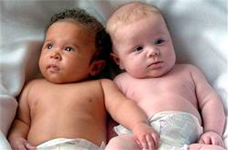
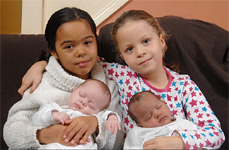
Modern genetics shows that when a large, freely interbreeding group is suddenly broken into many smaller groups which from then on breed only among themselves (as the Biblical description of the language dispersion at Babel would imply), different racial characteristics will arise very rapidly.  It can be shown that one pair of middle-brown parents could produce all known shades of color, from very white to very black, in one generation.  The racial characteristics which exist today have not evolved, and generally speaking, are simply different combinations of pre-existing (created) genetic (hereditary) information.  Remee and Kian Hodgson born April 2005, and Layton and Kaydon Richardson born July 2006 (pictured below) are fraternal “black and white” twins.  More incredible was the birth of two sets of mixed-race twins by Alison and Dean Durrant.  Their first twins were born in 2001, and their second twins arrived November 2008 (all pictured below).  Other fraternal twin births include Alicia and Jasmin Singerl born May 2006, and Ryan and Leo Gerth born July 2008 (not pictured), all providing proof of such genetic detail.  The environment plays a secondary role in favoring certain combinations over others.
 

Hodgson Twins
Richardson Twins
Durrant Twins (times two)
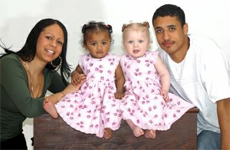
 

As family groups became isolated by language barriers, environmental factors allowed particular traits already present to be expressed more frequently.  Noah’s family suggests a “racially mixed” population with biological potential for variation.  The Biblical viewpoint is that there is not a black race, white race, yellow race, etc.  Instead, there are three distinct families or characteristics of man that make up the oldest Table of Nations in existence, which is a completely authentic statement of how the present world population originated and spread after the flood, as recorded in Genesis 10 of the Bible (a historical document itself).  Here we learn the true divisions of mankind, indicating how the present population of the world came to be.  The listing of Noah’s descendants is more theological than hereditary, so we must understand that Noah’s descendants existed because of his righteousness.

Genesis chapter 10 describes how the present world population was derived from Noah’s three sons:  Shem, Ham and Japheth, and their wives (three family groups).  Verse 32 states, “From these the nations spread out over the earth after the flood.”  Additional references are given in 1 Chronicles chapter 1.  Genesis 10 exactly names 16 grandsons of Noah, and then we are provided further details of the Babel dispersion (Genesis 11) where their descendants fanned out over the earth and established the various nations of the ancient world.  The number of descendants of Noah (grandsons, great-grandsons, etc.) mentioned are 26 from Shem, 30 from Ham, and 14 from Japheth, totaling 70 “sons” or “nations.”  These 70 nations are the descendants (generations, genealogies or family histories) of the sons of Noah, known from Hebrew antiquity (Talmudic tradition of seventy nations in the world), and other ancient sources. Most, if not all, tribes and nations can be traced to these men through their descendants.  Chapter 10 describes the differentiation of nations, and asserts that we were all descended from Noah.  It is important to understand that people and nations are referred to in a genealogical form (common in Hebrew and other Semitic languages).  We find genealogical references in Genesis 10 are firstly to persons or families (ethnological), and secondly to nations or tribes (ethnographical); thus, the chapter ends with an emphasis on nations or tribes, which helps us understand in following chapters where they settled or “spread out over the earth” (geographical).  We must acknowledge the early reality of inter-family marrying as individual family groups were established.  This would later define skin color and other unique features within various subgroups and their subsequent populations.  They began as hunter-gatherers and/or pastoral nomads (living off the land as they migrated).
Evidence shows that Noah’s sons kept together at first, then broke up into small groups and eventually arrived from the east in the southern Mesopotamian Plain (Gen. 11:2).  The descendants of Elam, the first born son of Shem, were the first people to enter Mesopotamia.  Susa, the capital city of the Elamites (Shemitic Elamites), gave rise to other early cities, such as Al-Ubaid (which later gave rise to Hamitic settlements—including the Sumerian civilization) and Jemdet Nasr.  Recent excavations have provided very strong evidence of direct cultural links between some of the earliest cities in Babylonia and the lowest layers uncovered at Susa.  These peoples established themselves first in the south and gradually spread toward the north, but without losing the cultural links.  There are no known modern descendants of the Elamites.  Other excavations have shown that one of the first Hamitic groups, the Sumerians, gave rise to considerable cultural advance and power in that region.  Other people groups known very early included the Japhethites, noted especially for their fairness of skin, in the hill country east of the Tigris. [Soon the great tower of Babel arose.]

Further evidence indicates that the rulers of the City of Babel attempted to avert dispersal of the people by proposing the building of a monument as a visible rallying point on the flat plain of Mesopotamia.  Scripture and historical texts note that the tower of Babel, the building of which Nimrod (a Sumerian) supervised, was to have two great significances.  The city of Babel would become the metropolis of the world and unite its inhabitants under the dictatorial rule of Nimrod.  The tower was to be a monument to man to stand as a symbol of Babel.  Given the present knowledge of Babel history, Genesis 11 has a solid historical foundation in early Mesopotamia.  Nimrod hoped to prevent the people from scattering abroad into colonies as God intended, thus bringing upon themselves a judgment which led to confusion of the languages and rapid scattering throughout the earth.  Babel means confusion.  Urbanization, as attested by archaeological records, did not occur until after the dispersal of languages.  The history of linguistic development and settlement patterns in Mesopotamia support this.  There are dozens of unclassified and isolate languages throughout the world, such as Basque, Ainu and Ticuna, which testify to the widespread language distribution at Babel.  The name Babel would be preserved as Babylon, a future world empire.  We can safely conclude that all people in the world are descended from the inhabitants of Babel, the first civilization after Noah’s flood.  From there the great empires of the past arose, including Egypt, Assyria, Babylon, Persia and Greece, and all have strong historical links to the sons of Noah.

We can find validation from research scientists who study human genetics.  They claim that lineages derived from known people groups did in fact appear to have migrated from the “Near East”, “Middle East” or “Mesopotamia” (also called the “Cradle of Civilization” or the “Cradle of Mankind”) sometime during prehistory.  This information is derived from DNA haplogroups.  Haplogroups are used in DNA tests for markers that give a broad or regional picture; haplotypes are one person’s results on various DNA tests.  Data comes from either Y-chromosome DNA (Y-DNA) passed down from a father, or mitochondrial DNA (mtDNA) passed down from a mother.  Both can be used to define genetic populations from one generation to the next intact.  Here we attest there was a first pair, Adam and Eve.  Scientists have traced the mitochondrial DNA in all living humans back to a single female, and similarly, genetic markers in all males in the world today can be traced back to a single male.  Y-chromosome Adam and mitochondrial Eve are connected to everyone now living by an unbroken father-to-son or mother-to-daughter line (including everyone else in their generations who’s ancestors are connected through one or more father-to-daughter or mother-to-son links).  Haplogroup classifications are based on identification of genetic markers which a population of individuals share, passed down from an ancient but common ancestor.  These genetic markers are evolving as new markers are found, sometimes resulting from occasional mutations to DNA.  Different populations carry distinct markers.  Examples of these markers can be seen in the charts below:
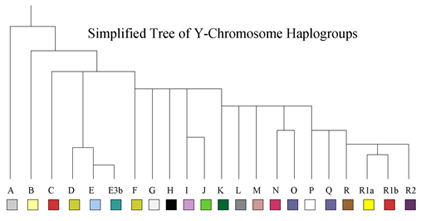
 

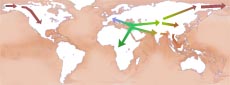
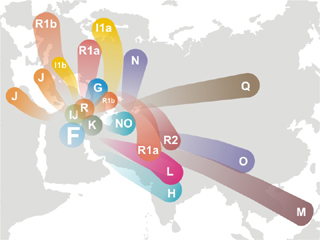
Notice in the images below (public domain) that the genetic lineages originate from “somewhere in the Middle East” or Mesopotamia as the Bible claims:

The migration map below represents migration patterns for Y-chromosome DNA (Y-DNA) passed down from a father.  The letters represent markers for individual mutations. The migration map below represents patterns for mitochondrial DNA (mtDNA) passed down from a mother.  The letters represent markers for individual mutations.
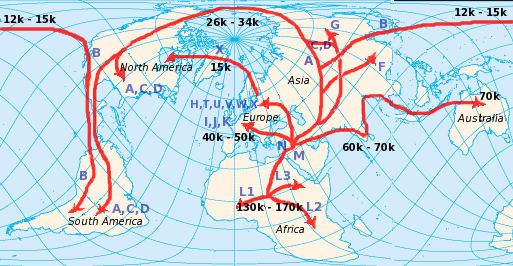
A majority of scholars and Bible historians agree that most of the descendants of Shem stayed in the Middle East, and that Shem’s descendants are well documented.  These include the Hebrews, Persians and Assyrians.  Modern day Arabs and Jews trace their lineage to Shem.  Many Arabic nomad tribes still claim they descended from Shem.  The descendants of Shem (Shemites) are often called Semites, a term first used in the late 18th century for peoples listed in the Bible as descended from Shem.  Today the term Semite refers to peoples who speak any of the Semitic languages, including the ancient peoples who inhabited Babylonia (Mesopotamia).  Modern peoples speaking Semitic languages include the Arabs and Jews.  Several centuries before the Christian Era, many ancient Semitic populations were migrating in large numbers from Arabia to Mesopotamia, the coasts of the Mediterranean Sea, and the Nile River delta.  Jews and other Semites settled in villages in Judea (southern Palestine).  Today, Semitic-speaking peoples are concentrated in the Middle East and northern Africa.

The descendants of Ham include the Egyptians, Ethiopians, Canaanites, Phoenicians and Hittites.  His descendants appear to be the first to fill the earth, as they were the early settlers of Africa, Asia, Australia, the South Pacific and the Americas.  The descendants of Japheth migrated into Europe and parts of Central Asia.  The Greeks, Romans, Spanish, Celts, Scythians and Medes were Japheth’s descendants.  Some people groups merged to form one nation, as did the Persians (Shem) and the Medes (Japheth), which later became the Medo-Persian empire.  We also find that many nations or peoples were named after an ancestor.  Romans, and their capital city, were named after Romulus.  Israelis and their country are named after their forefather, Israel.  The observable fact of attaching the name of a leader to his people and his empire appears often in Ancient Near Eastern history.  The Table of Nations in Genesis 10 illustrates this principle, whereby every land was named after its first successful settler:  Canaanites were named after Ham’s son, Canaan, and so on.

Note that the many names of family groups and nations listed here naturally follow well-established rules in the development of language, and the transfer of words between languages of a different family or nation.  Letters may be transposed, endings added, prefixes taken away or added, but the basic root persists to help trace the spread of the peoples of the earth.  For example, the ancient city of Unuk (in the Bible is the first city ever built, equated with Enoch), later appears as Uruk and Erech, then as Wark or Warka by the Sumerians, and finally appears in Greek as Purgos or Pergos.  The conversion of “wark” into “purg-” shows the transfer of words between languages of a different family (more on language groups at the end of this article).

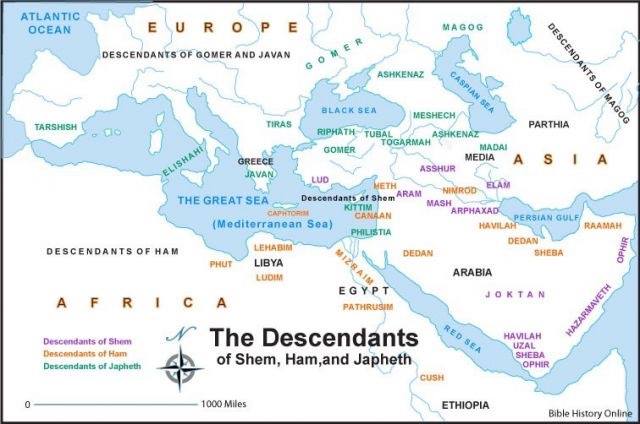
Interestingly enough, purg- becomes burgh in modern Indo-European languages, which is the root of the English word, borough.  Several examples of this are below, specifically in the lines of Japheth.  The three sons of Noah and their descendants listed below are not in any particular order.  From Babel the three families of man would populate the earth, and here we have the beginnings of all people groups through Shem, Ham and Japheth:

Shem.  Also Sem.  Literal meanings are named or renown (father of the Semitic people groups – Shemites).  The sons of Shem were:

(1) Elam “eternity”(sons were Shushan, Machul and Harmon) – (Elamites, Persians);

(2) Asshur “a step” or “strong” (sons were Mirus and Mokil) – (Assyrians/Northern Iraqis);

(3) Arphaxad “I shall fail” (sons were Shelach, Anar and Ashcol) – (Chaldeans/Southern Iraqis, Hebrews/Israelites/Jews1, Arabians/Bedouins, Moabites/Jordanians/Palestinians, and related groups);

(4) Lud “strife” (sons were Pethor and Bizayon) – (Ludim, Lubim, Ludians, Ludu, Lydians, Chubs, other related groups in Asia Minor and North Africa);

(5) Aram “exalted” (sons were Uz, Chul, Gather and Mash) – (Aramaeans/Syrians, Lebanese, other related groups), and remnant groups throughout Asia, the Middle East, and North Africa.

1Hebrews descended from Eber (Heber), a great-grandson of Shem.  Six generations after Heber, Abram (Abraham) was born, so Abraham was both a Hebrew and a Semite, born of the line of Heber and Shem.  Ishmael and Isaac were born of Abraham.  However, Ishmael was born of an unlawful union between Abraham and his Egyptian maid Hagar (Genesis 16, Galatians 4), making Ishmael half Semitic and half Hamitic.  Sunnite Arabs (specifically Arabian Muslims) consider themselves to be descendants of Ishmael, often calling themselves Ishmaelites, and thus are both Semitic Hebrews and Hamites.  To this day the descendents of Ishmael (Arabs) and his half-brother brother Isaac (Israelites) have fought over which family group is Abraham’s true spiritual heir, specifically relating to ownership of land in the Middle East.  Thus, there has been an unsolvable problem, and the nation of Israel is progressively being forced to give up land for peace.

Isaac was born to Abraham and his lawful wife Sarah (Gen. 17, 18 & 21).  Isaac had twin sons named Esau and Jacob.  Esau was firstborn, and so had the right to inheritance (as was custom), but instead sold his birthright to Jacob during a time of hunger.  Esau’s name was changed to Edom, and Jacob’s name was changed to Israel.  The descendants of Esau (Edom) became known as Edomites, and the descendants of Jacob (Israel) became known as Israelites.  Jacob fathered 12 sons which became the twelve tribes of Israel.  Those who interchange the words “Jew” and Israelite, call Abraham a Jew, though Abraham was neither an Israelite or a Jew.  The word “Jew” was not used in the Bible until nearly 1,000 years after Abraham.  One of Jacob’s (Israel’s) children was Judah (Hebrew “Yehudah”).  His descendants were called Yehudim (“Judahites”).  In Greek the name is Ioudaioi (“Judeans”).  Most all Bible translations use the word “Jew,” which is a modern, shortened form of the word “Judahite.”  A “Jew” in the Old Testament would be a “Judahite;” and a “Jew” in the New Testament would be a “Judean.”

A bitter rivalry between the descendants of Esau and Jacob continued throughout history, and as they lived in close proximity for hundreds of years, their hatred worsened.  The Romans referred to the Edomites as Idumeans, separate from Israelites, when they lived in the region of Palestine together.  The Romans later divided Palestine into districts, with Idumea (land of Edomites) being one of the districts.  As the Roman Empire faded, Idumea was divided again into Northern Idumea, and the region fell to an Ishmaelite (Arabian) Muslim army led by Caliph Umar in 638 A.D.  Historians suggest the remaining Edomites embraced Islam at that time and remained in the land, blending with the Arabs, and uniting against the Israelites.

Jerusalem soon became a focal point for the Muslims (Moslems), being the third most holy city of Islam, after the cities of Mecca and Medina (though Jerusalem is never mentioned in the Koran, it is mentioned over 800 times in the Bible).  By 691 A.D., the Mosque of Omar (also called the “Dome of the Rock”) was completed on the Temple Mount, where Muslims believe Mohammed ascended to heaven from.  The Arabic term for the holy place is “al-Haram as-Sharif” meaning “The Noble Sanctuary.”  To Israelites and Jews, Jerusalem was the city of the great prophets and the capital of the Kingdom of Israel and Judah under King David and his son King Solomon.  The first and second temples were the center of worship until the destruction of the city by the Romans in 70 A.D.  Christians revere the city as the place where Jesus Christ taught in the temple, and was later crucified.  Christians believe that Jesus will return to establish His Kingdom at the Temple Mount with Jerusalem as world capital.

Still confused?  Here’s a simple patriarchal chart, beginning with Noah, showing how these family groups came to be:

Noah
  |
Shem-->Eber-->Terah
                |
  --------------|----
  |        |        |
Abram    Nahor    Haran
  |                 |
  |----------|     Lot
Isaac    Ishmael    |-------------------
  |          |                |        |
  |------|   |--->Arabs<-----Moab    Ammon
Jacob  Esau                            |
  |      |------->Arabs<----------------
  |
Israelites & Jews

Ham.  Also Cham or Kham.  Literal meanings are passionate, hot, burnt or dark (father of the Australoid, Negroid and Mongoloid people groups – Hamites).  He was the progenitor of:

(1) Cush “black” (sons were Seba, Havilah, Sabtah, Raamah, Sabteca and Nimrod) – also Chus, Kush, Kosh, Kish, Cushaean (Cushites, Nubians, Ethiopians, Ghanaians, Africans, Bushmen, Pygmies, Australian Aborignies, New Guineans, other related groups);

(2) Mizraim “double straits” (sons were Lud, Anom, Pathros, Chasloth and Chaphtor) – also Masr, Misr, Misraim, Mitzraim, Mizraite, Mitsrayim (Egyptians1, Khemets, Copts, other related groups);

(3) Phut “a bow” (sons were Gebul, Hadan, Benah and Adan) – also Punt, Puta, Put, Puni, Phoud, Pul, Fula, Putaya, Putiya, Libia, Libya (Libyans, Cyrenacians, Tunisians, Berbers, Somalians, Sudanese, North Africans, other related groups);

(4) Canaan “down low” (sons were Sidon [Zidon]2, Heth, Amor, Gergash, Hiv, Ark, Sin, Arod, Zemar and Hamat) – also Canaanites, Cana, Chna, Chanani, Chanana, Canaana, Kana, Kenaanah, Kena’ani, Kena’an, Kn’nw, Kyn’nw, Kinnahu, Kinahhi, Kinahni, Kinahna, Kinahne (Mongols, Asians, Orientals, Chinese, Tibetans, Taiwanese, Thais, Vietnamese, Laotians, Cambodians, Japanese, Eskimos, American Indians3, Malayasians, Indonesians, Filipinos, Hawaiians, Maoris, Polynesians, Tahitians, Guamanians, Samoans, Fijians, Tongans, Tokelauans, Tuvaluans, Pacific Islanders4 and related groups5).

Tribes in other parts of Africa, Arabia and Asia, aboriginal groups in Australia, native Pacific Islanders, American Indians and Eskimos were birthed from descendants of Canaan, Cush, Mizraim and Phut.

Looking at history, whichever region is considered, Africa, Europe, Australia, or America, the major migrations have always been from Asia.  In every area of the world where Japhethites have subsequently settled, they have always been preceded by Hamites.  This pattern applies in every continent.  In early historic times the circumstance seems always to be true, the earliest fossil remains of man being Mongoloid or Negroid in character and in head shape, whereas those that came last belong to the family of Japheth (Caucasoid).  When we study ancient history and technological achievements, which were in many ways the equal of, or superior of, much that we have today, we find Hamitic people showed an amazing adaptability to the world in which they founded, and carried to a high technological proficiency their societies.  Their achievements were exploited by Japhetic and Semitic peoples, who became great scientific discoverers.  The Hamitic migrations indicate they sought a way of life, not an understanding or a control of nature beyond what was immediately useful.  A majority of Ham’s descendants were not negroid.  Genesis 10:15-20 records that of the 32 descendants of Ham, four settled in unknown places, 23 settled in the Middle East and five settled in Africa.  Archeologists tell us that no groups inhabiting the Middle East in Biblical times were negroid.  Many had brown, red and white racial characteristics.  Ham’s descendants appear to be the most varied of Noah’s lineage.

Ham’s fourth born son was Canaan.  Genesis 10:15-19 identifies a distinctive characteristic of the sons of Canaan:  They liked to spread out.  The Canaanites are specifically mentioned as migrating far and wide, “…and afterward the families of the Canaanites were spread abroad.  The territory of the Canaanites extended from Sidon as you go toward Gerar, as far as Gaza; as you go toward Sodom and Gomorrah and Admah and Zeboiim, as far as Lasha.”  History indicates they did have a propensity for sprawl.  The descendants of Canaan would later make up the vast populations of Asia, Africa and the Western Hemisphere.  Much smaller populations migrated to the Southern Hemisphere.  To this day, only about 10% of the world’s population lives in the Southern Hemisphere.

1Epypt is one of the most frequently mentioned names in the Bible.  Egypt is also synonymous with Mizraim.  For example, Misr (Mizraim) is the Arabic name for Epypt.  The name Egypt is thought to be derived from the name Hout ka-Ptah or Hi-ku-Ptah, both meaning the “Place of the Spirit of the god Ptah.”  The name was Hellenized by the Greeks, rendering Hi-ku-ptah as Ai-gu-ptos (Aiguptos), becoming the Latin Aegyptus, and later Egypt in modern English.  The term Copt is also believed to be etymologically derived from this name.  Hi-ku-Ptah was believed to be located in the capital city of Memphis.  In the Bible, Memphis is called Moph or Noph.

2Sidon (or Zidon) and his descendants settled on the Mediterranean coast of present-day Lebanon, then known as the land of Canaan.  The Sidonians called themselves Kena’ani, or Canaanites (adopted from the name of their father Canaan, and the land named after him).  Interestingly, these “new” Canaanites came to speak a Semitic language, probably adopted from a large migration of Semites who came from land and sea, and introduced their language and a sophisticated maritime technology about 1800 B.C.  Historians suggest these Canaanites succumbed to racial and linguistic intermixture with the invading Semites, which led to the loss of their own ethnic predominance, as evidenced by modern excavations.  They eventually moved westward and occupied a very narrow coastal strip of the east Mediterranean, building new cities, and establishing significant trade with neighboring nations.  In fact, the Israelite name for “Canaan” came to mean “traders,” though some suggest the name Canaan is from the Hebrew nameHurrian, meaning “land of red purple.”

These Sidonian Canaanites were known for their red and purple cloth (a purple dye was extracted from murex snails found near the shores of Palestine, a method now lost).  The Greeks called the land of Canaan “Phoenicia,” which meant “purple.”  Thus, Sidonians became known as Phoenicians, and became a nation of great trade, language, and culture.  Phoenician, Hebrew and Moabite were a group of west Semitic languages, all dialects from Canaan, as referred to in Isaiah 19:18.  The writing system of the Phoenicians is the source of the writing systems of nearly all of Europe, including Greek, Russian, Hebrew, Arabic and the Roman alphabet.  The Phoenician empire fell under Hellenistic rule after being conquered by Alexander the Great about 332 B.C.  In 64 B.C. the name of Phoenicia disappeared entirely, becoming a part of the Roman providence of Syria.  At the beginning of the Christian era, remaining Phoenicians were the first to accept the Christian faith after the Jews.  Sidon’s name is still perpetuated in the modern-day city of Sidon (Saidoon is the Phoenician name, Saida in Arabic) in southern Lebanon.

3Evidence for diverse migrations into the Americas comes from research on living American Indian populations, which includes data from Mitochondrial DNA (mtDNA) that is passed down from a mother to her children from one generation to the next intact.  These studies have consistently shown similarities (deep ancestry) between American Indians and recent populations in Asia, Siberia and northern Scandinavia.  These groups include the Lapps in northern Europe/Scandinavia, the Chukchi and Yukaghir in Siberia, plus Indians and Eskimos/Aleuts throughout Canada and North America.  There is a wealth of information on the genetic relationship between early Taiwanese populations and southeast Asian, Oceanic (South Pacific) and Native American descendants.  Ancient American Indian skeletal remains show a range of physical attributes (round-headed) suggesting separate migrations of different populations from Asia and the South Pacific, representing 97 percent of all modern American Indian populations.  What of the other 3 percent?

There are exceptions.  A 1998 DNA study conducted by the Center for Molecular Medicine, Emory University School of Medicine, Atlanta, GA discovered a mtDNA strain in roughly 3% of American Indians (Amerindians) called “Haplogroup X” which suggests a prehistoric migration of peoples to the Americas from the European theater.  This genetic inheritance likely reflects transatlantic links since Haplogroup X is not found in Asians, demonstrating the DNA did not originate from those Asians who arrived in the Americas via the Bering Strait.  Other researchers conclude that these transatlantic migrations took place before the Asian migrations into Canada and North America.  Some experts believe that Haplogroup X provides concrete evidence of European ancestry for certain Native Americans (noted below).  For example, the Algonquian Indians (Mahicans/Ojibwe) have as high as 40 percent of Haplogroup X, and their distant relatives, the Siouan family of tribes (Sioux), have as high as 15 percent of the DNA.  Experts suggest a large amount of gene flow occurred between Algonquian-speaking and Siouan-speaking groups, consistent with archaeological and linguistic evidence.  These tribes, initially arriving along the eastern shores of North America, migrated deep inland, also north into Canada.  They are the popular red-skinned tribes having a long-head shape similar to that of early Italic peoples in Europe.  They are thought to be descendants of Canaanites (Phoenicians) who intermarried with Indo-Europeans while migrating across Europe, and subsequently sailing to North America.

Having been the largest group of Native Americans in the United States, their DNA stretched across America, though very sparse further west.  According to tradition, they populated the Carolinas then migrated to the regions of Louisiana, Mississippi, Missouri, and eventually Minnesota and the Dakotas.  Many of these tribes had fortified villages similar to ancient Canaanites (who lived along the coast of the Mediterranean Sea, including parts of Egypt and the Jordan Valley).  Archaeological evidence shows they constructed towns and cities with small pyramids and vast road systems throughout the Mississippi Valley.  With them came a tradition that is thought to be a reference to the wives of Noah and his three sons.  Four women are identified as “mothers of origin” whose names (possibly Canaanite) have been preserved down through the generations (see name chart below).  Additionally, there are striking similarities between the languages of ancient Egypt and those of the Native Americans that inhabited the areas around Louisiana about the time of Christ.  Epigraphy experts have stated that the languages of the Attakapa, Tunica and Chitimacha tribes have affinities with Nile Valley (Egyptian) languages involving certain words associated with Egyptian trading communities of 2,000 years ago.  Scholars note the Algonquian and Siouan peoples used pictographs and ideographic writing symbols that also have similarities with ancient Canaanites.

Many groups migrated southwest into Oklahoma, Texas, New Mexico and eventually Mexico, establishing the powerful Aztec tribes with their beautiful fortified cities, integrating with the Mayas (who had been there hundreds of years before, and thought of the Aztecs as barbarians).  Likely there was a mixing of cultures as they migrated, as there was no conquest of the Maya world by the Aztecs; that title would be given to the Spaniards in the late 17th century.  The Aztec’s traditions and legends are largely ignored by modern scholars as myths and fables.  The Aztecs, according to their own legends, departed from a region in the north called Chicomoztoc, a region that is today the areas of Texas, Oklahoma and New Mexico.  Later establishing a city known as Aztlan, somewhere in north or northwest Mexico (now lost), their tribal name Aztec was born.  Being nomadic, they eventually reached the valley of Mexico in the 12th century A.D.  They were known as fearless warriors and pragmatic builders who raised an enormous city called Tenochtitlan, their capital city (now Mexico City).

The Aztecs would later call themselves “Mexica” (where Mexico is derived), and their language, Nahuatl, was linguistically related to other native language groups throughout the U.S. southwest and northern Mexico.  Linguists note, for instance, the Shoshoni language in the Utah-Nevada region was understood by all the tribes from Mexico, without difficulty.  Other related tribes included the Paiute, Hopi, Pima, Yaqui/Apache, Tepehuan, Kiowas and Mayos.  Catholic missionaries in the 1850’s established the fact that all of those peoples were of one language family.  While there are other examples of language similarities, studies of the native languages of the Americas have shown them to be extremely diverse, representing nearly two hundred distinct families, some consisting of a single isolated language.

4Pacific Islanders have a diverse and unique history.  These oceanic peoples of the South Pacific, whom we know as Polynesians, Maoris, Tahitians, Samoans, Fijians, Tongans and others, have their roots in southern China.  Prior to the Mongoloid peoples establishing themselves in southern China, there were migrations of negroid peoples from east Africa and the Sahara.  A number of African cultures kept documents and ancient texts, as well as strong oral history and legends, of migrations to ancient China from Africa.  Mongoloid groups later migrated into southern China, resulting in a mixing of cultures.  Southern China is thought to have first come into being out of the mixture of Mongoloid and Negroid peoples.  These peoples were likely driven out by other aggressive Mongoloids.  Being master seafarers, they sailed into Polynesia and the surrounding region, populating the islands of the South Pacific.

5The vast aggregate of peoples who are generally classified as Mongoloid, who settled the Far East, have been a question as to where they fall into the Table of Nations.  Evidence shows they are Hamitic, even though some have incorrectly reasoned that the Chinese were of Japhetic stock, and the Japanese were either Japhetic or Semitic.  There are two names which provide clues.  Two of Canaan’s sons, Heth (Hittites) and Sin (Sinites), are the likely progenitors of Chinese and Mongoloid stock.  The Hittites are described in the Bible as a people ruled by kings living north of Assyria.  Historians note they populated western Asia and the Far East, but conquered regions into Asia Minor and as far south as Palestine.  The Hittite Empire was short-lived in history, but left a mark on the ancient world.

Assyrians called them Khatta or Khate, and they were known as the Kheta or Khata to the Egyptians.  These names were variations of Hatti or Chatti, described on monuments of Assyria and Egypt.  Archaeologists have noted many similarities between the Hittites and the Mongoloids.  Egyptian monuments depicted the Hittites with prominent noses, full lips, high cheekbones, hairless faces, varying skin color from brown to yellowish and reddish, straight black hair in a pigtail or ponytail, and dark brown eyes.  The Hittites depicted themselves in their bas-reliefs and hieroglyphs with short and thick limbs, pushed forward faces and large nostrils, confirming their identity when compared with Egyptian representations.  Craniologists observe that these were characteristics of Mongoloid peoples.

The term Hittite in Cuneiform (the earliest form of writing invented by the Sumerians) appears as Khittae* representing a once powerful nation from the Asia and the Far East known as theKhitai, also in Hebrew as Khitti, Kheth and Khettai.  Khitai and Khettai have been preserved through the centuries in the more familiar term, Cathay.  They battled the Egyptian armies of Ramses II in the 13 century B.C., then disappeared forever from history.  Their remnant, the Cathay, are considered the Mongoloid people who are part of early Chinese stock.  This evidence comes from links between the Cathay and Hittites, for example, their modes of dress, their shoes with turned-up toes, their manner of doing their hair in a pigtail, and so forth.

*Khittae has, at times, been incorrectly associated with Kittim or Chittim (Greek Kition, Roman Citium, Jewish Cethimus), son of Javan, son of Japheth.  Kittim is also the Biblical name for modern-day Cyprus.  Javan is the Hebrew word for Greece, appearing five times in the Old Testament.  Interestingly enough, Javan has been incorrectly interpreted to mean Japan.  History distinctly shows Javan to be the ancestor of the Greeks and other related Mediterranean people groups.

Sin (or Seni), a brother of Heth, has many occurrences in variant forms in the Far East.  There is one significant feature concerning the likely mode of origin of Chinese civilization.  The place most closely associated by the Chinese themselves with the origin of their civilization is the capital of Shensi, namely, Siang-fu (Father Sin).  Siang-fu appears in Assyrian records as Sianu.  Today, Siang-fu can be loosely translated, “Peace to the Western Capital of China.”  The Chinese have a tradition that their first king, Fu-hi or Fohi (Chinese Noah), made his appearance on the Mountains of Chin, was surrounded by a rainbow after the world had been covered with water, and sacrificed animals to God (corresponding to the Genesis record).  Sin himself was the third generation from Noah, a circumstance which would provide the right time interval for the formation of early Chinese culture.  In addition, the Miao tribe of southwest China had a tradition similar to the Genesis account, even before they met Christian missionaries.  According to their tradition, God destroyed the whole world by a flood because of the wickedness of man, and Nuah (Noah) the righteous man and his wife, their three sons, Lo Han (Ham), Lo Shen (Shem), and Jah-hu (Japheth) survived by building a very broad ship and taking on it pairs of animals.

There is strong evidence that suggests early Chinese knew of the God of the Bible.  There are accounts described in the “Shu Jing” (Book of History), compiled by Confucius, where it is recorded that Emperor Shun (ruled from about 2256 B.C. to 2205 B.C. when the first recorded dynasty began) that he worshiped and sacrificed a bull to “ShangDi.”  ShangDi literally means “Heavenly Ruler.”  Linguists point out that ShangDi, Creator-God of the Chinese, is the phonetic equivalent to El Shaddai, Creator-God of the Hebrews.  About 700 B.C., the early Zhou pronunciation of ShangDi was “djanh-tigh” (Zhan-dai).  The bull was sacrificed at an annual ceremony called a “Border Sacrifice,” a rite that did not end until 1911 when the last emperor was deposed.  Additionally, recitations from the ancient rite parallel several Bible passages, including the creation account in Genesis.  Scholars who have analyzed the most ancient forms of these pictographic Chinese writings (graphic symbols called ideograms), which date from before the time of Moses, have the entire story of creation, the temptation, the fall of man into sin, and God’s remedy for sin in the animal sacrifices, which pointed to the coming Savior, Jesus Christ.  All the elements of the Genesis narrative are found recorded, and still in use, in Chinese character-writing.  This confirms the idea that the ancient Chinese incorporated their early knowledge of Genesis into their written language.

History has much to say about the descendants of Sin who came from the Far East to trade.  They were called Sinæ (Sin) by the Scythians.  Ptolemy, a Greek astronomer, referred to China as the land of Sinim or Sinæ.  Reference to the Sinim in Isaiah 49:12 notes they came “from afar,” specifically not from the north and not from the west.  Arabs called China Sin, Chin, Mahachin, Machin.  The Sinæ were spoken of as a people in the remotest parts of Asia.  For the Sinæ, the most important town was Thinæ, a great trading emporium in western China.  The city Thinæ is now known as Thsin or simply Tin, and it lies in the province of Shensi.  Much of China was ruled by the Sino-KhitanEmpire (960-1126 A.D.), which Beijing became the southern capital.  The Sinæ became independent in western China, their princes reigning there for some 650 years before they finally gained dominion over the whole land.

In the third century B.C., the dynasty of Tsin became supreme.  The word Tsin itself came to have the meaning of purebred.  This word was assumed as a title by the Manchu Emperors and is believed to have been changed into the form Tchina.  From there the term was brought into Europe as China, probably from the Ch’in or Qin dynasty (255-206 B.C.).  The Greek word for China is Kina (Latin is Sina).  As well, Chinese and surrounding languages are part of the Sino-Tibetan language family.  Years ago, American newspapers regularly carried headlines with reference to the conflict between the Chinese and Japanese in which the ancient name reappeared in its original form, the Sino-Japanese war.  Sinology refers to the study of Chinese history.

With respect to the Cathay people of historical reference, evidence suggests that a remnant of the Hittites fled eastward after the destruction of their empire and apparent disappearance from history.  As they traveled towards the east, their clans settled among the Sinites who were relatives, contributing to their civilization, and thus becoming the ancestors of Asian people groups.  They are found together in major historical events that formed the Chinese nation and its people.  Still others migrated throughout the region and beyond, making up present-day Mongoloid races in Asia and the Americas.  The evidence strongly suggests that Ham’s grandsons, Heth (Hittites/Cathay) and Sin (Sinites/China), are the ancestors of Mongoloid peoples.

There are many native African tribes which trace themselves back traditionally to Ham.  The Yoruba, who are black skinned, for example, claim to be descendants of Cush, and the Beja people have specific genealogical traditions of descent from Cush.  Ethiopians still trace their ancestry back to Cush.  To this day Cush has many tribal and ethnic designations in Africa and Arabia.  Jewish historian Josephus in his Antiquities of the Jews gives an account of the nation of Cush as the son of Ham and grandson of Noah:  “For of the four sons of Ham, time has not at all hurt the name of Cush; for the Ethiopians, over whom he reigned, are even at this day, both by themselves and by all men in Asia, called Cushites.”  Libyans, who are much lighter skinned, are traced back to Phut (Phut is the Hebrew name for Libya).  Egyptians are direct descendants of Mizraim (Mizraim is the Hebrew name for Egypt).  Today, “Misr” is the name Egyptians use to refer to their country.  Ancient Egyptians have been considered the greatest technicians in all human history.

Other African groups trace their roots back to Ham or one of his descendants.  It is therefore suggested that all of Africa, despite the different shades of color of its native populations, was initially settled by various members of this one Hamitic family.  In the course of time, some of these people groups had migrations to Australia, Melanesia, New Guinea and the surrounding region.  For example, there is evidence of similarities in the form of horticulture found in the Sahara and in Papua New Guinea.  Recent studies from archaeology have discovered there was once extensive trade between east Africa and New Guinea.  The evidence appears to point consistently in the same direction, supporting that not only Africa with its black races, but the Far East, the Americas, Australia and the Oceanic nations with their colored races were all descendants of Ham.  The Hamitic people were the first to reach the far and distant lands of the world, preparing the way for the future.  Their inventions and discoveries made a significant impact on the world, and provided inspiration for those to follow.
Japheth.  Also Diphath.  Literal meanings are opened, enlarged, fair or light (father of the Caucasoid/Indo-Europoid, Indo-European, Indo-Germanic, or Indo-Aryan people groups -Japhethites).  Japheth is the progenitor of seven sons:

(1) Gomer “complete” (sons were Ashkenaz, Riphath and Togarmah) – also Gamir, Gommer, Gomeri, Gomeria, Gomery, Goth, Guth, Gutar, Götar, Gadelas, Galic, Gallic, Galicia, Galica, Galatia, Gaulacia, Gael, Galatae, Galatoi, Gaul, Galls, Goar, Georgian, Celt, Celtae, Celticae, Kelt, Keltoi, Gimmer, Gimmerai, Gimirra, Gimirrai, Gimirraya, Kimmer, Kimmeroi, Kimirraa, Kumri, Umbri, Cimmer, Cimmeria, Cimbri, Cimbris, Crimea, Chomari, Cymric, Cymry, Cymru, Cymbry, Cumber (Cimmerians, Caledonians, Armenians, Phrygians, Turks, Picts, Milesians, Umbrians, Helvetians, Celts1, Galatians, Ostrogoths, Visigoths, Goths, Vandals, Scandinavians, Jutes, Teutons, Franks, Burgundians, Alemanni, Germans2, Belgians, Dutch, Luxembourgers, Liechensteiners, Austrians, Swiss, Angles, Saxons, Britons, English, Cornish, Irish, Welsh, Scots, French, and other related groups);

(2) Magog “land of Gog” (sons were Elichanaf, Lubal, Baath, Jobhath and Fathochta) – also Gog3, Cog, Gogh, Gogue, Gogarene, Jagog, Yajuj, Majuj, Juz, Majuz, Agag, Magug, Magogae, Magogue, Ma-Gogue, Mugogh, Mat Gugi, Gugu, Gyges, Bedwig, Moghef, Magogian, Massagetae, Getae, Dacae, Sacae, Saka, Scyth, Skythe, Scythi, Scythii, Scythini, Scythia, Scythae, Sythia, Scythes, Skuthai, Skythai, Cathaia, Scythia, Skythia, Scynthia, Scynthius, Sythian, Skudra Sclaveni, Samartian, Sogdian, Slovon, Skodiai, Scotti, Skolot, Skoloti, Scoloti, Skolo-t, Skoth-ai, Skoth, Skyth, Skuthes, Skuth-a, Slavs, Ishkuzai, Askuza, Askuasa, Alani, Alans, Alanic, Ulan, Uhlan (Scythians, Scots); also Rasapu, Rashu, Rukhs, Rukhs-As, Rhos, Ros, Rosh, Rox, Roxolani, Rhoxolani, Ruskolan, Rosichi, Rhossi, Rusichi, Rus, Ruska, Rossiya, Rusian (Russians4, Belarusians, Ukrainians, Chechens, Dagestanis); also Mas-ar, Mas-gar, Masgar, Mazar, Madj, Madjar, Makr-on, Makar, Makaroi, Merkar, Magor, Magar, Magyar (Hungarians – also Huns, Hungar, Hunugur, Hurri, Gurri, Onogur, Ugor, Ungar, Uhor, Venger); Yugoslavians, Finns, Lapps, Estonians, Siberians, Voguls, Poles, Czechs, Croatians, Bosnians, Montenegrins, Mordvins, Serbians, Slovenians, Slovakians, Karelians, Komi-Zyrians, Udmurts, Izhorians, Livonians, Bulgarians, Avars, Tartars, Turks, Colchi, Armenians, Georgians and other related groups).

(3) Madai “middle land” (sons were Achon, Zeelo, Chazoni and Lotalso) – also Mada, Amada, Madae, Madea, Manda, Maday, Media, Madaean, Mata, Matiene, Mitani, Mitanni, Minni, Megala(Medes5, Aryans, Persians, Parsa, Parsees, Achaemenians, Manneans, Caspians, Kassites, Iranians, Achaemenians, Kurds, East Indians, Romani, Pathans, Hazaras), including the peoples of Afghanistan, Pakistan, Azerbaijan, Khazachstan, Turkmenistan, Uzbekistan, Tajikstan and Kyrgyzstan, and other related groups;

(4) Javan “miry” (sons were Elishah, Tarshish, Kittim and Dodanim) – also Jevanim, Iewanim, Iawan, Iawon, Iamanu, Iones, Ionians, Ellas, Ellines, El-li-ness, Hellas, Hellenes, Yavan, Yavanas, Yawan, Yuban, Yauna, Uinivu, Xuthus (Grecians, Greeks, Elysians, Spartans, Dorians, Tartessians, Britons6, Aeolians, Achaeans, Myceneans, Macedonians, Albanians, Carthaginians, Cyprians, Cypriots, Cretans, Latins, Venetians, Sicanians, Italics, Romans7, Valentians, Sicilians, Cilicians, Italians, Spaniards, Portugese, other related groups);

(5) Tubal “brought” (sons were Ariphi, Kesed and Taari) – also Tabal, Tabali, Tubalu, Thobal, Thobel (Thobelites, Iberoi, Ibers, Iberians, Ivernians, Irish8, Spanish, other related groups),Tbilisi, Tibarenoi, Tibareni, Tibar, Tibor, Sabir, Sapir, Sabarda, Subar, Subartu, Tobol, Tobolsk (Cossacks, Samoyeds, Siberians, other related groups);

(6) Meshech “drawing out” (sons were Dedon, Zaron and Shebashnialso) – Me’shech, Mes’ek, Meshekh, Meshwesh, Meskhi, Meschera, Mushch, Muschki, Mushki, Mishi, Muski, Mushku, Musku, Muskeva, Muska, Muskaa, Muskai, Maskali, Machar, Maskouci, Mazakha, Mazaca, Mtskhetos, Modar-es, Moskhi, Moshkhi, Mosah, Mosher, Moshch, Moschis, Mosoch, Moschi, Moschian, Moshakian, Mo’skhoi, Moschoi, Mosochenu, Mosochean, Mossynes, Mosynoeci, Moskva, Moscovy, Moscow (Muscovites, Latvians, Lithuanians, Romanians, other related groups);

(7) Tiras “desire” (sons were Benib, Gera, Lupirion and Gilak) – also Tiracian, Thracian, Thirasian, Thiras, Thuras, Tyritae, Thrasus, Thrace, Trausi, Tereus, Trecae, Troas, Tros, Troia, Troiae, Troyes, Troi, Troy, Troya, Trajan, Trojan, Taunrus, Tyras, Tyrsen, Tyrrhena, Illyrian, Ilion, Ilium, Rasenna, Tursha, Tusci, Tuscany, Etruria, Etruschi, Etruscan, Eturscan, Euskadi, Euskara (Basque9), Erul, Herul, Heruli, Erilar, Vanir, Danir, Daner, Aesar, Aesir, Asir, Svear, Svea, Svie, Svioner, Svenonian, Urmane, Norge (Leleges, Carians, Pelasgians, Scandinavians10, Varangians, Vikings, Swedes, Norwegians, Danes, Icelandics, Baltics, other related groups).

The Japhetic people are, in general, the peoples of India and Europe (Indo-European stock), with which any demographer is familiar11.

1The whole Celtic race has been regarded as descended from Gomer, though history suggests modern Celts are descended from both Gomer and Magog.  Archaeologists and ethnologists agree that the first Indo-European group to spread across Europe were Celts.  The Irish Celts claim to be to the descendants of Magog, while the Welsh Celts claim to be to the descendants of Gomer.  Irish chronicles, genealogies, plus an extensive number of manuscripts which have survived from ancient times, reveal their roots.  The Irish were descendants of Scythians, also known as Magogians, which is strongly supported by etymological evidence.  Archaeological evidence shows that both the Celts (from Gomer) and Scythians (from Magog) freely shared and mingled cultures at their earliest stages.  Russian and eastern European excavations plainly reveal the blending of these two groups.  Their geographical locations (what is now eastern Europe, southern Russia and Asia Minor) were referred to by the Greeks under the name of Celto-Scythae, which was populated by the Celts to the south and west, and the Scythians to the north.  The ancient Greeks first called the northern peoples by the general name of Scythae; but when they became acquainted with the nations in the west, they began to call them by the different names of Celts, including the Celto-Scythae.  Celts and Scythians were considered essentially the same peoples, based on geography, though many independent tribes of Celts and Scythians existed.  The Latins called them “Galli,” and the Romans referred to them as “Gauls,” and considered them fiercely independent barbarians.  Later names used by Greeks were the Galatai or Galatae, Getae, Celtae and Keltoi.  In the third century before Christ (about 280 B.C.), the Gauls invaded Rome and were ultimately repelled into Greece, where they migrated into the north-central part of Asia Minor (Anatolia).  They conquered the indigenous peoples of that region and established their own independent kingdom.  The land became known as Galatia (Gaulatia).  The Apostle Paul wrote his famous epistle to their descendants, the Galatians.  Jewish historian Flavius Josephus wrote that the Galatians of his day (93 A.D.) were previously called Gomerites.Early Celtic tribes (from Gomer) settled much of the European theater, including present-day Spain, France, England and Germany, prior to contact with Scythians.  For many centuries France was called Gaul, after the Celtic descendants of Gomer, whom ceded the territory to Romans and Germanic/Teutonic Franks (whence France) in the 4th century A.D.  Northwest Spain is called Galicia to this day.  Some of the Gomerites migrated further to what is now called Wales.  The Welsh claim their ancestors “first landed on the Isle of Britain from France, about three hundred years after the flood.”  The Celtic language survives intact today mainly in the two variants of Welsh and Irish/Scottish Gaelic.  The Welsh call their language Gomeraeg (after Gomer).  The Celts of today are descendants of Gomer, and of the blended tribes of Magog and Gomer.

2Present-day Germanic people groups are descendants of both Japheth and Shem, and there are several references from recent and ancient history.  Recent history records the descendants of Gomer migrated and settled in the region that is now northern Europe (Germany and Scandinavia).  These tribes became the Goths, Ostrogoths, Visigoths, Teutons and Burgundians, descendants of some of the first peoples to migrate to northern Europe from ancient times—the Askaeni.  The Askaeni were descendants of Ashkenaz, son of Gomer, son of Japheth.  When the Askaeni arrived in northern Europe, they named the land Ascania after themselves, which later translated Scandia, then Scandinavia.  Later in history, we find the Askaeni being referred to as Sakasenoi, which became Sachsen, and finally Saxon.  The Saxons played an large part in European and English history.  Ashkenaz has been one of the most well preserved names throughout European history.

Semitic peoples also migrated to central Europe (southern Germany, Austria and Switzerland).  These people were the descendants of Asshur, son of Shem, where early Germans originated.  Asshur is well known in history as the father of the Assyrians.  In the Aramaic language, “Aturaye” means Assyrian, and the land of the Assyrians is called “Atur,” which became “Tyr” or “Teiw” by early Germanic peoples.  Later, the name linguistically changes to “Ziu.”  Germans likely derived their identity and language from these ancestral names.  The earliest known name of the German language was called “Diutisc,” which later becomes Dietsch, Deutsch or Deutsche (what Germans call themselves today).  Deutschland (land of the Deutsch) could be called “Asshurland.”  The Romans referred to the Deutschen as Teutons or Teutones.  The Teutons were a tribe of Germans nearly wiped out by Romans in the second century B.C.

The term “German” comes from Latin (Roman) sources.  The Assyrians occupied a Mesopotamian city on the lower Tigris River called “Kir” and placed captive slaves there (also referenced in 2 Kings 16:9, Isaiah 22:5-6, Amos 1:5, 9:7).  The city was populated by the Assyrians for many years, and the inhabitants became known as “Kir-man.”  The Assyrians (Kerman) were driven from their land shortly after their fall about 610 B.C.  They migrated into central Europe where they were called “German” or “Germanni,” a general name used by the Romans to represent all Assyrian tribes.  The known Assyrian tribes were the Khatti (also, Chatti, Hatti and Hessian)—Chatti is still the Hebrew term for German, and Khatti was also used by the Romans to represent various Germanic tribes; the Akkadians (Latins called them Quadians); the Kassites (or Cossaei); and the Almani (or Halmani, Allemani was the Latin name).  Almani or Almain were historical terms for Germans living in southern Germany.  Without question, these Assyrian Germans assimilated with the previously established tribes of Askaeni (descendants of Gomer) and adopted their Indo-European language, becoming one people.

3One of the earliest references to Gog is thought to come from Assyrian inscriptions in the 9th century B.C. referencing “Mat Gugi,” meaning “country of the Gugu.”  Hesiod, considered the father of Greek didactic poetry and literature, identified Magog with the Scythians and southern Russia in the 7th century B.C., written prior the book of Ezekiel.  Hesiod likely derived this from the Colchi people (a Thracian tribe) where, in their ancient Chaldaic language, described the region of southern Russia as “Gog-chasan” or “Gog-hasan” (Arabic “Gog-i-hisn”) meaning “fortress of Gog” or “Gog’s fort.”  There are scholars who also suggest that Gog and Magog, as a region, is where the name “Caucasus” originated.  Certain scholars speculate the name “Caucasus” was derived from “Gog-chasan” which the Greeks translated as Gogasus or Caucasus.  The Caucasus is generally considered the land between the Black and Caspian seas.

Greek historian Herodotus, whom historians call “the father of history,” mentions in the 5th century B.C. a people living around the Caucasus mountains called “Gargarians.”  Greek myth depicted the Gargarians as “Gorgons,” which eventually became Gorgene or Gorgaene.  He also wrote extensively about the descendants of Magog by their Greek name, the Scythians, about 150 years after Ezekiel.  He wrote of “Royal Scythians” who ruled over all other Scythians of Scythia.  Herodotus describes them as living in the territory north of the Black Sea, and that they terrorized the southern steppes of Russia beginning in the 10th century B.C.  Numerous archaeological discoveries have confirmed Herodotus’ reports in general, and his Scythian accounts in particular.  Flavius Josephus, Jewish and Roman historian, continued with that reference in the 1st century A.D. when he records that Magogians were called “Scythians” by the Greeks.  Philo, Greek and Jewish philosopher in the 1st century A.D., also identified Magog with southern Russia.

The Gargarians show up again in Greek history.  Strabo, early 1st century Greek historian, geographer and philosopher, famous for his 17-volume work Geographica which presented a descriptive history of people and places from different regions of the world known to his era, mentions “Gogarene” as a region in Iberia (present-day Armenia and Georgia).  Scholars agree Gogarene is one of the best preserved names from Gog, which belonged to the Caucasian Iberian kingdom (present-day Armenia and Georgia) up to the 2nd century B.C. Aelius Herodianus, Greek and Roman scholar of antiquity, called the region “Goerene” in the 2nd century A.D.  In the 5th century A.D., a viceroy in the region of old Armenia called himself Achoucha Gougarqtzi (Arshusha of Gogarene).  In the 6th century A.D., geographer Stephanus of Byzantium referred to the region as Gogarene, and in the 7th century the region was known as Gougarq.  Today it still exists as Gugark, a historical region in Armenia.  As noted earlier, commentators suggest Georgia also derived its name from Gogarene, and today the Turkish name for Georgia is Gurgistan.  In recent history, certain Georgians referred to themselves as “Gogi.”  Interestingly, a peculiar Skythian people, who appear at the end of the 4th century A.D., called the Geougen (also Jou-jan, Jeu-jen, Juan-juan or Jwen-jwen), emerging as a powerful empire in the region of Tartary (Mongolia).  Scholars suggest they were a mixture of eastern Huns (Skythian) and Tungus (Manchu) peoples, who for a short time became a Central Asian group of historical importance.  The empire of the Geougen lasted from the end of the 4th century A.D. to the middle of the 6th century.

Magog’s name is also preserved.  Albius Tibullus, Latin poet in the 1st century B.C., mentions a people living on the River Tanais (present-day River Don) called “Magini” or “Magotis”, whom scholars say were from the colonies of Magog.  The Greeks called the area where the Magini lived along the Tanais, the “Maeotian marshes” where the river emptied into the Maeotian Lake (present day Sea of Azov).  The marshes served as a checkpoint to the westward migration of nomad peoples from the steppe of Central Asia.  The area was named after the Maitois or Maeotae people (as the Greeks and Latins called them) who lived around the Maeotian Lake or Sea.  Jerome (who translated the Latin Vulgate), an Illyrian Christian apologist of the late 4th and early 5th centuries, affirms “the Jews of this age understood by Magog the vast and innumerable nations of Scythia, about Mount Caucasus, and the Palus Maeotis (Latin for Maeotis Sea), and stretching along the Caspian Sea to India.”  Scholars suggest that at the early stages Magogites assimilated with Skythians, thus making up a part of the early Scythian hordes.  In fact, wherever or whenever we see references to Gog and Magog in name or place, we also see the Skythians. Many of the mountains peaks in the Caucasian mountains and land areas there retained the place name “Gog” in medieval European and Armenian maps.  Scholars also regard Gog and Magog as the wild tribes of Central Asia, including the Scythians, Alans, Parthians, Turks, Tartars, Mongols, and Huns, who had been making incursions on various kingdoms and empires from very ancient times.  Russian traveller Jacob Reineggs, who visited the Caucasus five times in the 18th century, left many records of people groups he enountered.  He discovered in the central Caucasus a people called Thiulet, who lived amidst mountains called Ghef or Gogh.  The very highest of these mountains, lying to the north of their country, they knew by the name of Moghef or Mugogh.  These place names are Gog and Magog derivatives.

Some have mistakenly confused the term Mongol with Magog.  While the terms sound similar, Mongol was derived from a different source.  For hundreds of years the descendants of Magog arrived from the west and north from Siberia, settling in parts of northern China.  By by the 8th century A.D., we find the Chinese referring to these invading peoples as “Huangdou Shiwei” meaning “yellow (blonde) heads.”  These Shiwei tribes were also called “Mengwu” or “Maoshou” which meant “hairy head or hairy face (bearded)” people.  The Mengwu/Maoshou tribes were the first to be called “Mongols”, though they were not Mongoloid peoples of China.  The term would later apply to Mongolic peoples who migrated to the region and named it Mongolia.

4The Scythians are descended from Ashkenaz, son of Gomer, son of Japheth, and first appear in Assyrian records as “Askuza” or “Ishkuzai.”  The Assyrians tell of the Askuza as being involved in a revolt and pouring in from the north some time around the beginning of the 7th century B.C., which is also mentioned in the Old Testament (Jeremiah 51:27).  The Askuza later became the Skythai (Scythians) of Herodotus.  According to scholars, ancient peoples known as the Sarmatians (not to be confused with the Samaritans) and Alans lived in the area around the Caspian Sea from about 900 B.C.  Sarmatian and Alani tribes were later called Scythians (Slavic peoples of today), who were also known as the Rukhs-As, Rashu, Rasapu, Rhossi, Rosh, Ros, and Rus.  There is no debate that they were the inhabitants of southern Russia, and the existence of the names of rivers, such as the “Ros,” refer to Rus populations.  Much later, about 739 A.D., the word Rus appears again in eastern Europe, interestingly, from a different source.  Finnish peoples referred to Swedes as “Ruotsi,” “Rotsi” or “Rus” in contrast with Slavic peoples, which was derived from the name of the Swedish maritime district in Uppland, “Roslagen,” and its inhabitants, called “Rodskarlar.”  Rodskarlar or Rothskarlar meant “rowers” or “seamen.”  Those Swedish conquerors (called Varangians [Vikings] by the Slavs), settled in eastern Europe, adopted the names of local tribes, integrated with the Slavs, and eventually the word “Rusi,” “Rhos” or “Rus” came to refer to the inhabitants.  Russia means “land of the Rus.”  Scholars continue to debate the origin of the word Rus, which has derived from two sources:  the Ruotsi or Rhos, the Finnish names for the Swedes, and earlier from the Scythians known as Rashu or Rosh in southern Russia.

5The Aryans first come into historical view about a thousand years before Christ, invading India and threatening Babylonia.  Historians of old reference an Aryan chief called Cyaxeres, king of the Medes and Persians.  The Medes and Persians seem to have been tribes of one nation, more or less united under the rule of Cyaxeres.  Elam (son of Shem) is the ancient name for Persia.  Elamites are synonymous with Persians.  The Persians are thus descended from both Elam, the son of Shem, and from Madai, the son of Japheth.  The Medes and Persians had settled in what is now modern Persia, the Medes in the north, the Persians in the south.  The most notable Persians of today are the Iranians.  Interestingly, the word Iran is a derivative of Aryan.  The Medo-Persian people groups are divided into hundreds of clans, some sedentary and others nomadic.  All speak Indo-European languages, and some groups have pronounced Mongoloid physical characteristics and cultural traits, derived from Mongolian invasions and subsequent cultural integration.  An example today would be the Uzbeks of Uzbekistan, and remnant groups living in Afghanistan and parts of Central Asia.

6The history of Britain can be traced back to the sons of Japheth.  Historical evidence strongly suggests the first inhabitants of the British isles were the descendants of Javan (from his sons Elishah and Tarshish), and of Gomer and Magog.  Gomerites are today’s modern Welsh.  Traditional Welsh belief is that the descendants of Gomer arrived about three hundred years after the flood, and the Welsh language was once called Gomeraeg.  The Welsh (Celts) are thought to have created Stonehenge.  Additionally, the descendants of Tarshish (Elishah’s brother) appear to have settled on the British Isles in various migrations about the same time.  Genesis 10:4 refers to Tarshish as those of “the isles of the Gentiles.”  The Phoenicians traded silver, iron, tin and lead with them (Ezekiel 27:7,12), and even mention the incredible stone monuments at Stonehenge.  Around 450 B.C., ancient historian Herodotus wrote about shipments of tin coming from the “Tin Isles” far to the north and west.  There is no question that the British isles, including the northern coast of Spain, were the seat of the tin trade.  King Solomon acquired precious metals from Tarshish (1 Kings 10:22).  English historians assert that British mines mainly supplied the glorious adornment of Solomon’s Temple, and in those days the mines of southwestern Britain were the source of the world’s supply of tin.

The name Briton originated from Brutus (a descendant of Elishah), the first king on Britain’s mainland, arriving about 1100 B.C.  Two sons of Brutus, Kamber and Albanactus, are referenced in English prehistory.  From Kamber came Cambaria and the Cambrians (who integrated with the Gomerites [mostly Celts] and became the present-day Welsh).  The descendants of Albanactus were known as the Albans (or the Albanach whom the Irish commonly called them).  Geographers would later call the land Albion.  The Britons (also Brythons), Cambrians and Albans populated the British Isles, which later endured multiple invasions, beginning with successive waves of Celts about 700 B.C.  The Celts (or Gaels) called the land Prydain, their name for Briton.  Those Celts (descendants of Gomer) integrated with the descendants of Elishah and Tarshish (sons of Javan), creating what some scholars called “a Celticized aboriginal population” in the British Isles.  Some of the invading people groups were Scythians, descended from Magog, who became known as the Skoths or Scots.  The name for the Celts or Cymru was “Weahlas,” from Anglo-Saxon origins, meaning “land of foreigners”—Wales.  The Welsh still call themselves Cymru, pronounced “Coomry.”  Later the Romans referred to the land as Britannia, invading there about 50 years before the birth of Christ.  By the third century A.D., Jutes, Franks, Picts, Moors, Angles, Saxons and other groups were invading from surrounding Europe.  In the sixth century A.D., Saxons called the land Kemr (Cymru), and the language Brithenig (Breton).  The Angles eventually conquered Britannia, renaming the territory Angleland, which became England.  Vikings invaded in the 9th century, and the Normans (or Northmen—former Danish Vikings) conquered England in 1066.  Today, the British isles are settled by the ancestors of those people groups, which included Gomer and Javan (first inhabitants), plus Magog (later invasions by various people groups).

7What of Romans and pre-Roman peoples?  Migrating nomadic peoples came from across the Alps and across the Adriatic Sea to the east of the Italian peninsula.  They were primarily herdsmen, and were technologically advanced.  They worked bronze, used horses, and had wheeled carts.  They were a war-like people and began to settle the mountainous areas of the Italian peninsula.  Historians called these people Italic, and they include several ethnic groups:  the Sabines, the Umbrians and the Latins, amongst others.  Rome was, in part, founded by these agrarian Italic peoples living south of the Tiber river.  They were a tribal people, and thus tribal organization dominated Roman society in both its early and late histories.The date of the founding of Rome is uncertain, but archaeologists estimate its founding to around 753 B.C., although it existed as a village or group of villages long before then.  As the Romans steadily developed their city, government and culture, they imitated the neighboring civilization to the north, the Etruscans (former Trojans).  Romans are sometimes referred to as “Etruscanized Latins.”  Roman legend states that Aeneas, founder of the Roman race, was a prince of Troy who was forced to flee that city at the close of the Trojan war against Greece.  Rome’s founder, Romulus, had a Latinized Etruscan name.  The Etruscans dominated central Italy, and had already founded many cities, having arrived some 500 years earlier after leaving the city of Troy around 1260 B.C.  The Etruscans were greatly influenced by the Greeks, and the Etruscans brought that influence to the city of Rome.  The Romans called Etruscans the Tusci, and Tuscany still bears the name.  The Etruscan language, once thought lost, is still spoken by the Basques, called Euskara.  The first two centuries of Rome’s growth was dominated by the Etruscans.  The Romans were first a subject people of the Etruscans, but the Romans would later be their conquerors.  After many battles with the Etruscans, the city of Rome identified itself as Latin, eventually integrating the Estruscans and remaining peoples in the region.  Rome became a kingdom, then an empire.

8The Irish were likely some of the first settlers of Great Britain.  The Irish derive their name from Tubal, son of Japheth.  Tubal’s descendant’s were called by various names, including Tabali (Tibarenoi in Greek), Tiberani (from the annals of the Assyrian Kings from which Iberian is derived), and Thobel from which the Thobelites came who were also called Iberes according to Jewish historian Flavius Josephus in the 1st century AD.  Scholars note the Iberian and Ivernian peoples were a Mediterranean race from the east, possibly originating from the area of present-day Georgia.  Tabal, Tubal, Jabal and Jubal were ancient Georgian tribal designations.  The Iberians settled in what is now present-day Spain or Hispania, the name given by the Romans to the whole of the Iberian Peninsula.  The Ivernians settled in the British Isles, arriving by sea as early as the 5th century B.C.  Later invading Celts (called Goidels, later Gaels) encountered the tribes of Iverni (also Euerni), noting they were a small, dark-haired race, harsh-featured and long-headed.  Strabo’s early 1st century work Geographia lists the Greek name of the isle as Iernh.  Ptolemy’s 2nd century works describe the pre-Celtic tribes of Iverni as Eraind orErainn who spoke a Proto-Celtic language known as Ivernic (Primitive Irish).  The Iverni were called Iouernoi by Greeks, also the Hiberni or Hibernians by Romans.  As their names transliterated through time, Iverni descendants would call themselves Everiu, and later Eire, from which the term Irish comes, and the land of Eire, or Ireland was derived.

9The Etruscans are controversial in history.  Their language, culture, and apparent departure from history are debated amongst scholars.  Descendants of Tiras, the Etruscans did not disappear entirely from history.  Their language and people, though a remnant, are the Basques of today.  Though the Basques mixed with local populations over the past few millennia, their language didn’t die.  A number of scholars consider Euskara (Basque language) the closest living relative to ancient Etruscan.  Euskara is an isolate language, meaning it did not descend from an ancestor common to any other language family known today.  The original Etruscan language (from ancient Etruscans in northwestern Italy) is thought to be an extinct isolate language, and there is agreement that the current Euskara language was already present in Western Europe before the arrival of other Indo-European languages.  Another interesting connection is to Georgian (language of Georgians in southern Russia), each of which have linguistic commonalities, prompting scholars to hypothesize Euskara has a relationship to a lost Eurasian superfamily of languages.  This further supports the suggestion that Etruscans were originally Trojans.  After a succession of wars with the Greeks, around 1260 B.C. thousands of Trojans (speaking an ancient Thracian language) resettled abroad, which included Trojan warriors and families who sailed across the Black Sea to the Caucasus region in southern Russia, and also those who sailed to present-day northwest Italy.  Their descendants, the Basques, would eventually migrate into what is present-day southeast France and northeast Spain.

DNA (R1b Y-DNA haplogroup) findings also support a connection between Basques and peoples of Georgia.  As noted earlier, haplogroups (i.e., R1b) are used in DNA tests for markers that give a broad or regional picture; haplotypes are one person’s results on various DNA tests.  Y-DNA is the theoretical most recent common male-lineage.  The greatest concentration of the R1b haplogroup maps found a heightened incidence in the Basque region of Spain and in the region east of the Black Sea in southern Russia (present-day Georgia).  Both DNA research and language commonalities provide a link to the history of the Basques, and thus the Etruscans.

10Scandinavian predecessors have a unique history.  Scholars agree that Scandinavians (Danes, Norwegians, Swedes) came from early Germanic people groups, including the Goths, Ostrogoths, Visigoths, Teutons and Burgundians (descendants of Gomer).  Ashkenaz, son of Gomer, is ancestor of those Germanic peoples.  The descendants of Ashkenaz have many historical references.  Known as the Askaeni, they were some of the first peoples to migrate to northern Europe, naming the region Ascania (after themselves).  Latin writers and Greeks called the land Scandza or Scandia (now Scandinavia).  Roman records describe a large city on the southern shore of the Caspian Sea (about 350 A.D.) where a chain of mountains begins, and runs eastward along the shore and beyond it, forming a natural boundary.  Those mountains were called the Ascanimians, the region was called Sakasene (a form of Ashkenaz), and the dwellers of the city were the Saki.  The Saki tribes had been migrating north to Europe for some time.  The Saki called themselves the Sakasenoi, which we know as the Sachsens or Saxons.  Around 280 A.D. the Romans tell of the employment of Saxons to guard the eastern British coasts against barbarians.  About 565 A.D., the Saxons battled over territory in the Baltic region with another powerful people, the Svear.  Historical records indicate that descendants of Tiras also settled in Scandinavia, a people called the Svear.  The Svear are descendants of the first inhabitants of the ancient city of Troy, a people then known as the Tiracians (also Thracians, Trajans or Trojans).  They were described as a “ruddy and blue-eyed people.”  The city of Troy was destroyed around 1260 B.C. after a succession of wars with the Greeks.  Thousands of Trojans resettled abroad, which included Trojan warriors who sailed across the Black Sea to the Caucasus region in southern Russia.  One of the most documented of Trojan settlements is along the mouth of the River Don on the Black Sea.  The locals (Scythians) named those Trojan settlers the “Aes,” meaning “Iron” for their superior weaponry.  Later, the inner part of the Black Sea was named after them, called the “Iron Sea” or “Sea of Aesov” in the local tongue.  Today, the name continues as the “Sea of Azov.”

The Aes or Aesir, traveled from the Caucasus region to the Baltic Sea in Scandinavia around 90 B.C., which is supported by scholars, modern archaeological evidence, and DNA.  A tribe that migrated with them were the Vanir.  The Aesir clans traded with local Germanic tribes, including the Gutar.  Romans called the Gutar “Goths,” the Aesir “Svear”—Swedes, and the Vanir “Danir/Daner”—Danes.  The Svear and Daner populations were described specifically as taller and fairer (blonde) than other people groups in the Baltic region.  The Svear population flourished, and with the Goths they formed a powerful military alliance of well-known seafarers.  The Romans noted that Svear people together with the Goths were, from the 3rd century A.D., ravaging the Black Sea, Asia Minor and the Mediterranean, using the same type of weapons as their Trojan ancestors.  The Svear and Goths dominated the Russian waterways, and by 739 A.D. together they were called Varyagans or Varangians (from the Swedish Vaeringar), according to written records of the Slavs near the Sea of Azov.  Like their ancestors, Scandinavians lived in large communities where their chieftains would send out maritime warriors to trade and plunder.  Those fierce warriors were called the Vaeringar, which literally meant “men who offer their service to another master.”  We later know them by their popularized name, theVikings.  Further evidence of Aesir (Asir) settlements in the Baltic region came from their Thracian language, which not only influenced, but is very close to the Baltic and Slavic (Balto-Slavic) languages of today.  By the 9th century A.D., the Svear state had emerged as the major power in Scandinavia.  The Svear, Daner and Goths, along with other Germanic tribes, settled in what is now present-day Sweden, Norway, Denmark and other parts of the Baltic region.  They were forefathers of the Scandinavians—the descendants of both Gomer and Tiras.  Y-DNA (the most recent common male-lineage) in Scandinavians was found to be grouped with the Basques mentioned above.

11Early history shows the Japhethites split into two groups.  One group settled in the region of present-day India and Central Asia, and the other group in the European theater.  Indo-European languages originate from those people groups who migrated throughout western Eurasia (Europe, the Near East, Anatolia, and the Caucasus).  Together they form what is known as the “Indo-European” family of nations.  Both of these divisions trace their ancestry back to Japheth.  For example, early Aryans knew him as Djapatischta (chief of the race), Greeks referred to Japheth as Iapetos or Japetos, East Indians called him Jyapeti or Pra-Japati, Romans used Ju-Pater or Jupiter, the Saxons perpetuated his name as Iafeth, subsequently transliterated as Sceaf (pronounced “sheef” or “shaif”—and recorded his name in their early genealogies as the son of Noah, the forebear of their various peoples), and the variant Seskefwas used by early Scandinavians.  All of these peoples, we must remember, were pagans whose knowledge or even awareness of the book of Genesis had been lost, or was non-existent.

Endnote:

The information presented here is only an interpretation of historical research and Biblical data.  Certain assumptions may not be accurate, and new discoveries can change group references.  While many of the peoples and nations listed are easily identifiable, many remain obscure.  Numerous scholars have attempted to identify lost or unknown nations with varying degrees of success.  Much of the material is archaic, and there remains considerable ambiguity.  There are some who suggest problems within the Table of Nations when attempting to correlate specific people groups with modern comparative linguistics.  For example, we know Elamites descended from Shem, yet their language was not Semitic.  Canaanites descended from Ham, yet their language was Semitic.  These apparent conflicts are not conflicts at all.  Cultures from ancient times were constantly subject to foreign migrations and invasions.  Conquering powers often imposed their language and culture upon the defeated; this is what came to pass in Elamite and Canaanite civilizations.  There are many other examples in history.  The Israelites, who primarily spoke ancient Hebrew up until the Babylonian and Persian captivities, would eventually adopt Aramaic, the official language of the Persian Empire.  That resulted in the Jewish Talmud being written in Aramaic.  Aramaic was a language spoken by Jesus.  The famous Grecian conqueror, Alexander the Great, subdued Persia, and soon the Jews adopted Greek as a second language.  The result was the New Testament being written in Greek.

We are all directly related to either Shem and his wife, Ham and his wife, or Japheth and his wife.  History has long since confirmed abundantly this distribution of mankind, exactly as the Bible describes.  Every human being on earth today is your cousin, whether first, second or thousandth!  Nothing in the legendary or archaeological history of the ancient world denies the biblical account of the creation of the world, the entrance of sin and death, the judgment of Noah’s flood, and the rise of the peoples from his descendants after their dispersal from Babel.  Furthermore, the historical dates used to determine the formation of people groups, nations or kingdoms does not in any way conflict with the Genesis account, but are well within the approximate dates for the creation of the world and mankind about 4000 B.C., the flood of Noah about 2350 B.C., and the dispersal from Babel around 2100 B.C.  Click here for a genealogical chart from Genesis 10.

This information is not intended to promote or reflect a particular theology, religious sect or genealogical group.  Don’t dismiss the fact that with some of the Shemites, Hamites and Japhethites there would have been intermarriage and subsequent people groups.  For example, scholars note evidence that suggests the descendants of Lud (Shemites) migrated north and intermarried with the Greeks (descendants of Japheth), and were eventually absorbed in that culture.

The interaction of all three family contributions is the theme of history.  The remarkable thing is that they all can be substantiated to a degree, often unsuspected by students of history, up to the present time.  The descendants of Shem, Ham and Japheth are evidenced, not only by Biblical history, but archeological, anthropological, biological, ethnographical, ethnological, etymological, geological and secular history.  The question is not one of levels of worth but of uniqueness of contribution, and though differences exist, not any one group is superior or inferior.


Listed below are 19 of the 94 recognized language families of the world, representing just over 6,900 distinct languages.  Approximately 45 percent of the world’s population fall into the Indo-European language family, with 22 percent falling into the Sino-Tibetan language family.  Linguists claim that many of the languages of the world are related by their “proto-language.”  Subsequently, all languages can be traced back, in their various linguistic groups, to a “father tongue,” which then evolved multiple times.  However, current knowledge refutes such explanations entirely.  For example, the two largest language families, Indo-European and Sino-Tibetan, come from their own Proto-Indo-European and Proto-Sino-Tibetan families exclusively.  Many linguists now understand these two proto-languages were so radically different, they could not have come from a single original language.  The same holds true for the other 92 language families.  Such evidence supports the Bible’s claim that the languages given at Babel were unique and distinct from each other:

  • Indo-European (Northern India/Europe)
  • Sino-Tibetan (Northern & Eastern Asia)
  • Afro-Asiatic (Northern Africa/Middle East/Southwestern Asia)
  • Kartvelian (Caucasus Mountains/Southern Russia)
  • Uralic (Northern Europe/Central Siberia/Eurasia)
  • Altaic (Eastern Europe/Central Asia)
  • Dravidian (Central & Southern India)
  • Malayo-Polynesian (Southeastern Asia/Pacific Islands)
  • Austro-Asiatic (Eastern India/Southwestern Asia)
  • Niger-Congo (Western & Central Africa)
  • Nilo-Saharan (Northeastern Africa)
  • Khoisan (Southern Africa)
  • Eskimo-Aleut (Northeastern Siberia/Alaska/Aleutians)
  • Algonkian, Athapascan, Iroquoian, & Mosan (North America)
  • Uto-Aztecan-Tanoan, Oto-Manguean, Mayan, & Macro-Chibchan (Central America)
  • Carib, Andean-Equatorial (South America)
  • Torricelli, West Papuan & Sepik-Ramu (New Guinea)
  • Bunaban, Ngaran & Yiwaidjan (Northern Australia)
  • Pama-Nyungan (Central & Southern Australia)

Here are some of the most common spoken & written languages worldwide:Achinese, Afrikaans, Akan, Albanian, Amharic, Arabic, Armenian, Assamese, Aymara, Azerbaijani, Balinese, Baluchi, Bambara, Bashkir, Basque, Batak Toba, Baule, Beja, Belorussian, Bemba, Bengali, Beti, Bhili, Bikol, Brahui, Bugis, Bulgarian, Burmese, Buyi, Cantonese, Catalan, Cebuana, Chagga, Chig, Chinese, Chuvash, Croatian, Czech, Dairi, Danish, Dardic, Dimli, Dogri, Dong, Dongola, Dutch, Dyerma, Dyula, Edo, Efik, Ethiopic, English, Esperanto, Estonian, Ewe, Finnish, Fon, French, Frisian, Fula, Fulakunda, Futa, Jalon, Gaelic, Galician, Ganda, Georgian, German, Gilaki, Gogo, Gondi, Greek, Guarani, Gujarati, Gusii, Hadiyya, Hakka, Hani, Hausa, Haya, Hebrew, Hiligaynon, Hindi, Ho, Hungarian, Iban, Icelandic, Igbo, Ijaw, Ilocano, Indonesian, Italian, Japanese, Javanese, Kabyle, Karo, Kamba, Kannada, Kanuri, Kashmiri, Kazakh, Kenuzi, Khmer, Kikuyu, Kongo, Konkani, Korean, Kurdish, Kyrgyz, Lampung, Lao, Latvian, Leyte, Lingala, Lithuanian, Luba, Luhya, Lulua, Luo, Luri, Luxembourgish, Lwena, Macedonian, Madurese, Makassar, Makua, Malagasy, Malayalam, Malaysian, Malinke, Mandarin, Manx, Marathi, Mazandarani, Mbundu, Meithei, Mende, Meru, Miao, Mien, Migindanaon, Min, Minangkabau, Mongolian, Mordvin, Moré, Nepali, Ngulu, Nknole, Norwegian, Nung, Nupe, Nyamwezi, Nyanja, Occitan, Oriya, Oromo, Panay, Pampangan, Pangasinan, Pashtu, Pattani Malay, Persian, Polish, Portuguese, Provençal, Punjabi, Quechua, Rajang, Rifian, Romanian, Romany, Ruanda, Rundi, Russian, Samar, Sango, Santali, Sasak, Serbian, Sgaw, Shaba, Shan, Shilha, Shona, Sidamo, Sindhi, Sinhala, Slovak, Slovenian, Soga, Somali, Songye, Soninke, Sotho, Spanish, Sudanese, Sukuma, Swahili, Swedish, Sylhetti, Tagalog, Tajiki, Tamazight, Tamil, Tatar, Tausug, Telugu, Temne, Thai, Tho, Thonga, Tibetan, Tigrinya, Tiv, Tonga, Tswana, Tudza, Tulu, Tumbuka, Turkish, Turkmen, Uighur, Ukranian, Urdu, Uzbek, Vietnamese, Welsh, Wolaytta, Wolof, Wu, Xhosa, Yao, Yi, Yiddish, Yoruba, Zande, Zhuang, Zulu.

Interesting fact:  Worldwide, one language disappears every two weeks.


Curious about the names of the wives of Noah, Shem, Japheth and Ham?  The Bible gives us no information on the names of the wives of Noah and his three sons, although the phrase “Noah’s wife” appears five times.  The Book of Jasher (or Book of the Upright), referred to in the Bible in Joshua and 2 Samuel, is considered a reliable ancient Hebrew source for Biblical patriarchs.  The Book of Jasher cites Noah married Naamah, daughter of Enoch.  They brought forth Japheth and Shem.  Later, Noah married Namah, daughter of Lamech, and they brought forth Ham.  There are several extra-Biblical sources of the names of their wives in the chart below:


HISTORICAL NAMES OF THE WIVES OF NOAH AND HIS THREE SONS

Ancient Hebrew Sources (including the Book of Jasher) Book of Jubilees (from 2nd century B.C.) Syriac Targum (Aramaic
translation of the Hebrew Bible, 3rd century A.D.)
Theologian John Gill (1697-1771) from his
“Exposition of the Bible” of an Arabic tradition
Siouan Indian Tribes (Monacan Indian Nation “Mothers of
Origin”)
Folklore, literature and other traditions
Noah Naamah, Namah, Na’amah, Nahamah, Amurah, Artzia,Tutzia Emzara Askarin Set, Haical, Coba, Dalila, Dalida, Phiapphara, Puarphara, Percoba, Nuraita, Nhuraitha, Anhuraita, Tytea
Shem Mahalatoren,
Machlah
Sedukatelbab, Sedeqetelebab Nahalath Mahnuk Nahlat, Nahalath Maraskarin Cateslinna, Jaitarecta, Salit, Parsia, Nora, Noela, Olla, Ollia
Ham Demihtazri,
Samzatva
Neelata-Mek, Na’eltama’uk,
Naaltamiki
Zedkat Nabu Zalbeth, Zalith Sepoy Catafluvia, Cataphua, Laterecta, Sare, Sabba, Sambethe, Sibyl, Noegla, Ollina, Olina, Oliva, Egyptus
Japheth Natinir,
Katanachnavo
Adalenses, Adataneses Arathka Arisisah, Aresisia Pash Aurca, Fura, Serac, Eneh, Pandora, Ollibana, Olybana, Olivana

Gog And Magog – Their Names In History – Their Places In Prophecy

913ac25b813c62ffd1a8f6e46608c776

“The sons of Japheth:  Gomer, Magog, Madai, Javan, Tubal, Meshech and Tiras.” Genesis 10:2

And the word of the LORD came to me saying, “Son of man, set your face toward Gog of the land of Magog, the prince of Rosh, Meshech and Tubal, and prophesy against him and say, ‘Thus says the Lord GOD, “Behold, I am against you,  O Gog, prince of Rosh, Meshech and Tubal.” Ezekiel 38:1-3

“And you, son of man, prophesy against Gog and say, ‘Thus says the Lord GOD, “Behold, I am against you, O Gog, prince of Rosh, Meshech and Tubal; and I will turn you around, drive you on, take you up from the remotest parts of the north and bring you against the mountains of Israel.” Ezekiel 39:1-2


Author: Tim Osterholm

The study of Gog and Magog has long been a challenge to Bible scholars and historians alike.  Magog is described in Genesis 10:2 and 1 Chronicles 1:5 as a grandson of Noah.  The prophet Ezekiel claims Magog’s descendants are from the far north, and will some day attack Israel.  Throughout history we find Gog and Magog identified with many place names, as well as numerous tribes and people groups; some firmly leaving their mark on history, including many present-day cultures.  The people who descended from Magog, son of Japheth, son of Noah, are not obscure as some have suggested.

Perhaps the most known of Magog’s descendants (sometimes referred to as Magogians) are the Scythians.  Well, sort of.  The Scythians (or Skythians) are associated with Magog, but not by genealogy.  Scythians are descended from Ashkenaz (or Ashkuz), son of Gomer, son of Japheth as listed in Genesis chapter 10.  Ashkenaz is sometimes mistakenly thought of as a son of Magog, though he was Magog’s nephew.  The term Scyth or Skyth is derived from Ashkenaz, appearing in Assyrian records as “Ishkuzai,” reported as a people pouring in from the north some time around the beginning of the 7th century BC.

One of the earliest references to Magog is thought to come from Assyrian inscriptions in the 9th century BC referencing the “Mat Gugi,” meaning “country of the Gugu.”  There can be no doubt that at their earliest stages, tribes of Magogians and Scythians assimilated into one people.  Together they made up a part of the early Scythian hordes.  In fact, wherever or whenever we find references to Gog and Magog in name or place, we usually find the Scythians.  A commonality with the descendants of both Magog and Ashkenaz was their domestication and widespread use of horses, and their reputation as master archers.  The Scythians were known specifically as horse-riding nomads.  Ancient peoples known as Alans and Sarmatians (not to be confused with the Samaritans) lived in the area around the Caspian Sea from about 900 BC, and their tribes were called Scythian.  A people known as the Hippe-Molgoi or Hippo-Molgoi (hippo is Greek for horse, and Molgoi presumably a transliteration of Magog), are mentioned in Homer’s Iliad around the beginning of the 9th century BC as “Scythian drinkers of mare milk.”  Not only known for drinking the milk of horses, they are mentioned as equestrian nomads of the northern Russian steppes.  Strabo, 1st century Greek historian, also makes mention of Homer’s Hippemolgi.

There are numerous examples from geography, archeology and historical records.  Scythian culture extended more than 2,000 miles east from the Ukraine to Mongolia.  This was demonstrated by the discovery of tombs in the Chilikta Valley of East Kazakhstan, evidence that Scythian culture had spread to the Mongolian border as early as the 6th century BC.  Historians suggest the Great Wall of China began construction around the 5th century BC to keep out hordes of invading Magog-Skythian warriors.  Thousands of Scythian burials, ranging from the 6th to 2nd centuries BC, have been uncovered in areas to the north and east of the Black Sea.

Albius Tibullus, Latin poet in the 1st century BC, mentions that a people living on the River Tanais (present-day River Don) were called “Magini,” “Magogitis” or “Magotis,” which in Greek became “Maiotis,” whom scholars say were from the colonies of Magog, sometimes referred to as Magogites.  The Greeks called the area where the Magini lived along the Tanais “the Maeotian marshes” where the river emptied into the Maeotian Lake (present day Sea of Azov).  The marshes served as a checkpoint to the westward migration of nomad peoples from the steppe of Central Asia.  The region was named after the Maeotae people (as the Greeks and Latins would call them) who lived around the Maeotian Lake or Sea.  Jerome (translator of the Latin Vulgate), an Illyrian Christian apologist of the late 4th and early 5th centuries, affirms “the Jews of this age understood by Magog the vast and innumerable nations of Scythia, about Mount Caucasus, and the Palus Maeotis (Latin for Maeotis Sea), stretching along the Caspian Sea to India.”

Going back in history, prior to the writing of the book of Ezekiel, we find Hesiod, father of Greek didactic poetry and literature, identifying Magog with the Scythians and with southern Russia in the 7th century BC.  Hesiod likely derived this identity from Colchians or Colchi people (a Thracian tribe) where, in their ancient Chaldaic language, described the region of southern Russia as “Gog-chasan” or “Gog-hasan” (Arabic “Gog-i-hisn”) meaning “fortress of Gog” or “Gog’s fort.”  There are scholars who suggest that Gog and Magog, as a region, is where the name “Caucasus” originated.   Scholars speculate the name “Caucasus” was derived from “Gog-chasan” which the Greeks translated as Gogasus or Caucasus.  The Caucasus is generally considered the mountainous land between the Black and Caspian seas.

Greek historian Herodotus, whom historians call “the father of history,” mentions in the 5th century BC a people living around the Caucasus mountains called “Gargarians.”  He later refers to agricultural Scythians in the region at “Georgi.”  Greek myth depicted the Gargarians as “Gorgons,” which eventually became Gorgene or Gorgaene, likely the origin of the name Georgia.  He also wrote about an enormous city, Gelonus, in the northern part of Scythia, surrounded by a lofty wall, where inhabitants had deep blue eyes and bright red hair.Herodotus wrote extensively about the descendants of Magog by their Greek name, the Scythians, about 150 years after Ezekiel.  He wrote of three tribes of Scythians, one being “Royal Scythians” who ruled over all other Scythians of Scythia, and two other tribes having different lifestyles:  one a tribe of farmers and settled agriculturalists, and another a tribe of migrant stockbreeders who immigrated with their horses, cows and sheep.  Herodotus describes them as living in the territory north of the Black Sea, and that they terrorized the southern steppes of Russia beginning in the 10th century BC.  He supposed the word Scythian meant “father.”  Perhaps he was correct, as the name Scythian is a derivative of Ashkenaz, who was the father of the Scythians.  Numerous archaeological discoveries have confirmed Herodotus’ reports in general, and his Scythian accounts in particular.

Gorgon from 
Greek mythology

He also wrote that “the wandering Scythians once dwelt in Asia, and there warred with the Massagetae (Magogites), but with ill success; they therefore quitted their homes, crossed the Araxes (Volga) river, and entered the land of Cimmeria.”  Historical records indicate that in the 7th century BC tribes of Scythians swept across the Caucasus mountains displacing the Cimmerians (Gomerites).  Flavius Josephus, Jewish and Roman historian, continued with that reference in the 1st century AD, when he records that Magogites (Magogians) were called “Scythians” by the Greeks.  He also recorded that “Magogia” was the Greek name for the ancient city of Scythia.  Philo Judaeus (Philo of Alexandria), famous Greek and Jewish philosopher in the 1st century AD, also identified Magog with southern Russia.

The Gargarians show up again in Greek history.  Strabo, early 1st century Greek historian, geographer and philosopher, is distinguished for his 17-volume work Geographica which presented a descriptive history of people and places from different regions of the world known to his era.  He mentions “Gogarene” as a region in Iberia (present-day Armenia and Georgia).  Interestingly, his ethic background was Georgian.  Scholars agree Gogarene is one of the best preserved names from Magog, which belonged to the Caucasian Iberian kingdom up to the 2nd century BC.  Aelius Herodianus, Greek and Roman scholar of antiquity, called the region “Goerene” in the 2nd century AD.  In the 5th century AD, a viceroy in the region of old Armenia called himself Achoucha Gougarqtzi (Arshusha of Gogarene).  In the 6th century AD, geographer Stephanus of Byzantium called the region Gogarene, and in the 7th century the region was known as Gougarq.  Today it still exists as Gugark, a historical district in Armenia.  As noted earlier, commentators suggest Georgia also derived its name from Gogarene, and today the Turks call Georgia, Gurgistan.  In recent history, certain Georgians referred to themselves as “Gogi.”

Russian traveler Jacob Reineggs, who visited the Caucasus five times in the 18th century, left many records of people groups and geographical locations he encountered.  He discovered in the central Caucasus a people called Thiulet who lived amidst mountains called Ghef or Gogh.  The very highest of these mountains, lying to the north of their country, they knew by the name of “Ghogh,” “Moghef” or “Mugogh” still in use today.  The high plains were called the “Maghal-Mindori,” and a village on the plains was called “Zaghra-Mugha or Zahra-Mughal.”  These names are Gog and Magog derivatives, which remained in tact after hundreds of years of tribal migrations and territory wars.

Today’s Armenian and Georgian peoples are not only descended from Magog, but also Magog’s nephew, Togarmah.  Magog’s brother, Gomer, had three sons, Ashkenaz (mentioned previously as father of the Scythians), Riphath and Togarmah.  Togarmah’s descendants show up in history as Armenians, Georgians and some Turkic peoples.  We first find them mentioned by the Hittites in the 14th century BC as the Anatolian kingdom of Tegarama, then later by the Assyrians as a people called Til-Garimmu.  After spreading south to Anatolia (Asia Minor/present-day Turkey), their better-known tribe, the Phrygians (from Armenia), dominated the region, and would become the ancestors of peoples in modern-day Turkey.  Though many Turks claim to be descendants of Togarmah, they are also descended from Magog, as explained below.

Flavius Josephus considered Togarmah as the father of the Phrygians, and other Jewish sources reference Togarmah as the father of the Turkish peoples.  Jerome, 4th century AD Roman Catholic priest, theologian and historian, along with 5th Century AD Archbishop Isidore of Seville (Spanish scholar and historian) each regarded Togarmah as the father of the Phrygians.  Armenian and Georgian historians claim Togarmah was the founder of their nations along with other Caucasian peoples.  Strabo mentions the Armenians as horse breeders, indicating a close relationship with Magog’s descendants.  Interestingly, these same peoples are listed in Ezekiel 38 as unified with Magog.  Again, Magog’s descendants appear to have mixed culturally with the descendants of Togarmah, just as they did with Ashkenaz’s descendants (Scythians).

The name Scythian has been used to refer to various peoples seen as similar to the Scythians, or who lived anywhere in a vast area covering present-day Ukraine, Russia and Central Asia, known until medieval times as Scythia.  The name was also used among early scholars studying the Proto Indo-Europeans.  The tribes of Magogians and Scythians would become many of the great confederations of steppe warriors, often mingling with others not of the same race, developing ethnic mixtures of Eurasian clans.  These peoples would later form tribes and ethnic groups we would come to know as familiar names in history:  Huns, Turks, Tartars, Mongols and others.  Evidence shows that clans of Scythians were forced to move to more favorable conditions, mostly east and south due to a changing climate in the steppe.  Wherever they went, they often attacked, intermingled with, or simply forced out indigenous peoples.

Huns.  Ancient tribes of of Scythians and Magogians, mixed with other indigenous peoples of the Asian steppe, would become the Huns.  Hunnic tribes are obscure in origin, though compelling evidence indicates they were descendants of Magog, a “Scytho-Siberian” people known by their Altaic lineage and language.  These tribes are thought to have arrived in the region around 600 BC.  First described in the 3rd century BC by Chinese sources as a controlling empire of the Hsiung-nu, Hiong-nu or Xiongnu (Hunnu-“Asian Hun Empire”) to the north (Mongolia), they were considered barbarians to be feared, as their horseback lifestyle proved very efficient for rapid invasion and raiding villages and townships.  As noted earlier, scholars postulate the Great Wall of China, begun in the 5th century BC, may have been built to keep these Hunnic hordes at bay.  The Arabic name for the wall was “The Wall of Al Magog,” meant to keep out the invading armies of Magog.  After intermingling with native Asian people groups, they would eventually form a nomadic coalition of warrior tribes who spoke a Hunnish language.The Huns went on the move, eventually attacking western Scythians about 170 BC, slowly dominating Scythian lands.  They also warred with the Han Dynasty beginning in the middle of the 2nd century BC, taking territory deep into China, reported as formidable enemies, a “wild people of the mountains” by the Chinese.  Eventually the Xiongnu would split into the north and south, and the south formed a weak alliance with the Chinese Han (who later would be known simply as the Chinese).  The north Xiongnu (Hunnu) would become the Huns we know in history, giving us Attila.  They traveled west, attempting to maintain themselves on the Caspian steppes (the areas north of the Caspian Sea).  By 200 AD, the Romans first became aware of the Huns as written by Pliny, a Roman author, philosopher and geographer, who described them arriving in the region as mounted horse archers.

Dionysius Periegetes (the guide), a Greek geographer who lived in the 4th century AD, wrote a geographical description of the known world.  He notes among the northern tribes of Europe there were Huns (Unni), Caspii, Massagets (living opposite from the Huns), Sacii, Alani and Scyths.  At this time only a remnant of the north Xiongnu (Huns) remained in the Altaic mountain steppes.  Attila, King of the Huns, reigned in the 5th century (from 434-453 AD), and embarked upon a series of wars extending Hunnish rule from the Rhine (Germany) across the north of the Black Sea as far as the Caspian Sea (Russia).Though Attila’s origins are in question, there is empirical evidence that he belonged to a group of Hunnic and Asian nomadic tribes in what is now Mongolia and northeastern China.  The Huns that attacked Europe were known as an Asiatic tribe.

The Greek writer Priscus gives us vital information about King Attila, having visited the Huns and spoken with Attila.  Priscus was sent by the Roman government with messages to Attila in 448 AD.  Priscus first tells of his long journey from Constantinople to Scythia, the territory then occupied by the Huns north of the lower Danube.  He described Attila as “short of stature, with a broad chest and a large head; his eyes were small, his beard thin and sprinkled with gray; and he had a flat nose and a swarthy complexion, showing the evidences of his origin.”  Indeed, he probably exhibited the characteristic eastern Asian facial features, which Europeans were not used to seeing, and so he was described in harsh terms.  No doubt Attila was descended from a mixture of western Scythian, Altaic (Siberian) and Asian tribes from the region near China.

Artist rendition of
Attila the Hun

After the Huns displaced the Scythians throughout Eurasia, these various Scythian clans went east, joining forces with Hunnic and Tungusian tribes, establishing a powerful alliance in Mongolia.  This alliance was lead by a Tungusian people called the Ruruans.  Tungusian or Tungu (Tugilan) derives its name from the Chinese “Toung-ho” or “Tung Hu” which referred to a people from the west or far borders.  The Tungu were descendants of the Donghu, a bow wielding, horse archer civilization, mentioned in Chinese histories as existing as early as the 4th century BC.  Later we find some Tungu tribes intermingling with local Asian tribes, forming historical groups like the Jurchens, who would become the Manchus.  Scholars would later call this a mixing of the Tungus-Altaic and Sinid ethnicities.  The Tungusic people were an ancient northern Siberian people, which we can be confident were descendants of Magog.  The Huns considered them a filthy, unclean nomadic people.

Future tribes of the Tungu included the Wuhuan, Xianbei, Toba, Ruruan and Gaoche who were known by the 2nd century AD to be attacking Chinese farms south of the Great Wall.  The Toba were a chief tribe over the Ruruan, while the Goache were reported to have expanded west by the 3rd century AD.  The Ruruans eventually fled to the Altai mountains, where they established a power base by absorbing Hun and Gaoche clans.  The Goache became the Geougen, and today scholars regularly interchange Geougen and Ruruan as the same peoples.  We find them mentioned as Gaogyuys, Juan-Juan, Ju-Juan, Jou-jan, Jouan-jouan Jeu-jen, Jwen-jwen, Ruanruan, Rouruan or Ro-ran by Chinese writers and other historians.  They were a Tungusian (Siberian) peoples, and interestingly, suddenly appear at the end of the 4th century AD as a powerful alliance with their assimilated clans.

The titles of their rulers were called Khan, and scholars believe they were proto-Mongols.  The Geougen/Ruruan tribes were the first to use the term Khan, from Kehan used by Xianbei clans in the 3rd century AD.  The title of Khan (meaning King or Chief) became widespread among the many ethnic tribes in the region.  The empire of the Geougen/Ruruan lasted from the end of the 4th century AD to the middle of the 6th century, embracing a wide section north of China from present-day Manchuria to Turkistan.  As well, this is generally considered the time of the fall of the Hun Empire, and the rise of the Avars.  The Avars were a loose confederation of Hunnic tribes under the Ruruans in the 3rd century.  Establishing their own Khans, they became a powerful nation that swept from Asia to Europe by the 6th century.  As feared nomadic horsemen, they maintained power in much of Europe and Russia until the end of the 8th century.  Essentially, the Avars took over where the Huns left off, leaving the Asian steppes for other tribes to fight over.

The Avars had left the Altai region by the end of the 4th century to escape the rule of the Ruruan.  The Ruruan would soon fill that void.  Old alliances between the south Xiongnu (now eastern Huns) and the earlier Han Dynasty had long since broken apart.  Chinese chroniclers record that during the Wei Dynasty (386-534 AD), the Xiongnu were driven out of China, back to the Altai mountains where they took refuge under the Ruruan/Geougen.  The Xiongnu lived at the base of the Altai mountains, and they wore a cloth covering on their heads, said to be of the same shape as the Altai mountains, like a helmut, which the Chinese called Tu-kui or Thu-kui (also Tuchueh, T’u-kuie, Turuk or Tujue).  Eventually the Xiongnu (Huns), under the Geougen/Ruruan Khanate, became known by the name Tu-kui, from which the term Turk is derived.  Even today, according to Turkish official history, the Hun Empire was the first state that Turks founded.  The Tungus, Ruruans and Turks are considered a Siberian Hunnic peoples who spoke similar Altaic languages.

Turks.  According to a legend recorded by the Chinese, the Tu-kui were specifically recognized from Chinese transcription, and were a subject tribe ruled by Geougen/Ruruan Khans.  During the middle of the 6th century AD, the Tu-kui (Turks) overthrew their Geougen masters with help from the forces of the Northern Wei Dynasty, and soon were in control of all Mongolia, centering their power in the northern part of the country.  As the struggle for regional power between the Khans continued, the Wei reconstructed the Great Wall during this period (5th and 6th centuries).  The Tu-kui (Turks) became known as the Gokturks (Gok Turks, Kok Turks or K’ou-kiue), meaning “Blue Turks.”  The color blue was a symbol representing the eastern direction, thus “Blue Turks” in the primary sense of “East Turks” had connotations of “first,” “rising,” “dawning;” meaning they were the “First Turks.”  That makes sense in light of the fact that Gokturks are considered the first Turkic tribe known to use “Turk” as a political name, and they were the first Turkic nomads to leave written records in a runic-like script deciphered by scholars in 1896.  Known as Old Turkic script, they are called “Turkic runes.”  The Huns also wrote in runic form, called “Hunnic runes.”  There are a number of early runic inscriptions found in Europe from the Scythians, indicating a common origin.  Herodotus records the earliest form of runecasting was with sticks by Scythian tribesmen.The Gok Turks gained control of a vast territory by the end of the 6th century AD, with their empire stretching into eastern Europe.  The empire became so large it split into east and west, and subsequently went into full decline by the middle part of the 7th century.  The east Gok Turks settled in the steppe territory of southern Siberia and the Orkhon river basin (Mongolia), and became known as Orkhon Turks.  The name Gok Turk disappeared from history by the early 10th century AD.

The tribes of Orkhon (Orhon) Turks flourished as the Tang Dynasty in China (618-907 AD) rose to power, gaining control of Mongolia and much of the surrounding region.  This is when significant intermingling of Sino-Chinese and Turkic-Huns occurred, becoming the base stock of the Mongols.  These early Turkic tribes were quite diverse, and some historians claim that reddish hair was predominant among them.  However, numerous tribal groups in the region became sinicized to the point that the vast region of deserts, mountains and grazing land was soon inhabited by people resembling each other in racial, cultural, and linguistic characteristics.  The similarities among those who inhabited the region has caused considerable ethnic and historical confusion.  Thus, the Turks would take on radically different blends of ethnicities, depending on the location of their various tribes.  These early Turkic tribes were quite diverse, and scholars claim they quickly spread out and developed different languages and cultures.  Many of these tribes would come to be known as Turko-Mongols, including the historic Orkhon Turkic clans of Khazars, Uyghurs, Khitans and Kirghiz.  The Khazars migrated from the Asian steppe between the 7th and 11th centuries, settling in the northern region of the Caucuses Mountains between the Black and Caspian Seas (modern-day Russia).  This left the Turkic Uyghurs (Uighurs) and Khitans to prosper throughout eastern Asia, dominating the region by early 10th century.

In the 6th century AD, living to the north were another notable Turkic people, the Tartars, first called Ta-ta the by the Chinese.  They are mentioned by Orkhon Turks on inscriptions from the 8th century.  The Tartars, Khitans, Krighiz and Uyghurs were known for attacking each other, and during the 9th century the Tartars went into subjugation by the Khitans (Kitans), and the Uyghurs were overthrown by the Kirghiz. By the 10th century, the Chinese were reporting that Khans from these various Turkic tribes were regularly battling for regional supremacy.  Migrating Khazars appeared again in the late 10th century as a large Turkish tribe called the Kinik.  Kinik was the son of Oghuz (both were tribal Khans and Khazar Turks).  The Kinik Turks would give rise to the Ghuzz Turks.  Ghuzz fathered Tukak who was the father of Seljuk.  Under the leadeship of Seljuk, the Kinik/Ghuzz Turks became the powerful Seljuk Turk empire. 

At the end of the 11th century, Seljuk Turks dominated Asia Minor (modern-day Turkey).  They produced the most famous Turk in history, Sultan Osman Ghazi (Osman I) who formed the Osmanli (Ottoman) Empire.  Their descendants make up a majority of today’s Turkish population, having integrated with the descendants of Togarmah and others previously established in the region.  About the same time (12th century), the Tartars became a major force in the Asian steppe, where their Khans expanded throughout a vast geographical region, including Europe and Asia, particularly after the 13th century.  They also exercised power over the Mongol tribes, descendants of the Geougen/Ruruan, from the 6th through 13th centuries.

Though the Geougen/Ruruan Khans were overthrown in the middle of the 6th century, their tribal groups remained in tact.  They were a large nation of many tribes, with two prominent “royal” tribes, the Mu-gu-li and the Mengwu-Shiwei (Mengwushiwei), names that were possibly derivatives of their ancestor Magog.  Living in the surrounding region under the Tartars, the Mengwu-Shiwei (also Meng-wu, Meng-ku and Shi-wei) were first mentioned in the writings of the Tang Dynasty in China between 618 and 907 AD.  In the 10th century the Mengwu-Shiweiappear as Mongol-Shiwei in the Chinese book “Jiu Tang Shu” (The Ancient History of the Tang Dynasty).  This has led scholars to speculate the term Mongol (or Mongul) originated between the 7th and 10th centuries AD.  In the late 13th century, Venetian trader and explorer Marco Polo, when traveling to Mongolia, understood the word “Mungul” to be a broken-down form of the word “Magog”, since he came across an association of names “Ung” and “Mungul”, which he considered the counterparts of Gog and Magog.  According to him, the Gog lived in Ung, and the Tartars lived in Mungul.  While some scholars contest any link, it is conceivable that the word “Mongol” was originally attached to these early Siberian Indo-European peoples descended from Magog.

Mongols.  The tribal names Mengwu and Shiwei are used interchangeably by historians, with Shiwei being the primary.  The Megnwu are mentioned only as Mongols by the 12th century.  The term “Mongol” became the common name for the many tribes of Shiwei, as recorded during the Yuan Dynasty (1271-1368).  The Chinese called Shiwei tribes by different names, including the “Huangdou Shiwei” meaning “yellow (blonde) head Shiwei,” and “Maodou” or “Maoshou” meaning “hairy head (bearded)” people. The physical attributes of the Shiwei tribes were that of their Geougen/Ruruan ancestors, from Siberian stock.  This is futher evidenced from the name of a prominent Shiwei tribe, the Borjigin (also Borjigid or Bourchikoun).  The Borjigin were known to have gray eyes and reddish hair.  This clan also had a Khan named Yesugei, the father of Temujin or Genghis Khan (1162-1227 AD).  Chinese descriptions of Genghis Khan indicated he was tall and heavy bearded.  After his death, few portraits show him as described in history, while many artistic interpretations show him with distinctive Asiatic features, contrary to evidence by major authorities.  

Mongolian Mural
of Genghis Khan

European Portrait
of Kublai Khan

Statue of
Tamerlane in
Uzbekistan


Persian historian Abu al-Ghazi Bahadur (1606-1663 AD), considered the most prominent historian of Turkic oral traditions, observed that the family of Yesugei, the father of Genghis Khan (also Chingis Khan, Chinggis Khaan, Jenghis Khan, Jenghiz Khan), were known for their children of fair complexions and blue or gray eyes.  Genghis Khan’s wife, Bourtai or Borte Ujin, bore a name meaning “gray-eyed.”  His son and successor Ogedei (1186-1241 AD) had gray eyes and red hair; his grandson Mangu (1208-1259 AD) had reddish eyebrows and a red-brown beard; his grandson Batu (1205-1255 AD), the first Khan of the Golden Horde, was freckled.  Genghis Khan’s famous grandson, Kublai Khan (1215-1294 AD) had dark hair, which likely came from his mother Sorghaghtani Beki, a princess from the allied Turkic tribe of Keraits.  Rashid al-Din Tabib (1247-1318 AD), Persian physician and historian of Jewish heritage, recorded in his chronicles that Genghis was shocked to find his grandson Kublai had not inherited his red hair.  Another of Genghis Khan’s descendants, conqueror Tamerlane (1336-1405 AD), also inherited the family’s characteristics.  An Arab who was taken captive by Tamerlane, Ahmed ibn Arabshah (1392-1450 AD), wrote that Tamerlane was “tall and strong, with broad shoulders, a large head and high forehead, he had a heavy beard, was white-skinned and had a ruddy complexion.”  This description was confirmed in 1941 when the tomb of Tamerlane was opened, clearly showing he was a man of strong build and imposing stature, with hair of a reddish-brown moustache still adhering to his skull.  Tamerlane was known as a Turkmen-Mongol conqueror who established an empire extending from India to the Mediterranean Sea.  Tamerlane’s name came from a European corruption of Timur-i Lang (“Timur the Lame”) which was given to him because his left side was partially paralyzed.

The story of Temujin (Genghis Khan) is remarkable.  From the oldest surviving Mongolian literary work, “The Secret History of the Mongols,” we have a written record of the royal Mongol family and the origin of their nation, and of Genghis Khan.  Written about 20 years after his death in the Uyghur script, the surviving manuscripts all derive from a Chinese transliteration of the 14th century, currently regarded as the single significant Mongolian account of Genghis Khan.  We are told that when he was a child, his father Yesugei (Yesukai) Khan, was murdered (poisoned) by rival Tartars.  Temujin (or Timuchin) lived his teen years with extended family, and by the age of 20 he would become leader of a sub clan.  Before he was 40, Temujin established strong alliances with surrounding clans, then succeeded in defeating all rival Mongol and Tatar tribes, from the Altai Mountains to Manchuria.  In 1206 his leadership of all Mongols was formally recognized in a Kuriltai (council) which chose him as their Khan.  He then took the title of Genghis Khan, meaning “supreme king” or “universal king,” to signify the scope of his power.

Genghis also popularized the Khanate.  Historians note that becoming a Khan required a number if prerequisites.  First, the Khan had to be the senior member of the clan.  Second, sovereignty rested not in an individual or an individual’s line, but in a clan, a whole clan.  The clan therefore had a right to control the territory over which it reigned, and male members of the clan who had reached their maturity were entitled to a share of the territory.  Political maneuvering often took priority, as Temujin was still a junior member of his clan when he was given the title of Khan.  He used similar tactics to build his empire.  Prior to Genghis Khan’s rule, the Mongols were many disunited clans, and they continued to be after the fall of their ancestors, the Geougen/Ruruan, in the 6th century.  Only the Turkic tribes had risen to power, such as the Tartars, which they fought with regularly.  To accomplish stability, Genghis created a system that would stress the unity of the empire, and would wipe out tendencies towards local tribal authorities.  This enabled him to incorporate many tribes from a vast region, and eventually create the largest contiguous land empire ever.

After Genghis Khan’s death, he was give the title “Khagan” or “Great Khan” (translated as Khan of Khans, equivalent to King of Kings), which is given to a Khan who rules an empire, also known as a Khaganate.  His empire would be split into four sectors by 1260.  One was composed of present-day China, Mongolia, Korea and Tibet (considered the Mongols in China and Mongolia); the second was Central Asia; and the third was West Asia (including present-day Iraq).  These first three sectors would lose their influence by 1368, but the fourth sector, known as the “Golden Horde” in Russia, would be a major influence until 1502.  After the fall of the Mongol Empire, the subsequent people groups established in Asia and Eurasia continue to this day.  In fact, some scholars consider the Mongol Empire to be the beginning of current world history.

For example, many people groups living in Mongolia, Tibet and northern China today are the result of the empire’s split.  The migration west of Khan’s descendants are evidence of that.  The Asian peoples living in present-day Mongolia arrived later, and are not the Hunnic Mongolians of Genghis Khan’s lineage.  Evidence for this can be found in the Ural-Altaic languages spoken in the region, and spoken by Ghengis Khan himself.  These ancient Siberian languages would later become the root for Turkic, Mongolian and Tungusic languages.As early as the 5th century AD, Turks and Asians had formed new ethnicities, depending on the location of their various tribes.  By the 14th century, Genghis Khan’s empire helped spread these new ethnic peoples west, and many of today’s southern Russian republics (including Central Asia) are where these peoples settled, sometimes referred to as Eastern Turks.  There are a number of Turkic languages, including Kazakh, Uzbek, Kyrgyz, Tatar, Uyghur, Turkish, Azeri, Turkmen, and many others spoken in Eastern Europe, Central Asia, Siberia, and parts of China.  The Kazakhs (Turkic people of the northern parts of Central Asia) have an internal group called the Tore who consider themselves to be direct descendants of Ghengis Khan and his family.   

10th century 
Turk from
present-day 
Kazakhstan

Eastern
Turk from
Kazakhstan


Historians have suggested that Ghengis fathered dozens of children, thus his Y-chromosome lineage today features prominently in the population genetics of numerous people groups in Asia and Eurasia.  This is well attested in the historical record as late as the early 20th century, where the aristocracy of Mongolia, which was 6 percent of the population, consisted of his patrilineal descendants.

There are many evidences that link Turks, Huns and Mongols from their earliest formations as tribes of Magogians and Scythians:  (1) their Ural-Altaic languages; (2) their use of Runic inscriptions; (3) their coming from the north; and (4) their extensive use of horses and archery.  Ezekiel describes them in similar terms:  Ezekiel 38:4, “I will turn you around, put hooks in your jaws and bring you out with your whole army – your horses, your horsemen fully armed, and a great horde with large and small shields, all of them brandishing their swords.”  Ezekiel 39:2-3, “I will turn you around and drag you along.  I will bring you from the far north and send you against the mountains of Israel.  Then I will strike your bow from your left hand andmake your arrows drop from your right hand.”

Similarities remain in the languages of Mongolian, Tungusic and Turkic to this day, having many words in common.  These Ural-Altaic languages have been historically considered “Scythian” or “Tatar” languages which make up some 40 languages spoken by about 100 million people.  Examples inlcude Turkish, Kazakh, Kirghiz, Bashkir, Azerbaijani, Uzbek, Samoyed, Oirat, Kalmyk, and Mogol, plus similar languages spoken by peoples living between the Black and Caspian seas.  Other language families, including Finno-Ugric (Finnish, Hungarian) and Balto-Slavic (Russian, Ukrainian, Czech) have affinities to the Ural-Altaic language family.

We know the early Huns and Mongols were a nomadic Siberian horse-riding peoples who would eventually travel west to conquer, subsequently leaving Asian tribes to populate the region known today as Mongolia.  We also know that the Huns became today’s Turks (Turkic peoples), and the Scythians are today’s Russians.  As noted earlier, these people groups would eventually populate present-day Eurasia, including Russia, Siberia, the numerous republics north of Israel as precisely described in Ezekiel 38 and 39.  Gog’s and Magog’s descendants are today the peoples of those regions.  Recent genetic research shows that many of the great confederations of early Asian steppe war tribes were not entirely of the same race, but rather tended to be ethnic mixtures of the Turkic, Tungus, Mongolian, and in many cases Scythian and Iranian (note that today more than 90% of these people groups are Muslim).  The following genealogical chart shows these ethnic relationships:

  |------------------------Noah------------------------|  -----------------------------| -----------|
  |                                                    |                               |            |
Japheth                                               Ham          Genesis 10          |            |
  |-----------|                                        |                               |            |
Gomer       Magog----------|--------------|           Canaan --------------------------|            |
  |           |            |              |            |                                            |
Ashkenaz    Gog-hasan    Donghu         Hiongnu       Seni (Sinites) ------------------|            |
  |           |            |              |            |                               |            |
Scythians<----------------------------->Huns<-------->Sianu (Sino-Asians)              |            |
  |           |            |              |            |                               |  Ezekiel   |
Saka<------>Gogarene     Tungus         Tu-kui         |           Historical          |  38 & 39   |
  |           |            |              |            |           Tribes,             |            |
  |           |          Ruruan         Turks<-------->|           Peoples,            |            |
  |           |            |              |            |           Nations             |            |
  |           |          Mengwu-Shiwei    |            |                               |            |
  |           |            |              |            |                               |            |
  |           |          Mongols<--------------------->|  -----------------------------|            |
  |           |            |              |                                                         |
  |           |            |              |                                                         |
  |---- Peoples of present-day Russia, Siberia, Eurasia, Asia Minor --------------------------------|


Source: Gog and Magog in History by Tim Osterholm

The Nations Of Gog (Yajuj)

5بسم الله الرحمن الرحيم

This work serves as part of our research into who Yajuj wa Majuj Are, it identifies them through scripture, the other means of doing so is by tracing their lineage. It is a continuation of our last work “Where Is The Wall Of Yajuj wa Majuj ” hence one would gain better context having read that first.

Allah instructs in the Quran “And if thou (Muhammad) art in doubt concerning that which We reveal unto thee, then question those who read the Scripture (that was) before thee. Verily the Truth from thy Lord hath come unto thee. So be not thou of the waverers. And be not thou of those who deny the revelations of Allah, for then wert thou of the losers.” (10:94-95)

Hence we have done this very thing regarding the subject of Yajuj Wa Majuj, you will find by the end that the Quran and the Bible complement and mimic each other on this subject, and establish much of what we have already said about who Yajuj wa Majuj are in our previous work, they are normal people living in parts of the world that the scholars already knew of and wrote about in their books, which we used to locate the wall in that work…unfortunately for current myths about them no magical underground hidden people exist on earth.


The Nations Of Gog – Yajuj

[The descendants of the three sons of Nuh, and the lands they migrated to.]


Looking on this map carefully you will find the location of every nation mentioned in the verses of the bible addressed by the same titles, through which Allah addresses Gog directly.

The following verses in the bible identify who these nations are, the names it gives are of the descendants of Nuh who migrated to these lands, hence Allah in the verse is calling out these nations by their lineage back to Nuh.

Allah said, “Son of man, set your face toward Gog, of the land of Magog, the chief prince of Meshech and Tubal, and prophesy against him and say, ‘Thus says the Lord GOD: Behold, I am against you, O Gog, chief prince of Meshech and Tubal. And I will turn you about and put hooks into your jaws, and I will bring you out, and all your army, horses and horsemen, all of them clothed in full armor, a great host, all of them with buckler and shield, wielding swords. Persia, Cush, and Put are with them, all of them with shield and helmet; Gomer and all his hordes; Beth-togarmah from the uttermost parts of the north with all his hordes—many peoples are with you.'” Ezekiel 38:2-6 (ESV)

These Are The Nations Of Gog and Their Allies When They Attack;

Gog (Rosh in some translations of the Bible, meaning Russia): This is the land north of the Black Sea. This is a reference to modern Russia and central Russia.

Magog: Magog was the ancient land of the Schythians (Majuj). This land is Central Asia (the “Stans”), but through history they extended it from the Caspean sea to the North of China, Mongolia and western China. It was from here that Genghis Kahn and the Golden Horde decimated China conquering it and decimated the Islamic Khalifah taking all Islamic lands up to Syria, had the Mamluk Khalifah in Syria not stopped them they would have continued on to Europe like the Huns before them, who they came from, Atilla the hun was their most famous leader who held Rome Hostage.

Meshek (also Meshech) : Located North east of Turkey above Georgia and the Caucus Mountains, it is the land in southern Russia between the black sea and caspian sea, this is the land of Yajuj Wa Majuj mentioned in the Quran, where Dhul Qarnain traveled to, and Built the Wall. The Hun empire was located Here which challenged the Roman Empire taking much of ancient Europe all the way to France, and almost taking the Rome itself with them.

Tubal: Located within modern Turkey near the black Sea which covers it’s Northern Border.

Persia: The ancient land of Persia is located in modern Iran. Iran was called Persia until 1935, less than 100 years ago. The verse in the Bible says Gog will attack with their allies, meaning with Iran today.

Ethiopia (also Cush) : In our time this is North Ethiopia, Eritrea, and eastern Sudan, basically all three countries.

Put (or Phut): This is Modern Libya.

Gomer: This is central Turkey south of the Black Sea and the Ukraine North Of The Black sea along with and Many Countries of Europe who are the descendants of Javan and Gomer, so today this is Belarus, Moldova, Poland, Slovakia, Hungary, Czech Republic, Austria, Germany, basically the descendants of Gomer among these nations and more than likely all of them if we consider most would have mixed lineage today, we should also take these names as general locations of the countries that will go to war because parts of countries dont declare war, it is the government on behalf of everyone regardless of their citizens beliefs or lineage.

Beth Togarmah: Located within modern Turkey on the Northern border of Syria, meaning from this southern border of turkey to the utmost part of the north (of this land) which reaches the black sea, so all of Turkey today.

These are the nations of Gog and their Allies that will attack Isa (as) when He returns, the Nations of Magog we will discuss in another work.

Their situation on the day of judgment is as the prophet (saws) mentioned; Ibn ‘Umar said, “The Messenger of Allah (peace and blessings of Allah be upon him) said: ‘Whoever imitates a people is one of them.’” (Abu Dawood) this is reiterated by Allah in the Quran when he said; “… And if any amongst you takes them as Awliyaa’ [friends, helpers, guides]), then surely, he is one of them…”(al-Maa’idah 5:51) which is the understanding of the companions, ‘Abd-Allah ibn ‘Amr said: “Whoever settles in the land of the mushrikeen and celebrates their Nawroz (new year) and Mahrajaan (festival) and imitates them until he dies will be gathered with them on the Day of Resurrection”, going to war with them is no less than this hence Allah will gather the nations of Yajuj wa Majuj along with their allies together as one group on the day of judgment.

It should be kept in mind that this is only for the generations of their Allies who went to war with them, Allah doesn’t punish any person for the crimes of their children or parents.

It Will Be The Arabian Peninsula (Islam) and Spain Who Stand Up To Them

The Bible Continues;

7 “Be ready and keep ready, you and all your hosts that are assembled about you, and be a guard for them. 8 After many days you will be mustered. In the latter years (at the end of time) you will go against the land (Jerusalem) that is restored from war (By this point in time the Mahdi would have emerged and fought Armageddon, which is the war between Europe and Islam, the Dajjal would then emerge in the aftermath but eventually would have been killed by Isa (as) who now lives in Jerusalem, the country restored from War) the land whose people were gathered from many peoples upon the mountains of Israel, which had been a continual waste (up to the advent of Islam when it stopped being a waste under the Roman Empire). Its people were brought out from the peoples and now dwell securely, all of them. 9 You will advance, coming on like a storm. You will be like a cloud covering the land, you and all your hordes, and many peoples with you. (meaning their Allies, this is North and Central Asia including China and who ever traditionally allies with them. The last two verses mimic descriptions given in the Quran)

10 “Thus says the Lord God: On that day, thoughts will come into your mind (this is because these are the countries who fell to the Dajjal and converted to His religion but never converted back when Isa (as) appeared, so upon the Dajjal’s death by Isa (as) they would want revenge), and you will devise an evil scheme 11 and say, ‘I will go up against the land of unwalled villages (this isn’t Israel today which is entirely walled, and probably why Allah made the distinction to begin with, since most cities today are unwalled and it is almost the only one on earth that has functional walls to protect it. The verse is talking about the time of Isa (as) when He goes to live there after Imam Mahdi passes away). I will fall upon the quiet people who dwell securely, all of them dwelling without walls, and having no bars or gates,’ 12 to seize spoil and carry off plunder, to turn your hand against the waste places that are now inhabited, and the people who were gathered from the nations, (this is the same wording as the Quran) who have acquired livestock and goods, who dwell at the center of the earth. 13 Sheba and Dedan and the merchants of Tarshish and all its leaders will say to you (standing up to them), ‘Have you come to seize spoil? Have you assembled your hosts to carry off plunder, to carry away silver and gold, to take away livestock and goods, to seize great spoil?’

Islam and Spain Stand Up To Gog and Magog (Yajuj wa Majuj)

Ezekiel 38 mentions several nations that will one day form an alliance to attack Jerusalem. Verse 13 then mentions two groups that will oppose this alliance, Sheba and Dedan these are the nations of the Arabian Peninsula if we look at the Map, basically Islam. These countries are Saudi Arabia, Yemen, Oman, The United Arab Emirates, Qatar and Bahrain which are representative of Islam in the Bible.

The term “The merchants of Tarshish” has been used in a variety of ways in the bible. It occurs 24 times, originally as a land of people descended from one of the early decadents of Nuh (as) named Tarshish in Genesis 10:4 (also 1 Chronicles 1:7) and elsewhere as the land the prophet Jonah (as) fled to (“fled to Tarshish”) to escape Allah’s call to preach to the people of Nineveh (modern Iraq).

Tarshish is southern Spain, and in this context “The merchants of Tarshish and all her villages” is all of Spain, it is a spot that would have been understood by the prophet Jonah (as) as the farthest point opposite Nineveh (Iraq) and it is where He (as) was swallowed by a Giant fish as punishment.

Why Spain

Why is it of all of Europe that it will be Spain who stands up with Islam against Gog and Magog, why not Italy or France Or Switzerland, Spain had the inquisition and the country is still shaped by that event, they are not friendly towards muslims or Islam today.

The reason is mentioned in Ahadith which we will summarise here, it is an event that will shape Spain in the future; When Europe begins it’s wars with Islam long before Armageddon, which will occur after Imam Mahdi appears, they will send an Army from Spain to conquer the North African muslim countries, Morocco, Libya, Tunis, Egypt, etc. The Army led by Spain will take these lands including Egypt, but when they reach Egypt the Leader of the Spanish Army will read a document which He has with Him from the beginning of the wars, but won’t read until this point in time, which mentions Him and all these events, it will urge Him to accept Islam. He along with the entire Army will accept Islam at this time and will end this war.

Hence now we have a situation where the entire Army of a christian country, Spain, has converted to Islam, this may not lead to Spain becoming muslim but it may certainly lead to them not falling into the deception of the Dajjaal (Allah’s curse be upon Him) later and accepting Isa (as) when He arrives to kill Him, hence they will be standing up for the true Messiah when they defy the Armies of Gog and Magog who want to Kill Him.

Similarities With The Quran The Tribes Of Yajuj wa Majuj Up To Our Time and The Jews

This is the description given in the Bible; “After many days you will be mustered. In the latter years (at the end of time) you will go against the land (Jerusalem) that is restored (rehabilitated) from war the land whose people were gathered from many peoples upon the mountains of Israel, which had been a continual waste (up to the advent of Islam when it stopped being a waste, up that point the temple of Solomon was used as a rubbish dump). Its people were brought out from the peoples and now dwell securely, all of them (this statement is important because today not all of them dwell in Israel). 9 You will advance, coming on like a storm. You will be like a cloud covering the land, you and all your hordes, and many peoples with you (Their Allies).

Here are the two verses in the Quran in which Allah says the exact same thing, with very similar wording;

“And We said unto the Children of Israel after him: Dwell in the land (earth); but when the promise of the Hereafter cometh to pass We shall bring you as a crowd gathered out of various nations.” (other translations have “bring you forth as [parts of] a motley (mixed) crowd!” meaning the Jews of the 12 original tribes will now come back from their exile having mixed origins from different nations of the world) (17:4)

Allah Says “But there is a ban on a town which We have destroyed (Jerusalem): that they (the people of the town) shall not return (to reclaim that town as their own); until, when Gog and Magog are let loose (upon the world), and they hasten from every mound (to Jerusalem).” (Qur’an, 21:95-96)

The first thing we should notice about the second verse is that the wall of Dhul Qarnain is not mentioned anywhere, rather Allah says they will be let loose, usually this was understood as from behind the wall because back then the earth was not explored but this can also mean let loose from something else that is holding them back since no wall built between any two mountains on earth can hold back a multitude of nations.

As the ahadith indicate it was a part of the Miracle Allah granted Dhul Qarnain that these tribes could not find a solution to the wall, they would break through it making a small hole each day but during the night Allah would restore it and they would continue the next day digging as if nothing happened the day before and they learnt nothing from the experience or remembered it. Clearly Allah placed something over their minds which is holding them back, and this is the very thing Allah is mentioning in this verse…while the wall between the two mountains came down in the first few hundred years of Islam when the Khalifah first went up against these people, this part of Allah’s miracle is still present upon their minds to this day.

After the Colonial powers took China, Asia, India, and many of these lands the world later marvelled at their numbers and asked why they didn’t simply swarm at them with these superior numbers taking control of Europe and the british isles, but we will find in every prophecy about the lands of Yajuj wa Majuj and their allies that Allah says He was the one who allowed them to be conquered, because He was holding them back.

If we recall the hadith in which the prophet (saws) had a dream about a hole being created in the wall He (saws) clearly says the fitnah of yajuj wa majuj is very near and the arabs will face it soon, the Arabs did face it soon after his (saws) death when they reached the Caucus Mountains, after taking Persia. The Fitah mentioned in the Quran is one which Isa (a) will face, hence this is an earlier one the Arabs would struggle with;

Transmitted by Imam Al- Bukhari and Imam Muslim on the authority of the Mother of the Believers, Zainab Bint Jahsh (May Allah be pleased with her) that the Prophet (saws) once (woke and) came to her in a state of fear and said: “None has the right to be worshipped but Allah. Woe unto the Arabs from a danger that has come near. An opening has been made in the wall of Gog and Magog like this,” making a circle with his thumb and index finger. Zainab Bint Jahsh said: “O Allah’s Messenger! Shall we be destroyed even though there are pious persons among us?” He said: “Yes, when the evil people increase.”

This hadith tells us that the hole was created in the prophet’s lifetime, if we see the History of the Yajuj wa Majuj tribes in this region we will find that exactly in the prophet’s life time a new Majuj Empire had risen in the region of the wall, the Khazar empire this is the “danger that has come near” which the muslims would face. When they came to power they renewed efforts to take down the wall and where the first to punch a hole through to the other side, the previous empire in this region where the powerful Huns who tried to conquer Rome but they couldn’t succeed in this task more than likely because of technological limitations back then.

If we see Maps of their territories it is very surprising that this Empire which crossed the Alps to March on Rome could not march through the Caucus mountains to take the Iberian (Georgian) empire there, they never extended their territory at their own door step but they took Most of Europe.

Here is a Map Of their land from 400 AD, it stops at the Caucus Mountains, during this time the small Iberian empire from which georgians are descended from occupied the region on the other side of the wall;

Z1

And Here is a map of the Khazar Empire After the prophets (saws) life time when they where fighting the Islamic Khaifah, during the back and forth conflict in which land was taken and lost, the Khazar achieved what the Huns couldn’t and took the lands of Georgia destroying the wall. Eventually the Khalifa forced them into an alliance with their northern neighbours after which they famously concluded they needed to adopt one of the three Abrahamic religions to survive, subsequently they chose Judaism, later upon the complete collapse of their empire many of these convert Jews migrated to Europe and today large portions of the Jewish population in Europe are descended from them.

Z2

It should be kept in mind that, if we still hold to the mythology that has arisen around Yajuj wa Mauj, if they are people capable of threatening the entire world they would need to develop advanced technology to overcome modern empires, hence certainly an ancient wall built from Iron, Brass and possibly Stone should be no issue by our time, Allah only repaired the damage they did during that day by fixing it while they slept and weren’t watching. Allah made no assertions that if they could bring it down in one day, as their technology advanced and they became capable of damaging a Solid Iron wall, He would stop them while they watched. This miracle was first given in the prophets (saws) lifetime because of Him, which was the first time they where able to put a hole in it, the huns before them could not, it was something Allah granted Him (saws) so Muslims wouldn’t have to face them along with Persia and Rome in His lifetime or in the time of Rashideen Kalifah, but the prophet (saws) said the Arabs would soon face them and they did when evil increased and the first Monarchy Khalifah’s formed.

The hadith also tells us that the arabs will be destroyed by them, referring to either loss of Arab sovereignty or outright annihilation, when evil people increase in the Ummah and it occurred, we are all today suffering from the result of this today. Hence this hadith cant be talking about our future because right now evil people rule the entire earth, this isnt the time when evil would first spread as the hadith states.

Because we know who these Yajuj wa Majuj tribes are we can see what occurred in history because of them that affected the Arabs and ultimately the Ummah. The two most devastating events in Islamic History are the invasion of the Majuj Mongol Horde into Islamic lands destroying the Khalifah in Iraq and taking all lands up to Syria, this stopped Islam’s Golden Age whose center was Baghdad at the time, along with technological and social advancement by later muslim generations. The other event was the creation of the Ottoman Empire by the Majuj turks who where extremely materialistic which shaped Islam’s spiritual and religious future as we existed under them.

Because they where also expansionists they warred with other khalifah’s around them ending the Abasid Khaifah descendant from the prophets uncle Abbas, they where the last Arab Khalifah to exist, and the Mamluk Kalifah which was largely comprised of Georgian muslims integrated into that society, ironically it was the ancestors of the Georgians who Dhul Qarnain Helped by building the wall, so the Ottomans would continue what their Majuj Ancestors began.

While the Ottoman empire was not evil and achieved many things, materialism itself destroys spirituality hence they destroyed what was left of Islam’s heart and essence by their end. It was materialism that drove them to hoard power (Islamic Rule) for themselves, they literally wanted to be the only Islamic Khalifah left on earth. Hence this along with their materialism where the two things the prophet (swas) clearly criticised them over in Ahadith; Abu Thalaba al Khashny the companion of Rasul Allah (saws) said: I heard in the era of Mu’awiyah when he was trying to open Constantine (that the prophet had said), “I hope my community will not fail to maintain their position in the sight of their Lord if He delays them half a day, when you see Sham is a bounty for a man and his oligarchy family members then at this time Constantine will be opened.” (Majmu’ al Zawa’id, 6/222, Abu Dawud similarly reported a version in his Sunan) It was the Ottoman Sultan Mehmed II who opened Constantinople in 1452, Oligarchy means a small group of people or one family having control of a country for a long time and in this case almost the entire Muslim Ummah, the Ottomans had one of the world’s longest lasting single family dynasties.

They achieved the kind of empire that every majuj empire before them had wanted, but under Islam, this led to a unique situation where after their destruction during WW1 no other Islamic Khalifah existed to take their place or represent muslims, and so this world was given to the most evil of people among the Kufar. This is the fitnah of Yajuj wa Majuj that befell the Arab and Islamic world after the wall came down and we are all suffering because of it.

Looking at the two verses in the Quran, first and foremost they are about future events and both are a promise to the Jewish tribes that existed thousands of years ago, because of this we know it can’t be talking about people who are not descendant from Jews that converted much later, they could be, Allah could be all inclusive here but the fact is the promise itself can’t be fulfilled until all Jews from the 12 original tribes migrate from the countries of the world they now live in back to Jerusalem, the promise can’t be fulfilled by converts and their descendants.

Hence today it can’t be claimed that this has already occurred simply because Israel is once again a Jewish state. Most orthodox Jews, traditional Jews descendant from the tribes tend to stay away from Israel which is a zionist secular state and not an orthodox one, meaning Allah won’t accept it until it becomes orthodox, and because one of the major tribes which the promise was made to, would never be accepted back by the present government.

These are the muslim Pashtuns of Afghanistan who are descendant from the original 12 tribes and exiled to Afghanistan by the king Nebuchadnezzar, they accepted Islam soon after the time of the prophet (saws) at the hands of Khalid Ibn Walid the famous Islamic General who the prophet (saws) called the sword of Allah, the promise of Allah also refers to them hence it is clearly about a future time under Isa (as).

“In his Travels into Bokhara, which he published in 1835, Sir Alexander Burnes wrote: “The Afghans call themselves Bani Israel, or the children of Israel, but consider the term Yahoodi, or Jew, to be one of reproach. They say that Nebuchadnezzar, after the overthrow of Israel, transplanted them into the towns of Ghore near Bamean and that they were called after their Chief Afghan, they say that they lived as Israelites till Khalid (Ibn Walid) summoned them in the first century of the Muhammadans. Having precisely stated the traditions and history of the Afghans I see no good reason for discrediting them… the Afghans look like Jews and the younger brother marries the widow of the elder. The Afghans entertain strong prejudices against the Jewish nation, which would at least show that they have no desire to claim – without just cause – a descent from them. (Sir Alexander Burnes, Travels into Bokhara, Vol. 2:139-141.)”

What is significant about these Jews is that the prophet (saws) in many ahadith, far to many to quote here said they are Imam Mahdi’s Army, Islam’s strength at the end of time, they will conquer Arabia when it is completely lost because of corruption and re-establish Islamic rule for Imam Mahdi (ra) before He emerges, they will then conquer Israel and make it their capital.

The Messenger of Allah (upon him be peace and blessings) said: “Before your treasure (the Kaabah), three (Saudi Princes) will kill each other (trying to take control of Saudi Arabia, in a civil war), all of them are the sons of a different Khaliph (ruler) but none will be the recipient (of power). Then the black Banners will appear from the East (Afghanistan) and they will Kill you (Arabs) in a way that has never been done by a nation.” (This will take place 6 years before Imam Mahdi Appears according to ahadith) Thawban said: ‘Then he said something that I do not remember by heart’ then continued to say that the prophet (praise and peace be upon him) said: “ If you see him (Imam Mahdi) give him your allegiance, even if you have to crawl over ice, because surely he is the Khalif of Allah, the Mahdi.

If you see the black flags coming from Khurasan (Afghanistan), join that army, even if you have to crawl over ice, for this is the army of the Khaliph, the Mahdi and no one can stop that army until it reaches Jerusalem (Israel).” (It’s isnad is Sahih according to Al-Hakim who narrates it in Mustadrak al Hakim).

Al Zuhari said ” The black flags will come from the East, led by mighty men, with long hair and beards, their last names are taken from the names of their home towns and their first names are from a Kunya (nick name, usually starts with ‘Abu’, which means ‘father of”).” (Nuaim bin Hammad’s Kitab Al-Fitan)

Allah’s Apostle (may peace be upon him) said: You have heard about a city the one side of which is in the land and the other is in the sea (Constantinople in Turkey). They said: Allah’s Messenger, yes. Thereupon he said: The Last Hour would not come unless 70,000 persons from Bani Isra’il (Jews) would attack it (referring to the army of the Mahdi who will conquer it with Him). (Sahih Muslim: Book 41, Hadith 6979)

When the Arabian peninsula becomes Chaotic the Army from the east, Afghanistan will march on it in order to stabilise it, and when Imam Mahdi (ra) emerges about 6 years later He (ra) will live with His army and resemble them, this is why in many Ahadith the Prophet (saws) said;

“He (Imam Mahdi) would be wearing two Qutwani (Jewish) Cloaks. He will appear exactly as a person from Bani Israeel…(Ref: Kanz-ul-Aamal, Page 268, Hadith No 3868).

“The blessed Mahdi’s stature and posture resemble those of the People of Israel.” (Reference:Al-Qawl Al-Mukhtasar Fi alamat al-Mahdi al-Muntadhar, pp. 36-29.)

“He will resemble one of the Israelites”. (Reference: Al-Uqayli, An-Najmu’s-saqib fi Bayan Anna’l Mahdi min Awladi Ali b. Abu Talib Ale’t-Tamam ve’l Qamal).

Allah has decreed it in the Bible and the Quran that the Jews can’t settle permanently in Jerusalem until all the original tribes of Jews return to Israel, this includes the Pashtun of Afghanistan, these ahadith are a description of their return.

It is also very significant that their return is prophesied in the Bible, in one of Christianity’s major prophecies about the end of time;

The prophet (saws) in many ahadith said the world will be split into two camps at the end of time, the camp of religion in which there are no hypocrites (Kufar who pretend they are muslim, christian, jew etc to fool people and manipulate them for nefarious reasons through their own institutions) and the camp of hypocrites in which their is no religion (they are all Kufar). When Allah begins the punishment of the Camp of Hypocrites that has taken over the world He will send 7 Angels to punish them and their societies on earth in various ways.

John (as) in the book of revelations says (the verses are simile’s), “16 Then I heard a loud voice from the temple saying to the seven angels, “Go, pour out the seven bowls of God’s wrath on the earth.”(these verses are explained in detail in our book on Syria and Signs Of The Hour @ our website).

2 “The first angel went and poured out his bowl on the land, and ugly, festering sores broke out on the people (bani Adam, meaning all mankind) who had the mark of the beast and worshiped its image.”

This means their foulness was made apparent and open to people because they where hiding their real nature from the world, hence the camp of religion began to see the camp of hypocrites for who they truly are, occultists. It isnt coincidence that in folk lore witches loose their natural appearance and develope ugly sores and shriveled skin, these are meant to be the manifestations of their evil, this verse is a deliberate punishment from Allah that brings the camp of hypocrites out into the open so the camp of religion, which has good natured people that are more innocent, can see them for what they are, today they don’t care as much about hiding their occult nature, their occult reality is mentioned in an earlier verse in the bible very clearly.

“who had the mark of the beast and worshiped its image”, to be brief, the mark is a reference to the system that has taken over the world today, it uses barcode and tracking systems not just to keep track of everything but to control the world’s economies and strangle the countries that adopt this system, this verse is just the old way of describing capitalism 2000 years ago, the beast is the empire which invented the system, it is a very old and common term used in the bible in many places for empires that rule over many nations, it’s image means it’s culture ‘becoming the image or poster child of something’, hence the verse is saying these are “the people who adopted capitalism and worshiped the capitalist way of life”, in other words through this Angel the love affair with capitalism around the world is being ended by Allah.

3 “The Second angel poured out his bowl on the sea, and it turned into blood like that of a dead person, and every living thing in the sea died. (We have to remember these are visions or dreams representing events in life, not literal accounts)”.

The Jewish bible translated from Hebrew, which is closer to the original language, reads ‘the ocean became like a diseased person and every living thing died’, the significance of this is that a disease takes time to finish, while death is immediate, so more accurately the picture should be ‘the sea became sick and over time every living thing in it died’, it is a reference to the oceans becoming polluted, something man can only achieve today.

4 “The third angel poured out his bowl on the rivers and springs of water, and they became blood. (After the oceans are the rivers, which is a natural progression of pollution that we also see in the world today, hence the rivers similarly stopped producing food their are no fish in the river’s)”…

8 “The fourth angel poured out his bowl on the sun, and the sun was allowed to scorch people with fire. (Solar activity became more intense and drought became more common, sea temperatures are rising killing entire aquatic species and the world is heating up, this is where we are today in the list of Allah’s punishments, soon Allah will send the fifth Angel)”…

10 “The fifth angel poured out his bowl on the throne of the beast (America), and its kingdom was plunged into darkness. People gnawed their tongues in agony 11 and cursed the God of heaven because of their pains and their sores, but they refused to repent of what they had done…(the Jewish bible which is a more literal translation reads, ‘the kingdom of the Beast became

Darkened, and in agony they were gnawing their tongues’, regretting their words which they used to scare the world into submission, “You Are Either With Us Or Against Us”)”.

Plunged into Darkness or became Darkened in a modern context means the system itself will be plunged into Darkness, the Bible clearly (and islam indirectly) state that there will be a power struggle between Europe and America in the near future which America will loose, so the verse means economically America will collapse, we have seen the beginning of this process in the last economic crisis, as most analyst’s around the world agree America won’t survive another economic collapse because they are to much in debt.

The Prophet (saws) in many Ahadith showed that Islam at the end will fight Armageddon against Europe (which the bible also states clearly) and America by this time can’t be seen anywhere in either the Bible or Ahadith.

12 “The sixth angel poured out his bowl on the great river Euphrates, and its water was dried up to prepare the way for the kings from the East.”

The Prophet Mohammad (saws) said: “The time is approaching when the Euphrates (River) will recede (become dry) revealing a treasure of gold. Whoever is present there should not take away anything from it.”(this will lead to the instability of the Arabian peninsula, eventually causing the Army of the Mahdi to march upon it) (Sahih Bukhari and Sahih Muslim)

The euphrates river will dry up then we will see the black flags marching on Arabia and Jerusalem. The sixth Angel is the one most significant to Islam because He is the one who dries up the river Euphrates in Iraq which borders Afghanistan, to prepare the way for the Kings (rulers of the) East (the black flags, the Mahdi’s Army) to march across Arabia and conquer Jerusalem (Israel).

They will do this just before the appearance of the Mahdi (ra) by about 6 years, but they can’t call Jerusalem properly their’s because they will be challenged over it very soon after they take it, and later in about a decade and a half when Yajuj wa Majuj will force them out of it because they want to Kill Isa (as). The Jews of the 12 tribes will be able to call it their land when they live there with Isa (as), who will make it His (as) home, marry and have children.

The bible clearly says the land will be rehabilitated from war then all the Jews from around the world will return to it, again this can’t occur until all wars and enemies have come and gone including the Dajjaal (Allah’s curse be upon him).

If we read the description of the Bible having understood all this we will perceive the greater context of these events;

8 After many days you will be mustered. In the latter years (at the end of time) you (the nations of Gog) will go against the land (Jerusalem) that is restored from war, the land whose people were gathered from many peoples (today the Pashtun are yet to settle here) upon the mountains of Israel, which had been a continual waste (up to the advent of Islam). Its people were brought out from the peoples and now dwell securely, ALL of them…

10 “Thus says the Lord God: On that day, thoughts will come into your mind, and you will devise an evil scheme 11 and say, ‘I will go up against the land of unwalled villages (this isn’t Israel today which is entirely walled, the rehabilitation of the people of that land will occur when the walls come down). I will fall upon the quiet people who dwell securely (and not threatened by the nations of the world, like they are today), all of them dwelling without walls, and having no bars or gates,’ 12 to seize spoil and carry off plunder, to turn your hand against the waste places that are now inhabited, and the people who were gathered from the nations, who have acquired livestock and goods (are now openly trading with other nations), who dwell at the center of the earth.”

This verse may seem like it is focusing on materialism as the defining factor of peace and religion but in fact Allah is making a contrast between the Israel of the future under Isa (as) and the Israel of today which is entirely walled of, dysfunctional, constantly living under threat, war and embargoes because of their atrocities.

What we have seen from both the Quran and Bible, which complement each other in these verses, is that Yajuj wa Majuj are normal nations of the same world we live in today, they experience the same test of Allah as the rest of us but in the future they will decide to Attack Isa (as) when He returns, which more than likely means that the nations of Gog and Magog are the lands that accepted the Dajjal (Allah’s curse be upon him) when he emerged but never accepted Isa (as) when He returned and killed him, they never turned back after their mistake hence they then decided to take revenge for the death of their false Messiah (leader).


الْحَمْدُ لِلَّهِ رَبِّ الْعَالَمِينَ

Sayyid Rami Al Rifai.

وَحَنَانًا مِّن لَّدُنَّا وَزَكَاةً


Invoking and Receiving Baraka; How It Works

Shrine Of John the Baptist (Yahya) (q)

Invoking, How It Works; The word invoke has other meanings than to pray to, americans for example invoke their 5th amendment rights…..In our time of science, the science behind our deen can be explained and the difference between right and wrong that our scholars understood long ago can be made crystal clear to the rest of us. Our universe runs on laws Allah placed in it, this includes the unseen parts of it, ghayb, there is one law in science that explains how distant things connect with each spiritually, it is called quantum entanglement and our body uses it all the time [the science behind it is better explained in the books we have written, found at my website, here we are just summing up].

The idea of Invoking something, meaning connecting to it spiritually is the foundation of our religion, because the first verse Allah revealed in the Quran was for the Prophet (saws) to Invoke Allah while he was reading the spiritual signs so Allah could empower Him to understand them.

Gabriel asked the prophet to Iqra, read, Iqra in the name of your Lord who createth. In the name of is an invocation that connects us spiritually with a specific quality of Allah, in this verse two qualities Rabb and Creator.

How we are connected is a matter of science because at some point the body has to be doing something to connect itself and another thing so our heart and mind perceive, there is no alternative to this, religion isn’t magic.

Allah in the Quran often invokes things other than Him so we connect ourself to them while we are reading the Quran;

“Nuun By the pen And by the (record) Which (they) write.” 68:1

The words “By the” are an invocation for our benefit, Allah does this in the form of an Oath we recite after Him, but the act is an invocation by us. Imam al Ghazali explained in His work Mishqat al Anwar, that the Quran is a sun for the mind, it directs the self and connects it spiritually with the things Allah created in the seen and unseen universe (ghayb) as we read it.

In this respect Imam Ali (ra) explained “the vision of the eye is limited, (but) the vision of the heart transcends all barriers of time and space”, so the act of invoking connects a person spiritually to what ever they invoke regardless of whether it is in the physical world or in ghayb (the unseen).

Allah does this many times for us in the Quran;

In one Surah alone he does this more than 10 times asking us to invoke these things we are reciting so we can learn from them;

“BY the sun and its radiant brightness, By the moon as it reflects the sun!, BY the day as it reveals the (sun to the) world, By the night as it veils it darkly!, BY the sky and its wondrous make, By the earth and all its expanse! BY the Soul and how it is formed in accordance with what it is meant to be, And inspired it with what is wrong for it and right for it. To a happy state shall indeed attain he who causes this [self] to grow in purity, and truly lost is he who buries it [in darkness].”(al Shams, 91)

Elsewhere in the Quran He asks us to invoke not just created objects but ideas and thoughts so we benefit from them, He often asks us to do this when He begins a verse with the words “Say”, in other words invoke this idea so you benefit from it;

“Say: Are those equal, those who know and those who do not know?” 39:9

“Say, Journey in the land, and behold how He originated creation,.” 29:20

Allah also uses the words “and remember” to ask us to invoke things;

“And remember Abraham and Isma’il raised the foundations of the House (with this prayer): Our Lord accept (this service) from us, for you are the All-Hearing, the All-knowing.” 2:127

The act of reading these verses invokes the things being mentioned so we connect to them spiritually, this is the understanding of the great scholars of Islam, this is the science behind how the Quran benefits man spiritually, if we didn’t connect with these things on a spiritual level then there can be no benefit (baraka) in the Quran, to this end Allah explains that the Quran was sent down for this very purpose;

“And We send down with the Qur’an that which is healing and mercy for the believers, but it does not increase the wrongdoers except in loss.”(17:82)

This verse tells us a number of things about how this works, the words send down means we are given things from the spiritual world when we recite the Quran, things that heal us spiritually and psychologically and are a mercy, meaning things that protect us from harm in life. The other thing it tells us is that when the wrong doers read the Quran it increases them in loss, this is because through the wrong they do they build themselves up in the world on the back of haram, but the Quran takes them in the opposite direction towards good, so they loose the evil spiritual strength they had as they recite it.

It’s considered a loss for them because they deliberately persist in Haram for the sake of being strong and when they see good they ignore it, so it doesn’t benefit them anything except the loss of their strength, power and influence.

This is the act of invoking in the Quran, but people can invoke anything to connect to it spiritually, it is a fundamental law in the universe that people can use for wrong or for good. For example people who practice sihr invoke evil things to increase the effectiveness of their sihr, if the act of invoking didn’t connect you spiritually to what is being invoked then sihr would not work, but Allah mentions it clearly in the Quran, the evil eye also works by connecting to people or things spiritually with a gaze that has a bad intention behind it.

Muslims understood this law in the universe and discovered ways to use it to benefit people and society. Invoking the names of prophet of saintly men while pleading to Allah means to connect spiritually with the souls of these prophets and Awliyah, the science behind it then brings it’s Baraka into your life. All souls are given their place in the Akhira right after death, the place is a Maqam (station or rank) of baraka Allah granted them in the universe, this is the same for all people, but the Maqam of the Prophets has the most Baraka attached to it, this is Allah’s gift to them. The prophet (saws) Allah gave him the Maqam of writing His (saws) name on the Arsh (throne), the Arsh is what supports the entire universe and Allows man to know Allah, so the soul of the prophet has this benefit with it when it is invoked in the Quran, so man can know Allah when they invoke his (saws) name, a tremendous rank.

This is the essence behind invoking the names of those near to Allah, whether they hear you or not is not relevant and is entirely up to Allah and His Angels who choose to convey your words. But the science behind invoking works regardless, just like gravity doesn’t discriminate about who and what it affects on earth.

The Destruction Of Knowledge In Islam

QulX4Today we are plagued with fake fatwas by fake scholars and fake individuals on Q&A sites pretending to be knowledgable people hiding behind a mirage of authority because their organisation knows how to fake looking respectable and scholarly. Most of the time the absurd rulings which are never not adequately researched happens to be a woman with a fake profile picture on Facebook, suddenly she has a massive fan club of thousands that can’t even read the arabic alphabet who then begin defending her heresy. This is all deliberately done to manipulate trends and public opinion in the islamic world so they can sway and manoeuvre entire populations away from orthodox Islam, the prophet (saws) gave one piece of advice over and over again for the people of our time to combat this deliberate fitnah being staged by our own people against us;

He (saws) said repeatedly “You have to follow the congregation for verily Allah will not make the largest group of Muhammad’s community agree on error”… “Shaytan is a wolf like the wolf that preys on sheep, taking the isolated and the stray among them; therefore, avoid factionalism and keep to the congregation and the collective and the masjid”…“Allah’s hand is over the group, and whoever dissents from them departs to hell”…“Allah’s hand is over the group, follow the largest group, for verily whoever dissents from them departs to hell”.

The main body of muslims follow the same orthodox madhhabs that have been around from day one, in terms of islamic population, of 1.5 billion muslims Sufi’s make up over 55% of the Muslim Ummah, Salafi’s are not even 1%, of the sunni’s Hanafi’s are about 45% of the Muslim Umma, Shafii’s are about 33%, Maliki’s about 19% and Hanbali’s about 3% which is about the same number of people in the Arabian peninsula who are the smallest Islamic demographic.

Anas bin Maalik (ra) narrates that Rasulullah (saws) said: “Indeed, the example of the ‘Ulama (real scholar) is like that of stars in the sky, by which guidance is obtained in the darkness of the land and water…” (Musnad Ahmad)

The prophet (saws) said, “The virtue of a Alim (real scholar) to a worshipper (Aabid) is similar to the virtue of the moon when  it is full to the rest of the stars. And verily the Ulema are the inheritors of the Prophets. Verily the Prophets did not leave behind dirhams and deenars (money), but rather they left behind knowledge.” (Abu Dawood, Tirmidhi and Ibn Majah).

Abu Huraira reported the Messenger of Allah, peace and blessings be upon him, said, “The wise saying is the lost property of the believer, so wherever he finds it then he has a right to it.” (At-Tirmidhi)

Proper Islamic knowledge has been deliberately undermined for the past 100 years, everything that can be done is being done to corrupt it or alternately peoples understanding of it by public figures in the islamic world most would call scholars or respectable people, in a world that is heavily controlled by governments subservient to one super power no one is given an accidental podium, these people don’t speak out against islam, that is public suicide what they do is careful move you away from the real message so true islam will seem strange to people when they hear it. The Messenger of Allah, peace and blessings be upon him, said, “Islam began as a something strange and it will return to being strange, so blessed are the strangers.” (Those who know Islam) (Muslim) real Islam is the one that teaches you how to struggle against the world and your nafs, it is the one that has the ability to change you, if you have been listening to a scholar for 10 years and never learned the steps of how to change your life in the world you live in all you have been doing is being fed a bunch of facts, true or not a list of facts don’t do anything and this is deception the prophet (saws) said would be occurring, duplicit scholars making certain people don’t know how to act so everything in islamic society becomes superficial and fake.

When a scholar teaches you a path you need take in life and how to take it step by step that is complete Islam, anything less than that is a scholar for hire.

It may be a shock to know but nearly all modern publications of the Sahih Sita, Bukhari, Muslim, Dawuud, Tirmidhi etc, contain errors or are missing ahadith found in the original hand written manuscripts, this is the sad sate of islamic publications, in some cases the number of missing ahadith runs into the hundreds and in the case of the Musnad of Imam Ahmad it was found that in all published editions nearly 100 ahadith where missing that existed in the original manuscripts. This deliberate tampering of classical text is discovered almost every year in a published islamic text, the list of books is very long and it begins with false translations of the Quran to promote a sects ideology, selective “translations” of hadith collections, or ahadith being cut of outright. Tampering with fiqh manuals and every other kind of classical text one can imagine all deliberately done to manipulate islamic populations and create trends in religion people follow, if you don’t like fake Fiqh then for some fake spirituality will do nothing is left alone and there are fake groups for everything.

One scholar wrote about the tampering with Imam Nawawi’s Riyad al Saliheen “A team of unprincipled editors and translators out of a Ryad publishing house by the name of Darussalam was commissioned to produce a glossy 2-volume English edition of Imam al-Nawawi’s Riyad al-Salihin – being distributed for free to Islamic schools around the world – designed to propagate “Salafi” ideology to the unwary English-speaking Muslim students of Islamic knowledge. This ideology is couched within a thoroughly unscrupulous “commentary” inserted into the book chapters and authored by an unknown or spurious “Hafiz Salahuddin Yusuf of Pakistan,” “revised and edited by Mahmud Rida Murad” (1:7).” The fact is Imam Nawawi was Shafii in Fiqh, the new commentators took this book of the shafii madhhab and inserted their sects legal rulings through out it in disguise as commentary then passed it of as the famous Imams own work, they also relabelled many of it’s chapter headings because the titles went against their sects beliefs, these practices are now widespread and largely unnoticed by the uneducated public.

The people behind this are not dumb this effort is very deliberate and done by people who know exactly what they are doing and how to manipulate crowds. The prophet (saws) referring to the end of the Khalifah said “My community will be destroyed because of evil scholars and ignorant servants” (Darimi), the founder of the salafi sect also helped establish the Young turks who took over the khalifa….The Prophet (saws) said about the fake scholars and their servants “such a time will come when the scholars will be an element of Mischief” (Abu Nuaim). And “There will appear in latter times a people who will gain this world with the help of religion.” (Tirmidhi)

Allah’s Messenger (saws) said, “In the End Times men will come forth who will fraudulently use religion for worldly ends and wear sheepskins in public to display meekness. Their tongues will be sweeter than sugar, but their hearts will be the hearts of wolves.” (Tirmidhi)

The prophet (saws) said about our time “In the End Times of the community of the faithful, people who adorn the mosques but leave their own hearts in ruins, who fail to look after their religion as much as they do their clothes, who forsake their religious obligations for the sake of their activities in this world, will increase in number.” (Agreed upon)

The prophet (saws) swore by Allah himself that deception on a large scale would occur to His community, the Prophet (saws) said, “By the One Who has sent me with the Truth, this world will not come to an end until they are afflicted with Al-Khasf (earth- quakes), Al-Qadhf (Bombardment), and Al-Maskh (emergence of people who perform maskh on other’s i.e stunt, delude, deceive, peoples intellects, the deliberate dumbing down of society)”.

The companions said in reference to the madness in the world today shocked people would act so dumb and blindly…“And while the book of Allah will be still with us?!” He said: “While the book of Allah will be still with you.” We said: “Subhan’Allaah!! And while our intellects will be conscious?!” He said: “No, no, the intellects of the general masses at that time will be deceived! They will be following fools that have no intellects themselves. They will be assuming they have a cause (to follow), but they will not have a (legitimate) cause.” (Ahmad, Ibn Majah, Ibn Hibban).

The prophet (saws) said “The hour will not come until renunciation of this world (the heart of all spiritual life) no longer remains in peoples vocabulary (religious institutions and their scholars no longer teach it), and until fear of Allah also becomes artificial” (it is fake, your supposed to have it but no one actually does) (Jamiu al Sahgir, Imam Suyuti)

The Holy prophet (saws) prophesized about the current fitna of people abandoning real Ulema and following corrupt leaders, He (saws) said “…the people will take the ignorant as leaders,  who are asked for and give Islamic legal opinions without knowledge,  misguided and misguiding.” (Sahih Bukhari)

The prophet (saws) said “Such a time will come to people that only the name of Islam and the image of the Quran will remain (people won’t know actual Islamic knowledge which shapes peoples lives, and everything will be superficial, this situation was manufactured in society by those in charge of educating it). Mosques will be prosperous on the outside (they have the appearance that everything is fine), but will have no salvation in them (no real education). Their scholars will be the most evil under the sky. Corruption emerged from them and will return to them.” (Al Bayhaqi).

The prophet (saws) said “There will come a time for my people when… the mosques will be full of people but they will be empty of right guidance.” (Ibn Babuya, Thawab ul-A’mal), “A time will come upon people in which they will use the Masjid as a pavilion (a meeting place for the corrupt).” (Narrated by Hasan (r.a.), “Let him who reads the Qur’an ask (his reward) from Allah. Because in the final times there will be many people who read the Qur’an and seek their reward from other people (they read for show, benefit, money or to fool and manipulate people by displaying religion in front of them).” (Tirmidhi)

The prophet (saws) said “A time will come when the hypocrites will live secretly among you (secretly trying to corrupt you), and the faithful will try to live their religion in secret among others (because they are oppressed in public and in the groups these hypocrites live in).” (Agreed upon), “There will be years of deceit, in which a truthful person will be disbelieved and a liar will be believed” (Ibn Kathir),  “The (end of) time will be years of confusion. People will believe a liar, and disbelieve one who tells the truth. People will distrust one who is trustworthy, and trust one who is treacherous.” (because they can gain from them in life) (Ahmad) “There will be an abundance of critics, tale-carriers, backbiters and taunters in society.” (Al-Muttaqi Al-Hindi, Muntakhab Kanzul Ummaal) Ibn Mas’ood said, “Those are the days…when a man will not be safe from the companion he sits with.” Waabisah said, “And what do you order me to do if I reach that time?” He said, “Restrain your tongue and your hand, and be a fixture from the fixtures of your house.” (Abu Dawwud) Don’t get involved in community affairs not even the masjids who are filled with evil scholars, stay in your home.

Anas ibn Malik said, “I shall tell you a hadith which I heard from the Messenger of Allah (May Allah shower peace and blessings upon him), and which no-one will tell you after me. I heard him say “Among the signs of the Hour will be disappearance of knowledge and the appearance of ignorance. Adultery will be prevalent and the drinking of wine will be common…”” (Bukhari, Muslim).

The prophet (saws) said “Near the establishment of the hour there will days during which ignorance will spread, knowledge will be taken away and there will be much Harj, and al Harj means killing.”(Bukhari).

Allah’s messenger (saws) mentioned something and said “It will happen when knowledge will be no more. (Ziyad) said: “Allah’s messenger, how will knowledge vanish despite the fact that we will be reciting the Quran and teaching its recitation to our children and our children will teach it’s recitation to their children up to the day of Resurrection?” thereupon he (saws) said: “Ziyad, do these jews and christians not recite the Torah and the bible but not act according to what is contained in them?” (Ahmad, Ibn Maaja, Tirmidhi). Because everything will deliberately be made superficial people will no longer act on anything or have the knowledge that is only gained from experience in life.

Allah said  “The metaphor of those who were charged with the Torah but then have not upheld it, is that of a donkey carrying books…”(Surah Jumuah, verse 5)

The Prophet (saws) said that, despite the fact the Qur’an will be read, the knowledge and wisdom it contains will not be considered. “There will come a time upon the Umma when people will recite the Qur’an, but it will not go further than their throats” (Bukhari) it won’t reach their hearts because they are not sincere and the recitation is fake.

The prophet (saws) referring to scholars said “Wolves (scholars who use up people) will give readings in the end of time. Let those who come to those times seek shelter from their evil in Allah. They will be very corrupt people. Hypocrisy will prevail, and nobody will be ashamed of it and it’s manifestations (appearance in society).”(Tirmidhi)

He (saws) said about the people spreading this fitnah in the Ummah, they “shall continue to appear until the last of them appears with the Anti-Christ”

The prophet (saws) literally said people won’t be able to recognise them, and they will have a hard time seeing them for what they are; Ali (ra) said, “O people! Indeed, I heard Allah’s Messenger say, ‘There shall be a folk that comes from my Umma and they will recite the Quran—your recitation will not be comparable to theirs, or your prayers or your fasting to theirs. They will recite the Quran and believe it supports them but [in reality] it is against them. Their prayers will not go past their throats, and they shall exit from the religion just as an arrow exits from a hunted game. If only the army who encounters them knew what has been decreed for them upon the tongue of their Prophet, they would rely on it [if they knew it was referring to them]…they have shed inviolable blood and raided the people’s belongings. So go forth [against them] in the name of Allah”.’

All this is the work of the groups and sects that where invented during the last 150 years.

The prophet (saws) said “Seventy thousand scholars wearing turbans from my community will follow the Dajjaal” (Ahmad ibn Hanbal) these are the evil scholars in the masjid responsible for destroying the Umma of Muhammad (saws) today.

This is part of a larger hadith spanning the history of Islam, Hudhayfah said, I said: “O Messenger of Allah, will there be evil after this good?” (after the Khalifah has ended, after WW1) He said: “Yes, callers to the gates of Hell. (This is when the sects spread) Whoever answers their call, they will throw him into it.” “I said: “O Messenger of Allah! Describe them to us.” So he said: “They are from our people (arabs who are evil scholars), and they will speak our language.” “I said: “So what do you order me to do if that reaches me?” He said: “Hold fast to the Jama’ah (largest body) of the Muslims and their imam.” “I said: “And if there is no jama’ah, and no imam?” (no khalifa) He said: “Then avoid all of those groups (sects that will appear), even if you have to bite on the root of a tree (isolated from society), and death reaches you in that state.” (Bukhara)

[/fusion_builder_column][/fusion_builder_row][/fusion_builder_container]

Scientific Research Papers and Articles We Have Used

Kiswa2

Below you will find some of the research papers and articles used to right the books on this website, each article explains the research paper in simple terms, this is not a comprehensive list, just a starting point on these subjects.

Transduction of the Geomagnetic Field as Evidenced from Alpha-band Activity in the Human Brain

Abstract

Magnetoreception, the perception of the geomagnetic field, is a sensory modality well established across all major groups of vertebrates and some invertebrates, but its presence in humans has been tested rarely, yielding inconclusive results. We report here a strong, specific human brain response to ecologically-relevant rotations of Earth-strength magnetic fields. Following geomagnetic stimulation, a drop in amplitude of EEG alpha oscillations (8-13 Hz) occurred in a repeatable manner. Termed alpha event-related desynchronization (alpha-ERD), such a response is associated with sensory and cognitive processing of external stimuli. Biophysical tests showed that the neural response was sensitive to the dynamic components and axial alignment of the field but also to the static components and polarity of the field. This pattern of results implicates ferromagnetism as the biophysical basis for the sensory transduction and provides a basis to start the behavioral exploration of human magnetoreception.

Consciousness as a State of Matter

Abstract

We examine the hypothesis that consciousness can be understood as a state of matter, “perceptronium”, with distinctive information processing abilities. We explore five basic principles that may distinguish conscious matter from other physical systems such as solids, liquids and gases: the information, integration, independence, dynamics and utility principles.

Article: Human consciousness is simply a state of matter, like a solid or liquid – but quantum.

Article: Physicists Say Consciousness Might Be a State of Matter.

On the Rationality of the Appearance of Consciousness

Abstract

This paper tries to reveal the rationality of the appearance of consciousness in the evolution of the universe. Difficulties in understanding consciousness can be boiled down to two problems: the possibility of causality breaking and the origination of truth. By virtue of structural information from the neural networks, this paper gives a causality breaking description of the nervous system and promoted that the biological feelings can be abstracted as a mapping from the nervous system to the world of cognition. Cognition reflects the causality conserving experience, at the same time, it’s also connected with the causality breaking expectations. The mathematical description of trans- formation law provides a proper definition of truth, which makes cognition possible and integrate the framework. The hole theory is consistent with structures of the nervous system and biological feelings, which makes it a scientific framework of understanding consciousness.

Transmission of DNA Information Through Electromagnetic Waves

Abstract

Some bacterial and viral DNA sequences have been found to induce low frequency electromagnetic waves in high aqueous dilutions. This phenomenon appears to be triggered by the ambient electromagnetic background of very low frequency. We discuss this phenomenon in the framework of quantum field theory. A scheme able to account for the observations is proposed. The reported phenomenon could allow to develop highly sensitive detection systems for chronic bacterial and viral infections.

Article: DNA Sequence Reconstituted from Water Memory.

Electromagnetic Signals from Bacterial DNA

Abstract

Chemical reactions can be induced at a distance due to the propagation of electromagnetic sig- nals during intermediate chemical stages. Although is is well known at optical frequencies, e.g. photosynthetic reactions, electromagnetic signals hold true for muck lower frequencies. In E. coli bacteria such electromagnetic signals can be generated by electric transitions between energy levels describing electrons moving around DNA loops. The electromagnetic signals between different bac- teria within a community is a “wireless” version of intercellular communication found in bacterial communities connected by “nanowires”. The wireless broadcasts can in principle be of both the AM and FM variety due to the magnetic flux periodicity in electron energy spectra in bacterial DNA orbital motions.

Article: Bacteria on the Radio; DNA Could Act as Antenna.

Quantum Mechanical Evolution Towards Thermal Equilibrium

Abstract

The circumstances under which a system reaches thermal equilibrium, and how to derive this from basic dynamical laws, has been a major question from the very beginning of thermodynamics and statistical mechanics. Despite considerable progress, it remains an open problem. Motivated by this issue, we address the more general question of equilibration. We prove, with virtually full general- ity, that reaching equilibrium is a universal property of quantum systems: Almost any subsystem in interaction with a large enough bath will reach an equilibrium state and remain close to it for almost all times. We also prove several general results about other aspects of thermalisation besides equi- libration, for example, that the equilibrium state does not depend on the detailed micro-state of the bath.

Article: Time’s Arrow Traced to Quantum Source.

Quantum Entanglement and the Spread of Information

Abstract

The key to explaining and controlling a range of quantum phenomena is to study how information propagates around many-body systems. Quantum dynamics can be described by particle-like carriers of information that emerge in the collective behaviour of the underlying system, the so-called quasiparticles. These elementary excitations are predicted to distribute quantum information in a fashion determined by the system’s interactions. Here we report quasiparticle dynamics observed in a quantum many-body system of trapped atomic ions. First, we observe the entanglement distributed by quasiparticles as they trace out light-cone-like wavefronts. Second, using the ability to tune the interaction range in our system, we observe information propagation in an experimental regime where the effective-light-cone picture does not apply. Our results will enable experimental studies of a range of quantum phenomena, including transport thermalization, localization and entanglement growth, and represent a first step towards a new quantum-optic regime of engineered quasiparticles with tunable nonlinear interactions.

Time From Quantum Entanglement: An Experimental Illustration

Abstract

In the last years several theoretical papers discussed if time can be an emergent propertiy deriving from quantum correlations. Here, to provide an insight into how this phenomenon can occur, we present an experiment that illustrates Page and Wootters’ mechanism of “static” time, and Gambini et al. subsequent refinements. A static, entangled state between a clock system and the rest of the universe is perceived as evolving by internal observers that test the correlations between the two subsystems. We implement this mechanism using an entangled state of the polarization of two photons, one of which is used as a clock to gauge the evolution of the second: an “internal” observer that becomes correlated with the clock photon sees the other system evolve, while an “external” observer that only observes global properties of the two photons can prove it is static.

Article: New Experiment Shows How Time May Emerge From Quantum Entanglment.

Article: Quantum Experiment Shows How Time ‘Emerges’ from Entanglement. 

Cardiac Coherence a New Measure of Autonomic Nervous System Order

Abstract

Although cardiac sympathovagal regulation has been studied during stress using power spectral density analysis of heart rate variability, little is known about its regulation during emotional states. Using heart rate variability measurements, we studied autonomic balance in 20 subjects trained in a mental and emotional self-management technique called Freeze-Frame. The study was conducted in two environments: under controlled laboratory conditions, and under real-life stressful conditions in the workplace. Power spectral density plots of R-R intervals obtained from electrocardiogram recordings were divided into three regions: low frequency (predominantly sympathetic activity), midfrequency, and high frequency (parasympathetic activity). Measurements were taken for a 5-minute baseline period, followed by a 5-minute period of positive emotional expression. Three unique conditions of autonomic nervous system order can be clearly discriminated in the data: (1) normal heart function mode, (2) entrainment mode, and (3) internal coherence mode. The internal coherence mode is new to the electrophysiology literature. We provide supporting data for modes 2 and 3 and show that a group of 20 subjects trained in this technique can enter and maintain these states at will. We found that, when one is in the entrainment mode, other physiological systems lock to the entrainment frequency, which is approximately 0.1 Hz. The results suggest that emotional experiences play a role in determining sympathovagal balance independent of heart rate and respiration and further suggest that positive emotions lead to alterations in heart rate variability that may be beneficial in the treatment of hypertension and reduce the likelihood of sudden death in patients with congestive heart failure and coronary artery disease.

Abstract

The heart is an organ with continuous activity, which must satisfy demands of an organism on various conditions. Therefore, heart activity is modulated at many levels, including intrinsic regulatory mechanisms, humoral factors and autonomic nervous system. The regulation of heart activity by sympathetic and parasympathetic nervous system is well known. Accumulated evidence in recent decades indicates that intracardiac neurons can also significantly regulate heart activity. These neurons are concentrated in multiple heart ganglia. Interactions between neurons within intracardiac ganglia together with interconnections between individual ganglia provide anatomical and functional basis of complex nervous network of the heart. This complex intracardiac nervous system together with extracardiac autonomic neurons, innervating heart, provides modulation of heart activity during both physiological and pathological conditions.

This review article summarizes recent knowledge about the role of heart neurons in physiological con- ditions and in etiopathogenesis of selected diseases. Effect of pharmacological and surgical interven- tions on heart neurons is also discussed

Nerves of The Heart: a Comprehensive Review with a Clinical Point of View

Abstract

The heart is an organ which main characteristic is its autonomy of function. Therefore, it is possible to develop elementary experiments such as extirpating the heart of a frog (Bufo amenarum), which during a certain amount of time keeps beating and even responding to brady- or tachycardian chemical stimulations. The underlying cause of this phenomenon is the action of specific solutions, which shower the mentioned organ. However, inside the organism, it adapts its functions to the somatic reality and to the specific moment of that soma. These conducts are instrumented by a complex system of information gathering, the adoption of central nervous system’s function standards, and the production of functional responses suitable for the different possible situations. All these functions are related to cardiac innervation.

Locality of Gravitational Systems from Entanglement of Conformal Field Theories.

Abstract

The Ryu-Takayanagi formula relates the entanglement entropy in a conformal field theory to the area of a minimal surface in its holographic dual. We show that this relation can be inverted for any state in the conformal field theory to compute the bulk stress-energy tensor near the boundary of the bulk spacetime, reconstructing the local data in the bulk from the entanglement on the boundary. We also show that positivity, monotonicity, and convexity of the relative entropy for small spherical domains between the reduced density matrices of any state and of the ground state of the conformal field theory are guaranteed by positivity conditions on the bulk matter energy density. As positivity and monotonicity of the relative entropy are general properties of quantum systems, this can be interpreted as a derivation of bulk energy conditions in any holographic system for which the Ryu-Takayanagi prescription applies. We discuss an information theoretical interpretation of the convexity in terms of the Fisher metric.

Article: How spacetime is built by quantum entanglement.

Back

The Lataif Of Islam

03f32dbb73606405a281666b166da632

The Dua Of Light; the Prophet (saws) often prayed in Sujood, “O Allah, place light in my heart, and on my tongue light, and in my ears light and in my sight light, and above me light, and below me light, and to my right light, and to my left light, and before me light and behind me light. Place in my soul light. Magnify for me light, and amplify for me light. Make for me light, and make me light. O Allaah, grant me light, and place light in my nerves, and in my body light and in my blood light and in my hair light and in my skin light.” (Bukhari)

“O Allaah, make for me a light in my grave… and a light in my bones.” (Tirmidhi)

“Increase me in light, increase me in light, increase me in light.” (Bukhari, adab al mufrad)

“Grant me light upon light.” (Bukhari)

The Lataif al Sita (the six points of Lataif) in the body are similar to acupuncture points, they deal with mans physical body from his soul, and their role is to open the heart to greater depths, ultimately so it can finally perceive (receive sustenance) from the Arsh (throne) of Allah as the prophets (as) did, they bring man closer to Allah and have the dual function of healing the body because if the heart is sound the rest of the body is sound.

By simile, the human soul also possesses “vital organs” like the physical body; through which it acquires its knowledge, food and energy. In simple terms the soul performs various roles for the Human body all relating to how man learns and gains knowledge from his environment and experiences in life which serve to help him grow as a person.

“By the soul and how He fashioned it (sawwaha)” (97:1) Allah took an oath by the soul and said it can be moulded and changed, “Yet for all thou didst know,

[O Muhammad,] he might perhaps have grown in spirit”(80:3).

According to Allah in the Qur’an the “soul” has two universal dimensions it can turn to. The first dimension is called “fujoor” (Immorality) and the second one is called “taqwa” (morality);

– Immorality is the lower reality of the “Nafs” (self) which the soul is attached to through the body, “Man has been created weak” (4:28)

– Morality is the higher reality of the “Soul” because it witnesses the Angelic (subatomic) realm and is always influenced by it,  “And how He inspired it (the soul) with its Fujoor (Immorality) and its Ta’qwa (morality)” (91:8)

In relation to this Allah said “To a happy state shall indeed attain he who causes it (the soul) to grow, and truly lost is he who buries it [in evil]”(91:9-10), in the verse Allah uses the word nafs (self or ego) in arabic, but because this word can also refer to the soul in specific contexts, scholars understood Allah meant the soul in this verse because the evil self (nafs) is from our actions in life while only good comes from Allah, the soul of man knows good through Allah and knows evil through the self (nafs), Allah inspired the soul to recognize what is evil in life but it doesn’t do evil.

When Allah does this in the Quran, calls one thing by another name He is connecting the two things together, Allah was referring to soul’s higher morality and the human selfs immorality as they function together in the same body, because even though we are referring to them here separately in the body they work together as a part of a whole and the aim of the verse is to purify the entire body.

“IS THEN -HE who was dead [in spirit] and whom We thereupon gave (his soul) life (through morality), and for whom We set up a (literal) light whereby he might see his way among men – [is then he] like one [who is lost] in darkness deep, out of which he cannot emerge?” (Al-Anam: 122), the prophet (saws) said “The similitude of someone who remembers his Lord and someone who does not is like that of the living and the dead”(Bukhari) the body is a system that needs nourishment in every respect, the comparison between the living and dead is made because the soul is receiving a tremendous amount during this time while the person heedless is going deeper into loss with out replenishing himself, this is why we pray five times a day, this is the minimum the body requires to maintain our standard of morality.

Allah says in surah al Asr man is always in a state of loss unless he does good which refers directly to the body.

Morality isn’t simply a matter of will you need to nourish the soul so it’s acts become easier to perform otherwise as Allah said; “Whomsoever Allah desires to guide, He expands his breast (heart) to Islam (so it is easily nourished); whomsoever He desires to lead astray, He makes his breast narrow, tight, (so performing good is) as if he were climbing to heaven (it becomes difficult to nourish the soul and morality becomes like an uphill climb while evil becomes easy). So Allah lays abomination upon those who believe not.” (6:15)

This is why Allah said “Whoever turns away from my remembrance will have a wretched life”, because his body won’t be capable of living life to it’s fullest, his heart is narrow in what it is experiencing from life. Allah said, “Whosoever turns away from my message, verily for him is a life narrowed down, and we shall raise him up blind on the day of judgment (as a consequence)”(20:124), Allah also says “And whoever turns away from (the) remembrance (of) the Most Gracious, We appoint for him a devil, then he (is) to him a companion.”(43:36)  all this occurs because we deprive the heart from the moral life and this is what nourishes it so it grows, bad actions bury it in darkness so the devils become attracted to the person.

The part of us connected with the spiritual world are called Lataif (singular Latifah) meaning subtlety, they are also called Lataif al sita meaning the six subtle points in the body. Scholars of various Sufi Orders (tariqah’s) have identified the Lataif points in specific areas of the human body and there are five major Lataif points that Islamic scholars work with (even though the body contains more), they serve to open up the heart to the depths of the unseen world which will result in a person gaining wisdom and becoming sagacious in his nature, the depth of the unseen world ends with the persons heart receiving (knowledge, guidance, wisdom) from the Arsh (throne) of Allah as the prophet (saws) did.

This is a path (Tariqa) a person takes through life because it requires work to achieve it, before the prophet (saws) reached this depth in his heart, even as a prophet, he had to first gain prerequisite knowledge to understand the deeper knowledge that is with Allah. The Prophet (saws) said “My Lord came to me in the best form” – the narrator said: “I think he said: `in my sleep’” – “and asked me over what did the Highest Assembly (al-mala’u al-a`la) vie [i.e. “the angels brought near” according to Ibn al-Athir in al-Nihaya and others, these are the Angels closest to the Arsh (throne)]; I said I did not know, so He put His hand between my shoulders (meaning in his chest so the heart could benefit), and I felt its coolness in my innermost, and knowledge of all things between the East and the West came to me.” (this knowledge was required to understand the Angels around the Arsh) (Sahih, Tirmidhi)

The opening of the heart can occur to any person not just a prophet, this is how Harithah (ra) could see Heaven and Hell, the opening of his heart reached the depth of the Arsh hence he could see it with his inner vision, as the prophet (saws) said, Allah illuminated his heart so it could see these things.

But before this occurred Harithah (ra) placed the knowledge of all these things in his heart with his faith in them, this was the first step in directing his inner vision to the existence of something he knew nothing about before Islam, only then did Allah iluminate his faith so he could see.

The Prophet (saws) asked, “Harithah, how are you this morning?” He said, “This morning I have become a true mu’min” (A person who has believed). He said, “Think about what you are saying! Because every statement has a reality” (every statement shapes your reality). He said, “Messenger of Allah, my self dislikes the world, so that it is sleepless at night and thirsty in the day, and it is as if I am gazing upon the Throne of my Lord appearing (he sees them with his inner vision rather than his eyes), and it is as if I am gazing upon the people of the Garden in the Garden and how they visit each other in it, and it is as if I am gazing upon the people of the Fire and how they howl in it” (the words as if are used because it isn’t the vision of the eyes it’s his inner vision, “it’s as if my eyes are looking at these things”). He said, “You have seen, so remain firm. [You are] a slave whom Allah has illuminated the iman (faith) in your heart”.

Meaning Allah gave his heart a light so it can see the depths of the unseen world, his depth reached right up to the Arsh (throne) with his light. Our faith is the light we place in our heart through our own selfs, “every statement has a reality” or creates the light of faith in the heart. Allah gave him another light to guide this iman (light) to what it should see, all because of his practices in life which Harithah (ra) mentions at the beginning of the hadith. (Tabarani, Suyuti, al-Haythami, al-Askari, Ibn al-Mubarak, Abd al-Razzaq, Bayhaqi and Imam Abu Hanifa, Ibn Rajab, among others.)

Imam Ali (ra) was once asked what is creation ? (referring to Ghayb) he (ra) said “It is like the dust in the air, it only becomes visible when the light of Allah strikes it”, in other words the universe is created from subatomic particles (dust) and the subatomic world (Ghayb) is only seen when Allah places a light (an electromagnetic field) in a persons heart so His inner sight can see the unseen world with his own electromagnetic field (light).

Large electrical towers generate a strong electromagnetic field which affects the area around it, this is why it isn’t safe for children to live under strong power lines, they can develop cancer and other nervous system related illness later in life as a consequence. Through it’s own “electrical wiring” the nervous system of the Human body also generates an electromagnetic field that is safe for us which surrounds the entire body, this is the non physical (or spiritual) part of our body, the pre-modern term for this field is the human bodies aura or light and scientifically this is absolutely accurate because light is an electromagnetic field.

In Chinese this energy is called Chi, in Japanese it is called Ki, in Hindi it is called Prana and in Arabic it is called Qudra, many scholars have written about the human bodies light which the prophet (saws) often spoke of, asking Allah to regulate the light in his body for him and to increase it for him.

Ibn Abbas (r.a) related that the Prophet would say while in prostration: “O Allah, place light in my heart, light in my hearing, light in my sight, light on my right, light on my left, light in front of me, light behind me, light above me, light below me, and make light for me,” or he said: “Make me light” (Muslim) meaning the entire body, Allah answered Him (saws) and made Him an illuminating lamp for people, a clear reference to His Chi energy that was guiding other people, “O Prophet! We have sent you as a witness, a bearer of good tidings and of warning, And as a summoner unto Allah by His permission, and as a lamp that giveth light.”(33:45-46)

To aid him in this task as a lamp for people Allah gave Him the most special light of all, the light of prophethood, which is the light Allah created the entire universe from and is the oldest light in creation, so the light coming from the prophets body was even stronger than any other person who ever lived, all of this tells us light and chi have a very significant role in Islam and guiding people; Abd Al Razzaq narrates, from Jabir bin Abdullah (r), that he said, “Oh, Messenger of Allah, may my father and my mother be sacrificed to you, tell me about the first thing that Allah (swt) created, before all other things.” He said, “Oh, Jabir, Allah created, before anything else, the light of your Prophet (saw) from His Light.”

This was the light that Allah gave to each prophet as proof of their prophethood, hence light is central to the tenants of Islam; “O you who believe! Have Taqwa (fear) of Allah and believe in His Messenger; and He will provide you with a light by which you will walk.” (57: 28), “Those Allah gives no light to, they have no light.” (24:40) the scholars of Islam have never understood these verses as other than literal because traditionally they understood the physiological role of light in the body, if this wasn’t the case Imam Malik (as) wouldn’t have said “Knowledge does not consist in narrating much. Knowledge is but a light which Allah places in the heart” He was one of Islam’s four greatest scholars, the founder of the Maliki school of Law, hence he can’t be accused of inventing anything, his famous book al Muawata was given such a title because when the imam finished it He (ra) presented it to 80 prominent scholars in Madinah seeking their opinion before he released it, every single one accepted it from Him so He called it al Muwatta, the Approved.

This is the extent to which He sought the correct path on matters, the Imam was not afraid to say I don’t know if he did not know the answer to something  Al-Haytham said: “I heard Malik being asked forty eight questions, to thirty-two of which he replied: ‘I do not know.’” Because we have a clearer scientific understanding of the human body we can answer questions about the role of light (photons) than any previous generation in Islam, and it is the Ummah’s responsibility to do so.

The light of prophethood was shown to the other prophets and by it they became prophets, indicating the depth of it’s ability to guide man through his physiology; Imam Qastallani said “It has been narrated that (relatively speaking) when Allah created the light of our Prophet Muhammad (saws), He ordered him to look at the lights of the other Prophets. His light covered them, and Allah had them talk and they said, Oh, our Lord, who is covering us with his light? Allah replied, This is the light of Muhammad Ibn Abdullah (saws); if you believe in him I will make you Prophets. They said, We believe in him and in his Prophethood.” Allah said, Shall I be your witness? They said, Yes. Allah said, Do you agree, and take this My covenant as binding on you? They said, We agree. He said, Then bear witness, and I am with you among the witnesses (3:81). This is the meaning of Allah’s saying. Behold, Allah took the covenant of the Prophets, saying, I give you a book and wisdom, then comes to you a Messenger (Muhammad), confirming what is with you (your own lights); believe in him and render him help.” (3:81)

Allah clearly states the Quran, like the light of prophethood, provides an inner light to people so they can see as Haditha saw and be guided, Allah said “We have made it a light whereby We guide whom We will of Our bondmen” (42:52) this simply means that their are physiological process’s in the Human body that rely on light and Allah provides it to His servants through the Quran so they have the ability to walk the path of Islam.

All of this clearly shows the prophets (saws) understanding of how light or the electromagnetic field surrounding the body plays an important role in mans perception through his senses, He (saws) asked often for light in specific areas of the body and for Allah to increase the light that surrounds the body.

He (saws) clearly knew about the electromagnetic field of the body (or Chi), this is one of the reasons He (saws) said “seek knowledge even unto China” because China was famous for how it healed the body through acupuncture, a knowledge it discovered thousands of years ago and developed over the ages as scientific discoveries increased, while China was advanced in many areas historically Islamic society would not need to rely on this knowledge because they developed it themselves but the science behind Chi and the flow of energy, the electromagnetic field, in the body was theirs uniquely.

Many scholars through history similarly made the connection between light and the human body from the prophets (saws) prayers for light, these prayers are many and amongst the most famous and often repeated prayers by muslims today.

Light by definition in physics is energy because it is the carrier of the electromagnetic force in the universe. Light is a form radiation and it is Electromagnetic energy, this type of energy can take the form of visible light, like the light from a candle or a light bulb, or invisible waves, like radio waves, microwaves, x-rays and gamma rays, each of these is a type of light the difference being their wave length, some have longer wave lengths and less energy while others have shorter wave lengths and more energy but each is a form of light.

“Sometimes physicists describe electromagnetic radiation as being composed of particles – tiny packets of energy called photons. Each photon has a characteristic frequency, wavelength, and energy, but all photons travel at the same speed, the speed of light.”

Electromagnetic energy can be converted to chemical energy, this is one way the human body uses it, in fact this is how the eye sees when light (photons) hits it, a chemical reaction is generated by the energy in the photon which the body uses.

“Light is also produced by our own cells and forms a major component of man’s inner environment and a non-material part of our bodies connecting us with the outer environment. Scientifically this was discovered in the late 1920’s and  conclusively demonstrated by modern biophysicists since the late 1960’s.  All living organisms, including humans, emit a low-intensity glow that cannot be seen by the naked eye, but can be measured by photomultipliers that amplify the weak signals several million times and enable researchers to register it in the form of a diagram. As long as they live, cells and whole organisms give off a pulsating glow with a mean intensity of several up to a few ten thousand photons per second and square centimeter, this corresponds to a candle-light seen from a 15 mile distance.”

Scientists in Japan employed extraordinarily sensitive cameras capable of detecting single photons. The researchers found the body glow rose and fell over the day, with its lowest point at 10 AM and its peak at 4 PM, dropping gradually after that. These findings suggest there is light emission linked to the body clock, most likely due to how metabolic rhythms fluctuate over the course of the day, they also found faces glowed more than the rest of the body.

Allah says in the Quran “[Some] faces, that Day, will be radiant, looking at their Lord”(75:22-23) it is becoming increasingly clear to scientists that their is a far more powerful approach to healing that is based on physics and not chemistry, because physics is the foundation of every chemical reaction and man can access the laws of physics more easily through the electromagnetic fields of the body.

8.15lightemissions

[Schematic illustration of experimental setup that found the human body, especially the face, emits visible light in small quantities that vary during the day. B is one of the test subjects. The other images show the weak emissions of visible light during totally dark conditions. The chart corresponds to the images and shows how the emissions varied during the day. The last image (I) is an infrared image of the subject showing heat emissions. Credit: Kyoto University; Tohoku Institute of Technology; PLoS ONE]

What is interesting about this study is that the light emissions appear to be linked to our body clock and the rhythmic fluctuations of our metabolism over the course of the day. This suggests that you could detect medical conditions with the use of highly light-sensitive cameras. “If you can see the glimmer from the body’s surface, you could see the whole body condition”. There are other devices that can accomplish a similar feat already, such as electrodermal screening, which measures our electrical skin resistance.

“The DNA inside each cell of our body vibrates at a frequency of several billion hertz, which is unfortunately the same range at which modern cell phone communication systems also work. This vibration is created through the coil-like contraction and extension of our DNA — which occurs several billion times per second — and every time it contracts, it squeezes out one single biophoton (a biologically produced photon); a light particle.”

“That photon contains all the information on everything going on in our DNA at that moment. One single biophoton can carry more than four megabytes of information, and relays this information to other biophotons it crosses in the biophoton field (electromagnetic field) outside our body. All the photons that are emitted from our body communicate with each other in this highly structured light field that surrounds our body.”

“This light field also regulates the activity of our metabolic enzymes. This corresponds with the findings in the study that shows our light field ebbs and flows along with our metabolic rhythm. The information transfer on biophotons is bidirectional, which means your DNA sends information out on a photon, and on the same photon the information of all the biophotons from our body is broadcast back to our cells, and to our tubulin, which are light conductive molecules in our connective tissue. The tubulin, in turn, receives the information-carrying light impulse and conducts it at the speed of light throughout our body, where it is translated inside each cell into activating or inactivating certain metabolic enzymes.”

The electromagnetic field of the heart, brain and other organs communicate with the field produced by the body from each of it’s cells, they compound with each other to make the total electromagnetic field of each person and just like our senses compound with each other to shape our perception of the world the electromagnetic field of the body is our instinct which compounds with our physical senses. Because we understand the structures of the nervous system and biological feelings researchers around the world are already proposing a scientific framework for understanding consciousness based on biology and physics.

Since there are different fields produced from different areas of the body the coherence of waves is essential for man’s religion, this is the tawhid of physics when man is one with the forces of the universe that Allah is communicating to him through, “Allah guides to His light whome He wills”(24:35), what we do in religion is to purify the heart so nothing blocks it from connecting with these forces external to our body.

It’s because of these facts we can better understand what Allah said in surah al Shams (91); Allah says: “BY the sun and its radiant brightness, By the moon as it reflects the sun! (It reflects the suns solar activity at night) BY the day as it reveals the (sun to the) world, By the night as it veils it darkly! (The day and night cycle is the period of increased and decreased solar activity) BY the sky and its wondrous make (the atmosphere is created because of the earth’s magnetic field shielding it from the sun and space creating it’s own independent cycles that affect us), By the earth and all its expanse! (The expanse of the earth is affected by gravity, it creates the atmosphere and different weather patterns that exist around the world) BY the Soul (which is made from subatomic particles, as all things are), and how it is formed (from these particles) in accordance with what it is meant to be (it is subject to the Laws of physics and because it is subatomic…and Allah tied this subject to the previous verses…it is affected by the ecosystem and fields in space and on earth), And inspired it (through the subatomic universe, the particles and forces that exist there, all of which are the context of this surah because it begins with suns solar activity) with what is wrong for it and right for it. To a happy state shall indeed attain he who causes this [soul] to grow in purity (human flourishing and creativity is part of this process), and truly lost is he who buries it [in darkness] (91:1-10).

“Without the sun it is virtually impossible for most life forms to exist. For example, we now know that without appropriate sun exposure, we will become deficient in vitamin D, which will have very far ranging consequences for our health. Vitamin D influences at least 2,000-3,000 genes (that we know of), and without sufficient amounts of vitamin D, our body becomes susceptible to a staggering amount of diseases. The greater our store of light energy, the greater the power of our overall electromagnetic field, and consequently the more energy is available for healing and maintenance of optimal health and performance.”

When the flow of energy in the body is disturbed or insufficient this affects a persons health adversely because light is directly connected with the nervous system which is connected with all our organs, so maintaining a positive energy flow in the body is essential to a persons health because it allows the body to heal itself. If we don’t maintain the balance of our body this will create problems, hence dealing with the source of disease is the focal point of Lataif treatment.

While the body generates it’s own energy it also takes it in from it’s surroundings at the same time, Allah spoke about this in Surah al Shams (91) and said he guides man through the fields generated by the sun, moon and earth and are present in earths atmosphere (sky). The human body requires light from the sun to survive which each cell in our body uses to drive the chemical reactions in us that in turn drive the reactions in the rest of the body.

The Lataif are the points of maximum energy intake in the body and are very important focal points of balance within the bodies energy system, they also serve as an important part of mans perception through his heart which the prophet (saws) was careful to look after because this was vital to his role as a prophet (saws) charged with reading Allah’s signs in the Universe.

Through prayer and meditation these focal points generate energy as well as take in more energy from earths atmosphere and other sources in the universe, so then depending on the illness a person focuses on a specific Lataif point needed to cure that sickness.

Allah in many places in the Quran affirms man can be physically healed through his spiritual faculties, “And (Allah) shall heal the breast of the believers” (9:14) meaning He will directly heal them through these process’s we just mentioned.

“We send down (through) the Qur’an that which is a healing and a mercy to those who believe: to the unjust it causes nothing but loss after loss.”(17:82), the proclamation “send down” is a direct reference to the unseen world, which is the subatomic universe, this healing is sent down through the Quran because Allah made the Quran a source of light for people when it is recited and this light can heal.

“Mankind, a teaching from your Lord has now come to you, (it is) a healing for (the diseases) in [your] hearts (because the heart receives the light from the Quran first), and guidance and mercy for the believers.”(10:57), This is why the Lataif of Islam focus on the points in and near the heart because the heart is the first point Allah gives light to. The Quran is called a healing for mankind because through it’s recitation and contemplation a person generates energy and receives energy, in these verses Allah is saying a specific type of energy or light from him that heals the believers and causes oppressors loss, “And when I am ill, it is He Who cures me.”(26:80)

“(Declare O Muhammad) It (the Quran) is a Guidance and a Healing to those who believe.” (41:44) here again the Quran, a book, is called a healing for the physical and spiritual illness of man, this is because the human body is a complete system connected and interwoven together from our physical organs to our spiritual systems to our psychological self.

It was narrated that Abu Sa’eed (r.a) said: “A group of the companions of the Prophet (peace and blessings of Allaah be upon him) set out on a journey and traveled until they stopped in (the land of) one of the Arab tribes. They asked them for hospitality but they refused to welcome them. The chief of that tribe was stung by a scorpion and they tried everything but nothing helped them. Some of them said, ‘Why don’t you go to those people who are camped (near us), maybe you will find something with them.’ So they went to them and said, ‘O people, our chief has been stung by a scorpion and we have tried everything but nothing helped him. Can any of you do anything?’ One of them said, ‘Yes, by Allaah, I will recite ruqyah (spiritual healing) for him, but by Allaah we asked you for hospitality and you did not welcome us, so I will not recite ruqyah for you until you give us something in return.’ Then they agreed upon a flock of sheep.’ Then he went and spat drily and recited over him Al-hamdu Lillaahi Rabb il-‘Aalameen [Surah al-Fatihah].

(The chief) got up as if he was released from a chain and started walking, and there were no signs of sickness on him. They paid them what they agreed to pay. Some of them (i.e. the companions) then suggested to divide their earnings among themselves, but the one who performed the ruqyah said, ‘Do not divide them until we go to the Prophet (peace and blessings of Allaah be upon him) and tell him what happened, then wait and see what he tells us to do.’ So they went to the Messenger of Allaah (peace and blessings of Allaah be upon him) and told him what had happened.

The Messenger of Allaah (peace and blessings of Allaah be upon him) asked, ‘How did you know that it (al-Fatiha) is a ruqyah? (Contained spiritual healing) ’ Then he added, ‘You have done the right thing. Share out (the flock of sheep) and give me a share too.’ And the Messenger of Allaah (peace and blessings of Allaah be upon him) smiled.” (Bukhari, Muslim)

The fact the human body literally glows, emitting light at levels that rise and fall with the day was something Islamic scholars discovered and understood about the Human body a thousand years ago and the science of the Lataif revolve around this very fact. Each Lataif point corresponds to one of the five daily prayers because that is when that point is most active, beginning with the prayer just after sunset (Maghreb), then going to the prayer between sunset and midnight (Isha), then to the dawn prayer (Fajr), then the midday prayer (Dhur) and lastly the late afternoon prayer (Asr).

The prophet (saws) understood this himself and mentioned it in the vocabulary of the Arabs of his time, because He (saws) often described the power or benefit of each prayer and the strength of it’s merits in peoples lives, the benefit and power is based on what Allah placed for it in the universe through the systems He created, this is the only way man receives anything in the universe through it’s many systems, the exception to this are miracles but no scholar ever claimed each prayer is creating a miracle by providing benefit in each persons life hence the benefits the prophet (saws) was describing are through the subatomic and physiological systems Allah created.

No two prayers are ever the same and each offers a unique benefit in peoples lives, this benefit comes through mans physiology and these are the systems that bring this benefit about in each persons.

The prophet (saws) exlained this science in the language of the Arabs living 1400 years ago, prayer is light, He (saws) said every act of worship has an impact on the human body and the human body is owed it’s light because it needs it; The Messenger of Allah (saws) said, “Every morning charity is due from every joint bone of the body of every one of you. Every utterance of Allah’s Glorification (i.e. Subhan-Allah) is an act of charity, and every utterance of praise of Him (i.e. Al-hamdu lillah) is an act of charity, and every utterance of profession of Faith (i.e. La ilaha illallah) is an act of charity, and every utterance of His Greatness (i.e. Allahu Akbar) is an act of charity; and enjoining good is an act of charity and forbidding what is disreputable is an act of charity; and two Rak’ah prayer which one offers in the forenoon (Ad- Duha) will suffice for all this.” (Muslim).

This was the language used by the prophet (saws) to bring an illiterate people living in the desert out of ignorance (Jahaliya) and ground them in science, He expressed science in words they could understand, His method was amazing and effective because it resulted in these illiterate people defeating the worlds greatest superpowers in a little over 30 years, the Romans and Persians, and founding a world empire based on knowledge, science and wisdom.

The Prophet understood the importance of purifying the body and opening the heart so Allah could guide his perception through the body by taking hold of all the senses, like his hearing and sight, which is why He (saws) asked for increased light in his faculties, “O Allah, place light in my heart, light in my hearing, light in my sight, light on my right, light on my left, light in front of me, light behind me, light above me, light below me, and make light for me,”(Bukhari) in other words strengthen the instincts of my faculties by increasing the electromagnetic field in the body and surrounding it so that ‘i am always in a perfect state’.

The First Latifah Point Is Called Qalb (Heart): The prophet (saws) said “O Allah, place light in my heart”, this spiritual faculty is located to left side of the chest, the bulk of the heart is in the centre of the chest and the remainder is towards the left side stretching towards the nipple where this point is located above.

The first latifah involves the power of imprisoning the ego, its main function is knowledge and Dhikr, the remembrance and knowledge of Allah. Its strength increases one’s capacity for Allah’s Zikr (remembrance) and opens up ones spiritual hearing. When man first begins to work on himself, this latifah opens and he begins to contemplate his own actions and gain understanding of the world of Jinn, the lowest spiritual being, because there existence is the lowest spiritual existence just above our physical one on earth.

The surah associated with the first level (or depth of the heart) is surah al Shams (91), Allah inspires the soul to know what is right and wrong for it, this is the foundation of man’s spiritual reality and the lataif, through them the body is equipped to receive spiritual guidance.

The Lataif points are very important because they shape a persons reality, how we perceive the world. Allah in a hadith Qudsi said “I am as my servant thinks I am, I am with him whenever He remembers me: If He thinks of Me, I think of Him; if He mentions Me in a gathering, I mention him in a gathering even better than it. If He draws near to Me a hand’s span, I draw near to him an arm’s length; If he draws near to Me an arm’s length, I draw closer to him by two arms length; and if he comes to Me walking, I go to him running.” (Bukhari, Muslim)

This hadith tells us the speed at which Allah changes a person’s reality as He remembers him. Because Allah has no need of travel, He doesn’t have a body and isn’t in creation, when He says “I go to Him running” this refers to mans perception of Him, meaning ‘I shape his reality quickly’, the more a person comes to Allah by remembering Him the faster Allah changes his perception.

The prophet (saws) said Ihsan (human perfection) is to worship Allah as if you see Him which is the highest form of worship and the end of this path. Allah says “He is with you, wherever you are” (57:4), “And we are nearer to him than his jugular vein”(50:16) Allah in the second verse is saying you will find my nearness in you already.

The muslim day begins at Maghreb which is the prayer just after sunset, hence we move from the Latifah most active at maghreb to the next at Isha then to the next at Fajr which is the deepest spiritual point and is at night time, then we continue to the Dhur latifah and then to the Asr which is the end of the Islamic day, if we trace this pattern in the diagram below it makes an hourglass shape and is a daily cycle that influences each human.

The colours below associated with each point represent the four seasons and black represents death and the next life it is deepest spiritual point in man, in the centre of his heart. The light (energy) in our body fluctuates throughout the day, we receive the least at night when there is little light, this is the cycle of influence the body goes through, Allah put us on earth and subjected us to the four seasons of the earth, which are also cycles of increased and decreased light (energy) in earths atmosphere and they shape who we are, this is alluded to in surah al shams where Allah teaches man about what shapes his soul in the subatomic world, He begins with the suns solar activity, then the moon then the earth and it’s atmosphere which are the four seasons, the scholars understood all this and developed the science of the Lataif around this knowledge.

Lataif.001

The Second Latifah Is Called Sir (secret) or Ruh (Soul): The site of this Latifah, which is a faculty of the human soul, is on the right side of the chest at the same level as the Qalb (heart) latifah. Imam Ali said the soul is located or centered in the lungs which these points work through. The primary function of this latifah is concentration towards Allah, when man opens his heart to this depth, he gains knowledge of Alam al Araf (The Unseen world, surah al Araf which means ‘the heights’ has a similar name), this is at the depth of the unseen (subatomic) world that the soul begins to work at, when a person has reached (opened) this depth in his heart it then becomes easier to see those who have died in our dreams and visions, like the prophets or relatives.

Allah opens mans spiritual vision and he is able to see things from the unseen world, like the Jinn or visions in his sleep, “We have stripped from thee the Veil that covered thee and thy (inner) vision, this day is iron” (50:22) we sometimes have dreams but don’t see them clearly or remember them when we wake up, when a person opens his heart those visions are easier to see and remember, the key to the second latifah is Dhikr with la ilaha illallah, focusing the self on Allah focuses our inner vision so it sees better.

The Third Latifah Is Called Sir al Sir (secret of the secret) or just Sirri (Secret): This is located below the Qalb (heart) latifah and functions to make possible Kashf (unveiling) from the unseen world, unveiling means the person’s ability to see through the veil (Barzakh) that hinders man’s sight of the unseen world. The prophets had clear vision of the unseen world because nothing hindered the sight of their heart, “And He (Allah) revealed unto His slave that which He revealed. The heart lied not (in seeing) what it saw.” (53:10-11)

This depth of the heart is where Allah records His commands for the individual in similitude (at the same time) as it is recorded for him in Lawh al Mahfouz (the preserved tablet) which Angels take mans fate from.

At this depth of the unseen (subatomic) world man is aquatinted with ‘Alam al misl’, the Allegorical realm (realm here just refers to a depth and not another world), dreams are allegorical representations of what is occurring in the unseen world, the subatomic universe, events in life take on forms in the unseen world this is the subatomic world beyond the particles that just float around because other things beside us exist which shape that part of the universe, sometimes we see them in our dreams or visions.

A perfect example of this is the prophet’s (saws) night journey as He (saws) travelled from makkah to madinah Allah showed the prophet the reality of people on earth, as their actions took on form in the spiritual world. One example, as He (saws) was traveling with Jibril (as), the prophet (saws) saw people who in front of them had excellent meats disposed in pots and also putrid, foul meat, and they would eat from the foul meat and not touch the good meat. He (saws) said What is this O Jibril? He replied: These are the men from your community (who are still alive) who had an excellent, lawful wife at home and who would go and see a foul woman and spend the night with her; and the women who would leave her excellent, lawful husband to go and see a foul man and spend the night with him. (The connection between the physical world and the unseen world and it’s literal relationship within dreams which are allegory is discussed in the next section, Imam Ibn Arabi also explains this in detail in works, of which we have quoted in our book Imam Ibn Arabi On Imagination and The Creation Of The Universe).

The Soul latifah is sometimes instead called Sir (secret) and this Lataif is instead called Sir as Sir (the secret of the secret) by different sufi tariqah’s. Allah says the soul is a Sir (secret) from him, and the Quran is were much of the terminology originated from, it is an encompassing term that relays both it’s name and function at the same time, that Sir al Sir is a greater depth, than the Sir Latifah because sir means hidden knowledge and refers to depth of knowledge one is gaining from the unseen world, “Allah has encompassed (in ghayb) all things in knowledge” (65:12) hence sir al sir is a greater subatomic depth, this is also why the last latifah point which is the deepest is called Akhfa (the most Hidden).

This Latifah point allows a person to properly see the unseen world and receive knowledge and experience from it, dreams are one type of Kashf (unveiling) from the unseen world, through dreams we gain both knowledge, experience and feelings because the soul is giving information to the heart and the heart is giving information to the body which it is physically reacting to, this is how dreams have physical consequences on the body, we live out the dream just like we live out real life.

The prophets and saintly men (Awliya) experience other kinds of unveilings (Kashf) such as visions whilst they are awake, Imam Kubra who first developed the science of the Lataif wrote books to help explain the meaning of these visions, which come from deeper within the unseen quantum universe rather than our immediate surroundings that influence normal dreams.

The prophet (saws) said “who ever sees me in a dream will see me whilst awake; the Shaytan (devil) can not take on my form” (Bukhari) this means if a person saw the prophet (saws) in a dream the prophets (saws) soul will visit that person when he is a wake, some people are able to see Him when He visits them most can not. The hadith was meant for people after His (saws) death because the reassurance that shaytan can not imitate Him was not for the companions  He (saws) was protected whilst alive, the reassurance was for the time when people would come to see his soul whilst awake because people are not certain if what they saw was real or a trick. Most people can’t see the unseen world but their soul will see the prophet (saws) regardless and benefit from his presence, like the Quran He (saws) is a Lamp for the soul.

This is a role Allah gave his prophet (saws), many scholars who had been given visions of the unseen world reported seeing Him (saws) whilst awake because they had purified their hearts enough to see that world, “O Prophet! We have sent you as a witness, a bearer of good tidings and of warning, And as a summoner unto Allah by His permission, and as a lamp that giveth light.” (33:45-46).

As the majority of scholars throughout history believe, the prophet’s (saws) are alive in their graves, just like the Quran says martyrs are alive in Jannah (heaven), and they can travel because when the prophet (saws) went on His (saws) night journey (Isra wal Miraj) He (saws) visited them and saw them in their graves on earth, then when He (saws) travelled to Jannah (heaven) He (saws) again saw the prophets, who had left their graves and were in different levels of Jannah having different roles in each level.

The scholars deduced they had roles after death from the fact that each level of Jannah corresponds to a nearness to Allah (and a deeper depth in the subatomic universe) until we reach the Arsh (throne) of Allah (which is the furthest limit or depth in subatomic space), so these levels of Jannah where not their final destination (or reward) because each prophet (as) is deserving of the highest part of Jannah (Heaven).

This is why each Latifah point corresponds to a different prophet, “Latifat al-qalb, the stage of the Heart, is under the authority of Sayyidina Adam , because it represents the physical aspect of the heart and this is the beginning of mans journey in this physical life.

Latifat as-sirr, the station of the Secret, is under Sayyidina Nuh, because it is the Vessel which is saved from the Ocean of Darkness, salvation from the flood of ignorance because it is the beginning of the real opening of the spiritual world and He as) is mankind’s second father, it is a point in history when all mankind would no longer become animals deserving of death.

Latifat Sirr as-Sirr, the station of the Secret of the Secret, is under two Prophets: Ibraham and Musa (as), who represent Allah’s Divine Presence on Earth, for man this is the real opening towards Allah. Allah made Ibraham the symbol of all His Khalifs on this Earth, as mentioned in the verse of the creation of mankind, “I will create a vicegerent on earth.” [2:30]. Musa was blessed with hearing and speaking to Allah which are the two essential attributes of knowledge.”

Latifat al-khafa, the Hidden Station, is under Sayyidina Isa (Jesus). Because of his relationship with Hidden Knowledge, he represents spiritual understanding, Allah increased Him in spirituality “We gave Jesus the son of Mary Clear (Signs) and strengthened him with the holy spirit” (2:87) He moved towards the Angelic nature which is the most spiritual.

Latifat al-Akhfa, the Most Hidden Station, is under the Reality of Sayyidina Muhammad (saws), because he was granted a station high above that of all other Prophets and messengers. He was the one who was raised up, in the Night of Ascension to the Divine Presence. This is represented by the Kalima (Sacred Phrase), because there is no la ilaha illallah without Muhammadun Rasulullah and Allah wrote this on His throne so all creation would know this, there is no knowing Allah without Muhammad Rasul Allah.

The Fourth Latifah Is Called Khaffi (Hidden): This is located below the soul Latifah and functions to perceive the presence of Allah and the beginning of perfecting the soul, it also represents intuition.

“Behold he cried to his lord in secret (Khafiya)”(19:3), the names for these points refer to the unseen world and the deeper a person can sense into it, what is hidden by Allah is deeper than what is secret, as He mentioned in the Qruan.

The end of the unseen world and the created universe in the Quran is called “Sidrat al Muntaha”, the furthest limit (depth), this is were Allah’s Arsh (throne) is, no being can pass the Arsh or know what is there, this is the significance of the prophet (saws) reaching Sidrat al Muntaha on the night of His ascension into Jannah (al Isra wal Miraj).

If we can imagine looking into the atom that is one type of depth in front of us, another is going into Jannah (heaven) it’s the same depths that exist in each atom but this is spread out in the entire universe, each of it’s levels exists at a deeper subatomic depth in space. Each level of Jannah (heaven) requires that the heart is connected to a deeper level of the subatomic world so it can experience what is there otherwise it will be blind to it, Allah placed different prophets in charge of guiding people at each depth of the heart, it is one reason why people are visited by different prophet (as).

“So did (Allah) convey the inspiration to His Servant- (Allah conveyed) what He (meant) to convey. The (Prophet’s) heart in no way falsified that which he saw.” (53:10-11) The prophets heart was capable of seeing the deepest part of the unseen world and Allah said this was significant, had the prophet (saws) not been able to see, His (saws) heart would have wavered from it’s vision and the imagination would have made up something because it was overwhelmed, “Near the Lote-tree (of furthest limit) beyond which none may pass…(His) sight never swerved, nor did it go wrong! For truly did he see, of the Signs of his Lord, (He saw) the Greatest!” (53:14,17-18)

In the Quran Allah praises the quality of His heart for being capable of seeing what Allah created at this subatomic depth of creation. The night Journey was a journey of the heart, the prophet (saws) saw the physical world and unseen world with his inner sight.

It was from everything that was recorded about this Journey, which can’t be related here, that the scholars understood the significance of the Lataif in Islam, uneducated people will simply say Allah gave the prophet (saws) “something” to be capable of going on this Journey, but “something” isn’t a scientific explanation, on the other hand the scholars deduced the science behind the human body that allowed Him (saws) to see on this night, this is the science behind the Lataif. (The complete account of the night journey can be read in the article entitled “The Collated Ahadith Of Isra Wal Miraj” at my blog).

The scholars understood the events of the night journey along with the verses relating to it deeper than us and took from it knowledge about the human soul and self, things occur because of (Asbab) laws Allah placed in the Universe, it is just a matter of knowing them and the science behind them.

“Your Lord is Allah, who created the heavens and earth in six Aeons (periods), then established Himself on the throne; He makes the night cover the day in swift pursuit; He created the sun, moon, and stars to be subservient to His command (the laws of the Universe, e.g. physics); all creation and command (Laws) belong to Him. Exalted is Allah, Lord of all the worlds!” (we see in space) (7:54).

The Fifth Latifah Is Called Akhfa (The Most Hidden): This is located in the middle of the heart and makes it possible for the Ruh (soul) to perceive the closeness of Allah, “And we are nearer to him than his jugular vein”(50:16) .

The naming convention used for the Lataif is in line with how people in the old world often named things, using simple and descriptive terms, for example the old name for Syria is Sham which simply means the land to the north, while Yemen means the land on the right.

The name comes from the verse “What is secret and what is more hidden (Akhfa)”(20:7), to hide something in the unseen world is to take it deeper into it, from verse 20:7 we can see why many of the Lataif where named this way because they refer to deeper levels of the heart as it penetrates deeper into the unseen world, “What is secret and what is more hidden (Akhfa)”(20:7).

This is also mentioned in the story of Adam, Allah “said, “O Adam, convey unto them (Angels) the names of these [things]” So, when he (Adam) informed them of their names, He said (to the Angels), “Did I not say to you (that) surely I know the Unseen (subatomic) of the heavens (space) and the earth and I know whatever you (Angels) reveal (bring forward towards the physical world) and whatever you used to keep back (Keep deeper in the subatomic world)” (2:33), Allah created the Angels to do His will and they choose what to bring forward and to keep deep in the unseen, this is clear from the context of Allah saying He knows the subatomic (unseen) of both space and earth before mentioning the work of the Angels.

Imam Tustari said in his Tafsir “the nafs (self) has seven celestial veils (hujub samawiyyah) and seven earthly veils (hujub ardiyyah)”, things that cover the nafs, in relation to mans character a veil is something that covers our inner perception about things, it makes us in varying degrees delusional, the imam then explained “when ever man buries his nafs (self) in earth upon earth (ardan ardan), (lowers his esteem and ego), his heart (qalb) is raised up heaven upon Heaven (sama’an sama’an). And when he (completely) buries the nafs (ego) under the ground (tahta at tara), the heart reaches the throne” (Arsh, in it’s perception and the sustenance it receives).

When all the lataif points become receptive we gather information from greater depths and can understand a more complex picture of life.

This is the meaning behind the hadith in which Allah places His hand in the prophets (saws) chest to allow his heart to know all knowledge on earth so He can understand the conversation of the Angels near the Arsh (throne), a wide array of knowledge was required so He (saws) could put together the more complex picture of life needed to understand the conversation of the highest Angels.

By reaching this Latifah point the person begins to understand how the universe works, from it’s hidden realties to it’s manifest laws and can complete the picture of how things exist, He understands the meaning of “for you we have revealed whatever is in the earth and the heavens”, this centre is associated with deep perception and is only accessible to a person who has developed the others, at this point a person is called a sage.

In the Quran Allah says He established Himself on the Arsh (throne), which is an allusion to something because Allah has no form or body and isn’t in creation, but the Arsh (throne) is, so if we consider the Arsh (throne) we know it has a location and it is at the furthest limit of subatomic space at the end of all the levels of Jannah, in Allah saying He established himself on the Arsh means He is associating it with His qualities directly and in a complete manner, hence this Latifah point which puts the greater picture of life together is called the most Hidden, the deepest.

These five Lataif points are the basis for the Tariqa (path of tassawwuf) and it’s teachings, which scholars use to purify a person, they are the levels of the heart as it penetrates (perceives) deeper into the unseen world (ghayb) through it’s connection to the soul. The inner sight of the prophet Muhammad (saws) penetrated the deepest of any prophet into that world, Allah then connected this feat with the perfection of His (saws) heart by praising it in the Quran.

Unlike acupuncture points which deal with energy as it flows through the body then connects to the heart and soul, the lataif begin with the heart and deal with how it penetrates into the body, this is the most top down approach to healing and helping the body.

The word quantum comes from the latin word quantus which means quantity or “how much”, today it is used to refer to a universe filled with small subatomic particles in space that are created from even smaller particles, this smallness doesn’t end except at the Arsh (throne) of Allah.

What Allah is teaching man is that space isn’t empty He has created an entire universe of things from quantum particles which we can’t see, Human’s are unique in that they are physical creatures with intelligence, while other intelligent creatures are not physical, like the Jinn made from thermal energy (fire) and Angels made from photons (Light) and the Buraq which the prophet (saws) rode on in his night journey, (the article at my blog “The Ahadith Regarding Life On Other Worlds” elaborates on this subject further).

The prophet (saws) spoke about the depths of the Unseen world (quantum world) directly and likewise gave names for each depth, but they where descriptive of their role in space (and physics) not the heart, Imam Tabari records them in the first volume of his Tarikh (history) which deals with the creation of the universe. (Insha Allah we will write about the prophets (saws) knowledge of space in a future work, my book Ibn Arabi On Imagination and The Creation Of The Universe covers much of these ahadith).

Each Lataif point is associated with the perfection of one of our senses, the Heart Latifah is associated with hearing, the Soul (or Sir) Latifah with vision, the Sir (or Sir al Sir) is associated with touch, the Khafa Latifah smell and the Akhfa Latifah with taste. Allah mentions this in a hadith Qudsi were He takes hold of mans senses, literally saying they become His senses, in order to shape the persons perception of the universe so he can know Him and love him, when He loves him that is when He grants him miracles;

Th prophet (saws) said “Allah (mighty and sublime be He) said: Whosoever shows enmity to someone devoted to Me, I shall be at war with him. My servant draws not near to Me with anything more loved by Me than the religious duties I have enjoined upon him, and My servant continues to draw near to Me with supererogatory (extra) works so that I shall love him. When I love him I am his hearing with which he hears, his seeing with which he sees, his hand with which he strikes and his foot with which he walks. Were he to ask [something] of Me, I would surely give it to him, and were he to ask Me for refuge, I would surely grant him it. I do not hesitate about anything as much as I hesitate about [seizing] the soul of My faithful servant: he hates death and I hate hurting him.” (Bukhari).

The heart’s depth into the unseen world reaches the deepest subatomic level, we can do this because the soul id made from the particles that exist at the deepest subatomic depth, hence perfecting the self and becoming a complete person (Insan Kamel or Bashran Sawiya in the Quran) is a matter of following the path Allah already placed in us.

“Say, “The spirit (rooh) is from the command (amr) of my Lord” (17:85) literally the soul is one of the laws of the universe, the particles at the deepest subatomic depths are given this kind of description because they are responsible for creating the laws of physics, the Higgs field is responsible for giving particle Mass without it most of the laws of physics would not exist, the Kursi which is an even deeper subatomic field is responsible for Allah’s knowledge, this relates to quantum entanglement which surrounds all things in knowledge deciding how they form and the creation of time in the universe, Allah says He is Time, while the Arsh is responsible for all creation being able to know Allah and His qualities, it brings everything together so the bigger picture can be seen.

Allah “the most gracious “Istawa” (is established) on the Throne (Arsh)” (20:5), “He fashioned him (man) in due proportion, and breathed into him something of His (own) spirit. And He gave you (the faculties of) hearing and sight and feeling (meaning because it is from Allah’s own spirit we are able to experience life as we know it, while other creatures like Angels experience life differently): little thanks do ye give!”(32:9)

“When I have fashioned him (in due proportion) and breathed into him of My spirit, fall ye (Angels) down in obeisance unto him.” Imam Suyuti said regarding this verse in his tafsir “So, when I have proportioned him, completed him, and breathed, caused to flow, of My Spirit in him, so that he becomes a living thing — the annexation of ‘the Spirit’ to him is a conferring of honor upon Adam” (15:29)

We honour things in ourself by having a high regard for them, in the unseen world Honor is given literally, things are raised and lowered and clothed in special qualities, this is part of the role of Angels, “I know whatever you (Angels) reveal (bring forward towards the physical world) and whatever you used to keep back (deeper in the subatomic world)” (2:33) in the Unseen world the honor befitting Allah and the human soul is represented by a location and that is the Arsh which He established Himself upon, so Allah honouring something by saying it is from Him self is to bring it to Himself, hence the soul is originated from the Arsh.

‘The heart of man is called the “true essence of a human being” (al Jurjani), containing “all levels of inner being” (al Hakeem al Tirmidhi), and for the prophets (saws) it is the place of revelation. Concerning mans ability to perceive and know Allah (Taqwa) the prophet (saws) said while pointing to his heart “God-wariness is right here” (al taqwa hahuna), this is it’s function to have the ability of knowing Allah fully, the only other thing Allah said knows Him properly is the Arsh which He established Him self upon.

These are the five Lataif points of Islam, there are more in the body but scholars focus on these, the following two lataif points exist elsewhere in the body and have separate roles indirectly relating to the heart and soul.

The Sixth Latifah Is Called Nafs (self or ego): This Latifah is located at the centre of the forehead, below the starting of the hair (some place it slightly lower), and functions to purify the human soul. Man’s struggle against his ego purifies the soul from being buried in darkness and helps it grow, Imam Rumi said “Allah turns you from one feeling to another and teaches by means of opposites so that you will have two wings to fly, not one”.

Allah’s universe and what He created is vast man could dedicate his life to learning and knowing anything in it, this struggle to know and it’s results help give the soul direction, and by the end of man’s life each person’s soul is unique because his life was unique, this will then decide what his after life will look like. Man will be given according to the light Allah grants the soul and the next creation will revolve around the human soul and what it knows, wants and achieved, this is the Jannah (Heaven) Allah promised.

The prophet (saws) said about the people of Jannah “Their Lord will say to them, ‘I have removed from you the provision of worship (your bodies need), and I have made your bodies to rest (they no longer need to work in any way). Long it is that you have tired your bodies for Me and now you have come to My Mercy and Generosity, so ask me whatever you please and hope from Me: I will give you all of your wishes, for I will not reward you today in proportion to your deeds, but rather in proportion to My Mercy, My Generosity My Exaltedness, My High Place, and the Greatness of My Affair.’” (The Greatness of his existence and nature, in relation to us) (Ibn kathir)

In this life the laws of physics govern how things work and how people receive things, while in this hadith Allah has removed many of these laws and replaced it with a Universe that is governed by a different set of laws were man’s body no longer needs to work to get anything he wants, Allah called worship a provision because of what it produces in the human body from the subatomic to the physical, because man’s body and self are no longer in need of worshiping Allah the machine will no longer need oil to run and stay conditioned. What Allah said in surah al Asr about man, his body and the Laws of this universe, “Lo! man is in a state of loss” (103:2), will no longer exist in the next one.

Very literally the second law of thermodynamics and entropy of the universe will no longer exist, the next universe will be created to last and won’t head towards a big chill or big crunch or have any kind of end, so there won’t be any systems in the universe that waste energy or take it towards a finality the laws of the universe will be self sustaining for eternity.

Everything will be granted to man according to what we have earned in this life, the extent of it is according to Allah’s greatness, and the soul is key to what we are and what we will be, we shape our soul in this life and live according to what we achieved in the next.

Allah mentions this Lataif point in the Quran in relation to Abu Jahl who was trying to stop the prophet (saws) from praying at the Kaaba, “No! If he does not stop, We shall drag him by his forehead, his lying, sinful forehead.” (96:15-16), the ego (nafs) is the centre of sin and lying in the body, and Allah located it here. Physiological in the brain this is the centre of aggression and planning in man any sin or act of lying he commits is done by this portion of the brain hence it is the seat of the ego, when man is cut of from his spiritual heart his ego begins to dominate his personality, he begins to think in a heartless dry rational manner that is devoid of substance, peoples lives are like a number on a piece of paper and it is easier to treat others as faceless masses.

Some sufi Tariqa’s place this point below the naval, they say because below the naval is the birth canal of life for man but this is limited to women, or because they state that food is the source of evil for the ego the fact is food is not part of mans physiology so it isn’t the ego and man doesn’t think from below the naval, and the part of the brain behind the forehead is responsible for lying and sin (wrong acts) in the body as well as man’s sense of direction in life, in religious terms this is called his fate, the nafs has a higher role to play in mans consiousness than the place were food is stored.

These tariqa’s are correct in that below the naval is a source for evil, even in modern terms we have the saying “gut feeling”, “what does your gut tell you” etc, which is a reference to waswasa (whispering) of the Jinn, and evil Jinn deriving influence and power over a person from what he ate, but these are not part of man’s physiology they are external things influencing man, because this is a matter of science there are different opinions on the subject but today we have a better undressing of mans physiology.

Together with the five previous Lataif these are commonly known as the Lataif al Sita (the six Lataif). The following latifah point is another that some Sufi Tariqa’s use as well.

The Seventh Latifah Is Called Sultan al-Azkar (the leader of remembrance): This Latifah is located at the top centre of the head and serves to absorb the Barakah (blessing) from Allah into the entire body, so that every cell resonates with Zikr (barakah of remembrance), in some tariqa’s this Latifa is also called latifa Qalbiyah.

Allah sends down light into a persons heart, as well as other things we call barakah like peace (Salam) and tranquility (Sakina), when it descends this Lataif benefits from Allah’s blessings, “He it is who sent down tranquility into the hearts of the faithful” (48:4)

“Surely the hearing, the sight and the heart, all of those shall be questioned” (17:36), “when the heart is illuminated, the whole personality is affected. When the inside is purified, the outside displays it. When a battery becomes charged it illuminates light bulbs and makes motors work.” Every single cell in the body produces photons (light) and through it sends and receives information that the body needs to regulate itself, prayer is light and light interacts with other light.

“The training of Sultan al ­Azkar is such that while, doing the Zikr of ALLAH’s Name, its influence flows throughout and envelops the whole person. It is like touching an electric wire when the current flows through the whole body and every single cell feels its effect (every cell produces photons and uses photons). Similarly, through Sultan al ­Azkar the whole body, all the limbs, every single strand of hair and every single drop of blood is suffused by the remembrance of ALLAH (which is a source of light). The strength that it gives to the mind diverts the direction of its thoughts to the Will of ALLAH (making it easy to perform right actions, Allah expands the breast). If a hand is to rise it will rise for the welfare of all creations and to aid justice. The eyes will refuse to witness injustice. The ears are only prepared to hear truth. In short, every limb in the body is engaged in the exaltation of justice and the welfare of all creations.”

“When I love him I am his hearing with which he hears, his seeing with which he sees, his hand with which he strikes and his foot with which he walks.”

“Since the seat of acquiring the nearness of ALLAH, rests in actions and the instruments of these actions are the limbs, the questions concerning the execution of the Divine injunctions will be directed towards the limbs. The ordinance of the Creator is: Surely the hearing, the sight and the heart, all of those shall be questioned. (17:36)

“That Day shall We set a seal on their mouths. But their hands will speak to Us, and their feet will bear witness to all that they did.” (36:65) a thing can only speak about what it knows, hence the hands will speak about the actions of the hands and the feet about the actions of the feet.

“At length when they reach it (the Fire) their hearing, their sight and their skins will bear witness against them, as to all their deeds. They will say to their skins, “Why bear you witness against us. They will say: ALLAH has given us speech; He gives speech to everything.” (41:20-21) this is a unique type of speech we know in science, every atom, cell and organ in the body records the history of what it experiences, just like a scar on the arm is testament to the fact the arm was injured or the diseased liver is a witness to alcohol abuse.

“The influence of the illumination of latifa Qalbiyah and its demand (on the body) is that, a human should keep a strict eye on his practical life. In the use of his ears, eyes and all other organs he should keep in mind the approval of the beloved. His ears are not ready to hear anything improper. His eyes cannot lift up to see any obscenity, no matter how attractive it may be. His tongue cannot utter anything improper. His feet refuse to walk in the wrong direction and his hands can never be a source of pain to others. The centre of his thoughts and reflections is nothing but the pleasure of ALLAH and the ways and means to achieve this goal.”

“The main base for the spiritual journey are the lataif, that is why a devotee is taught the lataif as the first chapter of Tasawwuf or the spiritual Journey. Therefore, in every chain of the Sufi Order whether it is Qadriah, Naqshbandiah, Chishtiah, or Suharwardiah, the lataif are accepted as the basis of Sulook. In Naqshbandiah the training and education of these lataif are through Zikr ALLAH. After all the lataif are illuminated, the Ruh finds strength to direct the body in the right direction. Secondly, it becomes strong enough for its flight to its native land (the spiritual world). In other words, the thoughts and reflections are in the right direction and a firm belief in ALLAH is created. A change is brought about in the character and conduct of person and he becomes an obedient servant of ALLAH in the true sense, in order to live a perfect life in this world and in the Hereafter.”

After practising Zikr ALLAH upon all the seven lataif individually, the devotee is directed back to the first latifa that is the latifa Qalb, because it is the beginning and centre of all inward and outward qualities in the heart.

Contained in the hadith of Jibril where He asked the prophet (saws), what is islam, iman, the hour and ihsan, are two names. The answer concerning Ihsan- excellence, is that we should worship Allah as if we saw Him, because if we do not see Him, He sees us. These names are the description of two main practices:  mushahada- witnessing, to be as if you see Him, and if Allah grants it, it will be as if we actually see Him, this is witnessing or mushahada.  The second is Muraqaba and refers to the second part of the prophets (saws) answer: to always be aware that He sees you.  It comes from the word al-Raqib- The Watchful, referring to the ayat-Signs Allah mentions in the Qur’an and means we always see the signs of Allah in creation because seeing them is to be aware of Him and how He is watching us.

“And know that Allah knows what is in your minds, so fear Him.”(2:235), “And Allah is Ever a Watcher over all things.”(33:52), “And He is with you wherever you may be.”(57:4) Allah would not say this if we could not know it, hence as the prophet (saws) answered Jibril, through Ihsan there is a way of seeing Allah and Allah is seen through creation, in the process one will come to know creation through the eyes of the creator, “I am His Eyes when he sees”.

All that we have explained in this article shouldn’t insha allah be understood as something unique or happens to other people, this is the physiology of every person, this is the science behind what think is the chaos in our life, why we experience and feel things randomly or unexpectedly, it is only chaos if we can’t understand the reasons (asbab) behind it. This is why when a person trains spiritually one of the main states or stations he achieves is the station of muraqaba, meaning he begins to see the causes behind why things occur to him in life, and their origin, this is so he can fix them and correct the source of harm that is coming to him.

When an entire community achieves muraqaba and is correcting the sources of harm in the world, this was the community in Madinah during the time of the prophet (saws), this is the real Islamic Ummah.

There are many things in the unseen world we don’t know about yet but which the scholars have considered with depth, so there is a side to us that is influenced by these creations whose basis is light and subatomic particles. It is clear that this world and the unseen world (ghahb) are one and the same universe, we live in the physical world while most of Allah’s creation lives in the subatomic depths of the universe, the vastness of space attests to this, we only think it’s empty while Allah has filled it with creatures of a different nature, it’s more reasonable to assume that because most matter in the universe is subatomic not physical most creatures in the universe would be created from them, and in the prophets (saws) words we live in the universe while they live on it.

The prophet (saws) said about the creation on the day of judgment “The earth will be changed to another earth and so will be the heavens. Then He will unfold, even out, spread, and then extend it (the universe), like the extending of tanned leather… You will see therein nothing crooked or curved. Then Allah will drive out (resurrect) the creation with one driving, and they will be like they were the first time: whoever was inside of it will be inside of it, and whoever was on it will be on it.” (Ibn Kathir).

It’s significant to know that subatomic particles are small, much smaller than atoms, and like we are made from atoms but are 6ft tall, subatomic creatures are created from these small particles but their size can be greater than planets, many Angels have been reported to be these sizes. Subatomic particles pass through everything in space including the earth itself like it wasn’t even there, in fact there are about 60 billion neutrinos passing through a persons fingernail every single second.

Usayd bin Hudayr narrated:…that while he was reciting ‘al-Baqarah’ at night, and his horse was tied beside him, the horse was suddenly startled and troubled. When he stopped reciting, the horse became quiet, and when he started again, the horse was startled again. Then, he stopped reciting, and the horse became quiet, too. He started reciting again, and the horse was startled and troubled once again. Then, he stopped reciting, and his son, Yahya, was beside the horse. He was afraid that the horse might trample him. When he took the boy away and looked towards the sky, he could not see it (any longer, the thing that startled the horse). The next morning he informed the Prophet who said: “Recite, O Ibn Hudayr! Recite, O Ibn Hudayr!” Ibn Hudayr replied: “O Messenger of Allah! My son, Yahya, was near the horse, and I was afraid that it might trample him, so, I looked towards the sky, and went to him. When I looked at the sky, I saw something like a cloud containing what looked like lamps (lights), and I went out in order not to see it.” The Prophet said: “Do you know what that was?” Ibn Hudayr replied: “No.” The Prophet said: “Those were Angels who came near you for your voice, and if you had kept on reciting till dawn, it would have remained there till morning for the people to have seen it, as it would not have disappeared.”(‘Sahih al-Bukhari’; # 5018)

The hue of light from a light bulb can be described as a cloud, and similarly Angels are made from photons, the subatomic part of the universe is all around us and we are connected to it through our body.

Imam Qastallani: The Divine Gifts In The Form Of The Muhammadan Grants

8ae2379cdbe0232e2e4416f2d317532cAl-Muwahib al-ladunniyya bi al-minah al-Muhammadiyya

The Divinely-Granted Gifts in the Form of the Muhammadan Grants

By Imam Ahmad Shihab Al Deen Al Qastallani (d.923 AH)

Translated by Staff of As-Sunna Foundation of America

One should keep in mind the ancient world didn’t have a complete picture of the universe so matters concerning the first things Allah created were understood vaguely by our standards.

Imam Al-Qastallani said in al-Mawahib al-Laduniyya (al-Zarqani’s Sharh 3:174):

The name Muhammad matches its meaning exactly and Allah thus named him Himself before he was thus named

[by people]. It constitutes one of the signposts of his Prophet-hood, for his name confirms his truth. Thus he is praised (Mahmud) in the world with whatever knowledge and wisdom he guides to and benefits with; and he is praised (Mahmud) in the hereafter with the office of intercession.” (saws)

On how Allah bestowed honour upon Sayyidina Muhammad (salla lahu alayhi wa’ale hi wasallam), by giving precedence to his Prophethood. Also, on the purity of his lineage, the signs that accompanied his conception, birth, and upbringing.

The Creation of the Blessed Soul 

When Allah made the Divine decree to bring Creation into existence, He brought forth the Muhammadan Reality from His Lights. He then pulled away from this Reality all the worlds, upper and lower. Allah then informed Sayyidina Muhammad (salla lahu alayhi wa’ale hi wasallam) of his Prophethood, while Adam was nothing but soul and body. Then from him gushed forth the springs of the souls, making him superior to all created things, and the greater father to all things in existence.

In Sahih Muslim, the Prophet (saw) said that Allah wrote the Destinies of the Creation fifty thousands years before He created the Heavens and Earth, and His Throne was on the Water, and among the things that have been written in the Dhikr, which is the Mother of the Book, is that Sayyidina Muhammad (salla lahu alayhi wa’ale hi wasallam) is the Seal of Prophets. Al Irbadh ibn Sariya, said that the Prophet (saw) said, “According to Allah, I am the Seal of the Prophets, while Adam was still in clay.”

Maysara Al Dhabbi (r) said he asked the Prophet (saw), “Oh, Messenger of Allah, when did you become a Prophet?” He (s) answered, “While Adam was still between the soul and the body.”

Suhail bin Salih Al Hamadani said, “I asked Abu Ja’far Muhammad ibn Ali (ra), ‘How did Prophet Muhammad (salla lahu alayhi wa’ale hi wasallam) precede the other Prophets when he is the last to be sent?’ Abu Ja’far (ra) answered that when Allah (swt) drew forth the children of Adam and made them testify concerning Himself (answering His question, ‘Am I not your Lord?’), Sayyidina Muhammad (salla lahu alayhi wa’ale hi wasallam) was the first to answer ‘Yes!’ Therefore, he preceded all the Prophets, even though he is the last to be sent.”

Al Shaykh Taqiy al Deen Al Subki comments on this hadith saying that since Allah (swt) created souls before bodies, Sayyidina Muhammad’s (salla lahu alayhi wa’ale hi wasallam) saying, “I was a Prophet,” is a reference to his sanctified soul, to his reality; and our minds fall short of understanding these realities. No one can understand them except the One who created them, and those whom Allah (swt) has supported with divine light.

So, Allah (swt) has bestowed Prophethood upon the soul of the Prophet (saw) before even the creation of Sayyidina Adam (as); for He created it thus, and He blessed immeasurably this creation, writing Sayyidina Muhammad’s (salla lahu alayhi wa’ale hi wasallam) name on the Heavenly Throne, and informing the angels and others of His high esteem for him. Thus, Prophet Muhammad’s (salla lahu alayhi wa’ale hi wasallam) reality has existed ever since, even though his blessed body came later. Al Shi’bi related that a man said: “O, Messenger of Allah, when did you become a Prophet?” He said: “when Adam was between the soul and the body, when the covenant was taken from me”. Thus he (s) is the first of the Prophets to be created, and the last to be sent.

It was narrated that the Prophet (saw) was the only one to be drawn forth from the loins of Adam before his soul was blown into him, because he (salla lahu alayhi wa’ale hi wasallam), is the cause for the creation of mankind, he (salla lahu alayhi wa’ale hi wasallam) is their master, their substance, their extraction, and the diadem of their necklace.

Ali ibn Abi Talib (r) and Ibn Abbas (r) both narrated that the Prophet (saw) said, “Allah has never sent a Prophet, from Adam onward, unless he took from Him the covenant regarding Sayyidina Muhammad (salla lahu alayhi wa’ale hi wasallam): if Muhammad (salla lahu alayhi wa’ale hi wasallam) is sent in that Prophet’s lifetime, he was to believe in him and support him, and that Prophet was to take this covenant to his people as well.

It has been narrated that when Allah created the light of our Prophet Muhammad (salla lahu alayhi wa’ale hi wasallam), He ordered him to look at the lights of the other Prophets. His light covered them, and Allah had them talk and they said, “Oh, our Lord, who is covering us with his light?” Allah replied, “This is the light of Sayyidina Muhammad Ibn Abdullah (salla lahu alayhi wa’ale hi wasallam); if you believe in him I will make you Prophets.” They said, “We believe in him and in his Prophethood.” Allah said, “Shall I be your witness?” They said, “Yes.” Allah said, “Do you agree, and take this My covenant as binding on you?” They said, “We agree.” He said, “Then bear witness, and I am with you among the witnesses” (3-81). This is the meaning of Allah’s saying. “Behold, Allah took the covenant of the Prophets, saying, ‘I give you a book and wisdom, then comes to you a Messenger, confirming what is with you; believe in him and render him help.'”

Shaykh Takiy Deen Al Subki said, “In this noble verse the tribute to the Prophet (saw) and the veneration of his high prestige is evident. It also indicates that if he had been sent in the other Prophets’ lifetimes, that his message would have been for them to follow, too. Therefore, his Prophethood and message is general to all creation from the time of Sayyidina Adam until the day of Judgment, and all the Prophets and their nations are from among his nation. So, Sayyidina Muhammad’s (salla lahu alayhi wa’ale hi wasallam) saying, “I have been sent to all the people,” is not only for people in his time and until the day of Judgment, but also includes those before them. This further explains his saying, “I was a Prophet (saw) when Adam was still between the soul and the body.” Knowing this, Sayyidina Muhammad (salla lahu alayhi wa’ale hi wasallam) is the Prophet of Prophets, as was made clear on the night of his Ascension, when all the Prophets (As) prayed in congregation behind him. His pre-eminence will be further evident in the Hereafter, when all the Prophets will be under his banner.

The Creation of the Sacred Body 

Ka’b al Ahbaar (r) said, “When Allah wanted to create Sayyidina Muhammad (salla lahu alayhi wa’ale hi wasallam), he ordered the Angel Gabriel to bring him the clay which is the heart of the earth, its splendour and light. Then Gabriel descended, accompanied by the angels from the Highest Part of Paradise. He took a handful for the creation of the Prophet (saw) from the spot where his hallowed resting place is; it was shining brightly white. Then he kneaded the clay with the most superior water of creation from the Heavenly Fountain Tasneem, in the clear flowing rivers of Paradise, until it became like a white pearl with a tremendous white radiance. The angels carried it, circling the Heavenly Throne and the mountains and the oceans. In this way the angels and all creation came to know our Master Muhammad (salla lahu alayhi wa’ale hi wasallam) and his prestige, before they knew Sayyidina Adam (as).”

Ibn Abbas (ra) said, “The origin of the clay of Prophet Muhammad (salla lahu alayhi wa’ale hi wasallam) is from the navel of the earth, in Mecca, at the spot where the Ka’aba is located. Therefore, Sayyidina Muhammad (salla lahu alayhi wa’ale hi wasallam) became the origin of creation, and all created things are his followers.”

The author of Awarif Al Ma’arif [al-Suhrawardi], said that when the Flood, surged, sending foam in every direction, the essence of the Prophet (saw), ended up near his resting ground in Medina, so he (salla lahu alayhi wa’ale hi wasallam) became someone of both Makkah and Medina.

It has been narrated that when Allah (swt) created Sayyidina Adam (as), He (swt) inspired him to say, “Oh, Lord, why did you give me the nickname, Abu Muhammad (the father of Muhammad)?” Allah replied, “Oh, Adam, raise your head.” He raised his head and saw the light of Sayyidina Muhammad (salla lahu alayhi wa’ale hi wasallam) in the canopy of the Throne. Adam then asked, “Oh, Lord, what is this light?” Allah replied, “This is the light of a Prophet from your progeny. His name in the heavens is Ahmad, and on Earth it is Muhammad (salla lahu alayhi wa’ale hi wasallam). If it were not for him, I would not have created you, nor heaven, nor the Earth.”

Abd Al Razzaq narrates, from Jabir bin Abdullah (r), that he said, “Oh, Messenger of Allah, may my father and my mother be sacrificed to you, tell me about the first thing that Allah (swt) created, before all other things.” He said, “Oh, Jabir, Allah created, before anything else, the light of your Prophet (saw) from His Light. That light started to move about by Allah’s Divine Power to wherever Allah wished. At that time there was neither Tablet nor Pen; neither Paradise nor Fire, no angels; neither Heaven, nor Earth; neither Sun nor Moon; neither Jinn nor humankind. When Allah (swt) wanted to create His Creation, He divided that light into four parts. From the first part he created the Pen, from the second, the Tablet, and from the third, the Throne. Then He divided the fourth part into four parts: the first part formed the bearers of the Throne, the second part became the Footstool, and from the third He created the rest of the angels. He then divided the fourth part into four parts: He created the heavens from the first part, the earths from the second, the Paradise and Fire from the third. Then he divided the fourth part into four parts: creating the light of the vision of the believers from the first part, the light of their hearts (that is knowing Allah) from the second, and from the third the light of their pleasure and joy (Uns, which is La ilaha illa Allah, Muhammadun Rasoolullah).

Another narration from Ali ibn Al Husain (r), from his father (r), from his grandfather (r), from the Prophet (saw) who said, “I was a light in front of my Lord, fourteen thousand years before the creation of Adam.” It has been narrated that when Allah (swt) created Adam (as), He (swt) put that light in his back, and it used to glow from his front overwhelming all the rest of his light. Then Allah raised it to the Throne of His Sovereignty, and had it carried on the shoulders of His angels, and ordered them to take Adam around the heavens and show him the wonders of His Kingdom.

Ibn Abbas (r) said, “Adam’s (as) creation was on Friday in the afternoon. Allah then created for him Eve, his wife, from one of his left ribs while he was asleep. When he woke up and saw her, he felt at ease with her, and he stretched his hand out to her. The angels said, ‘Stop, Adam.’ He said, ‘Why, didn’t Allah create her for me?’ They said, ‘Not until you pay her dowry.’ He asked, ‘What is her dowry?’ They answered, ‘To recite praises on Sayyidina Muhammad (salla lahu alayhi wa’ale hi wasallam) three times.'” [and in another narration, twenty times].

It has also been narrated that when Adam (as) left Paradise, he saw written on the leg of the Throne and on every spot in Paradise, the name of Sayyidina Muhammad (salla lahu alayhi wa’ale hi wasallam) beside the name of Allah (subhan hu wa ta’ala). He asked, “Oh, Lord, who is Muhammad?” Allah answered, “He is your son, who, were it not for him, I wouldn’t have created you.” Then Adam said, “Oh, Lord, for the sake of this son, have mercy on this father.” Allah called out, “Oh, Adam, if you were to intercede through Muhammad (salla lahu alayhi wa’ale hi wasallam) for the inhabitants of Heaven and Earth, We would grant you intercession.”

Hasrat Umar Ibn Al Khattab (ra) said that our Master Muhammad (salla lahu alayhi wa’ale hi wasallam) said, “When Adam committed the mistake, he said, ‘Oh, Allah, I ask you for the sake of Sayyidina Muhammad (salla lahu alayhi wa’ale hi wasallam) to forgive me.’ Allah (swt) said to him, ‘How did you know Sayyidina Muhammad (salla lahu alayhi wa’ale hi wasallam) when I haven’t created him yet.’ Adam answered, ‘Because, O My Lord, when You created me with Your Hand, and blew into me from Your Spirit, I looked up and saw written on the legs of the Throne, La ilaha illallah, Muhammadun Rasoolullah. I knew that You did not attach any name to Yours except that of the most beloved of Your creation.’ Allah (swt) said, ‘Oh, Adam, you have spoken the truth: he is the most beloved of My creation. And since you asked Me for his sake, you are forgiven. Were it not for Sayyidina Muhammad (sala lahu alayhi wa’ale hi wasallam), I would not have created you. He is the seal of the Prophets from your progeny.'”

In the Hadith of Salman (ra) it is related that: Gabriel (as) descended on the Prophet (saw) and said, “Your Lord says, ‘If I have taken Abraham as a beloved, intimate friend (Khalil), I have taken you for the same. I have never created any creation more precious to Me than you, and I have created this world and its inhabitants for the purpose of letting them know your honour and what you mean to Me; and if it were not for you I would not have created this world.'”

Bibi Hawa – Eve (as) gave birth to forty sons from Sayyidina Adam (as), in twenty births; but she gave birth to Sayyidina Seth (as) separately, out of respect to Our Master Muhammad (salla lahu alayhi wa’ale hi wasallam), whose light moved from Sayyidina Adam (As) to Sayyidina Seth (As). Before Sayyidina Adam (as) departed, he gave Seth (as) custody over his children, and he, in turn, entrusted the children with the testament of Sayyidina Adam (as): to put this light only into pure women. This testament continued, century after century, until Allah (swt) gave this light to Abdul Muttalib and his son Abdullah. In this way, Allah (swt) kept pure the impeccable lineage of Prophet Muhammad (salla lahu alayhi wa’ale hi wasallam) from the fornication of the ignorant.

Ibn Abbas (ra) said, “Sayyidina Muhammad (salla lahu alayhi wa’ale hi wasallam) said, ‘Nothing of the fornication of ignorance has touched my birth. I was born by no other than the marriage of Islam.'”

Hisham ibn Muhammad Al Kalbi narrated that his father said, “I counted for Prophet Muhammad (salla lahu alayhi wa’ale hi wasallam) five hundred mothers, and I never found in any of them a trace of fornication, or any of the ignorant one’s affairs.”

Sayydina Ali (karamullah waj ho) said that the Prophet (saw) said, “I came forth from marriage, I did not come from fornication; from Adam until I was born to my father and mother, nothing of the fornication of ignorance has touched me.”

Ibn Abbas (ra) said Prophet Muhammad (salla lahu alayhi wa’ale hi wasallam) said, “My parents never committed fornication. Allah (swt) kept moving me from the good loins to the pure wombs, purified and refined; whenever there were two ways to go, I was in the best of them.”

Anas (r) said Prophet Muhammad (salla lahu alayhi wa’ale hi wasallam) recited, “La qad ja’akum Rasoolun min Anfasikum, and said, I am the best among you in my lineage, in my relations, and ancestry: there is no fornication in my fathers all the way back to Adam.”

Sayyidina A’isha Siddique (ra) related from the Prophet (saw) that Gabriel (as) said, “I have searched the Earth, east to west, and I have never found a man better than Sayyidina Muhammad (salla lahu alayhi wa’ale hi wasallam), and have never seen any father’s sons better than the sons of Hashim.”

In Sahih Al Bukhari, Abu Huraira (ra) relates that the Prophet (salla lahu alayhi wa’ale hi wasallam) said, “I have been sent from the best generations of the sons of Adam, one after the other, until I reached the one I am in.”

In Sahih Muslim, Wathila ibn al Aska’ narrated that Sayyidina Muhammad (salla lahu alayhi wa’ale hi wasallam) said, “Allah has chosen Kinana from the sons of Isma’il, and Quraish from Kinana, and from Quraish the sons of Hashim, and finally chose me from the sons of Hashim.”

Al Abbas (ra) said Prophet Muhammad (salla lahu alayhi wa’ale hi wasallam) said, “Allah created the creation, and put me in the best groups, and the best of the two groups; then He chose the tribes, and put me in the best of their families. Therefore, I have the best personality, the best soul and nature, and possess the best origin among them.”

Ibn Umar (ra) said Sayyidina Muhammad (salla lahu alayhi wa’ale hi wasallam) said, “Allah (swt) examined His creation and chose the children of Adam from among them; He examined the children of Adam and selected the Arabs from among them; He examined the Arabs and chose me from among them, so I was always the choicest of choices. Behold, people who love the Arabs, it is out of love for me that they love them, and those who hate the Arabs, it is out of hatred for me that they hate them.”

Know that Sayyidina Muhammad (salla lahu alayhi wa’ale hi wasallam) was not directly related to any brothers or sisters from his parents; he was their only child and their lineage stops at him. In this way, he exclusively enjoyed a lineage which Allah (swt) intended as the highest that Prophethood can reach, and which holds the ultimate honour.

If you examine the status of his lineage (s) and know the purity of his birth, you will be certain that his is a progeny of honourable fathers, for he is Al Nabi (saw), Al Arabi (saw), Al Abtahi (saw), Al Harami (saw), Al Hashimi (saw), Al Quraishi (saw), the elite of the Sons of Hashim(s), the one who had been chosen from the superlative tribes of the Arabs, from the best lineage, the most noble descent, the most flourishing branch, the highest pillar, the best origin, the strongest roots, possessing the most eloquent tongue, the most articulate diction, the most outweighing scale, the most perfect faith, the most powerful company, the most honourable kinfolk from both parents, and from the most honourable of Allah’s (swt) land. He (saw) has many names and the foremost of which Muhammad (salla lahu alayhi wa’ale hi wasallam) the son of Abdullah. He is also the son of Abdul Muttalib, whose name is Shaybat-ul Hamd, the son of Hashim, whose name is Amr, the son of Abd Manaaf, whose name is Al Mugheera, the son of Qusai, whose name is Mujammi’, the son of Kilaab, whose name is Hakeem, the son of Murra, the son of Ka`b (of the tribe of Quraish), the son of Lu’ai, the son of Ghalib, the son of Fihr, whose name is Quraish, the son of Maalik, the son of Al Nazhir, whose name is Qais, the son of Kinana, the son of Khuzaima, the son of Mudrika, the son of Ilias, the son of Mudhar, the son of Nizar, the son of Ma’add, the son of Adnan.

Ibn Dihia said, “The scholars agree and the scholarly consensus is proof that Prophet Muhammad (salla lahu alayhi wa’ale hi wasallam) has mentioned his lineage back to Adnan, and did not go beyond that.”

Ibn Abbas (r) related that whenever Sayyidina Muhammad (salla lahu alayhi wa’ale hi wasallam) mentioned his genealogy, he never went beyond Ma’add, the son of Adnan, and would stop, saying, “The genealogists have lied.” He would repeat that twice or thrice. Ibn Abbas also said, “Between Adnan and Isma’il there are thirty fathers who are not known.”

Ka’b Al Ahbaar (r) said, “When the light of Sayyidina Muhammad (salla lahu alayhi wa’ale hi wasallam) arrived at Abdul Muttalib, and he had reached the age of maturity, he slept one day in the courtyard of the Ka’ba; when he woke up his eyes were blackened with antimony (kohl), his hair was oiled, and he was adorned with the robe of gorgeousness and beauty. He was amazed, not knowing who had done this to him. His father took him by the hand and hastened to the soothsayers of Quraish; they advised him to get him married, and he did. The smell of the finest musk used to exude from him, with the light of Sayyidina Muhammad (salla lahu alayhi wa’ale hi wasallam) glowing from his forehead. Whenever there was a drought, Quraish used to take him to Mount Thabeer, and call on Allah through him asking for Allah to send rain. Allah would answer their call and send them rain because of the blessings of the light of Sayydina Muhammad (salla lahu alayhi wa’ale hi wasallam).”

When Abraha, the king of the Yemen came to destroy the sanctified house and news of this came to Quraish, Abd Al Muttalib told them, “He will not get to this House, for it is under the protection of its Lord.” On the way to Mecca, Abraha plundered Quraish’s camels and sheep, among them four hundred she-camels that belonged to Abd Al Muttalib. He and many of the Quraish rode to Mount Thabeer. After climbing the mountain the light of Allah’s Prophet (saw) appeared in the form of a circle on his forehead like a crescent, and this beam reflected on the Sanctified House. When Abd Al Muttalib saw that, he said, “Oh, people of Quraish, you may return now, it is safe. By Allah, now that this light has formed a circle on me, there is no doubt that victory belongs to us.”

They returned to Mecca where they met a man sent from Abraha. Upon looking at the face of Abd Al Muttalib the man was overwhelmed; his tongue stuttering. The man fainted, all the while bellowing like an ox being slaughtered. When he regained his senses, he fell in prostration to Abd Al Muttalib, saying, “I bear witness that you are truly the Master of Quraish.”

It has been narrated that when Abd Al Muttalib appeared before Abraha, the huge white elephant in his army looked at Abd Al Muttalib’s face and kneeled down like a camel does, and fell into prostration. Allah caused the elephant to speak, saying, “Peace be upon the light in your loins, Abd Al Muttalib.” When, the army of Abraha approached to destroy the Holy Ka’ba, the elephant kneeled down again. They beat him severely on his head to make him stand up, which he refused to do. But, when they turned him around toward Yemen, he stood. Then Allah sent against them flights of birds from the ocean, every one of them carrying three stones: one in its beak, and one in each claw. The stones were the size of lentils, and when one hit a soldier, it killed him. They fled in chaos. Abraha was stricken with a disease. His fingertips began to fall off, one by one. His body poured out blood and pus, and eventually his heart split and he died.

It is this event that Allah was referring to when He addressed His Prophet (saw) saying, “Seest thou not how thy Lord dealt with the companions of the elephant…” This event is an indication of the prestige of our Master, Muhammad (salla lahu alayhi wa’ale hi wasallam), and a sign of his Prophethood, and its establishment. It also points out the honour given to his people, and how they were protected, which caused the Arabs to submit to them and believe in their nobility and distinction, because of Allah’s protection of them and defending them against the plots of the seemingly invincible Abraha.

The Conception of the Beloved Prophet 

Once while sleeping in the courtyard of the Kaa’ba after Allah (swt) had saved Abd Al Muttalib from Abraha’s wrath, he saw an amazing dream. He woke up frightened, and came to the soothsayers of Quraish, to whom he related his dream. They told him, “If it is a true vision, then from your loins someone will come whom all the inhabitants of Heaven and Earth will believe in, and who will be very well known. At that time he married Fatima, and she conceived Abdullah, Al Zabeeh (ra), whose story is well known.

Years later, when they were returning home after having sacrificed a hundred camels as a ransom to save his life, Abdullah (ra) and his father passed by a Jewish soothsayer named Fatima. When she looked at the face of Abdullah (ra), who was then the most handsome man in Quraish, she said, “I will give you the same number of camels which were sacrificed for you if you have intercourse with me now.” She said this because of the light of Prophethood that she saw in his face, and she was hoping that she would conceive this honorable Prophet. Abdullah (ra) replied,

“Regarding haram, death is better,

And I don’t see any halal in sight,

And about what you are asking for,

An honourable one must protect his honor and religion.”

The next day, Abd Al Muttalib brought him to meet Wahab ibn Abd Manaaf, who was the chief of Bani Zuhra, their master in lineage and origin. Abd Al Muttalib married Abdullah (ra) to Wahab’s daughter, Aamina (ra), who was then the best woman in Quraish, both in lineage and birth. They became husband and wife on Monday, one of the days of Mina, at the mountain pass of Abu Talib, and she conceived the Prophet (saw).

The next day, Abdullah (ra) went out and passed by the woman who proposed to him earlier. He asked her, “Why don’t you offer me what you offered me yesterday?” She replied, “The light that you were carrying yesterday has left you; therefore I have no need for you today. I was hoping to have that light in me, but Allah (swt) willed it to be put elsewhere.”

As early as the Prophet’s (saw) conception, many wonders began to happen to Amina (ra). Sahl Ibn Abdullah Al Tustari said, “When Allah (swt) created Sayydina Muhammad (salla lahu alayhi wa’ale hi wasallam) in his mother’s womb, on a Friday night during the month of Rajab, he ordered Ridwan, the Keeper of Paradises, to open the Highest Paradise. A caller announced in the Heavens and Earth that the concealed light which would form the guiding Prophet (saw) would settle on that very night in his (saw) mother’s womb where his (saw) creation would be completed. It was also revealed that he would come out as a bearer of glad tidings and as a warner. (salla lahu alayhi wa’ale hi wasallam)

It is narrated by Ka’b Al Ahbaar (r), that on the night of the Prophet’s (saw) conception it was announced in Heaven and each of its divisions, and on Earth and all its corners, that the concealed light, from which the Prophet of Allah (saw) was made, would settle in Aamina’s (ra) womb.

Also, on that day all the idols on Earth turned upside down. Quraish was suffering from a severe drought and great distress, but through this blessed event the earth turned green and the trees bore fruit, and blessing came to them from every direction. Because of these blessed signs, the year when Sayyidina Muhammad (salla lahu alayhi wa’ale hi wasallam) was conceived was called the ‘Year of Triumph and Joy’.

Ibn Ishaq narrated that Amina (ra) used to say how she had been visited by angels while she was pregnant with the Prophet (saw), and she was told, “You are pregnant with the master of this nation.” She also said, “I never felt that I was pregnant with him, and I never experienced any difficulties or food cravings like other women do; I only noticed that my menstruation had stopped. Once, an angel came to me while I was in between sleeping and wakefulness, and said, ‘Do you feel that you are pregnant with the Master of people?’, then he left me. When the time of birth approached, he came again and said. ‘Say: I seek refuge for him with The One from the evil of every envious one. and name him (Sayyidina) Muhammad.'” (salla lahu alayhi wa’ale hi wasallam)

Ibn Abbas (ra) said, “One of the miracles of the Prophet’s (saw) conception was that on that night, every one of Quraish’s animals spoke and said, ‘By the Lord of the Ka’aba, the Messenger of Allah has been conceived. He is the leader of the world and the light of its inhabitants. There is no throne belonging to any king of this world which hasn’t been turned upside down tonight.’ The beasts of the east rushed to the beasts of the west carrying the good news, and likewise the inhabitants of the oceans greeted each other. Every day of the month of his conception there was a call in Heaven and a call on Earth: Rejoice, the time is near when Abul Qasim will appear, blessed and fortunate.”

Another narration indicates that on that night, each and every home was illuminated, and the light reached everywhere and each and every beast spoke.

Abu Zakariya Yahia ibn Aa’ith said, “Sayyidina Muhammad (salla lahu alayhi wa’ale hi wasallam) remained in his mother’s womb the entire nine months, during which she never had any complaints of pain or anything that pregnant women often experience. She used to say, ‘I have never seen an easier pregnancy than this one, or a more blessed one.'”

When Amina (ra) was in her second month of pregnancy, Abdullah died in Medina amongst his uncles of the Bani Al Najjar, and was buried in Al Abwa’. It has been mentioned that when Abdullah (ra) died, the angels said, “Oh, our Lord and Master, your Prophet has become an orphan.” Allah said, “I am his Protector and Supporter.”

The Miraculous Birth of the Prophet (saw) 

Amr ibn Qutaiba heard his father, who was very knowledgeable, say, “When it was time for Amina (ra) to give birth, Allah (swt) said to the angels, ‘Open all the gates of Heaven, and the gates of Paradise.’ The sun on that day was dressed with a great light, and in that year Allah (swt) allowed all the women on Earth to conceive boys, for the sake of Sayyidina Muhammad (salla lahu alayhi wa’ale hi wasallam).”

Ibn Abbas (ra) said Amina (ra) used to relate, “An angel came to me in a dream during my sixth month of pregnancy and said to me, ‘Oh, Amina, you are pregnant with the best of the worlds. When you give birth to him name him (Sayyidina) Muhammad (salla lahu alayhi wa’ale hi wasallam), and keep it secret.’ When I started to experience the pains of labour no one knew that I was home alone, including Abd Al Muttalib who was doing his circumambulation of the Ka’aba. I heard a loud bang that scared me. Then I saw what looked like the wing of a white bird, rubbing my heart, causing all fear to subside, and every pain I was feeling disappeared. Before me appeared a white drink which I drank, after which a bright light fell upon me and I was surrounded by some women, tall as palm trees, who looked like the women of Abd Manaaf. I was amazed, thinking, ‘Oh, how did they find out about me?’ They said to me, ‘We are Asiya, Pharaoh’s wife, and Maryam, the daughter of Imran.’ My condition continued to intensify, and I could hear the banging getting louder and more frightening hour after hour. While I was still going through this I suddenly saw a piece of white silk stretched between Heaven and Earth, and heard someone say, ‘Hide him so people can not see him.’ I saw men standing in the air with silver jugs in their hands. I saw a group of birds filling my room, each possessing emerald beaks and ruby wings. Then Allah (swt) removed the veil from my sight, and I witnessed the whole Earth east and west, and three banners erected; one in the east, one in the west and one on top of the Ka’aba. Then I gave birth to (Sayyidina) Muhammad (salla lahu alayhi wa’ale hi wasallam). Immediately he (saw) was prostrating, raising his two hands (salla lahu alayhi wa’ale hi wasallam) to Heaven as if in humble supplication. Then I saw a white cloud coming from Heaven which covered him (salla lahu alayhi wa’ale hi wasallam) causing him to disappear from my sight, and I heard a voice calling, ‘Take him around to all the corners of earth, east and west, and into the oceans, so all will know him by his name, his attributes, and his form.’ Then the cloud quickly disappeared.”

Al Khateeb Al Baghdadi narrates that Amina (ra) said, “When I gave birth to (Sayyidina) Muhammad (salla lahu alayhi wa’ale hi wasallam) I saw a large illumined cloud, wherein I heard horses neighing, wings flapping, and men talking. It covered him and he disappeared from my sight. Then I heard a voice calling, ‘Take (Sayyidina) Muhammad (salla lahu alayhi wa’ale hi wasallam) all over the Earth. Show him to every spiritual being; the Jinn, human beings, angels, birds, and wild beasts. Give to him the shape of Adam (as), the knowledge of Seth (as), the courage of Noah (as), the intimacy of Abraham (as), the tongue of Ismail (as), the contentment of Isaac (as), the eloquence of Salih (as), the wisdom of Lot (as), the glad tidings of Jacob (as), the strength of Moses (as), the patience of Job (as), the obedience of Jonah (as), the strife of Joshua (as), the protection of David (as), the love of Daniel (as), the reverence of Ilias (as), the impeccability of John the Baptist (as), and the asceticism of Jesus (as), and immerse him in the qualities of the Prophets (Alayhi Salaam).’ Then the cloud cleared and Sayyidina Muhammad (salla lahu alayhi wa’ale hi wasallam) was grabbing a piece of green silk, folded tightly, with water gushing forth from it, and someone was saying, ‘Great, great, (Sayyidina) Muhammad (salla lahu alayhi wa’ale hi wasallam) has grasped the whole world; all the creation in it has entered into his (saw) grasp, with none left out.’ Then I looked at him and he looked like a moon on the night when it is full. His (saw) fragrance spread like the finest musk and suddenly, there were three individuals, one held a silver jug, the second, an emerald washtub, and the third, a piece of white silk, which he unfolded. He then took out a dazzling looking ring and washed it from the jug seven times, then he made a seal between his (saw) shoulders with the ring, wrapped him (saw) with the silk, and finally carried him (saw) under his wings and gave him back to me.” Salla lahu alayhi wa’ale hi Wasallam.

Ibn Abbas (r) related, “When Sayyidina Muhammad (salla lahu alayhi wa’ale hi wasallam) was born, Ridwan, the keeper of Paradises, spoke in his ear saying, ‘Rejoice, oh, (Sayyidina) Muhammad salla lahu alayhi wa’ale hi wasallam, whatever knowledge any other Prophet has, you have been given that knowledge. Therefore, you are the most knowledgeable and the most courageous of heart, among them.” Salla lahu alayhi wa’ale hi Wasallam.

Ibn Abbas (r) also said that Aamina (ra) said, “When I gave birth to the Prophet (saw), with him came out a light that lit the space between the east and west. He then fell on the ground, and leaning on his (saw) hands, took a handful of soil, grasped it, then raised his (saw) head toward Heaven.”

Al Tabarani narrates that when he (saw) fell to the ground, he had his (saw) fingers drawn together, with the index finger pointing, testifying to the oneness of Allah (swt).

Uthman ibn Abi il Aas narrated that his mother Fatima said, “At the time of Sayyidina Muhammad’s (s) birth (salla lahu alayhi wa’ale hi wasallam) I saw the house filled with lights and the stars drew so near that I thought they were going to fall on me.”

Al Irbadh Ibn Sariya related that Prophet Muhammad (salla lahu alayhi wa’ale hi wasallam) said, “I am the slave of Allah, and the Seal of the Prophets, from the time when Adam was thrown from clay. I will explain this to you: I am the answer to the prayer of my father Abraham, the glad tidings of Jesus, and the vision that my mother saw. Mothers of Prophets often see visions.” When the Prophet’s (saw) mother gave birth to him she saw a light which lit the palaces of Syria. This is what his uncle Al Abbas (ra) was referring to when he said in his poem, “When you were born, the earth shone and the horizon was illuminated with your light. We are travelling in that light and in the paths of righteousness.”

Ibn Sa’d narrated that when Amina (ra) gave birth to the Prophet (saw) he had no meconium (fetal fecal matter) in him.

Regarding the light which illuminated the palaces of Syria, Lebanon, Palestine and Jordan, there is a reference being made here to the benefit that these kingdoms received from the light of Sayyidina Muhammad’s (salla lahu alayhi wa’ale hi wasallam) Prophethood, as these are the places of his (saw) dominion. It has been said, “Prophethood is no longer with the Children of Israel, oh, people of Quraish. By Allah, Sayyidina Muhammad (salla lahu alayhi wa’ale hi wasallam) will lead you to have such influence that it will be spoken of from east to west.”

Some of the wonders of the Prophet’s (saw) birth have been narrated by Ya’qoob ibn Sufian, with a fair chain of narrators, in Fath Al Bari. He said that the Palace of Kisra of the emperor of Persia shook and fourteen of its balconies collapsed; the water of Lake Tiberias abated; the fire of Persia was extinguished (according to numerous narrations this fire had burned non-stop for a thousand years); and in the Heavens security was increased, being filled with more guards and shooting stars which prevented the devils hiding there from their evil eavesdropping.

According to narrations by Ibn Umar (ra) and others, Prophet Muhammad (salla lahu alayhi wa’ale hi wasallam) was born circumcised and with his umbilical cord already cut off. Anas (ra) related that the Prophet (saw) said, “One of the signs of the honour I have been given by my Lord is that I was born circumcised, and no one saw my private parts.”

There are different opinions regarding the year of Prophet Muhammad’s (salla lahu alayhi wa’ale hi wasallam) birth. The majority agree that he was born in the ‘Year of the Elephant’, and that it was fifty days after the incident with Abraha’s elephant, and it was at dawn of the twelfth night of the month of Rabi’ Al Awwal. Ibn Abbas (ra) said, “Sayyidina Muhammad (salla lahu alayhi wa’ale hi wasallam) was born on a Monday, given the Prophecy on a Monday, immigrated from Mecca to Medina on Monday, arrived in Medina on a Monday, and carried the black stone on a Monday; moreover, the opening of Mecca and the revelation of Surat Al Ma’ida were both on a Mondays.”

Abdullah ibn Amr ibn Al Aas (r) said, “There was a monk in Marr Al Zhahran, of the people of Syria, whose name was Easa. He used to say, ‘It is about time that among the people of Mecca a child will be born whom the Arabs will submit to, and whose dominion the non-Arabs will also be under. This is his time.’ Whenever there was a newborn boy, he used to inquire about him. On the day of the birth of Sayyidina Muhammad (salla lahu alayhi wa’ale hi wasallam), Abd Al Muttalib went out and visited Easa. He came out and said to him, ‘May you be the father of the blessed newborn I told you about. I said he would be born on a Monday, receive Prophethood on a Monday, and pass away on a Monday.’ Abd Al Muttalib replied, ‘Tonight, at dawn, I had a newborn.’ The monk asked, ‘What did you name him?’ He answered, ‘(Sayyidina) Muhammad.’ Salla lahu alayhi wa’ale hi wasallam. Easa said, ‘I was anticipating that this newborn would be from among your kinfolk. I had three signs: his star appeared yesterday, he was born today, and his name is (Sayyidina) Muhammad.’ Salla lahu alayhi wa’ale hi wasallam. On the solar calendar it was the 20th of April and it is said that he was born at night.

Sayyidina A’isha said, “There was a Jewish merchant in Mecca on the night that the Prophet (saw) was born. He inquired, ‘Oh, people of Quraish, was there any newborn among you?’ They replied, ‘We don’t know.’ He said, ‘Tonight, the Prophet of this last nation was born. Between his shoulders there is a mark containing a few hairs on it like a horse’s mane.’ They accompanied the Jew and went to the Prophet’s (saw) mother, and asked her if they could see her son. She brought him to them and they uncovered his back and saw the birth mark, whereupon the Jew fell unconscious. When he regained consciousness, they asked him, ‘Woe to you. What is the matter with you?’ He answered, ‘By Allah, Prophethood has gone away from the children of Israel.'”

Al Hakim narrated that the Prophet (saw) was born in Mecca in the house of Muhammad bin Yousif. He was breast fed by Thuwaiba, the freed female slave of Abu Lahab. He freed her upon her bringing him the good news of the Prophet’s (saw) birth. After his death, Abu Lahab was seen in a dream, when he was asked, “How are you faring?” He answered, “I am in the fire. However, I get a break every Monday, when I am able to suck water from this spot between my fingers,” and he gestured with two of his finger tips. “This miracle is due to my freeing Thuwaiba when she brought me the good news of the birth of the Prophet (saw).”

Ibn al Jazri said, “If Abu Lahab, the infidel, who was dispraised in a Qur’anic revelation, was nevertheless rewarded because of his rejoicing at the birth of the Prophet (saw), how about Muslims from among his nation who rejoices in his birth and do the best they can out of love for him? By my life, their reward from Allah, the Generous, will be entry into the Paradises of bliss with Allah’s abundant bounties.”

The people of Islam always celebrate the month of our Holy Prophet’s (saw) birth by having feasts, giving all kinds of charity, expressing their joy, increasing their good deeds, and carefully reading the story of Sayyidina Muhammad’s (salla lahu alayhi wa’ale hi wasallam) birth. In return, Allah (swt) fills believers with the abundant blessings of this month. It has been proven that one of the qualities of the Prophet’s (saw) birthday, which is called the Mawlid, is that it brings safety throughout the year and the good news that all wishes and desires will be fulfilled. May Allah shower His mercy on everyone who turns the nights of this month of Sayyidina Muhammad’s (salla lahu alayhi wa’ale hi wasallam) blessed birth into festivities.

An Infancy of Wonders 

Sayyidina Halima (ra) said, “I came to Mecca with some other wet nurses from the tribe of the Bani Sa’d ibn Bakr, looking for newborn babies. It was a bad year for prospective nurslings. I and my child arrived riding a she-donkey and my husband led an old she-camel that didn’t have a drop of milk. Throughout the journey the three of us could not sleep at night and I could find nothing in my breast to feed our son.

“When we came to Mecca every woman of our group was offered Sayyidina Muhammad (salla lahu alayhi wa’ale hi wasallam) as a nursling, but each turned down the offer after finding that he was a fatherless orphan. Literally, none of my women friends left Mecca without taking an infant, but no one would accept Sayyidina Muhammad (salla lahu alayhi wa’ale hi wasallam). When I could find no other nursling, I told my husband that I hated to be the only one in the group to go back without an infant, and that I wanted to pick up that orphan.

“When I went to get him (saw) he was wearing a wool dress, whiter than milk. The fragrance of musk spread from him (saw). Under him (saw) was a piece of green silk, as he lay on his back in a deep sleep. I was careful not to wake him (saw), because of his beauty and grace. I carefully came close to him (saw), and putting my hand on his (saw) chest, he (saw) smiled and opened his (saw) eyes. From his (saw) eyes came a light which went all the way to Heaven while I was looking. I kissed him (saw) between his (saw) eyes and gave him (saw) my right breast, which gave him (saw) all the milk he (saw) wanted. Then I switched him (saw) to the left, but he (saw) refused. That was the way he (saw) always was. After he (saw) was satisfied, I gave my son his fill. As soon as I brought him (saw) to my camp, both my breasts started pouring milk. By Allah’s grace, Sayyidina Muhammad (salla lahu alayhi wa’ale hi wasallam) drank until he (saw) was satisfied, as did his brother. My husband went to our old camel for milk for us, and lo, it was full. He milked enough for us both to drink until we were satisfied, and we spent a wonderful night. Later my husband remarked, ‘Oh, Halima, it looks like you have picked a blessed soul. We spent the first night in blessings and bounties, and Allah continues to give us more and more ever since we chose him.’ Salla lahu alayhi wa’ale hi wasallam.

“I bid farewell to the Prophet’s (saw) mother, and mounted my she-donkey, holding Sayyidina Muhammad (saw) in my hands. My donkey outstripped all the animals of the others who were with me, who were watching it in amazement. When we arrived at the dwellings of Bani Sa’d, which is one of the most barren parts of the land, we found that our sheep were full of milk. We milked and drank plentifully in a time where no one else could find a drop of milk in an udder. Others began to tell each other, ‘Go to pasture wherever the shepherd of the daughter of Abu Thu’aib goes.’ Still their sheep used to return hungry, with no milk to be found in them, while mine would return full of milk.”

The Prophet’s (saw) uncle, Sayyidina Al Abbas (ra) said, “Oh, Messenger of Allah, what made me enter into your religion was my witnessing a sign of your Prophethood. I saw you in your cradle talking tenderly to the Moon and pointing at it with your finger. It moved across the sky to wherever you pointed.” Sayyidina Muhammad (salla lahu alayhi wa’ale hi wasallam) said, “I was talking to it, and it talked to me, which distracted me from crying. I could hear the sound of its prostration under the throne.”

In Fath Al Bari it is narrated that Sayyidina Muhammad (salla lahu alayhi wa’ale hi wasallam) spoke when he first was born.

Ibn Sab’ mentioned that Sayyidina Muhammad’s (salla lahu alayhi wa’ale hi wasallam) cradle was rocked by the angels.

Ibn Abbas (ra) said that Sayyidina Halima (ra) used to narrate that when she first weaned Sayydina Muhammad (salla lahu alayhi wa’ale hi wasallam) he spoke, saying, “Allah (swt)s most Great in His Greatness, and much praise be to Allah, and glory be to Allah (swt) in the beginning and end.” (Allahu Akbar kabira, wal hamdu Lillahi katheera, wa subhana allahi bukratan wa aseela.) When he (saw) grew older he (saw) used to go out, and when he (saw) would see other children playing, he would avoid them.

Ibn Abbas (ra) said that al Shayma’a (ra), the Prophet’s (saw) foster sister, witnessed that as a boy a cloud shaded the Prophet (saw). It stopped when he stopped, and moved when he moved. He grew up like no other boy. Sayyidina Halima (ra) said, “When I weaned him (saw), we brought him (saw) to his (saw) mother, even though we longed for him (saw) to stay with us for all the blessings that we saw in him (saw). We asked his (saw) mother to let him (saw) stay with us until he (saw) grew stronger, for we were worried about him (saw) being in the unhealthy environment of Mecca. We continued asking until she agreed to send him (saw) back with us.  Salla lahu alayhi wa’ale hi Wasallam.

Early Childhood Marvels 

“By Allah, two or three months after our return, while we were taking care of some of our animals behind our home, the Prophet’s (saw) foster-brother came running, shouting, ‘It is my Qurashi brother. Two men came to him wearing white clothes. They laid him (saw) down and cut his (saw) abdomen open.’ His father and I ran to him (saw). He (saw) was standing and his (saw) colour was changed. His father hugged him and asked, ‘Oh, son, what happened to you?’ Sayyidina Muhammad (salla lahu alayhi wa’ale hi wasallam) answered, ‘Two men wearing white clothes came to me. They made me lay down and cut my abdomen open. They took something out and threw it, then put my abdomen back together the way it was.’ We took him home and his father said, ‘Oh, Halima, I am afraid that something might have happened to this son of mine. Let’s return him to his family before it gets worse.’

“We took him (saw) back to his (saw) mother in Mecca. She said, ‘What made you bring him (saw) back after you were so anxious to keep him (saw)?’ We told her that we were worried that something bad might happen to him (saw). She said, ‘It is not that, so, tell me the truth.’ She insisted until we told her his story. She asked, ‘Were you afraid that the Devil might do something to him? No. By Allah, there is no way that the Devil can get to him. This son of mine will be of great standing. You may leave him now.'”

In the hadith of Shaddad ibn Aws (ra) it is related that Sayyidina Muhammad (salla lahu alayhi wa ale hi wasallam) said, “I was suckling at Bani Sa’d ibn Bakr. One day while I was in the valley with young boys my age, when suddenly three individuals appeared. They possessed a golden washtub filled with ice and took me from my friends, who ran back to the quarter. One of the three made me lay down gently on the ground and cut open my abdomen from my chest to my pubic bone. I was able to watch and felt no pain. He took out my intestines and washed them thoroughly with the ice, then returned them to my body. The second one rose and told his partner to move aside. He put his hand inside me, removing my heart while I watched him. He cut it, took out a black clot and threw it away, and moved his hands right and left, as if receiving something. Suddenly, there was a ring made of dazzling light in his hand. He stamped my heart with the ring, whereupon it was filled with light. It was the light of Prophethood and wisdom. He then returned the organ to my chest and I felt the coolness of that ring in my heart for a long time. The third one told his partner to move aside. He passed his hand over the area which had been cut and it was instantly healed with the permission of Allah (swt). He then took my hand and gently helped me up and said to the first one, ‘Weigh him against ten of his nation.’ I outweighed them. Then he said, ‘Weigh him against a hundred of his nation.’ I outweighed them. Then he said, ‘Weigh him against a thousand of his nation.’ I outweighed them. Then he said, ‘If you weigh him against his entire nation, he would outweigh them.’ They all hugged me, kissed my forehead and between the eyes and said, ‘Oh, beloved, if you only knew what goodness is waiting for you, you would be delighted.'” The weighing means a moral weighing. The Prophet (saw), therefore, outweighs all in merit.

The cleansing of his (saw) holy chest happened another time when Angel Gabriel (as) brought him (saw) the revelation in the cave of Hira’ and one more time on the night of his (saw) Ascension. Abu Nu’aim (ra) narrated in Al Dala’il, the cutting of his (saw) chest also when he (saw) was twenty years old. The wisdom of cutting his (saw) holy chest open in his (saw) childhood and removing the black clot, was to cleanse him (saw) from childish traits so he (saw) would have manly attributes. His (saw) upbringing was therefore perfectly immaculate. He (saw) was sealed with the seal of Prophethood between his (saw) shoulders which smelled of musk and looked like a partridge egg.

Ibn Abbas (ra) and others narrated that when Sayyidina Muhammad (salla lahu alayhi wa’ale hi wasallam) was six years old, his (saw) mother (ra) and Um Aiman (ra) took him (saw) on a month long visit to his (saw) maternal uncles of the Bani Adiy ibn al Najjar in dar al tabi’a in Yathrib. Later, he (saw) recalled events that happened when he (saw) stayed there. Looking at a certain house, he (saw) said, “This is where my mother and I stayed. I learned how to swim in the well belonging to Bani Adiy ibn Al Najjar. A group of Jews used to frequent this place to look at me.” Um Aiman (ra) said, “I heard one of the Jews saying that Sayyidina Muhammad (salla lahu alayhi wa’ale hi wasallam) is the Prophet of this nation, and this is the abode of his (saw) immigration. I understood everything they said.”

Rasulullah (salla lahu alayhi wa’ale hi wasallam) and his mother set out to return to Mecca, but when they arrived at Al Abua’, not far from Yathrib, she fell gravely ill. Al Zuhri (ra) narrated from Asma’ bint Rahm, from her mother, “I was present with Amina, the Prophet’s (saw) mother, during the ailment that led to her death. At this time Sayyidina Muhammad (salla lahu alayhi wa’ale hi wasallam) was a five-year-old boy. As he (saw) sat by his (saw) mother’s head she was reciting some poems, and looked into his (saw) face and said, ‘Every living thing must eventually die, everything new must eventually get old, and every abundance must eventually get less. I am dying, but my memory shall remain, I have left behind abundant goodness, and gave birth to purity,’ then she died. We were able to hear the Jinn crying over her.”

It has been narrated that Amina testified to Sayyidina Muhammad’s (salla lahu alayhi wa’ale hi wasallam) Prophethood after her death. Al Tabarani narrated in a chain of narration from Sayyidina A’isha (ra) that when the Prophet (saw) arrived at al Hajoon he (saw) was sad and grieved. He (saw) stayed there for as long as Allah (swt) willed him (saw) to stay. Upon his (saw) return, he (saw) was happy and said, “I asked my Lord, Mighty and Sublime, to bring my mother back to life. Allah (swt) did that and then took her back.” Also it has been narrated by both Al Suhaili and Al Khateen that Sayyidina A’isha Siddique (ra), said that Allah revived both of Sayyidina Muhammad’s (salla lahu alayhi wa’ale hi wasallam) parents and they both testified to Rasulullah’s (salla lahu alayhi wa’ale hi wasallam) Prophethood.

Al Qurtubi, in Al Tadhkira, said, “Sayyidina Muhammad’s (salla lahu alayhi wa’ale hi wasallam) merits and attributes never ceased to occur all his (saw) life. Bringing his (saw) parents to life so that they could believe in him (saw) is not impossible. There is nothing in the Islamic religious laws or logic against it.” It is mentioned in the Holy Qu’ran that the one who was murdered in Bani Isra’el was brought back to life to have his murderer revealed to him. Moreover, our Master Isa (as) – Jesus used to bring the dead back to life. Likewise, Allah (swt) brought a number of dead people back to life at the hands of our beloved Prophet (saw). Why is it not possible that Rasulullah’s (salla lahu alayhi wa’ale hi wasallam) parents testified to his Prophethood after they were brought back to life, since this occurrence only enhances his merit and virtue?

Al Imam Fakhruddin Al Razi said that all the fathers of Sayyidina Muhammad (salla lahu alayhi wa’ale hi wasallam) are Muslims, which is proven by Rasulullah’s (salla lahu alayhi wa’ale hi wasallam) saying, “I was transferred from the loins of pure men to the wombs of pure women.” And since Allah (swt) has said “Truly, the pagans are unclean,” we see that none of his (saw) ancestors were infidels. Salla lahu alayhi wa’ale hi Wasallam

Al Hafiz Shams Al Din Al Dimashqi addressed this subject so well when he wrote:

“Allah bestowed upon the Prophet more bounties

And more yet, and unto him He was most kind

He brought his mother back to life, and also his father

So that they could believe in him.

That was a subtle bounty

So believe these miracles, for He is capable of doing that

Even if the creature is weak.”

Um Aiman (ra) was Sayyidina Muhammad’s (salla lahu alayhi wa’ale hi wasallam) nurse and nanny after his (saw) mother’s death. He (saw) used to say about her, “Um Aiman is my mother after my mother.” When Rasulullah (salla alayhi wa’ale hi wasallam) was eight years old, his (saw) grandfather and custodian, Abdul Muttalib died. He was one hundred and ten years old (in another narration, he was one hundred and forty). At that time Sayyidina Muhammad’s (salla lahu alayhi wa’ale hi wasallam) uncle Abu Talib became responsible for him (saw) at the request of Abd Al Muttalib, because he was the full brother of Sayyidina Muhammad’s (salla lahu alayhi wa’ale hi wasallam) father, Abdullah.

Ibn Asakir narrated from Jalhama ibn Urfuta that Sayyidina Muhammad (salla lahu alayhi wa’ale hi wasallam) said, “I came to Mecca during a drought. Some men of Quraish came to Abu Talib and said, ‘Oh, Abu Talib, the valley is barren and the families are suffering. Let us go and pray for rain.’ Abu Talib came out, and with him was a young boy who looked like the Sun after the clouds have cleared. He (saw) was surrounded by other young children. Abu Talib led him to the Ka’aba and had him stand with his back against it. There wasn’t even a tiny cloud in the sky, but as soon as the young boy rose his hands, clouds started to arrive from every direction and it started raining, then pouring. The valley blossomed and both in Mecca and out in the desert became fertile. About this miracle, Abu Talib wrote the following verses:

‘To the one of bright complexion,

rain is sent for the sake of his countenance,

He is a refuge for the orphans,

and support for the widows.'”

Sultan Muhammad Ibn Qalawun’s Fatwa Regarding Ibn Taymiyyah

42a64889b40af4ee297eb7a6b08c4930Shaykh al-Islam Taqi al-Din al-Subki (d.756AH) on ibn Taymiyya and his Followers being from the Deviant Hashwiyya Sect, and that they were a Minority Fringe Group who would Teach their Beliefs in Secret

“As for the Hashwiyya, they are a despicable and ignorant lot who claim to belong to the school of (Imam) Ahmad (ibn Hanbal)… They have corrupted the creed of a few isolated Shafi’is, especially some of the Hadith scholars among them who are lacking in reason… They were held in utmost contempt, and then towards the end of the seventh century (AH) a man appeared who was diligent, intelligent and well-read and did not find a Shaykh to guide him, and he is of their creed and is brazen and dedicated to teaching his ideas… He said that non-eternal attributes can subsist in Allah, and that Allah is ever-acting, and that an infinite chain of events is not impossible either in the past or the future. He split the ranks and cast doubts on the creed of the Muslims and incited dissension amongst them. He did not confine himself to creedal matters of theology, but transgressed the bounds and said that travelling to visit the tomb of the Prophet (sallallahu ‘alaihi wa sallam) is a sin… The scholars agreed to imprison him for a long time, and the Sultan imprisoned him… and he died in prison. Then some of his followers started to promulgate his ideas and teach them to people in secret while keeping quiet in public, and great harm came from this.”

[al-Zabidi, Ithaf al-Sada al-Muttaqin, 2:11. al-Zabidi is quoting fromal-Subki’s al-Sayf al-Saqil fi al-Radd ‘ala ibn Zafil, see al-Rasa-il al-Subkiyya, 84-85]

The Edict Of Sultan Muhammad Ibn Qalawun

Al-Malik an-Nasir Nasir ad-Din Muhammad ibn Qalawun

(d. 741AH/1341CE)

Regarding Ibn Taymiyyah (d.728AH)

This is a translation of the Edict of the honorable Sultan Nasir al-Dunya wa Deen, Muhammad Ibn Qalawun.

It was read over the minbar of Masjid Jami’ Dimashq onFriday, in the year 705H:

Bismillah al-Rahman Al-Raheem. Alhamdulillah, Who is clear of having a thing or one similar or equal to Him. Allah said:

Laysa kamithlihi shay, wa huwa Sami’ al-Baseer.

Nothing resembles Him; yet He is the one who hears and sees everything.

I thank Him for inspiring us to act in accords with the Sunnah and the Book, and for lifting in our days reasons for doubt and suspicion. I declare that there is no God except Allah, alone without any partner, a shahada of someone who hopes by his sincerity a good ending, and declares that his Creator is clear of occupying a place in accordance with the saying of Allah:

Wa huwa ma’akum ayna ma kuntum, wallah bima ta’maluna Basir

He is with you (with His knowledge) wherever you are, and Allah sees what you do.

I testify that Muhammad is his slave and Messenger who clarified the route of safety for whoever followed the path of pleasing Him, and who ordered contemplating about the blessings of Allah and forbade thinking about the Self of Allah. May Allah send prayers and peace upon Prophet Muhammad and may Allah have mercy upon his Companions by whom the banner of Iman rose, and through whom Allah codified the rules of Deen, and by whom Allah extinguished the word of whoever deviated from the Haqq and leaned towards innovations.

The Islamic creed, the regarded rules of al-Islam, the Usul al-Din, and the acceptable Madhhabs of this religion are the bases upon which things are built, and the reference to which everyone resorts, and the route that whoever follows will succeed greatly and whoever deviates from is deserving of a painful torture. Therefore, they must be carried out, their permanence considered with harmony, the agitations of innovations extinguished and what gathered of their groups dispersed.

In our time, Ibn Taymiyyah spread his pen, and by his ignorance he extended the reins of his words. He talked about issues of the Self and attributes of Allah, and talked in his invalid words about rejected matters.

Additionally, he spoke in regards what the sahabah and tabi’un kept silent about, and about what the righteous salaf wrote against and what the a’immah of al-Islam renounced and what deviated from what the Ijma of the a’immah and rulers had determined.

He spread in the regions his fatwa which fooled the minds of the lay people and disagreed with the fuqaha of his time, and the ulama of Levant and Egypt. He sent his letters to every place and gave his fatawa names which have no evidence from what Allah revealed to his Prophet.

When this reached us and what his followers followed of these corrupt routes and showed these conditions and spread them, and we knew that he exploited the ignorance of his people and they obeyed him until it was said that he attributed to Allah, letter, sound, similarity to others, and a body, then we, for the sake of Allah stood up cautious of this news and renounced this bid’ah. It pained us to have this infamy spread in our kingdom. We hated what the false people uttered and recited the saying of Allah, the Exalted:

SubhanAllah amma yusifun.

Glorty to Allah; He is clear of what they describe.

He, subhana wa ta’ala is clear of a match or equal as He says:

La tudrikuhul absaru wa huwa yadrikul absara wa huwa Latiful khabir

He is not known by His creation, yet he knows about them.

He is the one who knows the apparent and hidden matters of His creation.

Our edict summoned Ibn Taymiyyah to our high doors when his false fatwa spread in our Levant and Egypt and in them he declared words which when read by any person with a sound mind, he would recite the ayah:

Laqad ji’ta shay’an nukra

You have brought an enormity.

When he arrived to us, we approached the people in charge and those of authentication and reporting. The judges of al-Islam, the rulers of the people, the scholars of the religion, and the fuqaha of the Muslims came. An Islamic court was conducted for him in the presence of people and a group of a’immah, and those who have knowledge in hearing and refuting.

Everything attributed to Ibn Taymiyyah by the saying of whoever is reliable and by his own handwriting which indicates his belief was shown to them. The assembling people departed renouncing his wicked belief, taking him by what his pen testified, reciting the ayah:

Satuktabu shahadatuhum wa yusalun

Their testimony will be written down and they will be asked.

It was reported to us that he had been ordered to repent many times. However, he returned (to his deviant beliefs) after he had been prohibited.

In the court of al-Hakim al-Aziz al-Maliki, the ruling of the honorable Shari’ah was passed to have Ibn Taymiyyah put in prison and to be prevented from disposing of such matters to the public. Our edict writes that no one is to follow what the aforementioned person followed and it forbids imitating believing the like or saying it, or listening to his words imitating him in tashbih (likening Allah to His creation), or to utter what he uttered about the direction of spatial highness or to speak about letter or sound, or to speak at leisure about the Self or attribute or utter any tajsim or utter anything about that which is not correct, or to dissent from the opinions of the a’immah, or to be alone of an opinion away from the scholars of the Ummah, or to attribute to Allah a direction or to allude to Him a place and manner. This belief will receive nothing but the sword.

Let everyone stop at his limit! Everything before and after this is by the will of Allah. 

Let the Hanabilah leave his belief and leave the serious, deviant, suspected matters and abide by what Allah ta’ala ordered of holding to the praised madhhabs of the people of Iman. 

Whoever dissents from the order of Allah has lost the way and does not deserve except torture, and his residence should be the long imprisonment; how bad a residence it is.

We decreed that it should be called out in the protected Damascus, the Levant countries and other close and far areas  with a serious forbiddance and threat to whoever follows Ibn Taymiyyah in this matter which we  have clarified.

Whoever follows him will be put in a similar place and will be regarded by the Ummah as he was. Those who insist to refuse our order and insist on defending him will be ordered to be dropped from their schools and offices and be put down from their offices and humiliated. They will have no place judging, ruling, in governance, teaching, testimony, imamah, rank or even residence in our countries.

We have removed the call of this man from the countries and we have refuted the belief by which he led or almost led astray many people. How many people did he lead astray, who then corrupted others?

Let the Islamic reports be affirmed to the Hanabilah to leave that out and let the reports after its affirmation to be carried out by the Maliki judges. Since we heave warned, we have left no excuse we have been fair.

Let our edict be read on the minbars to be the best admonisher and restrainer, and the most just forbidder, by the Will of Allah. Praise be to Allah alone, and His prayers and peace be upon His Prophet, and the sahabah of the Prophet.

The certified reference is upon the above mentioned honorable writing.It was written on the eighteenth of Ramadan in the year 705H.

The Depth Of The Heart Is The Depth Of The Subatomic Universe and It Ends With The Arsh Of Allah

Exif_JPEG_PICTURE

The universe Allah spoke about in the Quran is the same universe science is discovering today, no one knows it better than Him, hence He is the one who can make the promise (41:53) to show it to mankind before the hour is established and He did this by speaking about it in the Quran, therefor the science of the Universe is already with us but only those with understanding of science can see, “And we strike these similitudes for the people, but no one understands them except those who know.” (29:42).

The Heart has many roles in the human body the simplest of which is to pump blood, Allah refers to it by different names in the Quran for which it must have specific physiological process’s beyond the pumping of blood in order to carry out these roles;

– Fuad, Af’idah: the heart engrossed or inflamed in emotion, this is it’s role of sensing and reacting with happiness, sadness, lust, frustration, anger or regret, this term is used 25 times to refer to the heart in the Quran.

– Sadr (chest), Sudur: Allah calls the heart by the name for the chest, it is the place where shaytan (the Jinn) tries to gain access to influence man, the term is used 25 times in the Quran in this context.

– Lubb, Albab: the innermost place where the light of tawhid (oneness or wholeness or completeness) resides, which is always used with “the people of” albab, meaning the people of understanding or intellect, the term is used 16 times in the Quran in this context.

In relation to this Allah says “Know that Allah intervenes between man and his heart”(8:24), this is a physical description referring to mans physiology because the heart is a physical organ that creates spiritual experiences in man, so there must be more complexity to the heart.

Allah directly puts things like knowledge, revelation, tranquility (sakina), peace (salam) in mans heart to guide and help him, the Prophet (Allah bless him and give him peace) has said, “Verily the hearts of mankind, all of them, are between two fingers of the All-merciful like one single heart, which He turns whither He wills” (Muslim) Hence the heart must be capable of directing man in his life, an organ that just pumps blood is not capable of that so their must be more to the heart, recent advances in science have shown the heart has a very complex role in the body.

The first verse in the Quran is “In the Name of Allah, the Most Merciful and Compassionate” Imam Ibn al-‘Arabi says it is the predicate of a subject omitted in ellipse (intended in the subtext), as is frequent in the Qur’an, and its full meaning is “(The origin and appearance of the world are but) In

[‘in virtue of, because of’] the Name of Allah, the Most Merciful and Compassionate” (al-Futuhat al-Makkiyya (7), 1.102) because the universe was created from His light (particles) and our world appeared from the subatomic.

Both tranquility (sakina) and peace (salam) are subatomic substances that Allah mentions this way in the Quran, He for instance placed both in the Ark (Tabut) He gave to the Jews.

“Their prophet said to them, ‘The sign of his authority will be that the Ark [of the Covenant] will come to you. In it there will be [the gift of] tranquillity (Sakina) from your Lord and relics of the followers of Moses and Aaron, carried by the angels. There is a sign in this for you if you believe.’”(2:248), “Every single thing is perishing” because all particles can unravel to nothingness just like they formed, “except His face” (Qur’an 28:88) the face being an Arabic metaphor for what is most distinctive of someone, the person himself; here, the Being of Allah the originator of everything from His light.

If the heart just pumped blood how does it receive tranquility (sakina) and how is belief located in it, “It is He who sent down tranquility into the hearts of the believers, that they may add belief to their belief.” (48:4) the simple answer is found in the Light (electromagnetic field) the heart produces which is connected to it’s very intricate nervous system that is almost like a miniature brain in complexity and role.

Because all these matters refer to the subatomic part of our body and the universe Allah can say “And we are nearer to him than his jugular vein”(Qaf:16) which is another physical description, He can also say that He is the “light of the heavens and the earth” (24:35) He is all light (particles) that the heart perceives because all subatomic particles directly represent His will, this is what verse 24:35 means and it is also stated in a hadith Qudsi indirectly in which Allah says “I am Time” and time as physics teaches is created from the interactions of subatomic particles (quantum entanglement). Because light is an electromagnetic field and it is made from photons and the photon is the carrier of the electromagnetic force (Chi) He can also say He guides man’s heart to Him because the heart creates light (an electromagnetic field) and Allah places light in the heart as guidance, “Allah guides to His light whom He pleases”(24:35) the prophet (saws) used to pray “O Allah, place light in my heart”, these are the reasons behind that prayer.

“The Quran’s role in the soul’s transformation is implicit in the accounts of the Prophet’s ascent (miraj) to Allah, the “Night Journey,” to which reference is made in 17:1: Glory be to Him Who carried His servant by night. Laylat al-isra, “the Night of the Journey,” or al-miraj, “the Ascent,” was understood as the fulfilment of laylat al-qadr, “the Night of Power” (97:1-3, a reference to subatomic power). Having brought the Divine Word down to the Prophet on the Night of Power (when the effects of ghayb are increased), Gabriel took him up to meet Allah on the Night of the Journey. He could encounter Allah precisely because “His character was the Quran,” which had descended into his soul and transmuted it into a luminous lamp (33:46) in answer to his prayer, “Make me into a light.”(Muslim) The Quran itself, after all, is the light (64:8), revealed by the Light of the heavens and the earth (14:35) to bring forth mankind out of darkness into light (14:1)” and so light (particles in this context) is the medium by which mankind is guided.

‘Matter and energy are equivalent and can be transmuted through the equation E = mc^2; that is, energy (in ergs) is equal to mass in grams times the speed of light squared, in centimeters per second. In other words matter is just condensed energy, if you can get enough energy into one place (generally light or kinetic energy), then you’ll get a (mostly random) variety of particles popping out. This accounts for the vast energy released by small amounts of matter in nuclear explosions, but it also means that staggering amounts of energy are required to create even the tiniest particles of matter.’ Hence there is a clear relationship between every cell and atom in the body and the subatomic universe and what happens there influences every part of us directly.

Allah expands the chest, meaning opens the heart, to Islam, “Those whom Allah willeth to guide,- He expands their chest (heart) to Islam” (6:125), due to this opening man can then perceive deeper because guidance requires wisdom and wisdom requires depth. This opening is the essence of Tawhid, oneness with Allah, the light of the heart is connected with the light of Allah and through quantum entanglement with the rest of the universe. It is because light (particles) is the medium for tawhid that many sufi scholars often described tawhid in physical terms, and why translators often made the mistake of calling it unity with Allah. Being one with Allah means being the same as Him while unity with Allah means joining with Him, an impossible thing. Tawhid is the unity of man’s light with the Light Allah places in the heart, “It is He who sent down tranquility (a light) into the hearts of the believers, that they may add belief (light) to their belief (light).” (48:4), “so that he has received faith (light) from Allah” (39:22).

Tawhid can only be achieved when nothing else is in the heart of man but Allah, it means you experience the world through the Quran, Allah’s words, this is the true aim of saying Allahu Akbar, Allah is greater than everything else in mans heart, not verbally but literally, this is why Tawhid is called oneness it results in the self being the same as Allah in opinion.

Oneness with Allah is not an abstract or intangible idea, through subatomic particles it is physiologically literal and physical, “Allah is the light (particles) of the heavens and the earth” and He “guides to His light (particles) whom He pleases” (24:35). 1400 years ago Light was the name given to all particles by Allah because it could be understood by people of that time, Imam Abd al-Razzaq narrates that Jabir (May Allah be pleased with him) said: “I said: O Messenger of Allah, may my father and mother be sacrificed for you, tell me of the first thing Allah created before all things”. He said: “O Jabir, the first thing Allah created was the light of your Prophet (the light of prophethood) from His light (particles), and that light (particles) remained (“turned”) in the midst of His Power for as long as He wished (this is the first moments of the big bang), and there was not, at that time, a Tablet or a Pen or a Paradise or a Fire or an angel or a heaven or an earth or a sun or a moon or a jinn or a man.

And when Allah wished to create creation, he divided that Light (particles) into four parts and from the first made the Pen, from the second the Tablet, from the third the Throne (Arsh, the outer most subatomic layer of the created universe, sidrat al muntaha), and then he divided the fourth [part] into four [other] parts and from the first he created the bearer of the Throne, from the second the Kursi (Footstool, a subatomic layer just beneath the Arsh), from the third the rest of the angels.

Then He divided the fourth into four other parts and created from the first the heavens (space), and from the second the earth (planets), and from the third the Paradise and the Fire, and then he divided the fourth into four parts and created from the first the Light in the believers visions, and from the second the light of their hearts which is knowledge of Allah, and from the third the light of their inner harmony (‘Uns) which is Tawhid (that) ‘There is no god but Allah and Muhammad is the Messenger of Allah…”. (Abd al-Razzaq (d. 211) narrates it in his Musannaf according to Qastallani in al-Mawahib al-laduniyya (1:55) and Zarqani in his Sharh al-mawahib (1:56 of the Matba`a al-`amira edition in Cairo).

Here the prophet (saws) speaks about three different kinds of light in the human body that man relies on, the light of the believers vision is different from the light of the heart and this is different from the light of their Tawhid, (Uns) their inner light, it is very significant that the harmony of electromagnetic waves is called the coherence of waves, when there is coherence between waves (light) they can clearly communicate with each other, coherence is the name for Tawhid in physics.

The Prophet (saws) said, while pointing to his heart; “God-wariness is right here” (al-taqwa hahuna), if the heart wasn’t a perceptive faculty then it could not be aware of Allah, it is because of this that mens hearts will be judged “The day on which property will not avail, nor sons; except him who comes to Allah with a sound heart.” (26:88-9)

“but he who opens up his breast to unbelief, that is, [he who] opens it up and expands it [with unbelief]… upon such shall be wrath from Allah, and there is a great chastisement for them.”(Tafsir al Jalalayn, 16:109), the one’s who fail are those who bury their souls in darkness, they open the heart to perceive greater evil.

So then what is depth in relation to the heart, if we take the words literally the physical depth of the heart means we reach the other side of it which has no relevance, but because we know the heart is a vessel containing light which is a subatomic particle and light is used to pass on knowledge by Allah the depth we are referring to is subatomic depth. When Allah expands the breast He allows the heart to connect with deeper subatomic depths and this allows it to gather information from a wider number of sources (influences).

We know this because the qualities people display when Allah expands their chest (heart) are wisdom and sagaciousness and by definition these are the people who consider the widest amount of knowledge before judging anything, just like the prophet was “a walking Quran” they embody the physical attributes Allah gave them, “He gives wisdom to whomever He wills, and whoever is given wisdom has been given tremendous good” (Qur’an 2:269).

Hard heartedness is the root of all sin and sin is the root of all illness, the spiritual heart is affected by sin and the physical heart is affected by the spiritual heart.

Imam Tustari said “Allah does no open the heart of a servant if it still contains three things, loving to remain (in this world), love of wealth, and concern about tomorrow.” The prophet (saws) said “What I fear most for my community, is that they follow their desires and have long hopes” because of what these things do to the heart.

The Imam also said in his Tafsir “the nafs (self) has seven celestial veils (hujub samawiyyah) and seven earthly veils (hujub ardiyyah)”, things that cover the nafs, in relation to mans character a veil is something that covers our inner perception about things, it makes us in varying degrees delusional, the imam then explained “when ever man buries his nafs (self) in earth upon earth (ardan ardan), (lowers his esteem and ego), his heart (qalb) is raised up heaven upon Heaven (sama’an sama’an). And when he (completely) buries the nafs (ego) under the ground (tahta at tara), the heart reaches the throne” (Arsh, in it’s perception and the sustenance it receives).

In a number of verses Allah talks about the opening of the heart, which is a subatomic description referring to the heart opening up to the unseen world (quantum universe) and being influenced by it; “Is one whose heart Allah has opened to Islam, so that he has received faith (the heart is given light) from Allah, (not better than one hard-hearted)? Woe to those whose hearts are hardened against the remembrance of Allah! (because they can’t receive that light) they are manifestly wandering (this life in error)! (39:22), making bad choices because their judgment isn’t sound, their perception is not complete, and they are ill-informed.

The remembrance of Allah opens the heart and stops it from becoming hard (becoming shallow) which leads to depravity, “Has not the Time arrived for the Believers that their hearts in all humility should engage in the remembrance of Allah and of the Truth which has been revealed (to them), and that they should not become like those to whom was given Revelation aforetime, but long ages passed over them and their hearts grew hard? For many of them became depraved?.” (57:16)

Allah says in the Quran “AND [know, O men, that] whether you keep your beliefs secret or state them openly, He has full knowledge indeed of all that is in [your] hearts.”(67:13) Allah doesn’t simply know our thoughts He created the causes (asbab) in the universe that can make them known because He has creatures that record them which use these systems in the universe, this is the nature of the Universe what ever Allah says He can do has scientific reasons behind it’s existence, the underlaying science behind what is in the heart is light (the electromagnetic field), the subatomic part of the universe and it’s particles and Angels are made of the same matter.

Ibn ‘Abbas (may Allah be pleased with him) said that the Prophet (peace and blessings of Allah be upon him) said, relating from his Lord, may He be glorified and exalted: “Allah decreed good deeds and bad deeds, then He explained that. Whoever thinks of doing a good deed then does not do it, Allah will write it down as one complete good deed. If he thinks of doing a good deed and then does it, Allah [may He be glorified and exalted] will write it down between ten and seven hundred fold, or many more. If he thinks of doing a bad deed then he does not do it, Allah will write it down as one complete good deed, and if he thinks of it then does it, Allah will write it down as one bad deed.” (Bukhari, Muslim)

Al-Hafiz Ibn Hajar said in Fath al-Bari, “This indicates that the angel can see what is in the heart of the human being” because Angels are created from light and it is their place to know and record.

Imam Ibn Arabi said “Sound knowledge is not given by reflection, nor by what the rational thinkers establish by means of their reflective ability. Sound knowledge is only that which Allah throws into the heart of the knower (Allah himself literally places it there, and) it is (a) divine light for which Allah singles out any of his servants whom He will, whether Angels, Messenger, Prophet, friend, or a person of faith. He who has no unveiling (from Allah) has no knowledge.” Meaning through light (the electromagnetic field) Allah gives knowledge to all his creatures from Angels to men.

If we keep in mind that every thing occurs because of scientific causes in the universe, and Allah does things through the systems in the Universe, Allah then connects what is within mans heart with what occurs in the world “If Allah knows [any] good in your hearts, He will give you better than what was taken from you, and He will forgive you; and Allah is Forgiving and Merciful.” (Quran 8:70) Allah doesn’t look at the hearts then walks somewhere to bring us what He wants, He moves the universe from the deepest subatomic depths until we are given what He wants for us. The foundation for everything are subatomic particles, which is why the verse began with what is in the heart, and everything around us is made of them. The basis for any two things being connected regardless of distance is a Law in physics (quantum mechanics) called quantum entanglement, particles can connect with each other regardless of distance in space and physicist now believe this law which begins with just two small particles, on a cosmological scale is the driving force behind the entire universe shaping it’s evolution, the direction of it’s change.

Allah explains this in another verse, “Whatever misfortune befalls you is for what your very hands have earned, and He pardons much” (Qur’an 42:30) misfortune is a situation we fall into not a rock hitting us in the head, if we think of the many parts of any situation we fall into in life then some very complex things are occurring to bring it about which Allah is saying the bad of it comes together because of the evil we commit, quantum entanglement is the basis for this it’s building blocks, “what your very hands have earned” in the universe.

Allah in hadith Qudsi said “I am Time”, physicists believe time is born out of the quantum entanglement of particles, when Allah says He is something in the Universe, and keeping in mind time is something created while He is not, it is because it’s nature is encompassing of everything and quantum entanglement is the driving force behind every action in the Universe shaping it’s direction, and direction by definition is time.

Time as many assume is something that is meant to be intangible and abstract but it is created by “physical” matter, every moment of time occurs beocuse of how particles are entangled together creating literally everything that is occurring, from chemical reactions to electricity to the atmosphere, the fabric of space and time are woven together because in physics the arrow of time is the direction of matter in the universe, the quantum entanglement of particles shapes the direction of all matter and creates time.

Allah said, the “Sons of Adam inveigh against [the vicissitudes of] Time, and I am Time, in My hand is the night and the day”, the direction of the universe is the passing of the night and the day and they are created because of the forces in the universe, which is what “in My hand” means.

The soul directs the heart and the heart influences the mind creating our intellect which is our ability to understand based on the knowledge we can perceive into things, the act of sensing ghayb the unknown about something. Imam al Ghazali further elaborates on this,“The images supplied by the imagination hold together the knowledge supplied by the intellect.” (Imam al Ghazali, Mishkat al Anwar) and from here we can trace entire physiological process’s in the body that bring this about.

The Prophet (saws) said “There is a knowledge like the form of a hidden thing, known to none save those who know Allah.” (Imam al Ghazali, Mishqat al Anwar), the form of a hidden thing refers to knowledge that is inspired into man from ghayb (the unseen) when he looks into something, commonly called insight, the invisible things our heart has the ability to perceive about this world are the things that exist in ghayb (the subatomic world) about the nature of things, it exists as a hidden thing because “Allah has encompassed (in ghayb) all things in knowledge” (65:12).

In other words Allah’s knowledge is the knowledge gained from the subatomic universe because the prophet related the matter to the people who know Allah, and Allah said about them “Those whom Allah willeth to guide,- He expands their chest (heart) to Islam” (6:125) He gives them the ability to see deeper, Allah’s knowledge (light) is “neither of the East nor of the West” (24:35) because that depth is a subatomic depth.

All knowledge comes from Allah, it flows from the light of Allah which is beyond the Arsh (throne), He created the Universe from His light which are the subatomic particles and encompassed all He created with His Knowledge of it (65:12). The Arsh (throne) allows creation to know Allah because that is where He Istiwa (established) Himself for us while the Kursi allows creation to gain knowledge about everything because Ibn Abbas (ra) said: “His Kursi is His knowledge (kursiyyuhu `ilmuhu) (Bukhari), and man gains Allah’s knowledge through his self and heart, these are the roles of the Arsh and Kursi in the Universe.

The Arsh exists at the deepest most subatomic depth called sidrat al muntaha (the furthest limit) in the Quran (53:14) while the Kursi (footstool) is closer to us, it’s distance sub atomically is as a footstool in relation to a throne (Arsh), this is why it is called al Kursi, the footstool because of it’s role and location in relation to the Arsh of Allah not because it resembles a footstool.

Ayat al Kursi explains this reality of both the Arsh (Throne) and the Kursi (footstool) very clearly; “Allah! There is no deity save Him, the Alive, the Eternal. Neither slumber nor sleep overtaketh Him. Unto Him belongeth whatsoever is in the heavens and whatsoever is in the earth. Who is he that intercedeth with Him save by His leave? He knoweth that which is in front of them (death) and that which is behind them (this life), while they encompass nothing of His knowledge save what He will. His Kursi (footstool) encompasses the heavens and the earth, and He is never weary of preserving them. He is the Sublime, the Tremendous.” (2:255)

We can say much about this verse which the prophet (saws) said contains the greatest name of Allah, meaning it explains His greatest Quality in understanding it. The expression “He knoweth that which is in front of them (death) and that which is behind them (this life)” is the expression used to explain the Barzakh, a subatomic veil (field) stoping man from seeing ghayb (the unseen), mentioned in the Quran; referring to the dead Allah says “Behind them (in this life) lies the intervening barrier (Barzakh, stretching until) to the day of their resurrection” (23:99-100) stopping the souls from returning to this world.

“(He knoweth that which is in front of them) in front of the angels regarding the matter of the Hereafter (death) and who is to intercede (and that which is behind them) of the life of this world”(Tanwir al Miqbas min Tafsir Ibn Abbas 2:255)

What the verse is referring to is the subatomic world (ghayb) that the souls of the dead go to in relation to the physical world because that is the context in relation to the Kursi (footstool), it exists subatomicly. The main theme is about Allah’s knowledge which the verse teaches encompasses all that exists, none can gain that knowledge except by Allah’s leave, Allah then relates all these qualities He is mentioning in the verse to the Kursi which He says encompasses space and earth, this literally means it is spread out through the entire universe and earth. We usually assume everything relating to the unseen world like Heaven, Hell, and everything that exists in it exists in space above us because that is where it all begins and everything is distant from us, but Allah is saying something very different about His Kursi and by extension His Arsh, they cover the entire earth existing around us.

If we ask the simple question that if the Kursi covers the earth why can’t we see it and where is it; understanding that it is something which exists sub-atomically at a depth near the Arsh (sidrat al Muntaha) will explain how it can encompass the entire earth and space and can’t be seen, from Here we know the Arsh is larger than the Kursi and of a similar nature which also tells us the Arsh encompasses the heavens and the earth sub-atomically, and while the Kursi relates to His knowledge as Ibn Abbas (ra) said, and ayat al Kursi explained, the Arsh relates to His qualities directly as Allah explains in the Quran, man gains knowledge (al Kursi) to Know Allah (al Arsh) these are their roles, gaining knowledge is the steppingstone (Kursi/footstool) to knowing Allah hence it’s name.

“He is never weary of preserving them”, all matter in the universe is held together by forces Allah calls His hold on creation, this verse is the clearest indication that both the Kursi and Arsh are subatomic fields similar to the Higgs field which gives all particles their Mass. “Allah is the One who holds the heavens and the Earth (the universe), lest they cease to exist. And if they vanished no one could then keep hold of them. Certainly He is Most Forbearing, Ever-Forgiving.” (35:41) This verse refers directly to the subatomic forces that hold all particles together, if they stopped everything would vanish, this is what is directly preserving the Arsh and Kursi and “He is never weary of preserving them”.

“His Kursi is His knowledge”, man gains knowledge through His heart and Allah “encompassed all things in knowledge” (65:12) this is the explanation about the Kursi preferred by the Imams of the Salaf such as Sufyan al-Thawri, al-Bukhari, al-Tabari, al-Bayhaqi, and others. This means the Kursi is the thing responsible for gathering all the elements of knowledge in the heart of man from subatomic space so He can gain knowledge through his self, while the Arsh is responsible for gathering all the elements in man’s heart responsible for knowing Allah.

“Gravity in a three-dimensional volume (an object) can be described by quantum mechanics on a two-dimensional surface surrounding the volume (object) (think particles are relatively flat to solid matter so gravity is treated in objects layer by layer of particles in the object). In particular, the three dimensions of the volume should emerge from the two dimensions of the surface.”

Quantum entanglement is the entanglement of subatomic particles with each other, it is a subatomic “information carrier”, if we think about a heater heating a room the hot particles from the heater make contact with the cold particles of the room, they then entangle with each other and quantum entanglement carries the information (state) of the hot particle and tells the cold particle to become like it, hot, in this way a room is heated as the cold particles slowly copy the state of the hot particles, quantum entanglement does this for every single type of reaction in the universe it is how all particles interact with each other, essentially it is how everything occurs.

Presently it is believed quantum entanglement decides how the particles of all physical objects shape or create the object layer by layer, almost like a 3d printer prints the object layer by layer, not just because entanglement passes on information, the entanglement of all particles in a region like a giant spider web creates an atmosphere that influences what occurs sub atomically. Even though we are in the process of establishing all this, it is very significant Islamically because Allah states that He literally surrounds all things in Knowledge (65:12) which means every particle, and knowledge here does not mean words in a book it is a reference to how things come to be created.

“It is Allah Who created the seven heavens and of the earth, it’s like. The command (laws of physics) comes forth between them (subatomic space) so that perhaps you would know that Allah is Powerful over everything and that Allah, truly, enclosed everything in Knowledge.” (65:12), after Allah mentions the laws of physics and subatomic space He then explains how everything is enclosed in knowledge, the term here relates to the laws of the universe just mentioned in the verse and refers to how objects form since the verse begins with Allah creating the universe, the context of the entire verse.

Quantum entanglement projects data on the two dimensional surface of all objects and shapes how they form from the subatomic to the physical, this allows for the computation of energy density which is a source of gravitational interactions, this method is emerging as a possible way to unify general relativity with quantum mechanics and explains how things are created, by simile it is like DNA that defines the shape of the body but for subatomic particles. (This is explained in detail in our book “Ibn Arabi On Imagination and The Creation Of The Universe”, in the chapter with the same name.)

Quantum entanglement is very significant to many verses in the Quran because it is the underlaying law in physics at the heart of much of what Allah said. It is believed that it creates time and Allah says He is time, when Allah says He is something it means it is encompassing of all His qualities, translators often translate verse 65:12 as “enclosed everything in His knowledge” and Allah says elsewhere in the Quran His Kursi surrounds all things, “His Kursi (footstool) encompasses the heavens and the earth”(2:255), the Kursi is a subatomic field in space like the Higgs field, the companions explained that His Kursi is His knowledge hence it has a role in quantum entanglement and the data it projects onto objects shaping how they form.

Imam Tabari writes that many Companions (Allah be well pleased with them) and students of the Companions (Allah be well pleased with them) held the opinion that the word Kursi in this verse refers to the Knowledge of Allah Most High, meaning that His Knowledge encompasses all that is the heavens and the earth. Ibn Kathir writes that “Abdullah bin Abbas (Allah be well pleased with him) narrates that the meaning of the word Kursi in this verse is the Knowledge of Allah Most High, and His Knowledge encompasses the earth”, hence the purpose of the Kursi is to allow Allah’s creatures to gain knowledge about His universe.

Mans consciousness is connected to the subatomic part of the universe through the heart more directly than any other part of his body. We feel before we think and that should tell us we sense before we see, our senses direct our mind shaping our personality.

The miracle of the prophet (saws) was the opening of science for mankind, which we have elaborated on in previous articles of the Journal, it is because of this fact and the Kursi is Allah’s knowledge that the prophet (saws) said “On the Day of Resurrection your Prophet shall be brought and shall be made to sit in front of Allah the Almighty, on His Kursi.” (Abd Allah ibn Salam by Ibn Abi `Asim in al-Sunna (p. 351 #786) and al-Tabari in his Tafsir (8:100))

Imam al Ghazali further explains the unseen world: The Real Light is Allah; and the name “light” is otherwise only predicated metaphorically (light is a simile for particles)… you must know that the word light is employed with a threefold signification…”Light” as Physical Light; as the Eye (that sees); (and) as Intelligence (our imagination, which is made from more than just light)…You have now realized that there are two kinds of eye, an external and an internal; that the former belongs to one world, the World of Sense, and that internal vision belongs to another world altogether, the heavenly World (subatomic); and that each of these two eyes has a sun and a light whereby its seeing is perfected; and that one of these suns is external (the sun in space), the other internal (it’s sun is the Quran which is a light for the intellect)… If then this has been disclosed to you thoroughly and entirely, then one of the doors of the heavenly realm (Ghayb) has been opened unto you. In that world there are marvels, in comparison with which this world of sight is utterly condemned; For this reason the latter is called the World of Spirit (world of subatomic particles), or the World of Light (particles), in contrast with the World Beneath (the physical world), the World of Matter and of Darkness. (Mishkat al Anwar)

Illness is a manifestation of imbalance or lack of ch’i (energy) within the body, this is the top down approach to healing the body and self from our most subtle (Lataif) parts down to our physical organs. Unlike acupuncture from China the Islamic Lataif (subtle aspect of the body) deal with an even higher part of mans physiology relating to his psychology that is created from the subatomic world, but unlike modern psychology which has a myopic world view, Islam treats man from the absolute origins of his self and what influences them.

Allah teaches us about what influences our self from the subatomic world in the Quran in many places like surah al Rahman (55), al Shams (91), the verse of light (24:35), al Nun (68), al Najm (53) and indirectly in surah al Takwir (81). Two of these things are the Arsh and Kursi, other subatomic forces are the sun’s electromagnetic field (solar activity), the moon that reflects the suns light and earths gravity and atmosphere, all specifically mentioned by Allah as being responsible for inspiring the soul in surah al shams (91).

The picture Allah is painting for us in the Quran is that every subatomic field or force influences mans nature, a person need only take a flash light and shine it on their skin to feel the effect of photons hitting us, today there are clinics that conduct light (photon) therapy to treat depression, bipolar disease and other psychological disorders because increasing light (photons) is a natural antidepressant, in fact shining a soft natural light like an LED light on a persons head, face and shoulders will make you feel the tension is lifting from your body because every cell in the body naturally takes in light and uses it, (we have written a tafsir to surah al shams on our website).

If we understand that our consciousness is created from different parts of the body, the different senses and the organs responsible for them, all giving input to the brain at the same time to make up who we are and how we experience the world, then we can understand that while acupuncture is closely related to the physical body the Lataif of Islam are closely related to mans psychology as it comes about through his Chi meridians (centres of the nervous system), and it primarily revolves around the connection between the soul and the self through the heart, in other words the connection between the subatomic and the physical.

The human soul is the highest part of man’s consciousness because it is responsible for inspiring man with what it experiences (sees) in the unseen world, it plays an important role in who man is as an individual it doesn’t just give him life, this is why Allah said in surah al shams (the sun); (7) And inspired it (the soul with conscience of) what is wrong for it and (what is) right for it. (8) He is indeed successful who causeth it to grow, (9) And he is indeed a failure who stunteth it. (10), meaning the soul receives inspiration from the subatomic part of the universe and the person who causes it to grow, nourishes it with good acts and their light succeeds and the person who stunts it with evil fails.

So the soul expands with good acts meaning it is able to sense deeper sub-atomically and shrinks with evil making the person become shallow, his soul is not being nourished. The soul needs to sense deeper sub-atomically to gain more insight about this universe because our actions in the physical world affect the subatomic world to it’s deepest depths, our acts shape it’s atmosphere (quantum entanglement establishes this occurs) and this is something Allah mentions in the Quran. The prophet Luqman (saws) said referring to mans actions, “If there be (but) the weight of a mustard-seed (the grain is a simile for the smallest subatomic particle) and it were (hidden) in a rock (the name is a simile Allah and the prophet gave to a subatomic depth), or in the heavens (space) or on earth, Allah will bring it forth: for Allah understands the (most) subtle mysteries (a reference to the subtle subatomic part of our universe), (and) is well-acquainted (with them).”(31:16)

The companions understood the rock wasn’t in space or on earth, which the verse affirms, but was referring to a subatomic depth because the verse mentions the rock as something seperate from both space and earth, and the prophet (saws) said this in a number of ahadith. “Whatever misfortune befalls you is for what your very hands have earned, and He pardons much” (42:30) In other words the verse is saying Allah will hold us to account for the most subtlest impact our actions have on this universe down to it’s subtlest subatomic depths because “Allah understands the (most) subtle mysteries” and our actions bring about the situations we find ourselves in, in life, (our book “Ibn Arabi On Imagination and The Creation Of The Universe” discusses the prophets knowledge of subatomic space and quotes these ahadith).

It is because the heart is connected to the subatomic world and gains it’s insights from it that Allah said in the Quran that the Angel Jibril who is made from light revealed the Quran from the unseen world (the subatomic universe) to the physical one through the prophets heart, the heart is focused on the soul and the soul is constantly experiencing what is happening in the unseen world, because it is made from subatomic matter.

Our physical world is affected by what occurs on the subatomic level all the time, for example if we go to the beach our body can be burnt by the sun’s ultra violet (U.V) rays, so we need sun screen to protect us, those U.V rays are basically invisible light and part of the quantum universe, visible light has a longer wavelength and less energy while U.V light has a shorter wavelength but more energy which is why it burns.

Man is capable of seeing the unseen world normally, Allah created Adam (ra) with this ability and he saw Jannah (heaven) and everything in it clearly but a veil was placed over mans inner vision on earth, the physical part of the universe. When we see the unseen world the imagination shows man the spiritual world while his eyes the physical world, they both work at the same time. An example of this in life is a mirage which we see in front of us but it is our imagination showing something that we created from our lower self. Allah lifts the veils only for people who get rid of their lower self so it is impossible for them to see delusions, Imam Tustari said “Allah does no open the heart of a servant if it still contains three things, loving to remain (in this world), love of wealth, and concern about tomorrow” because these things are the basis for man’s delusions especially having long hopes, which is why the prophet (saws) said “What I fear most for my community, is that they follow their desires and have long hopes”.

Imam Ibn Arabi called the universe the imagination of Allah because He created it from subatomic particles like we imagine something, this is how we are created in Allah’s image, our mind imagines by arranging subatomic particles to make the image we see in our mind or dreams, the difference is the universe is the world Allah shaped from these particles, it isn’t a temporary.

It should become clear by now the subatomic world is the canvas our imagination uses to shape our world, what we think with our mind bears fruit there and we shape the subatomic world with it, with evil or good, the prophet (saws) affirmed this when He (saws) said “every statement has a reality” and our reality is how the subatomic world around us is shaped by us, this to is something the prophet (saws) affirmed in ahadith when He visited Jannah the place we are most pure and connected with the subatomic world; The Messenger of Allah (saws) said, “I met Ibrahim (saws) on the Night of Ascension (Al-Asra), and he said to me: ‘O Muhammad, convey my greetings to your Ummah, and tell them that Jannah has a vast plain of pure soil and sweet water. It is a plain levelled land. The plants grow there by uttering: Subhan-Allah, Al-hamdu lillah, La ilaha illallah and Allahu Akbar (Allah is free from imperfection; praise be to Allah; there is no true god except Allah; and Allah is Greatest).” (At- Tirmidhi).

Allah says “Is the reward of goodness anything other than goodness?” (55:60) but because of our lack of purity many of our thoughts don’t have significant impact but specific statements are worth everything and the key is purity in the self because it means nothing is blocking our influence over the subatomic world. The Messenger of Allah (saws) said: “Purity is half of (our) iman (faith, inner light). (Saying) ‘Al-hamdu lillah (all praise and gratitude belong to Allah)’ fills the scales (of our deeds), and ‘subhan-Allah (how far is Allah from every imperfection) and ‘Al-hamdulillah (all praise and gratitude belong to Allah)’ fill that which is between heaven and earth.”(Muslim) all of these are allusions to subatomic realities because we can simply ask what is filling the entire sky, it isn’t sound and it isn’t our thoughts it’s the light of saying the things.

Regarding the impact of the subatomic world on us the prophet (saws) said “Belief (the light of Iman) is seventy and some branches (it appears through our acts in seventy or so ways). Its lowest branch is the removal of harm from the road while its highest is to say: There is no god but Allah. (A person gains real belief in Allah)” (Muslim)

The prophet (saws) said “Allaah created Adam in His image”(Bukhair),  The Messenger of Allah (peace and blessings of Allah be upon him) said: “When any one of you fights his brother, let him avoid the face, for Allah created Adam in His image.” (Muslim) this isn’t because Adam has a face like Allah, man’s mind, intellect and imagination are what the prophet (saws) is referring to.

In Jannah (heaven) our imagination at this time acts like our eyes seeing the invisible world, almost like an image superimposed on the physical world that our two eyes are seeing. Our inner sight sees only what is actually there since the lower self can’t control our imagination because it is no longer there, so when the veils are removed it becomes almost impossible for the imagination to create false images, our imagination is completely focused on what it sees because nothing is hindering it’s sight hence it can’t “wonder” because it is held in place.

When Allah took Adam (ra) out from heaven, He placed a barzakh (veil or field) over his vision so he couldn’t see the unseen world any longer, and asked for faith (Iman) of mankind, this was Allah’s test on earth because Adam wronged himself in Jannah while He (ra) could still see, the test at the same time is meant to train our hearts to trust Allah while facing deception and delusion, so we suffer the imagination in this world not the next.

We only have partial vision of the unseen world it is this veil (or field in physics) that stops mankind from seeing the unseen world with our physical eyes, but the heart can still see because the imagination is created by the mind no the heart.

Allah says “(But the unbelievers will persist) until when death comes to one of them he will say: “O Lord, send me back again, That I may do some good I did not do (in the world).” Not so. These are only words he utters. Behind them (the life they came from) lies the intervening barrier (Barzakh, stretching until) to the day of their resurrection” (23:99-100)

On the day of judgment Allah will remove this Barzakh (veil) from space and He will say to mankind on that day “We have stripped from thee the Veil that covered thee and thy (inner) vision, this day is iron” (50:22), meaning the subtle world you saw with your imagination will be seen clearly like solid iron. (We have explained this in detail in our books “Allah Is The Light Of The Heavens and The Earth” and “Who Was Al Khidr”).

Imam al Ghazali and many of the scholars said about this matter; “when the intelligence is separated from the deceptions of phantasy and imagination (delusion), error on its part is inconceivable; it sees things as they are. This separation is, however, difficult, and only attains perfection after death. Then is error unveiled, and then are mysteries brought to light, and each one meets the weal (a healthy state) or the woe which he has already laid up for himself (through his own actions), and “beholds a Book, which reckons each venial (small) and each mortal sin, without omitting a single one”. In that hour it shall be said unto him: “We have stripped from thee the Veil that covered thee and thy vision this day is iron.” Now that covering Veil is that of the imagination and phantasy; and therefore the man who has been deluded by his own fancies, his false beliefs, and his vain imaginations, replies: “Our Lord! We have seen Thee and heard Thee! O send us back and we will do good. Verily now we have certain knowledge!” (Mishqat al Anwar).

Imam Ibn al Arabi explains “It is to something like this reality (our world) that each human being goes to in their sleep and after their death”, meaning the world we see in our sleep is the same one we go to after death this is the subatomic part our universe. Imam al Ghazali identified the unseen world (ghayb) as the world our imagination looks at when we imagine something but a deluded self can’t see it properly because fantasy is a veil that distorts the vision the particles of the heart create.

Our dreams are made from subatomic particles we arrange to create it, but what we see is created inside the subatomic universe that Allah created, in this part of the universe He placed countless creatures on other planets as well as Angels throughout space whose number is only known to Allah, this is the picture of the universe we have to piece together from everything Allah said.

It’s because there is a relationship between the physical world and the unseen world that the science of Lataif attempts to help man understand the unseen forces in the universe that affect his psychology through his physiology.

That their is a physical relationship between mans body and ghayb (the subatomic world) was the understanding of Imam Ibn Arabi, Imam al Ghazali and many other scholars of Islam, this is what Ibn Taymiyah objected to (see Issue#4 of the Journal) when he debated with Ibn Ata Allah. He couldn’t understand that science was the basis for the scholars words and was the basis for all Imam Ibn Arabi’s works who He disagreed with.

Essentially Ibn Taymiya looked at physics and physiology with the mind of a lawyer (faqih) and said it was wrong and impermissible because law can’t explain it, this was the world 600 years ago if you hadn’t studied physics then it may as well not have existed. He even labeled the sciences behind it a Bidah (a reprehensible innovation), if that was truly the case with Allah then all scientific discoveries are Bidah but the universe is nothing but science waiting to be discovered, Imam Ibn Arabi and like him Imam al Ghazali employed science to understand religion so it shouldn’t be surprising that their detractors where the lawyers not trained in science.

It may be surprising to some but most sects in Islam that deviated in Aqeedah, Islamic creed, did so because they held wrong beliefs in physics. In Islam Aqeedah is the science that deals with physics because physics explains the universe, the nature of what Allah created, so modern physics and medicine have long since solved the arguments posed by Aqeedah, it was part of Allah’s plan to show mankind what Space and physiology were, mentioned in verse 41:53 and it would turn out that it was the Ashari and Maturidi schools of Aqeedah, that the majority of Muslims follow, that are in line with modern physics, even quantum mechanics. (Our book “Who Was al Khidr” discusses Physics and Aqeedah and our Book “Al Fiqh al Akbar: An Accurate Translation” covers the history of Aqeedah in more detail).

Man was created in the best of forms, he was given a unique soul which Allah honored above all other creations by likening it to His own self in the Quran, this is because it would have the responsibility of knowing Allah completely, so it must be capable of understanding everything in the universe completely which is why Allah created man with His two hands having the complete spectrum of matter in him “in the best of moulds”(94:5) and “in the image of Allah”.

The soul or Ruh of every person is a created reflection (it caries a likeness as Allah said) of the Divine Attributes, but with human limitations, this is how we are capable of knowing and understanding Allah, and it originates in Alam al Amar (the Realm of Command), the deepest part of our subatomic universe this is why the depth of the heart ends with the Arsh of Allah at sidrat al muntaha (the deepest limit to the universe).

The scholars separated the creation of the universe into it’s components in order to simplify these teachings, the realm of command is one component, the realm of the Angels is another and the human realm is another. These are simply the pre-modern terms for the physical and subatomic, the realm of the Angels is the quantum universe (subatomic world), the earthly realm is the physical universe, and the realm of command are the Laws of physics or laws of Allah governing creation, the Arsh (throne) of Allah is the limit of the created universe, the Laws (commands) of Allah have a realm (location or origin) because the scholars understood that what ever Allah does beneath his Arsh (throne) He does through the causes (laws) in the universe, and what ever Allah does above the throne He does with His command of “Be” (or Kun) and it occurs instantly, all commands or Laws originate (or began) from there hence the soul originates from there and it is one of the commands (Laws) of Allah.

The name Arsh (throne) is an honorific for what it is and what it does, it isn’t an actual throne. As the prophet (saws) said ‘the throne of Allah is the largest thing Allah ever created’, it surrounds the universe and sub atomically it exists everywhere in it, the heart with the help of the soul can perceive to the depths of the Arsh (throne) which our prophet (saws) consciously achieved, then Allah took Him (saws) on His night journey (Isra wal Miraj) to show Him (saws) that universe and praised him for reaching the furthest limit of creation (sidrat al muntaha).

“And they ask you about the soul. Say: The soul is one of the commands of my Lord, and you are not given aught of knowledge but a little.” (17:85)

Imam Suyuti said regarding this verse “And of knowledge you have not been given except a little’, relative to His knowledge, exalted be He.”(Tafsir al Jalalayn 17:85).

Each person’s soul began and is created from the Realm of Command, and because it is also made from matter all living souls require sustenance something to nourish it so it grows. Allah is the sustainer of everything as the human body grows from an infant to an adult the soul grows with it, when the body dies the soul persists, the souls of people going to Jannah (heaven) after death will be white with a beautiful musk smell from the light they nourished it with in life, while the souls of the people going to Jahanam (hell) will be black having a foul smell to it from the evil they buried it in during life, from this and other things Allah has said we know our actions in life shape the soul and change it.

Allah said “Think not of those who are slain in Allah’s way as dead. Nay, they live (their souls live), finding their sustenance in the presence of their Lord” (3:169), as the prophet (saws) explained it was a gift to Martyrs that when they died Allah kept their souls alive in Jannah receiving sustenance from Allah until the hour, this isn’t the case with normal people their souls experience the life after death in the grave, not Jannah (heaven).

Imam Suyuti said “The following was revealed regarding martyrs: Count not those who were slain (read qutilu or quttilu) in Allah’s way, that is, for the sake of His religion, as dead, but rather, that they are, living with their Lord, their spirits inside green birds that take wing freely wherever they wish in Paradise, as reported in a hadith; provided for [by Him].”(Tafsir al Jalalayn 3:169).

Allah is the light of the Heavens and the Earth, the food of the soul for living people is the Light of Allah, which it acquires from the Realm of Command through our actions in life, our actions in life bring the light of Allah to earth which nourishes the soul and heart, so does the knowledge we learn and the Quran whose status and function in the spiritual (subatomic) world is like the sun for the mind, the Quran is referred to as a light by Allah many times, “O mankind! Now hath a proof from your Lord come unto you, and We have sent down unto you a clear light” (4:174) through it the light of the heart and soul are nourished and grow until death.

Notes:

On the Hadith of Ibn Abbas that he said: “His Kursi is His knowledge” (kursiyyuhu `ilmuhu). (Bukhari)

Narrated marfu from the Prophet by Sufyan al-Thawri with a sound chain according to Ibn Hajar in Fath al-Bari (1959 ed. 8:199) and al-Tabarani in al-Sunna; and mawquf from Ibn `Abbas by al-Tabari with three sound chains in his Tafsir (3:9-11), al-Mawardi in his Tafsir (1:908), al-Suyuti in al-Durr al-Manthur (1:327), al-Shawkani in Fath al-Qadir (1:245), and others. Al-Tabari chooses it as the most correct explanation: “The external wording of the Qur’an indicates the correctness of the report from Ibn `Abbas that it [the kursî] is His `ilm… and the original sense of al-kursî is al-`ilm.” Also narrated in “suspended” form (mu`allaq) by al-Bukhari in his Sahih from Sa`id ibn Jubayr (Book of Tafsir, chapter on the saying of Allah Most High: {And if you go in fear, then (pray) standing or on horseback} (2:239). Its chains are documented by Ibn Hajar in Taghliq al-Ta`liq (2/4:185-186) where he shows that Sufyan al-Thawri, `Abd al-Rahman ibn Mahdi, and Waki` narrated it marfû` from the Prophet , although in the Fath he declares the mawqûf version from Ibn `Abbas more likely.

On the Hadith of Jabir that Allah created the universe from His Light;

It is certain that what Allah meant by light are particles by simile because a number of sources indicate this like the verse of light which begins with the words “the simile for His light” then goes on to explain how Atoms and particles come into existence. In the hadith of Jabir there is something very unique that only future discoveries in physics can prove.

At the moment we don’t know what photons, the “particle” light is made of are created from, by definition it is simply energy, it is like one of the building blocks of other particles which are called elementary particles, protons and electrons are not elementary particles because they are made of smaller particles. Because E = mc^2, matter is just energy condensed, light is energy and energy creates particles.

Im certain that Allah meant particles when he used the term light in the hadith of Jabir becouse light is an elementary particle but in the Hadith Allah divides Light a number of times to create everything so the light mentioned here is no longer elementary, He then uses it to create space and the earth which are made from the many particles we know about but continues to use the term light, because it is a simile, instead of something else for physical matter such as the earth.

Particles are created from smaller particles, if we go back to beginning of the universe when this step by step process was occurring; “We don’t know what happened in the very early stages of the Big Bang because we have no experimentally tested theory that takes us back that far. However, courtesy of the LHC (Large Hadron collider) we have an experimentally tested theory that takes us back to a time (in the creation of the universe) called the electroweak epoch, and we can use this theory to answer the question (was the universe created literally from Light, photons) in the negative.”

“Electromagnetism is a low energy effective theory. It works below energies of somewhere around a teraelectron volt, but above that energy it has to be replaced by a unified theory of the electromagnetic and weak forces (these are two of the three subatomic forces in the universe) called (somewhat obviously) the electroweak theory. The discovery that proved this (not that anyone seriously doubted it) was the discovery of the Higgs Boson at the LHC in 2013”, in other words photons (light) could not have existed at the very beginning of the universe.

“The electroweak theory tells us that during the electroweak epoch (at this stage in the formation of particles from smaller particles) there were four massless vector bosons (particles). At low energies these become the (particles) Z, W+,W−, and the photon (that light is made of), but above the electroweak transition (before this period) the four bosons were indistinguishable.”

This is exactly as the hadith of Jabir states, Allah divided that light (particle) into four lights but before it was divided they were indistinguishable, as one particle.

Or Contact us via email

Go to Top